> ## Documentation Index
> Fetch the complete documentation index at: https://notes.kodekloud.com/llms.txt
> Use this file to discover all available pages before exploring further.
# Introduction to Microsoft Purview and Data Governance
> Overview of Microsoft Purview for unified data governance, discovery, classification, protection, DLP, compliance, and AI data security to manage risk and lifecycle across cloud and hybrid environments.
Microsoft Purview is a unified platform for data security, governance, risk management, and compliance across Microsoft 365, multi-cloud, and hybrid environments. Purview helps organizations answer three critical questions about their data:
* Where is the data located?
* What type of data is it?
* How should it be protected and managed?
By centralizing discovery, classification, protection, and lifecycle policies, Purview enables teams to make trusted, auditable decisions about data handling.
## Core capability areas
Purview capabilities can be grouped into three primary domains:
| Capability area | Purpose | Typical teams |
| - | -: | - |
| Data security | Prevent unauthorized access or leakage of sensitive information | Security, IT, CISOs |
| Data governance | Discover, classify, catalog, and document data assets for trust and reuse | Data engineers, data stewards, analytics teams |
| Risk & compliance | Meet regulatory requirements, manage records, and investigate incidents | Compliance, legal, risk management |
Example: A healthcare organization might apply data security to protect patient records, use governance to catalog medical data, and rely on risk & compliance to meet healthcare regulations.
## Microsoft Purview capabilities that help protect sensitive information
* Information protection and sensitivity labels\
Sensitivity labels let organizations classify information by confidentiality (e.g., Public, Internal, Confidential, Highly Confidential). Labels enable Microsoft 365 to automatically apply protections such as encryption, access restrictions, and visual markings.
* Data Loss Prevention (DLP)\
DLP policies detect and prevent sensitive data from being shared inappropriately. For instance, DLP can block or warn users when an email with credit card numbers is sent to external recipients.
* Insider Risk Management and Communication Compliance\
These tools detect risky user behavior (unusual downloads or potential exfiltration) and review communications for policy violations to reduce internal and regulatory risk.
Together, these capabilities enable classification, prevention of exposure, and detection of risky activity across your environment.
## Extending Purview to AI: Data Security Posture Management (DSPM)
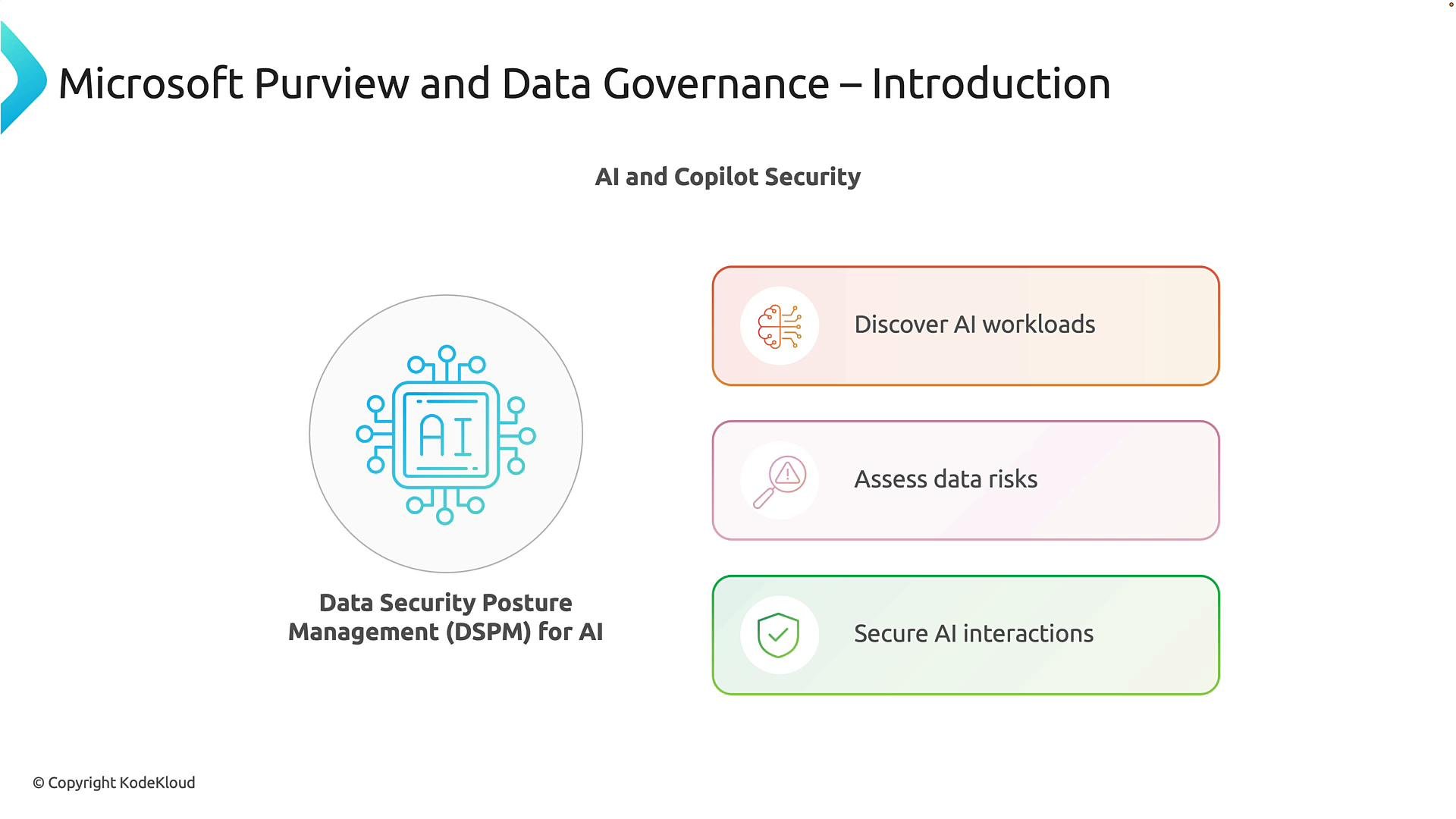
As organizations adopt AI (including Microsoft Copilot and other AI assistants), governing how AI systems access and use data becomes essential. Purview extends into AI governance via DSPM to give visibility and controls over AI interactions:
* Discover AI workloads — Identify which AI tools and copilot experiences are used across the organization.
* Assess data risk — Detect situations where AI services may access sensitive or overexposed data.
* Secure AI interactions — Apply existing security and governance controls so AI responses only include data the requester is authorized to view (for example, preventing Copilot from exposing restricted records).
These DSPM capabilities help ensure security and compliance remain effective as AI adoption grows.
 ## Data discovery, classification, and lifecycle management
Purview also provides core data governance features that establish data visibility and retention controls:
* Data discovery and classification\
Automatic scans of data sources identify sensitive content such as personal data, financial records, or intellectual property. Automated classification reduces manual effort and improves consistency.
* Data lifecycle management\
Create retention and deletion policies to meet legal, regulatory, and business requirements. For example, a record type can be retained for seven years while obsolete files are purged after a specified period.
These features help organizations stay compliant, reduce storage costs, and ensure consistent handling of data over time.
### Purview feature matrix
| Feature | What it does | Example outcome |
| - | -: | - |
| Automated scanning | Finds and indexes data across repositories | Centralized catalog of data assets |
| Classification | Tags data with sensitivity and business context | Enforced access policies and encryption |
| Retention policies | Automates retention and deletion | Meets regulatory retention requirements |
| Reporting & alerts | Surfaces incidents and policy violations | Faster compliance investigations |
## Accessing the Purview portal
Open the Microsoft Purview portal at `https://purview.microsoft.com`. The portal consolidates capabilities such as Data Security Investigation, Data Catalog, Information Protection, DLP, Insider Risk Management, and DSPM into one interface. Solutions are grouped by categories like data security, data governance, and risk & compliance for easy navigation.
To begin, sign in to `https://purview.microsoft.com` with an account that has the required administrative permissions. You can also access Purview from the [Microsoft 365 admin center](https://admin.microsoft.com).
## Summary and next steps
Microsoft Purview unifies discovery, classification, lifecycle management, protection, compliance, and AI governance into a single platform. This integration helps organizations:
* Understand their data estate
* Apply consistent protections and retention policies
* Maintain compliance as data and AI usage expand
Next, dive deeper into identifying and classifying data assets, building classification rules, and implementing DLP policies to protect high-risk data.
## Links and references
* Microsoft Purview overview: [https://learn.microsoft.com/microsoft-365/compliance/microsoft-purview-overview](https://learn.microsoft.com/microsoft-365/compliance/microsoft-purview-overview)
* Data Loss Prevention (DLP) in Microsoft 365: [https://learn.microsoft.com/microsoft-365/compliance/dlp-microsoft-365](https://learn.microsoft.com/microsoft-365/compliance/dlp-microsoft-365)
* Information protection and sensitivity labels: [https://learn.microsoft.com/microsoft-365/compliance/sensitivity-labels](https://learn.microsoft.com/microsoft-365/compliance/sensitivity-labels)
* Microsoft 365 admin center: `https://admin.microsoft.com`
This documentation is built and hosted on [Mintlify](https://mintlify.com), a developer documentation platform.
## Data discovery, classification, and lifecycle management
Purview also provides core data governance features that establish data visibility and retention controls:
* Data discovery and classification\
Automatic scans of data sources identify sensitive content such as personal data, financial records, or intellectual property. Automated classification reduces manual effort and improves consistency.
* Data lifecycle management\
Create retention and deletion policies to meet legal, regulatory, and business requirements. For example, a record type can be retained for seven years while obsolete files are purged after a specified period.
These features help organizations stay compliant, reduce storage costs, and ensure consistent handling of data over time.
### Purview feature matrix
| Feature | What it does | Example outcome |
| - | -: | - |
| Automated scanning | Finds and indexes data across repositories | Centralized catalog of data assets |
| Classification | Tags data with sensitivity and business context | Enforced access policies and encryption |
| Retention policies | Automates retention and deletion | Meets regulatory retention requirements |
| Reporting & alerts | Surfaces incidents and policy violations | Faster compliance investigations |
## Accessing the Purview portal
Open the Microsoft Purview portal at `https://purview.microsoft.com`. The portal consolidates capabilities such as Data Security Investigation, Data Catalog, Information Protection, DLP, Insider Risk Management, and DSPM into one interface. Solutions are grouped by categories like data security, data governance, and risk & compliance for easy navigation.
To begin, sign in to `https://purview.microsoft.com` with an account that has the required administrative permissions. You can also access Purview from the [Microsoft 365 admin center](https://admin.microsoft.com).
## Summary and next steps
Microsoft Purview unifies discovery, classification, lifecycle management, protection, compliance, and AI governance into a single platform. This integration helps organizations:
* Understand their data estate
* Apply consistent protections and retention policies
* Maintain compliance as data and AI usage expand
Next, dive deeper into identifying and classifying data assets, building classification rules, and implementing DLP policies to protect high-risk data.
## Links and references
* Microsoft Purview overview: [https://learn.microsoft.com/microsoft-365/compliance/microsoft-purview-overview](https://learn.microsoft.com/microsoft-365/compliance/microsoft-purview-overview)
* Data Loss Prevention (DLP) in Microsoft 365: [https://learn.microsoft.com/microsoft-365/compliance/dlp-microsoft-365](https://learn.microsoft.com/microsoft-365/compliance/dlp-microsoft-365)
* Information protection and sensitivity labels: [https://learn.microsoft.com/microsoft-365/compliance/sensitivity-labels](https://learn.microsoft.com/microsoft-365/compliance/sensitivity-labels)
* Microsoft 365 admin center: `https://admin.microsoft.com`
This documentation is built and hosted on [Mintlify](https://mintlify.com), a developer documentation platform.