> ## Documentation Index
> Fetch the complete documentation index at: https://notes.kodekloud.com/llms.txt
> Use this file to discover all available pages before exploring further.
# Review and Improve Model
> Guide to evaluating and iteratively improving ML models with metrics, error analysis, data augmentation, monitoring, and practical steps for handling low training data and deployment
Reviewing and improving a machine learning model is a recurring, critical phase in any ML workflow. This guide walks through practical steps to evaluate model performance, find gaps, and iterate so the model produces accurate, robust predictions over time.
## Training and evaluation overview
After labeling data, train your model (or fine-tune a pretrained backbone) so it can generalize to unseen examples. Once training finishes, evaluate with metrics that match your task and business needs.
Key evaluation metrics:
| Metric | Definition | When to use |
| --------------------- | ----------------------------------------------------------------------------------------- | --------------------------------------------------------------- |
| Precision | TP / (TP + FP) — proportion of predicted positives that are correct | When false positives are costly (e.g., spam detection) |
| Recall | TP / (TP + FN) — proportion of actual positives detected | When missing true positives is costly (e.g., medical diagnosis) |
| F1 score | 2 \* (Precision \* Recall) / (Precision + Recall) — harmonic mean of precision and recall | When you need a single balanced metric |
| NER F1 (entity-level) | F1 computed on exact span + label matches | Use for strict named-entity recognition evaluation |
For named-entity recognition (NER), compute F1 at the entity level (exact span and label match) rather than token-level when you require strict evaluation of entity extraction.
Example: a trained model reporting 100% precision, 100% recall, and 100% F1 often warrants skepticism. Perfect scores commonly indicate one of the following:
* too small or overly simplistic dataset,
* data leakage between training and test sets,
* or an evaluation set that doesn't reflect real-world variability.
Perfect evaluation scores are typically a red flag. Before trusting such results, verify that there is no data leakage, confirm the evaluation set size and representativeness, and inspect your train/validation/test splits.
 ## Iterative improvement cycle
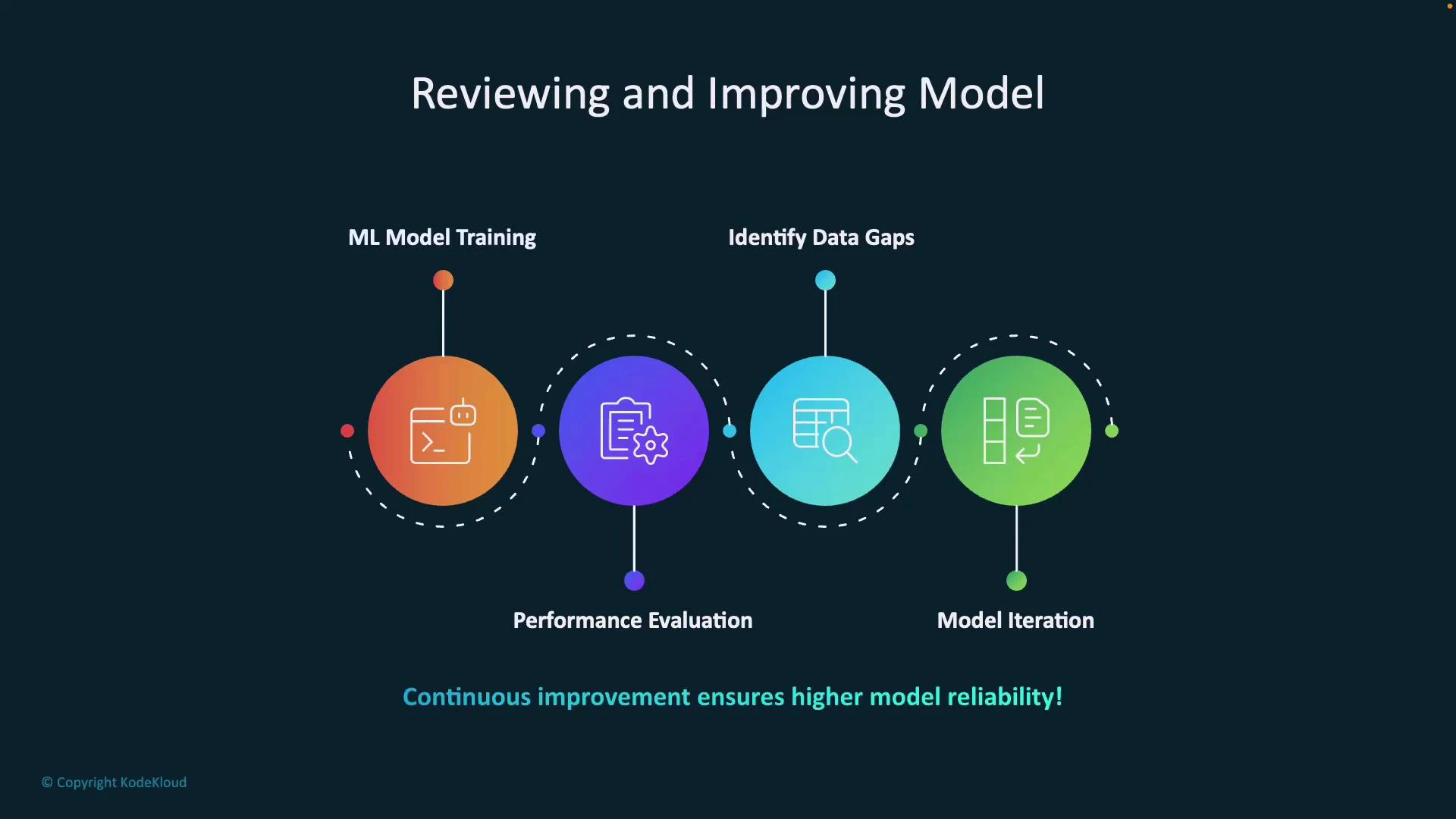
Improving a model is an iterative loop. A practical cycle looks like:
1. Train or fine-tune the model on labeled data.
2. Evaluate using appropriate metrics and robust held-out data (train/validation/test splits or cross-validation).
3. Perform error analysis to find systematic failures (missing categories, frequent misclassification, label bias).
4. Fix data gaps by:
* adding labeled examples for underrepresented classes,
* improving annotation quality and instructions (clear schema, training for annotators),
* using data augmentation or synthetic examples where appropriate,
* applying active learning to prioritize labeling informative samples.
5. Iterate: retrain with the improved dataset and tune hyperparameters, architectures, or regularization.
6. Monitor performance in production and repeat the loop as new data arrives.
Some practical notes for step 3 (error analysis):
* Create confusion matrices and per-class precision/recall to surface recurring mistakes.
* Inspect failure cases manually to discover annotation inconsistencies or ambiguous labels.
* Segment errors by features (e.g., text length, language, input source) to reveal hidden biases.
## Practical actions when the model UI flags "not enough training data"
If your model management UI reports insufficient training data, take these actions:
* Collect additional labeled examples that reflect real-world distributions and edge cases.
* Ensure the evaluation set is held out properly and mirrors production data.
* Improve annotation consistency: clear guidelines, multiple annotators, and adjudication for disagreements.
* Use cross-validation or enlarge holdout sets to stabilize metrics.
* Consider transfer learning or pretrained backbones to reduce labeled-data needs.
* Use ensembles or calibration techniques if score variance suggests instability.
Prioritize collecting diverse, representative examples and targeted error analysis—these activities usually deliver greater improvements than only tuning hyperparameters.
## Monitoring and production
Continuous improvement is the backbone of reliable AI systems. In production, instrument the model to:
* log predictions and key inputs,
* sample and label prediction failures,
* track drift in input distributions and label distributions,
* trigger retraining (or human-in-the-loop review) when performance drops.
Automating monitoring and retraining pipelines helps maintain model quality as real-world data evolves.
## References and further reading
* scikit-learn: Precision, recall, F1 — [https://scikit-learn.org/stable/modules/model\_evaluation.html](https://scikit-learn.org/stable/modules/model_evaluation.html)
* Best practices for annotation and labeling — consider documentation from your annotation provider or tools such as [Label Studio](https://labelstud.io/)
* NER evaluation tools: seqeval or spaCy evaluation utilities
With these steps, you can complete the review-and-improve cycle for custom classification or NER models and establish a repeatable process for continual model quality.
## Iterative improvement cycle
Improving a model is an iterative loop. A practical cycle looks like:
1. Train or fine-tune the model on labeled data.
2. Evaluate using appropriate metrics and robust held-out data (train/validation/test splits or cross-validation).
3. Perform error analysis to find systematic failures (missing categories, frequent misclassification, label bias).
4. Fix data gaps by:
* adding labeled examples for underrepresented classes,
* improving annotation quality and instructions (clear schema, training for annotators),
* using data augmentation or synthetic examples where appropriate,
* applying active learning to prioritize labeling informative samples.
5. Iterate: retrain with the improved dataset and tune hyperparameters, architectures, or regularization.
6. Monitor performance in production and repeat the loop as new data arrives.
Some practical notes for step 3 (error analysis):
* Create confusion matrices and per-class precision/recall to surface recurring mistakes.
* Inspect failure cases manually to discover annotation inconsistencies or ambiguous labels.
* Segment errors by features (e.g., text length, language, input source) to reveal hidden biases.
## Practical actions when the model UI flags "not enough training data"
If your model management UI reports insufficient training data, take these actions:
* Collect additional labeled examples that reflect real-world distributions and edge cases.
* Ensure the evaluation set is held out properly and mirrors production data.
* Improve annotation consistency: clear guidelines, multiple annotators, and adjudication for disagreements.
* Use cross-validation or enlarge holdout sets to stabilize metrics.
* Consider transfer learning or pretrained backbones to reduce labeled-data needs.
* Use ensembles or calibration techniques if score variance suggests instability.
Prioritize collecting diverse, representative examples and targeted error analysis—these activities usually deliver greater improvements than only tuning hyperparameters.
## Monitoring and production
Continuous improvement is the backbone of reliable AI systems. In production, instrument the model to:
* log predictions and key inputs,
* sample and label prediction failures,
* track drift in input distributions and label distributions,
* trigger retraining (or human-in-the-loop review) when performance drops.
Automating monitoring and retraining pipelines helps maintain model quality as real-world data evolves.
## References and further reading
* scikit-learn: Precision, recall, F1 — [https://scikit-learn.org/stable/modules/model\_evaluation.html](https://scikit-learn.org/stable/modules/model_evaluation.html)
* Best practices for annotation and labeling — consider documentation from your annotation provider or tools such as [Label Studio](https://labelstud.io/)
* NER evaluation tools: seqeval or spaCy evaluation utilities
With these steps, you can complete the review-and-improve cycle for custom classification or NER models and establish a repeatable process for continual model quality.