> ## Documentation Index
> Fetch the complete documentation index at: https://notes.kodekloud.com/llms.txt
> Use this file to discover all available pages before exploring further.
# Module Introduction
> Guide to implementing Retrieval-Augmented Generation with Azure OpenAI Service, covering embeddings, vector search, REST API and SDK workflows to integrate and retrieve your data for grounded model responses
Implementing Retrieval-Augmented Generation (RAG) with Azure OpenAI Service
Retrieval-Augmented Generation (RAG) combines the fluency of large language models with the precision of retrieval systems to generate answers grounded in your own data. In this module we'll explain the core concepts of RAG, show how Azure OpenAI Service supports RAG workflows, and demonstrate practical approaches to integrate your structured and unstructured content into model responses.
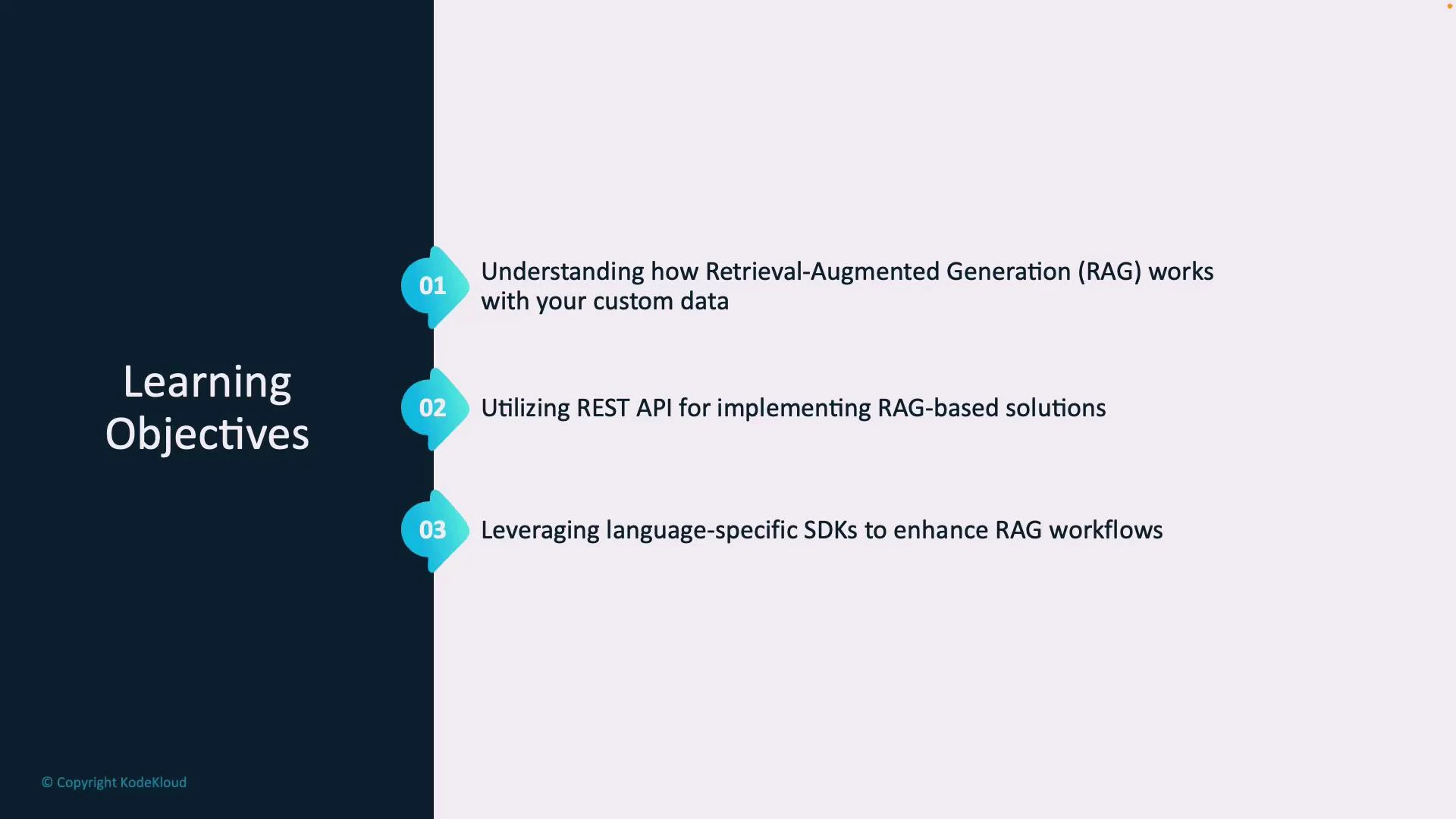 This lesson focuses on three practical outcomes:
| Topic | What you'll learn | Why it matters |
| ----------------------- | ----------------------------------------------------------------------------------------- | --------------------------------------------------------------- |
| How RAG works | Fundamentals of retrieval + generation, embeddings, vector search, and context management | Enables reliable, up-to-date answers grounded in your content |
| Azure OpenAI REST API | Patterns for calling Azure-hosted models and incorporating retrieved context into prompts | Reproducible integration across platforms and environments |
| Language SDKs & tooling | SDK features and workflows that simplify ingestion, retrieval, and prompt orchestration | Faster development, fewer errors, and production-ready patterns |
By the end of this module you'll be able to design and implement RAG solutions that augment Azure OpenAI model outputs with relevant data from your own sources—documents, knowledge bases, databases, and more.
Before you begin, make sure you have access to Azure OpenAI resources and a dataset (documents or structured data) to index. Familiarity with embeddings and vector search concepts will accelerate your progress.
What this lesson will cover, step by step:
* Overview of RAG architectures and when to use them (hybrid vs. pure retrieval).
* How to create embeddings for your data and store them in a vector store or search service.
* How to retrieve relevant context and construct prompts that safely and effectively condition model outputs.
* Implementing RAG via the Azure OpenAI REST API and leveraging language-specific SDKs to streamline the workflow.
* Best practices for relevance, latency, hallucinatory behavior mitigation, and production deployment.
Links and references
* [Azure OpenAI Service documentation](https://learn.microsoft.com/azure/cognitive-services/openai/)
* [Retrieval-augmented generation overview (concepts)](https://www.microsoft.com/research/project/retrieval-augmented-generation/)
* [Azure Cognitive Search (vector search & integration)](https://learn.microsoft.com/azure/search/)
* [Embeddings and vector databases — concepts and options](https://en.wikipedia.org/wiki/Vector_space_model)
Let's get started with the introduction.
This lesson focuses on three practical outcomes:
| Topic | What you'll learn | Why it matters |
| ----------------------- | ----------------------------------------------------------------------------------------- | --------------------------------------------------------------- |
| How RAG works | Fundamentals of retrieval + generation, embeddings, vector search, and context management | Enables reliable, up-to-date answers grounded in your content |
| Azure OpenAI REST API | Patterns for calling Azure-hosted models and incorporating retrieved context into prompts | Reproducible integration across platforms and environments |
| Language SDKs & tooling | SDK features and workflows that simplify ingestion, retrieval, and prompt orchestration | Faster development, fewer errors, and production-ready patterns |
By the end of this module you'll be able to design and implement RAG solutions that augment Azure OpenAI model outputs with relevant data from your own sources—documents, knowledge bases, databases, and more.
Before you begin, make sure you have access to Azure OpenAI resources and a dataset (documents or structured data) to index. Familiarity with embeddings and vector search concepts will accelerate your progress.
What this lesson will cover, step by step:
* Overview of RAG architectures and when to use them (hybrid vs. pure retrieval).
* How to create embeddings for your data and store them in a vector store or search service.
* How to retrieve relevant context and construct prompts that safely and effectively condition model outputs.
* Implementing RAG via the Azure OpenAI REST API and leveraging language-specific SDKs to streamline the workflow.
* Best practices for relevance, latency, hallucinatory behavior mitigation, and production deployment.
Links and references
* [Azure OpenAI Service documentation](https://learn.microsoft.com/azure/cognitive-services/openai/)
* [Retrieval-augmented generation overview (concepts)](https://www.microsoft.com/research/project/retrieval-augmented-generation/)
* [Azure Cognitive Search (vector search & integration)](https://learn.microsoft.com/azure/search/)
* [Embeddings and vector databases — concepts and options](https://en.wikipedia.org/wiki/Vector_space_model)
Let's get started with the introduction.