> ## Documentation Index
> Fetch the complete documentation index at: https://notes.kodekloud.com/llms.txt
> Use this file to discover all available pages before exploring further.
# Responsible AI Principles
> Overview of six core principles for designing and operating fair, safe, secure, transparent, inclusive, and accountable AI systems.
Now that you understand the basics of artificial intelligence, the next essential topic is responsible AI.
Building an AI system that functions correctly is only part of the job. Responsible AI means designing and operating systems that are fair, safe, secure, understandable, and trustworthy. This article explains the core principles that help teams build AI systems people can rely on — and why those principles matter in practice.
Responsible AI is a continuous practice applied across the entire AI lifecycle: problem definition, data collection, model development, deployment, monitoring, and maintenance.
Why this matters — a short example
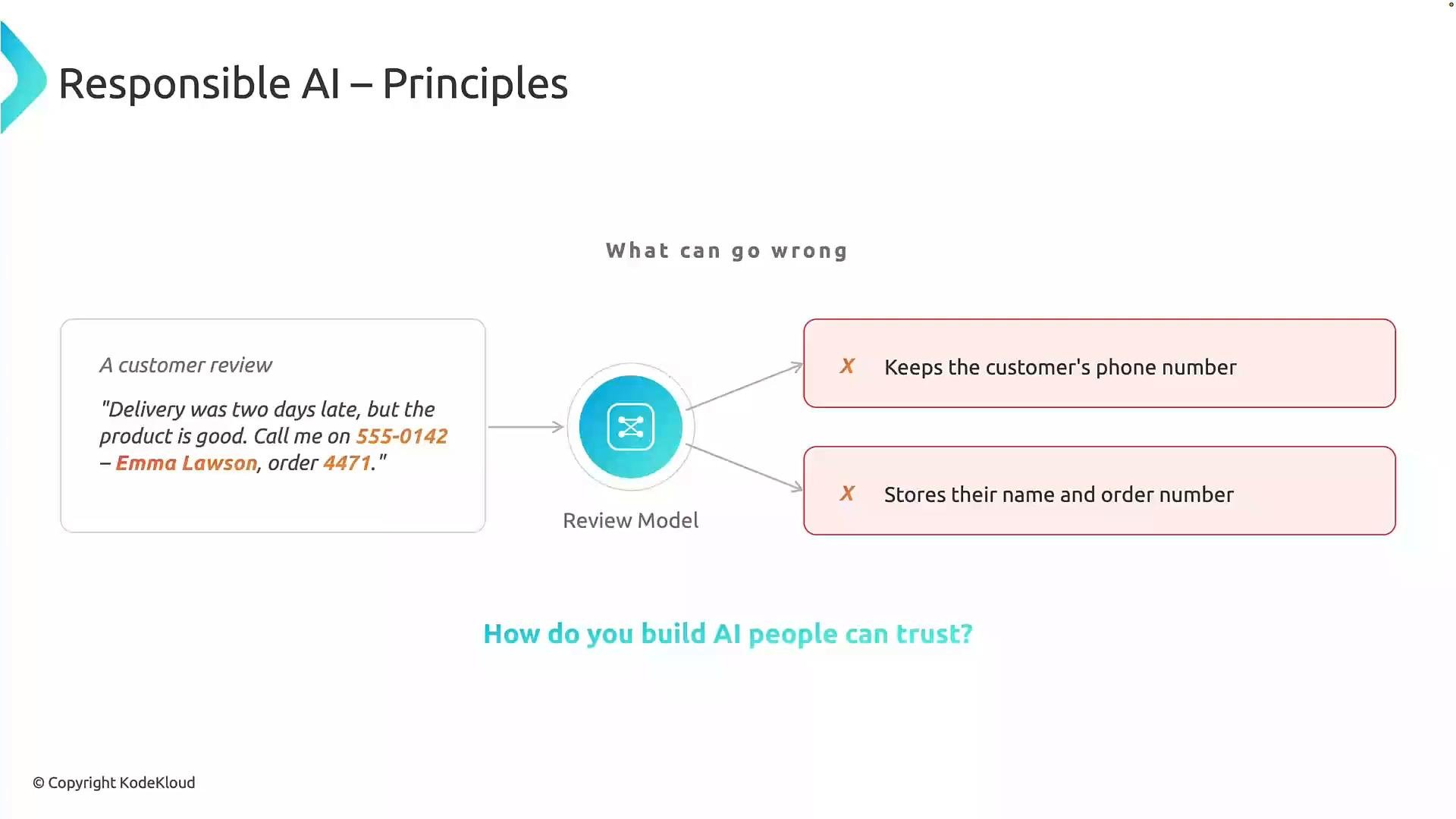
Imagine a customer review like this:
"Delivery was two days late, but the product is good. Call me on 555-0142, Emma Lawson, order 4471."
The text contains several distinct data elements: a delivery comment, product opinion, phone number, name, and order number. When an AI processes thousands or millions of reviews, a range of risks can appear if the system isn’t designed responsibly:
* Unnecessary data collection: Does sentiment analysis actually require the customer’s phone number?
* Overexposure: Order numbers or names might be needed for limited business workflows, but should not be accessible everywhere.
* Data retention and access controls: Storing PII without clear purpose or protection increases privacy and security risk.
 Key questions responsible AI helps answer
* What information is the AI collecting and is it necessary?
* Who can access the information and how is it secured?
* Could the system produce unfair or harmful outcomes?
* Who is accountable when something goes wrong?
Answering these questions drives design choices that produce useful results while respecting people, protecting data, minimizing harm, and building trust.
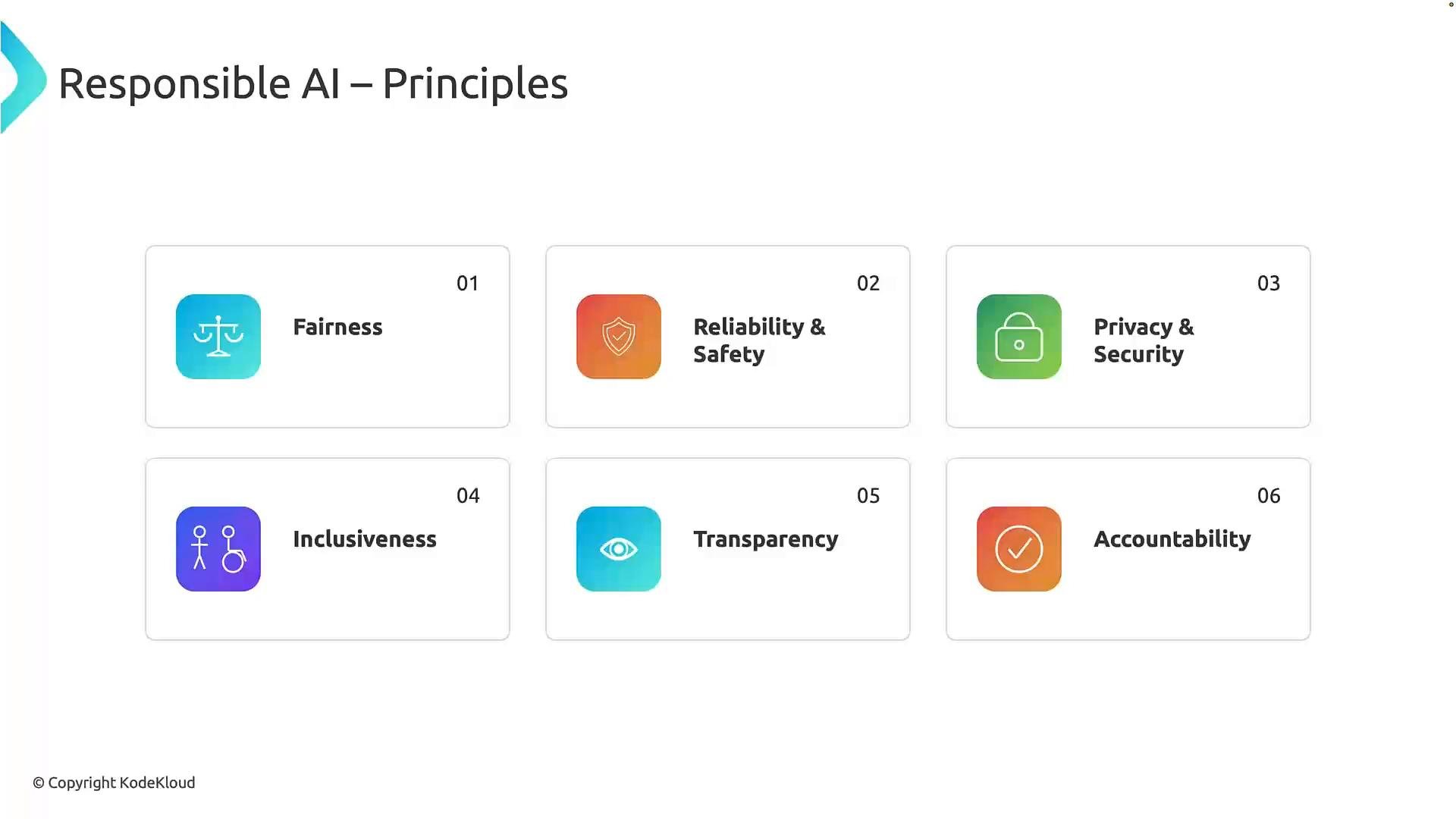
Six core principles of Responsible AI
Below are six practical principles to guide design, development, deployment, and operations for trustworthy AI systems.
| Principle | What it means | Practical checklist |
| - | - | - |
| Fairness | Treat people equitably and avoid systematic disadvantage to specific groups. | Evaluate training data for representation; run fairness metrics; perform subgroup testing; mitigate known biases. |
| Reliability & Safety | Behave consistently and avoid causing harm in expected operating conditions. | Test across scenarios; define safe operating limits; implement fallbacks and fail-safes; monitor performance in production. |
| Privacy & Security | Limit collection/use of personal data and protect systems from unauthorized access. | Apply data minimization; anonymize/PPI redact where possible; encrypt data at rest and in transit; enforce access controls. |
| Inclusiveness | Design for diverse backgrounds, abilities, and contexts. | Ensure accessibility standards; localize for regions and languages; involve diverse user testing. |
| Transparency | Provide an appropriate, understandable explanation of how AI is used and its limitations. | Disclose when users interact with AI; document decision factors and limitations; provide traceability for high-impact decisions. |
| Accountability | Assign responsibility and processes to address failures or harms. | Establish governance, incident response, and remediation procedures; maintain auditable logs and role definitions. |
Detailed explanations and considerations
1. Fairness
* Goal: Avoid systematic discrimination and ensure similar outcomes across comparable groups.
* Example: If a hiring or loan model rates a demographic lower because of biased training data, it is exhibiting unfair behavior.
* Considerations: Audit datasets, evaluate model fairness using metrics appropriate to the context, and apply bias mitigation techniques.
2. Reliability and safety
* Goal: Ensure the system performs consistently, detects failures, and prevents unsafe behavior.
* Example: A defect-detection model that intermittently misses critical faults is unsafe in manufacturing.
* Considerations: Comprehensive testing (including adversarial and edge-case tests), clear safety margins, continuous monitoring, and throttles or circuit breakers for unexpected behavior.
3. Privacy and security
* Goal: Respect user privacy and protect systems from misuse, data leaks, and unauthorized access.
* Example: Do not collect or store phone numbers when analyzing product sentiment.
* Considerations: Follow data minimization principles, apply anonymization or pseudonymization, use encryption, and implement least-privilege access.
Avoid storing or exposing personally identifiable information (PII) unless absolutely required. Treat PII as high-risk data: minimize use, secure storage, and clearly document purpose and retention.
4. Inclusiveness
* Goal: Make the AI usable and beneficial for people with different abilities, cultures, and contexts.
* Example: An app that assumes a particular screen layout may exclude users with visual or motor impairments.
* Considerations: Include accessibility testing, support localization, and gather feedback from diverse user groups.
5. Transparency
* Goal: Provide clear information about how AI is used, what it does, and its limitations, especially where decisions affect people.
* Example: Users interacting with an AI assistant should know they’re speaking with AI and understand the scope of its advice.
* Considerations: Clear disclosures, human-review options for high-stakes decisions, and documentation of model boundaries and known failure modes.
6. Accountability
* Goal: Ensure people and organizations are responsible for AI behavior and can investigate and remediate issues.
* Example: If an AI harms users or produces incorrect results, there must be defined roles and processes to address it.
* Considerations: Governance frameworks, assigned ownership, incident response plans, and documented audit trails.
Bringing the principles together
* Fairness ensures equitable treatment.
* Reliability and safety reduce risk and unexpected harm.
* Privacy and security protect people and systems.
* Inclusiveness widens accessibility and fairness.
* Transparency builds user understanding and trust.
* Accountability creates ownership and remediation pathways.
These principles shift the question from "Can we build this AI?" to "Should we build it this way? How will it affect people? What risks must we manage?"
Responsible AI is not an afterthought. Integrate these principles throughout the AI lifecycle — from problem scoping and data strategy to model selection, deployment, monitoring, and governance.
Key questions responsible AI helps answer
* What information is the AI collecting and is it necessary?
* Who can access the information and how is it secured?
* Could the system produce unfair or harmful outcomes?
* Who is accountable when something goes wrong?
Answering these questions drives design choices that produce useful results while respecting people, protecting data, minimizing harm, and building trust.
Six core principles of Responsible AI
Below are six practical principles to guide design, development, deployment, and operations for trustworthy AI systems.
| Principle | What it means | Practical checklist |
| - | - | - |
| Fairness | Treat people equitably and avoid systematic disadvantage to specific groups. | Evaluate training data for representation; run fairness metrics; perform subgroup testing; mitigate known biases. |
| Reliability & Safety | Behave consistently and avoid causing harm in expected operating conditions. | Test across scenarios; define safe operating limits; implement fallbacks and fail-safes; monitor performance in production. |
| Privacy & Security | Limit collection/use of personal data and protect systems from unauthorized access. | Apply data minimization; anonymize/PPI redact where possible; encrypt data at rest and in transit; enforce access controls. |
| Inclusiveness | Design for diverse backgrounds, abilities, and contexts. | Ensure accessibility standards; localize for regions and languages; involve diverse user testing. |
| Transparency | Provide an appropriate, understandable explanation of how AI is used and its limitations. | Disclose when users interact with AI; document decision factors and limitations; provide traceability for high-impact decisions. |
| Accountability | Assign responsibility and processes to address failures or harms. | Establish governance, incident response, and remediation procedures; maintain auditable logs and role definitions. |
Detailed explanations and considerations
1. Fairness
* Goal: Avoid systematic discrimination and ensure similar outcomes across comparable groups.
* Example: If a hiring or loan model rates a demographic lower because of biased training data, it is exhibiting unfair behavior.
* Considerations: Audit datasets, evaluate model fairness using metrics appropriate to the context, and apply bias mitigation techniques.
2. Reliability and safety
* Goal: Ensure the system performs consistently, detects failures, and prevents unsafe behavior.
* Example: A defect-detection model that intermittently misses critical faults is unsafe in manufacturing.
* Considerations: Comprehensive testing (including adversarial and edge-case tests), clear safety margins, continuous monitoring, and throttles or circuit breakers for unexpected behavior.
3. Privacy and security
* Goal: Respect user privacy and protect systems from misuse, data leaks, and unauthorized access.
* Example: Do not collect or store phone numbers when analyzing product sentiment.
* Considerations: Follow data minimization principles, apply anonymization or pseudonymization, use encryption, and implement least-privilege access.
Avoid storing or exposing personally identifiable information (PII) unless absolutely required. Treat PII as high-risk data: minimize use, secure storage, and clearly document purpose and retention.
4. Inclusiveness
* Goal: Make the AI usable and beneficial for people with different abilities, cultures, and contexts.
* Example: An app that assumes a particular screen layout may exclude users with visual or motor impairments.
* Considerations: Include accessibility testing, support localization, and gather feedback from diverse user groups.
5. Transparency
* Goal: Provide clear information about how AI is used, what it does, and its limitations, especially where decisions affect people.
* Example: Users interacting with an AI assistant should know they’re speaking with AI and understand the scope of its advice.
* Considerations: Clear disclosures, human-review options for high-stakes decisions, and documentation of model boundaries and known failure modes.
6. Accountability
* Goal: Ensure people and organizations are responsible for AI behavior and can investigate and remediate issues.
* Example: If an AI harms users or produces incorrect results, there must be defined roles and processes to address it.
* Considerations: Governance frameworks, assigned ownership, incident response plans, and documented audit trails.
Bringing the principles together
* Fairness ensures equitable treatment.
* Reliability and safety reduce risk and unexpected harm.
* Privacy and security protect people and systems.
* Inclusiveness widens accessibility and fairness.
* Transparency builds user understanding and trust.
* Accountability creates ownership and remediation pathways.
These principles shift the question from "Can we build this AI?" to "Should we build it this way? How will it affect people? What risks must we manage?"
Responsible AI is not an afterthought. Integrate these principles throughout the AI lifecycle — from problem scoping and data strategy to model selection, deployment, monitoring, and governance.
 Further reading and references
* OECD AI Principles: [https://www.oecd.org/going-digital/ai/principles/](https://www.oecd.org/going-digital/ai/principles/)
* Microsoft Responsible AI resources: [https://learn.microsoft.com/ai/responsible-ai/](https://learn.microsoft.com/ai/responsible-ai/)
* Partnership on AI: [https://www.partnershiponai.org/](https://www.partnershiponai.org/)
* NIST AI Risk Management Framework: [https://www.nist.gov/itl/ai-risk-management](https://www.nist.gov/itl/ai-risk-management)
Keep these six principles at the center of your AI projects to build systems that are not only effective, but also ethical, safe, and trusted.
This documentation is built and hosted on [Mintlify](https://mintlify.com), a developer documentation platform.
Further reading and references
* OECD AI Principles: [https://www.oecd.org/going-digital/ai/principles/](https://www.oecd.org/going-digital/ai/principles/)
* Microsoft Responsible AI resources: [https://learn.microsoft.com/ai/responsible-ai/](https://learn.microsoft.com/ai/responsible-ai/)
* Partnership on AI: [https://www.partnershiponai.org/](https://www.partnershiponai.org/)
* NIST AI Risk Management Framework: [https://www.nist.gov/itl/ai-risk-management](https://www.nist.gov/itl/ai-risk-management)
Keep these six principles at the center of your AI projects to build systems that are not only effective, but also ethical, safe, and trusted.
This documentation is built and hosted on [Mintlify](https://mintlify.com), a developer documentation platform.