> ## Documentation Index
> Fetch the complete documentation index at: https://notes.kodekloud.com/llms.txt
> Use this file to discover all available pages before exploring further.
# What Is Generative AI
> Explains generative AI, how prompts drive multimodal models, common applications and risks, and practical guidance for selecting model sizes from small to large.
This lesson explains what generative AI is, how it differs from traditional AI, and how to choose the right model for your task. You’ll learn how prompts drive generative models, what types of content they can produce, common applications, and practical guidance for selecting model size.
## Generative AI — a concise definition
Generative AI refers to systems that create new content from instructions (prompts) provided by a user. These systems—often powered by large language models (LLMs) or other generative architectures—interpret a prompt, reason about context, and produce a response tailored to the request instead of returning a fixed, prewritten answer.
A prompt is any instruction or question given to the model. Examples include:
* A student: “ChatGPT, explain photosynthesis in simple terms.”
* A developer: “Write a Python function to calculate the average of a list.”
* A customer service agent: “Draft a polite reply to a customer whose parcel arrived two days late.”
The model processes the prompt and synthesizes an answer based on learned patterns from training data and the immediate context you provided.
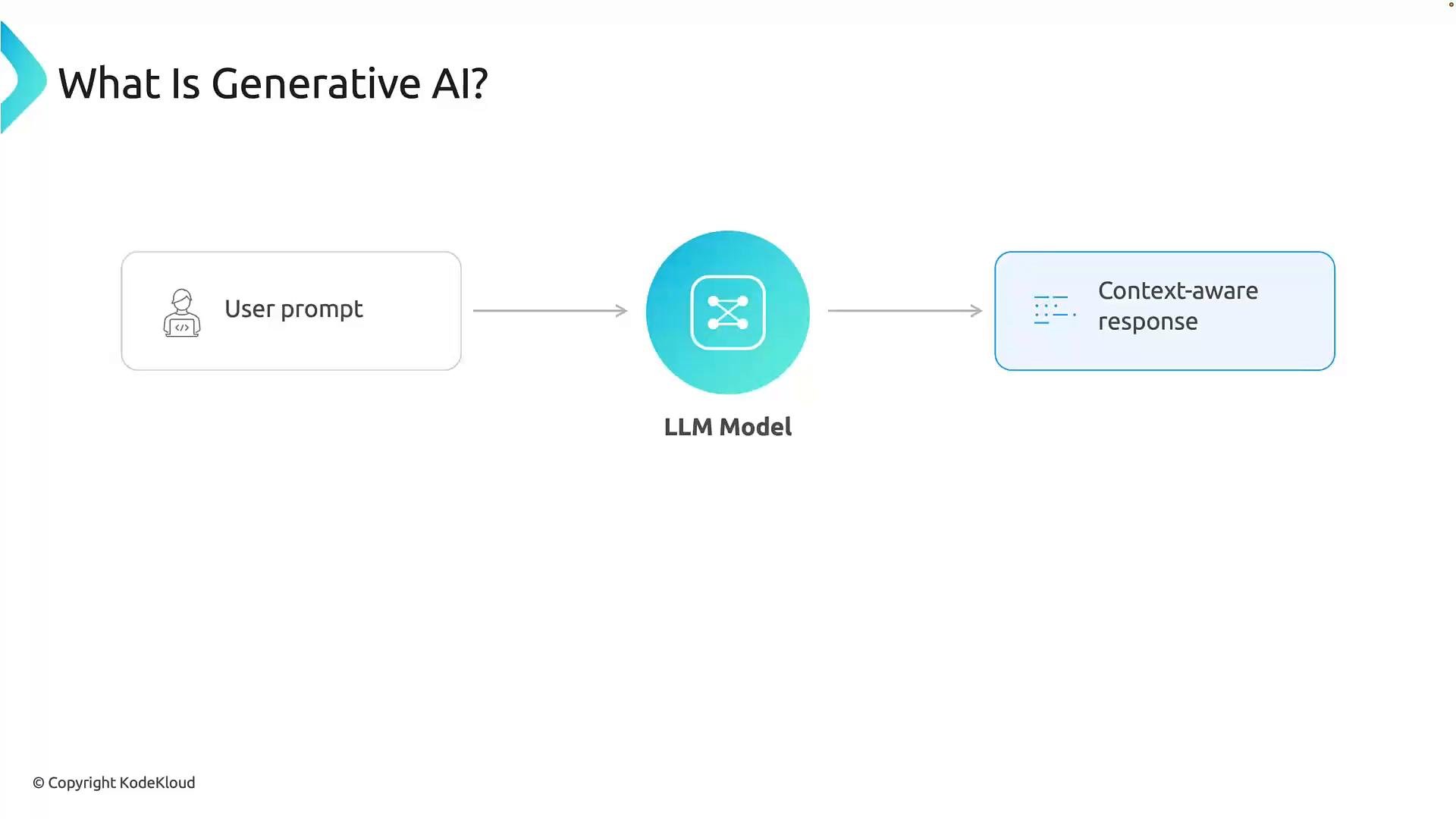 Example of a model-generated response:
"I'm sorry your parcel arrived two days late. I have noted this on your order and will follow up."
That sentence is generated to fit the specific context of the prompt—not selected from a static set of canned replies.
## What generative AI can produce (modalities)
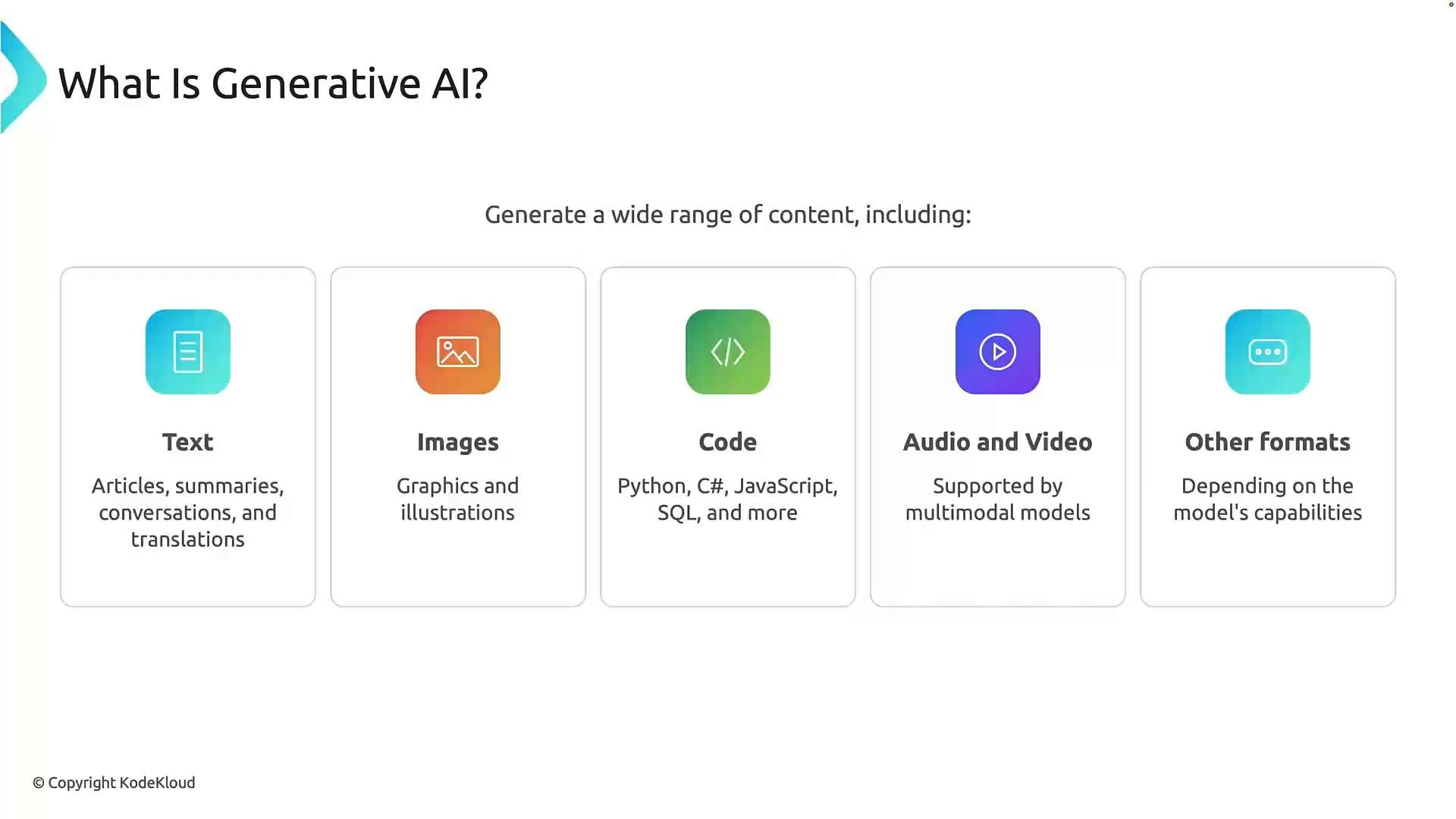
Generative AI is multimodal: models can produce text, images, code, audio, video, and structured data depending on their architecture and capabilities.
* Text: articles, summaries, translations, conversational responses, explanations, and more.
* Images: illustrations or graphics created from natural-language descriptions.
* Code: source code in languages such as Python, JavaScript, C#, SQL, plus debugging suggestions and docstrings.
* Audio & Video: speech synthesis, audio editing, and some multimodal models that generate audiovisual outputs.
* Structured formats: charts, JSON or CSV outputs, or any modality a model supports through tooling.
Example of a model-generated response:
"I'm sorry your parcel arrived two days late. I have noted this on your order and will follow up."
That sentence is generated to fit the specific context of the prompt—not selected from a static set of canned replies.
## What generative AI can produce (modalities)
Generative AI is multimodal: models can produce text, images, code, audio, video, and structured data depending on their architecture and capabilities.
* Text: articles, summaries, translations, conversational responses, explanations, and more.
* Images: illustrations or graphics created from natural-language descriptions.
* Code: source code in languages such as Python, JavaScript, C#, SQL, plus debugging suggestions and docstrings.
* Audio & Video: speech synthesis, audio editing, and some multimodal models that generate audiovisual outputs.
* Structured formats: charts, JSON or CSV outputs, or any modality a model supports through tooling.
 Quick reference: common use cases by modality
| Modality | Typical tasks | Example prompt |
| - | - | - |
| Text | Summaries, explanations, email drafts, dialogue | “Summarize this chapter in five key points.” |
| Images | Concept art, diagrams, product mockups | “Create an illustration of the water cycle.” |
| Code | Implementation, refactor, bug fixes | “Write a Python function to compute the moving average.” |
| Audio / Video | TTS, audio editing, short clips | “Generate a 30s voiceover with a warm tone.” |
| Structured data | Tables, JSON outputs, charts | “Output a CSV of monthly sales totals.” |
## Common applications
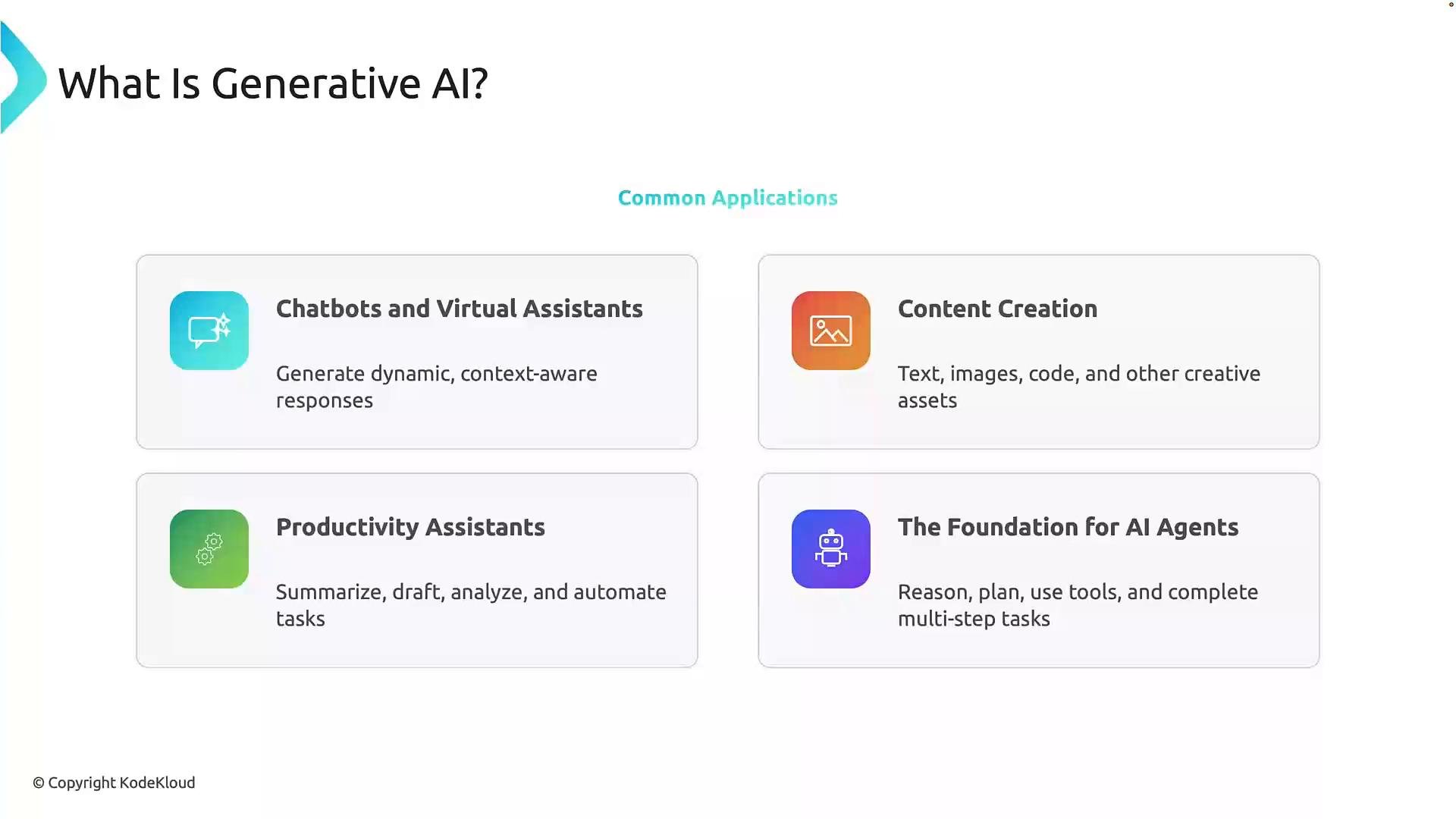
Generative AI powers many real-world workflows:
* Chatbots & virtual assistants: dynamic, context-aware responses for tutoring, interview practice, and customer support.
* Content creation: drafting outlines, articles, reports, or image concepts and producing starter code.
* Productivity assistants: summarizing long documents, extracting key points, drafting emails, and automating routine tasks.
* Foundation for AI agents: multi-step agents combine generative models with planning, tool use (APIs, databases, web), and reasoning to complete complex workflows—e.g., finding reliable sources, summarizing findings, and organizing the output into a study guide.
Quick reference: common use cases by modality
| Modality | Typical tasks | Example prompt |
| - | - | - |
| Text | Summaries, explanations, email drafts, dialogue | “Summarize this chapter in five key points.” |
| Images | Concept art, diagrams, product mockups | “Create an illustration of the water cycle.” |
| Code | Implementation, refactor, bug fixes | “Write a Python function to compute the moving average.” |
| Audio / Video | TTS, audio editing, short clips | “Generate a 30s voiceover with a warm tone.” |
| Structured data | Tables, JSON outputs, charts | “Output a CSV of monthly sales totals.” |
## Common applications
Generative AI powers many real-world workflows:
* Chatbots & virtual assistants: dynamic, context-aware responses for tutoring, interview practice, and customer support.
* Content creation: drafting outlines, articles, reports, or image concepts and producing starter code.
* Productivity assistants: summarizing long documents, extracting key points, drafting emails, and automating routine tasks.
* Foundation for AI agents: multi-step agents combine generative models with planning, tool use (APIs, databases, web), and reasoning to complete complex workflows—e.g., finding reliable sources, summarizing findings, and organizing the output into a study guide.
 Generative models can produce confident-sounding but incorrect or fabricated outputs (hallucinations). Always verify critical facts, source links, and any data-sensitive content before relying on model-generated results.
## Choosing the right model size: LLM vs. SLM
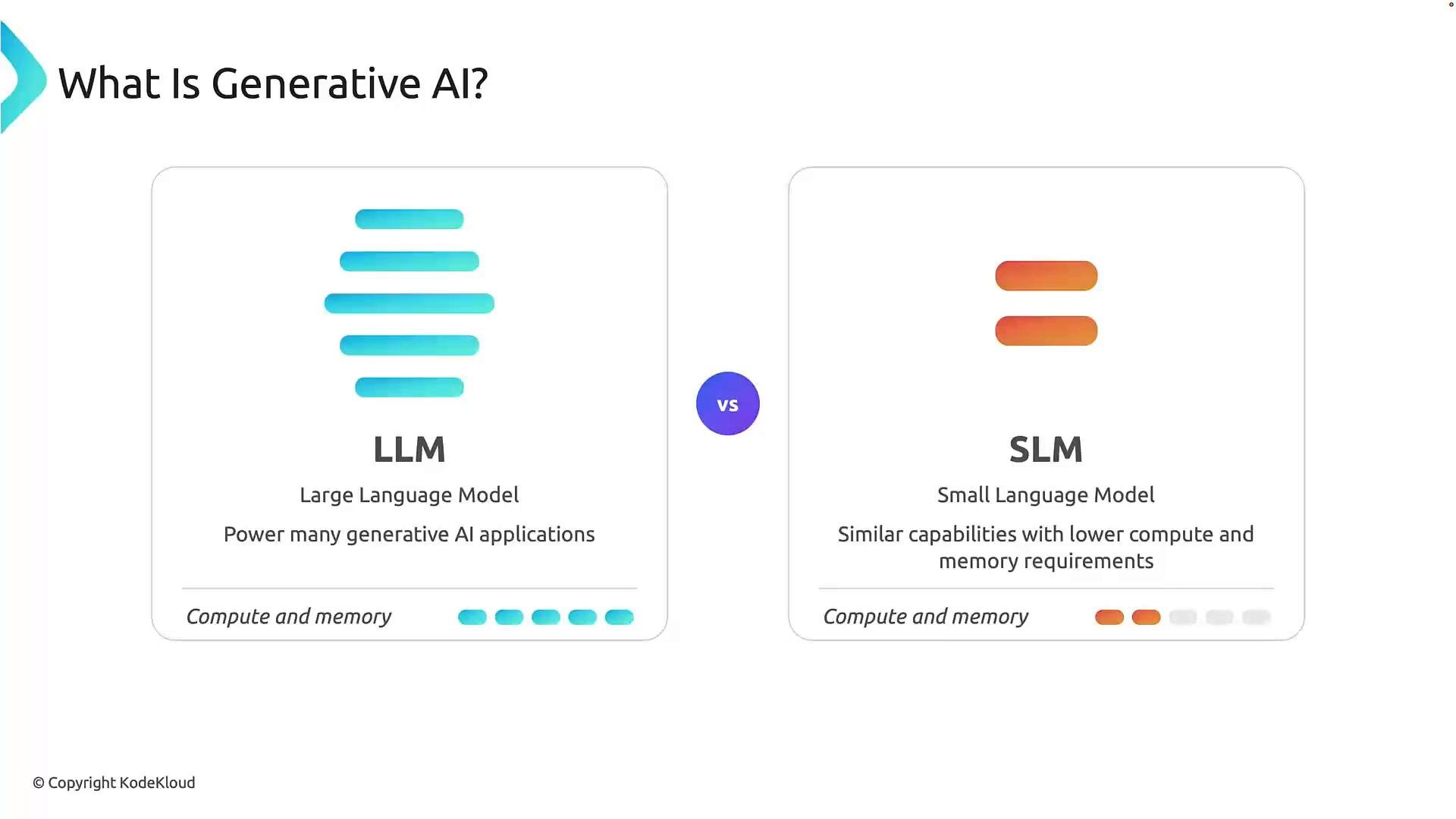
Model size is one factor in selecting a generative model. Two common categories:
* LLM (Large Language Model): larger architectures with greater compute and memory needs. Best for tasks requiring deep reasoning, long context windows, or nuanced language understanding.
* SLM (Small Language Model): smaller, resource-efficient models suitable for edge or local deployments. They trade some capability for lower latency, reduced memory usage, and offline operation. Techniques such as knowledge distillation and quantization can help SLMs approach LLM performance for targeted tasks.
Generative models can produce confident-sounding but incorrect or fabricated outputs (hallucinations). Always verify critical facts, source links, and any data-sensitive content before relying on model-generated results.
## Choosing the right model size: LLM vs. SLM
Model size is one factor in selecting a generative model. Two common categories:
* LLM (Large Language Model): larger architectures with greater compute and memory needs. Best for tasks requiring deep reasoning, long context windows, or nuanced language understanding.
* SLM (Small Language Model): smaller, resource-efficient models suitable for edge or local deployments. They trade some capability for lower latency, reduced memory usage, and offline operation. Techniques such as knowledge distillation and quantization can help SLMs approach LLM performance for targeted tasks.
 When to use LLM vs SLM — examples
| Task | Recommended model | Why |
| - | - | - |
| Draft a nuanced reply to a lengthy customer complaint | LLM | Requires nuanced language and larger context window. |
| Classify short notes on an offline handheld scanner | SLM | Runs locally with limited resources and no network connectivity. |
| Summarize a 40-page policy document | LLM | Handles long context and complex summarization. |
| Read a printed date from a delivery note on a factory tablet | SLM | Focused OCR/interpretation on a constrained device. |
When to use LLM vs SLM — examples
| Task | Recommended model | Why |
| - | - | - |
| Draft a nuanced reply to a lengthy customer complaint | LLM | Requires nuanced language and larger context window. |
| Classify short notes on an offline handheld scanner | SLM | Runs locally with limited resources and no network connectivity. |
| Summarize a 40-page policy document | LLM | Handles long context and complex summarization. |
| Read a printed date from a delivery note on a factory tablet | SLM | Focused OCR/interpretation on a constrained device. |
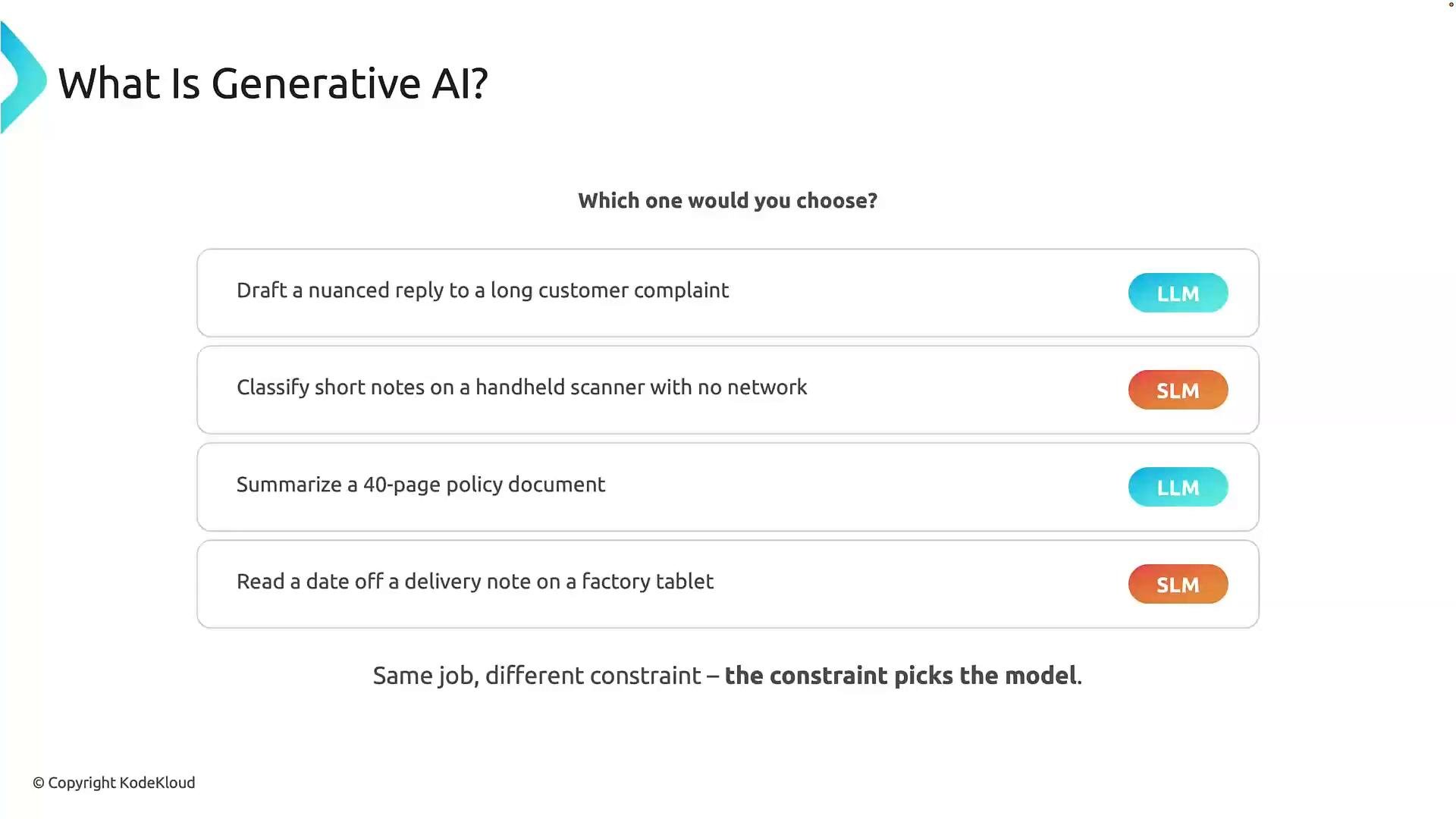 Pick the model based on the task requirements and environment: consider context size, required reasoning, latency, compute and memory limits, connectivity, and privacy needs—rather than defaulting to the largest model available.
## Summary
Generative AI synthesizes new content from prompts using models that understand and generate language and other modalities. It supports a wide range of applications—from chatbots and content creation to productivity tools and multi-step agents. Model selection is a trade-off: match the model’s capabilities to your task, infrastructure constraints, latency requirements, and privacy needs.
## Links and references
* [Introduction to Generative AI — Overview and examples](https://en.wikipedia.org/wiki/Generative_art)
* [Understanding Large Language Models (LLMs)](https://ai.google/education/what-are-large-language-models)
* [Best practices for prompt design and evaluation](https://www.deeplearning.ai/short-courses/prompt-engineering/)
* [Model compression: distillation and quantization techniques](https://arxiv.org/abs/2006.08254)
(These resources help deepen your understanding of prompts, LLM vs SLM trade-offs, multimodal models, and safe usage practices.)
This documentation is built and hosted on [Mintlify](https://mintlify.com), a developer documentation platform.
Pick the model based on the task requirements and environment: consider context size, required reasoning, latency, compute and memory limits, connectivity, and privacy needs—rather than defaulting to the largest model available.
## Summary
Generative AI synthesizes new content from prompts using models that understand and generate language and other modalities. It supports a wide range of applications—from chatbots and content creation to productivity tools and multi-step agents. Model selection is a trade-off: match the model’s capabilities to your task, infrastructure constraints, latency requirements, and privacy needs.
## Links and references
* [Introduction to Generative AI — Overview and examples](https://en.wikipedia.org/wiki/Generative_art)
* [Understanding Large Language Models (LLMs)](https://ai.google/education/what-are-large-language-models)
* [Best practices for prompt design and evaluation](https://www.deeplearning.ai/short-courses/prompt-engineering/)
* [Model compression: distillation and quantization techniques](https://arxiv.org/abs/2006.08254)
(These resources help deepen your understanding of prompts, LLM vs SLM trade-offs, multimodal models, and safe usage practices.)
This documentation is built and hosted on [Mintlify](https://mintlify.com), a developer documentation platform.