> ## Documentation Index
> Fetch the complete documentation index at: https://notes.kodekloud.com/llms.txt
> Use this file to discover all available pages before exploring further.
# LangGraph for AI Workflows
> Describes LangGraph extending LangChain to orchestrate stateful, multi-node AI workflows with conditional branching, loops, shared typed state, and reusable nodes for complex tasks like compliance analysis
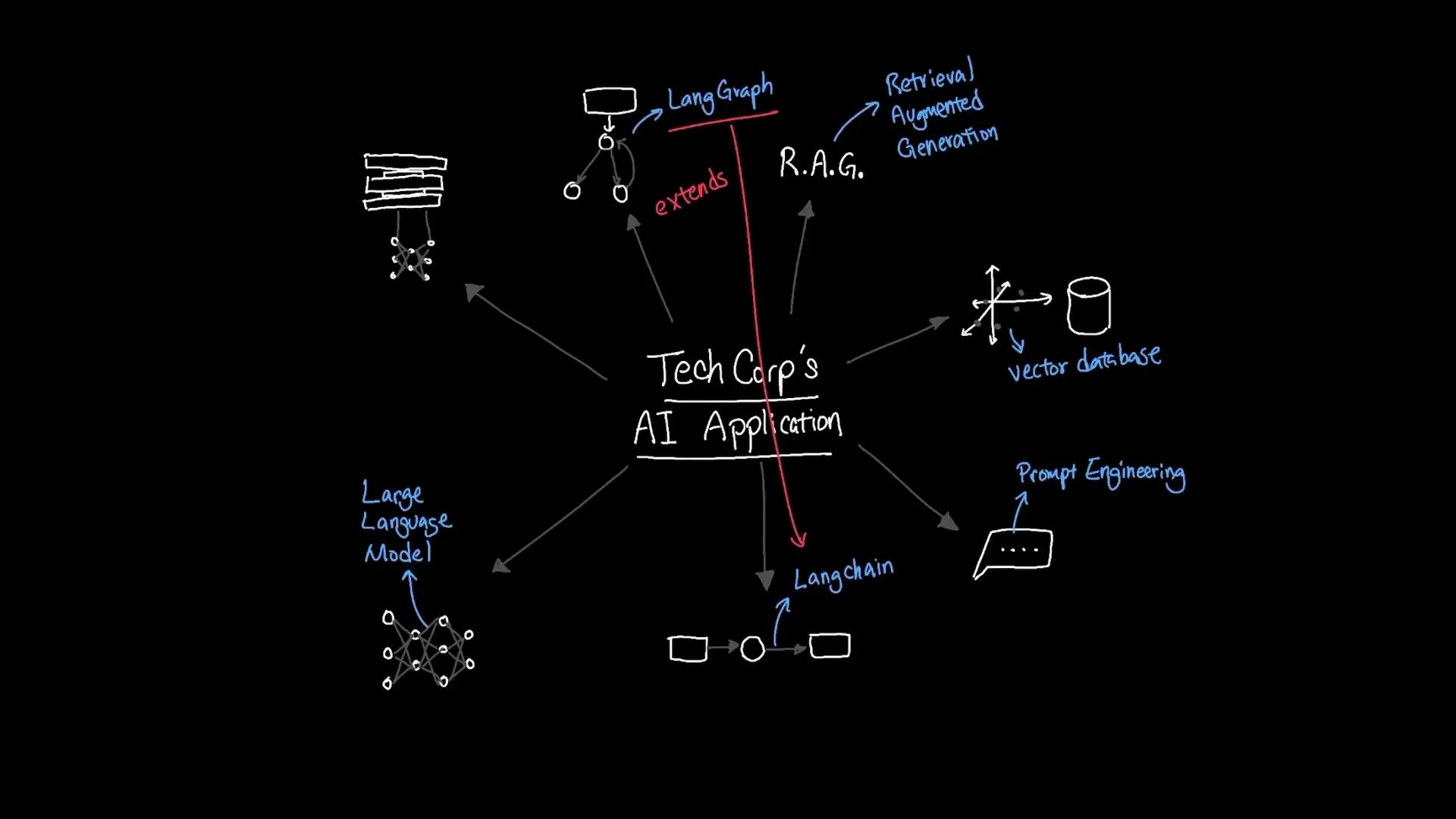
[LangChain](https://langchain.com) is excellent for linear chains and simple pipelines. However, when business requirements demand multi-step workflows, conditional branching, iterative processing, or persistent context, you need more advanced orchestration. LangGraph extends LangChain to handle stateful, multi-node workflows that go beyond single-turn Q\&A.
 Overview
* LangGraph models complex workflows as a graph of nodes (units of computation) connected by edges (execution flow).
* Each node encapsulates a specific responsibility (search, extraction, evaluation, reporting, etc.).
* Edges can be conditional, enabling branching and loops.
* A shared, persistent state (state graph) is accessible to all nodes, allowing context to carry across the entire workflow.
Example scenario
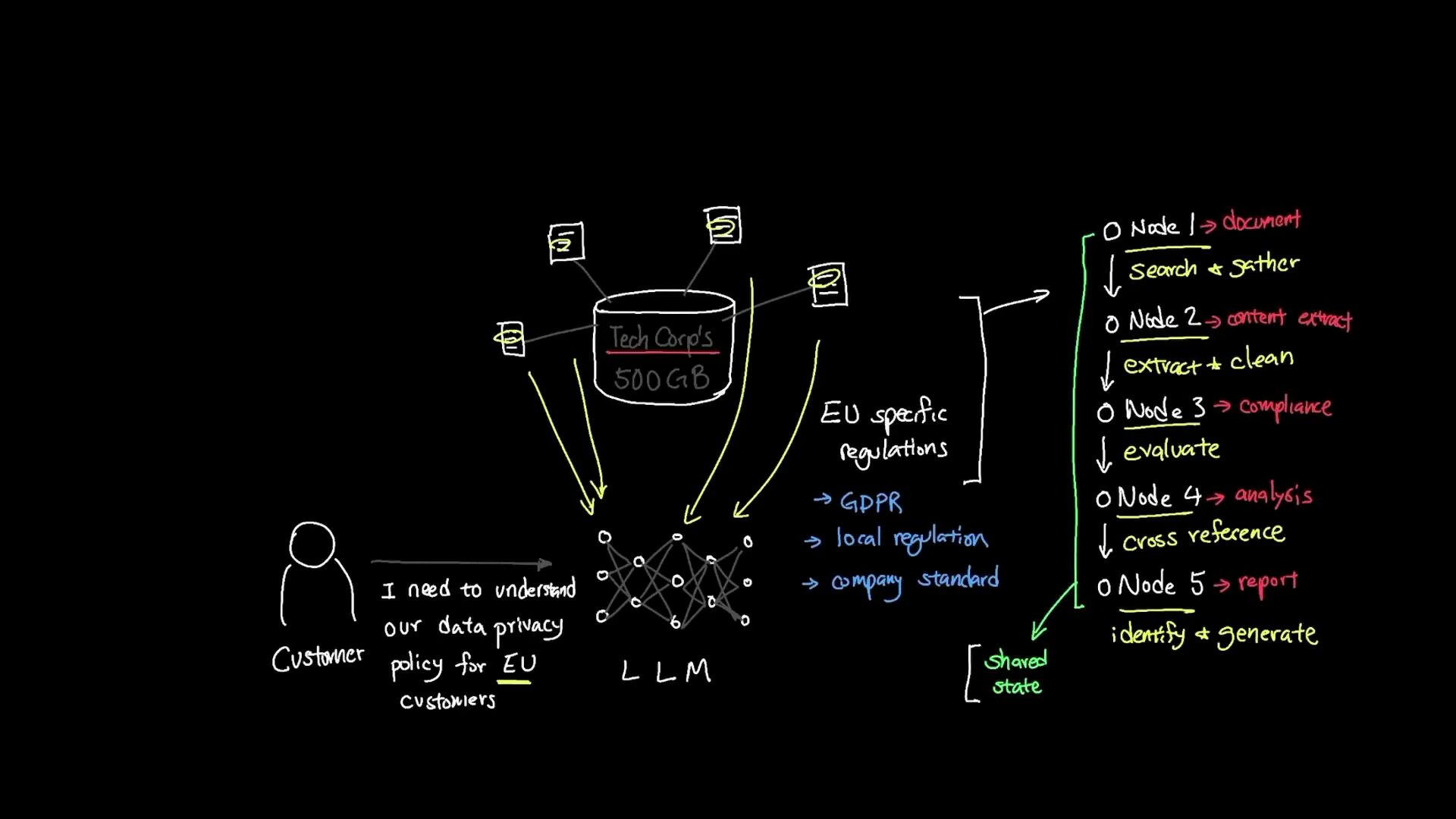
A customer asks: "I need to understand our data privacy policy for EU customers."\
Assume TechCorp has a 500GB data store that contains EU-specific policy documents. The system must locate relevant documents, extract the content, evaluate GDPR compliance, cross-reference local regulations, and produce an actionable report.
Typical LangGraph node workflow for this compliance task:
1. Search and gather privacy policy documents.
2. Extract and clean document content.
3. Evaluate GDPR compliance with an LLM.
4. Cross-reference local EU regulations.
5. Identify compliance gaps and generate recommendations.
A node is a callable task. Edges determine where execution flows next and can include conditional checks. For example:
* After Node 1 gathers documents, the edge routes to Node 2 for extraction.
* After Node 3 evaluates compliance, a conditional edge can route to Node 4 for deeper analysis or directly to Node 5 for reporting.
Shared state
LangGraph supports a typed, persistent state shared across nodes. This allows nodes to read and update workflow context (e.g., list of documents, current document, analysis results).
Overview
* LangGraph models complex workflows as a graph of nodes (units of computation) connected by edges (execution flow).
* Each node encapsulates a specific responsibility (search, extraction, evaluation, reporting, etc.).
* Edges can be conditional, enabling branching and loops.
* A shared, persistent state (state graph) is accessible to all nodes, allowing context to carry across the entire workflow.
Example scenario
A customer asks: "I need to understand our data privacy policy for EU customers."\
Assume TechCorp has a 500GB data store that contains EU-specific policy documents. The system must locate relevant documents, extract the content, evaluate GDPR compliance, cross-reference local regulations, and produce an actionable report.
Typical LangGraph node workflow for this compliance task:
1. Search and gather privacy policy documents.
2. Extract and clean document content.
3. Evaluate GDPR compliance with an LLM.
4. Cross-reference local EU regulations.
5. Identify compliance gaps and generate recommendations.
A node is a callable task. Edges determine where execution flows next and can include conditional checks. For example:
* After Node 1 gathers documents, the edge routes to Node 2 for extraction.
* After Node 3 evaluates compliance, a conditional edge can route to Node 4 for deeper analysis or directly to Node 5 for reporting.
Shared state
LangGraph supports a typed, persistent state shared across nodes. This allows nodes to read and update workflow context (e.g., list of documents, current document, analysis results).
 Typed shared state example
The following Python TypedDict demonstrates a concrete state shape used across the workflow:
```python theme={null}
from typing import List, Optional
from typing_extensions import TypedDict
class ComplianceState(TypedDict):
topic: str
documents: List[str]
current_document: Optional[str]
compliance_score: Optional[int]
gaps: List[str]
recommendations: List[str]
```
How the state flows through nodes:
* Node 1 (search) populates `documents` with found policy files.
* Node 2 (extract) iterates documents and sets `current_document`.
* Node 3 (evaluate) computes `compliance_score`.
* Node 4 (cross-reference) identifies `gaps`.
* Node 5 (report) appends `recommendations`.
Conditional routing and loops
Using the shared state, the graph can adapt execution dynamically:
* If Node 3 sets `compliance_score` below 75%, a conditional edge can loop back to Node 1 to gather more documents (iterative analysis).
* If the score exceeds 75%, the flow can proceed directly to Node 5 to generate the final report.
Common orchestration patterns enabled by LangGraph:
| Pattern | Description | Use case |
| --------------------- | ---------------------------------------------------------- | --------------------------------------------------------------------- |
| Iterative loops | Re-run parts of the graph until a condition is satisfied | Aggregate more documents until confidence threshold reached |
| Conditional branching | Route to different subgraphs based on intermediate results | Different analysis for EU vs non-EU regulations |
| Persistent context | Maintain a shared state accessible to all nodes | Carry findings, intermediate scores, and metadata across the workflow |
| Parallel branches | Execute independent nodes concurrently and merge results | Run multiple evaluation heuristics and combine outputs |
Benefits for the TechCorp compliance assistant
* Declarative modeling of complex workflows (no monolithic scripts).
* Clear separation of concerns (each node focuses on a single responsibility).
* Reusable nodes and conditional edges for flexible behavior.
* Persistent typed state for robust, type-safe orchestration.
Lab: hands-on LangGraph exercises
The course provides lab files to build and run a complete research assistant workflow demonstrating nodes, edges, conditional routing, and shared state.
| File | Purpose | Notes |
| ---------------------------------- | ----------------------------------------- | ----------------------------------------- |
| task\_1\_understanding\_imports.py | Explore required imports and dependencies | Verify correct SDKs and LLM clients |
| task\_2\_creating\_nodes.py | Define node implementations | Implement search, extract, evaluate nodes |
| task\_3\_connecting\_edges.py | Wire nodes together with edges | Add conditional logic for branches |
| task\_4\_complete\_flow\.py | Combine nodes into a runnable graph | End-to-end integration |
| task\_5\_conditional\_routing.py | Implement and test conditional edges | Threshold logic and branching |
| task\_6\_calculator\_tool.py | Small utility node/tool example | Demonstrates tool integration |
| task\_7\_research\_agent.py | Build the final research assistant agent | Orchestrates the complete workflow |
| verify\_environment.py | Environment checks and prerequisites | Run before labs to confirm setup |
Run verify\_environment.py first to confirm your Python version, required packages, and API keys are configured. This prevents common runtime errors during the labs.
Further reading and references
* [LangChain](https://langchain.com) — Core abstractions for chains and agents.
* Retrieval-Augmented Generation (RAG) — pattern for combining LLMs with external data sources.
* GDPR overview — [https://gdpr.eu/](https://gdpr.eu/) for regulation context when building compliance workflows.
By the end of these labs, you'll have a production-like research assistant that demonstrates how LangGraph orchestrates complex, stateful AI workflows with conditional routing and persistent shared state.
Typed shared state example
The following Python TypedDict demonstrates a concrete state shape used across the workflow:
```python theme={null}
from typing import List, Optional
from typing_extensions import TypedDict
class ComplianceState(TypedDict):
topic: str
documents: List[str]
current_document: Optional[str]
compliance_score: Optional[int]
gaps: List[str]
recommendations: List[str]
```
How the state flows through nodes:
* Node 1 (search) populates `documents` with found policy files.
* Node 2 (extract) iterates documents and sets `current_document`.
* Node 3 (evaluate) computes `compliance_score`.
* Node 4 (cross-reference) identifies `gaps`.
* Node 5 (report) appends `recommendations`.
Conditional routing and loops
Using the shared state, the graph can adapt execution dynamically:
* If Node 3 sets `compliance_score` below 75%, a conditional edge can loop back to Node 1 to gather more documents (iterative analysis).
* If the score exceeds 75%, the flow can proceed directly to Node 5 to generate the final report.
Common orchestration patterns enabled by LangGraph:
| Pattern | Description | Use case |
| --------------------- | ---------------------------------------------------------- | --------------------------------------------------------------------- |
| Iterative loops | Re-run parts of the graph until a condition is satisfied | Aggregate more documents until confidence threshold reached |
| Conditional branching | Route to different subgraphs based on intermediate results | Different analysis for EU vs non-EU regulations |
| Persistent context | Maintain a shared state accessible to all nodes | Carry findings, intermediate scores, and metadata across the workflow |
| Parallel branches | Execute independent nodes concurrently and merge results | Run multiple evaluation heuristics and combine outputs |
Benefits for the TechCorp compliance assistant
* Declarative modeling of complex workflows (no monolithic scripts).
* Clear separation of concerns (each node focuses on a single responsibility).
* Reusable nodes and conditional edges for flexible behavior.
* Persistent typed state for robust, type-safe orchestration.
Lab: hands-on LangGraph exercises
The course provides lab files to build and run a complete research assistant workflow demonstrating nodes, edges, conditional routing, and shared state.
| File | Purpose | Notes |
| ---------------------------------- | ----------------------------------------- | ----------------------------------------- |
| task\_1\_understanding\_imports.py | Explore required imports and dependencies | Verify correct SDKs and LLM clients |
| task\_2\_creating\_nodes.py | Define node implementations | Implement search, extract, evaluate nodes |
| task\_3\_connecting\_edges.py | Wire nodes together with edges | Add conditional logic for branches |
| task\_4\_complete\_flow\.py | Combine nodes into a runnable graph | End-to-end integration |
| task\_5\_conditional\_routing.py | Implement and test conditional edges | Threshold logic and branching |
| task\_6\_calculator\_tool.py | Small utility node/tool example | Demonstrates tool integration |
| task\_7\_research\_agent.py | Build the final research assistant agent | Orchestrates the complete workflow |
| verify\_environment.py | Environment checks and prerequisites | Run before labs to confirm setup |
Run verify\_environment.py first to confirm your Python version, required packages, and API keys are configured. This prevents common runtime errors during the labs.
Further reading and references
* [LangChain](https://langchain.com) — Core abstractions for chains and agents.
* Retrieval-Augmented Generation (RAG) — pattern for combining LLMs with external data sources.
* GDPR overview — [https://gdpr.eu/](https://gdpr.eu/) for regulation context when building compliance workflows.
By the end of these labs, you'll have a production-like research assistant that demonstrates how LangGraph orchestrates complex, stateful AI workflows with conditional routing and persistent shared state.