> ## Documentation Index
> Fetch the complete documentation index at: https://notes.kodekloud.com/llms.txt
> Use this file to discover all available pages before exploring further.
# Parameters
> How model parameters are learned, what they represent, and their trade offs in capacity, compute cost, and risks like bias and hallucinations
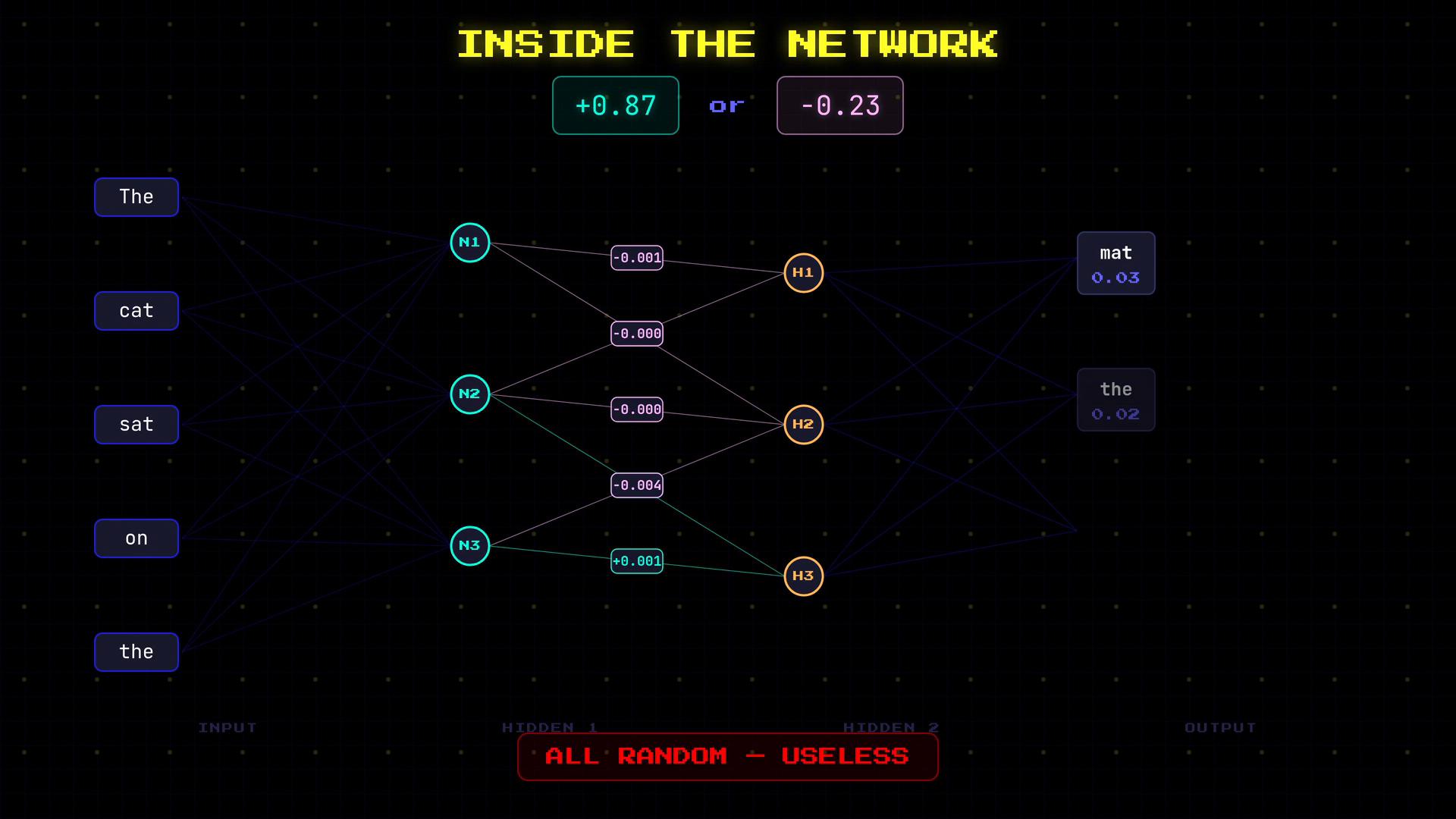
Parameters are the internal numeric settings a model adjusts during training to improve its ability to predict the next word. Each parameter is a single number (for example `0.87` or `-0.23`) stored on neuron connections or as neuron biases. More parameters generally give a model finer-grained control and higher capacity to represent subtle patterns in data — but they also raise computational cost and risk amplifying biases from training data.
 Analogy — learning to throw a basketball:
* You do not compute exact angles and forces consciously. You try, miss, adjust, and try again.
* Over many attempts your body settles on implicit, well-tuned muscle settings.
Parameters are the model’s implicit settings. Instead of muscles and torque, the network stores numbers that determine how signals flow and how strongly certain patterns are encoded.
Analogy — learning to throw a basketball:
* You do not compute exact angles and forces consciously. You try, miss, adjust, and try again.
* Over many attempts your body settles on implicit, well-tuned muscle settings.
Parameters are the model’s implicit settings. Instead of muscles and torque, the network stores numbers that determine how signals flow and how strongly certain patterns are encoded.
 Each parameter controls the strength or polarity of a connection in the network. When a model is initialized, its parameters are typically random, so the model cannot produce sensible text yet. The network only becomes useful after the parameters are adjusted by training.
 How models learn useful parameter values
* Training data (books, articles, websites) acts as the teacher.
* The model predicts the next word, compares its guess to the true next word, and computes an error (loss).
* A learning algorithm — typically backpropagation with gradient descent — computes how to nudge each parameter to reduce that loss. See this introduction to backpropagation for more details.
* This update process repeats billions of times across many examples; no human manually sets these numbers.
How models learn useful parameter values
* Training data (books, articles, websites) acts as the teacher.
* The model predicts the next word, compares its guess to the true next word, and computes an error (loss).
* A learning algorithm — typically backpropagation with gradient descent — computes how to nudge each parameter to reduce that loss. See this introduction to backpropagation for more details.
* This update process repeats billions of times across many examples; no human manually sets these numbers.
 After repeated updates, the initially random numbers settle into a precise configuration that captures statistical patterns of language. This is why a trained language model can produce fluent, coherent text: its parameters encode the relationships and distributions learned from the training corpus.
 Practical implications for choosing and using models
* Strengths: Large parameter counts often improve fluency, pattern recognition, and generalization.
* Trade-offs: More parameters require more compute (memory and inference time) and can be harder to fine-tune or deploy.
* Risks: Models reproduce statistical patterns in training data, so they can inherit biases and occasionally produce incorrect or misleading outputs (so-called hallucinations).
* Recommendation: Balance parameter count with your application’s latency, cost, and safety requirements.
| Resource | What it Affects | Example implication |
| - | - | - |
| Parameter count | Capacity to model complexity | Larger models handle subtler patterns but cost more to run |
| Training data | Knowledge and biases encoded | Diverse, high-quality data reduces some errors but may still contain biases |
| Training compute | How long and how well a model can be trained | More compute allows more steps and larger models |
More parameters usually improve capability but increase computational cost and can amplify issues in training data. Understanding parameters helps you choose a model that balances performance, cost, and safety for your application.
Further reading and references
* Backpropagation and gradient-based optimization: [https://en.wikipedia.org/wiki/Backpropagation](https://en.wikipedia.org/wiki/Backpropagation)
* Intro to language models and next-token prediction: [https://en.wikipedia.org/wiki/Language\_model](https://en.wikipedia.org/wiki/Language_model)
This documentation is built and hosted on [Mintlify](https://mintlify.com), a developer documentation platform.
Practical implications for choosing and using models
* Strengths: Large parameter counts often improve fluency, pattern recognition, and generalization.
* Trade-offs: More parameters require more compute (memory and inference time) and can be harder to fine-tune or deploy.
* Risks: Models reproduce statistical patterns in training data, so they can inherit biases and occasionally produce incorrect or misleading outputs (so-called hallucinations).
* Recommendation: Balance parameter count with your application’s latency, cost, and safety requirements.
| Resource | What it Affects | Example implication |
| - | - | - |
| Parameter count | Capacity to model complexity | Larger models handle subtler patterns but cost more to run |
| Training data | Knowledge and biases encoded | Diverse, high-quality data reduces some errors but may still contain biases |
| Training compute | How long and how well a model can be trained | More compute allows more steps and larger models |
More parameters usually improve capability but increase computational cost and can amplify issues in training data. Understanding parameters helps you choose a model that balances performance, cost, and safety for your application.
Further reading and references
* Backpropagation and gradient-based optimization: [https://en.wikipedia.org/wiki/Backpropagation](https://en.wikipedia.org/wiki/Backpropagation)
* Intro to language models and next-token prediction: [https://en.wikipedia.org/wiki/Language\_model](https://en.wikipedia.org/wiki/Language_model)
This documentation is built and hosted on [Mintlify](https://mintlify.com), a developer documentation platform.