> ## Documentation Index
> Fetch the complete documentation index at: https://notes.kodekloud.com/llms.txt
> Use this file to discover all available pages before exploring further.
# Understanding GPT
> Explains GPT architecture, transformers and self-attention, pre-training, generative decoding, model evolution, risks like hallucinations, and practical takeaways about verifying outputs.
Let's start with something familiar: [ChatGPT](https://chat.openai.com/).
ChatGPT has two parts: "Chat" — the application or interface you use to interact with the system — and "GPT" — the underlying AI technology that generates the responses. GPT stands for Generative Pre-trained Transformer. Below we unpack each term (in reverse order), explain the core technical ideas, and show why these choices made modern language models so effective.
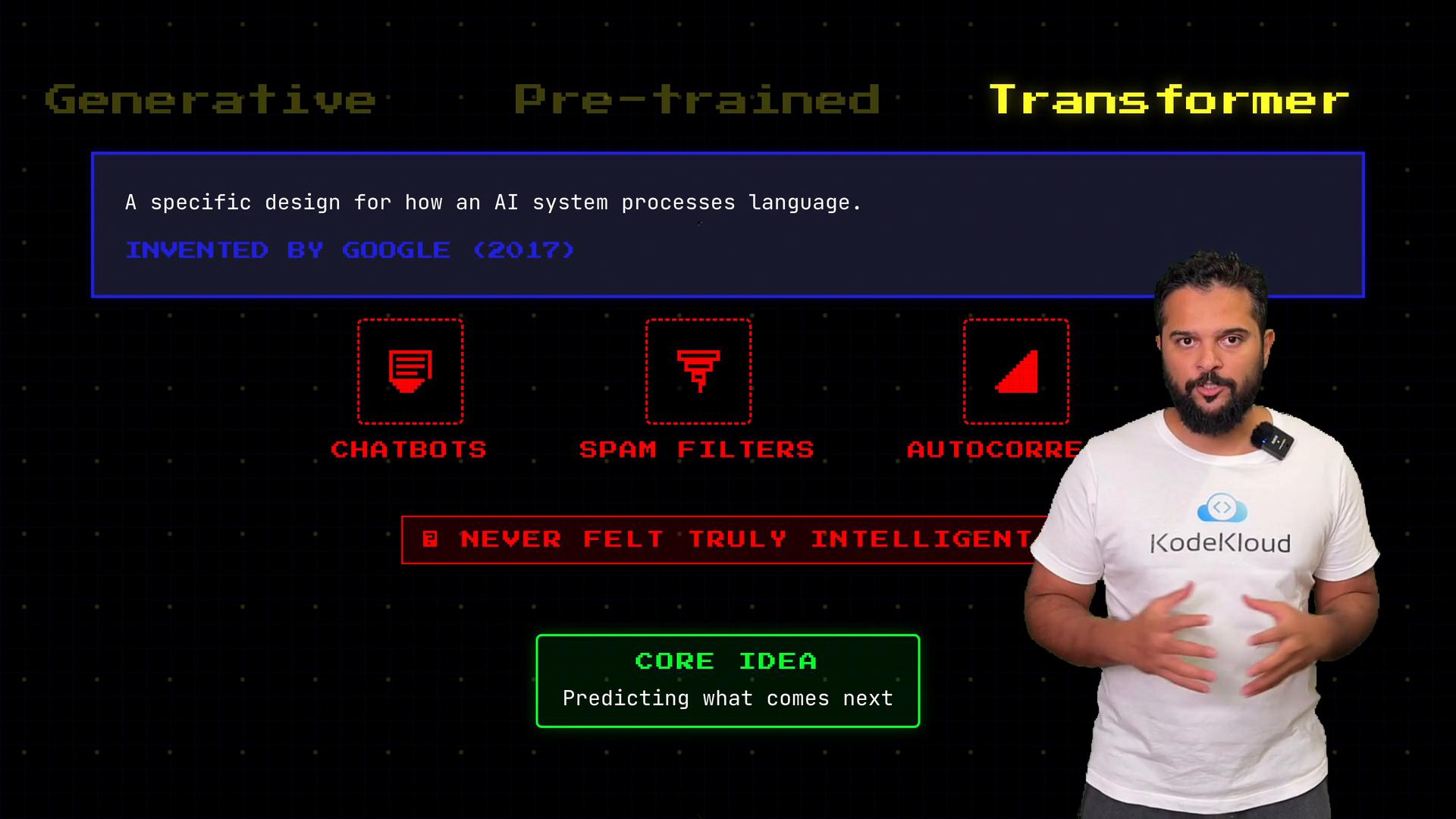
A transformer is a neural-network architecture designed to process sequences such as text. Introduced in 2017 by Google researchers in the paper "Attention Is All You Need" ([https://arxiv.org/abs/1706.03762](https://arxiv.org/abs/1706.03762)), transformers changed how AI handles language by enabling models to examine all tokens in a sequence simultaneously and model how they relate.
You don't need every implementation detail to understand the impact: before transformers, many systems struggled with long-range dependencies and context; after transformers, performance on many language tasks improved dramatically.
 ## Attention (self-attention): the key idea
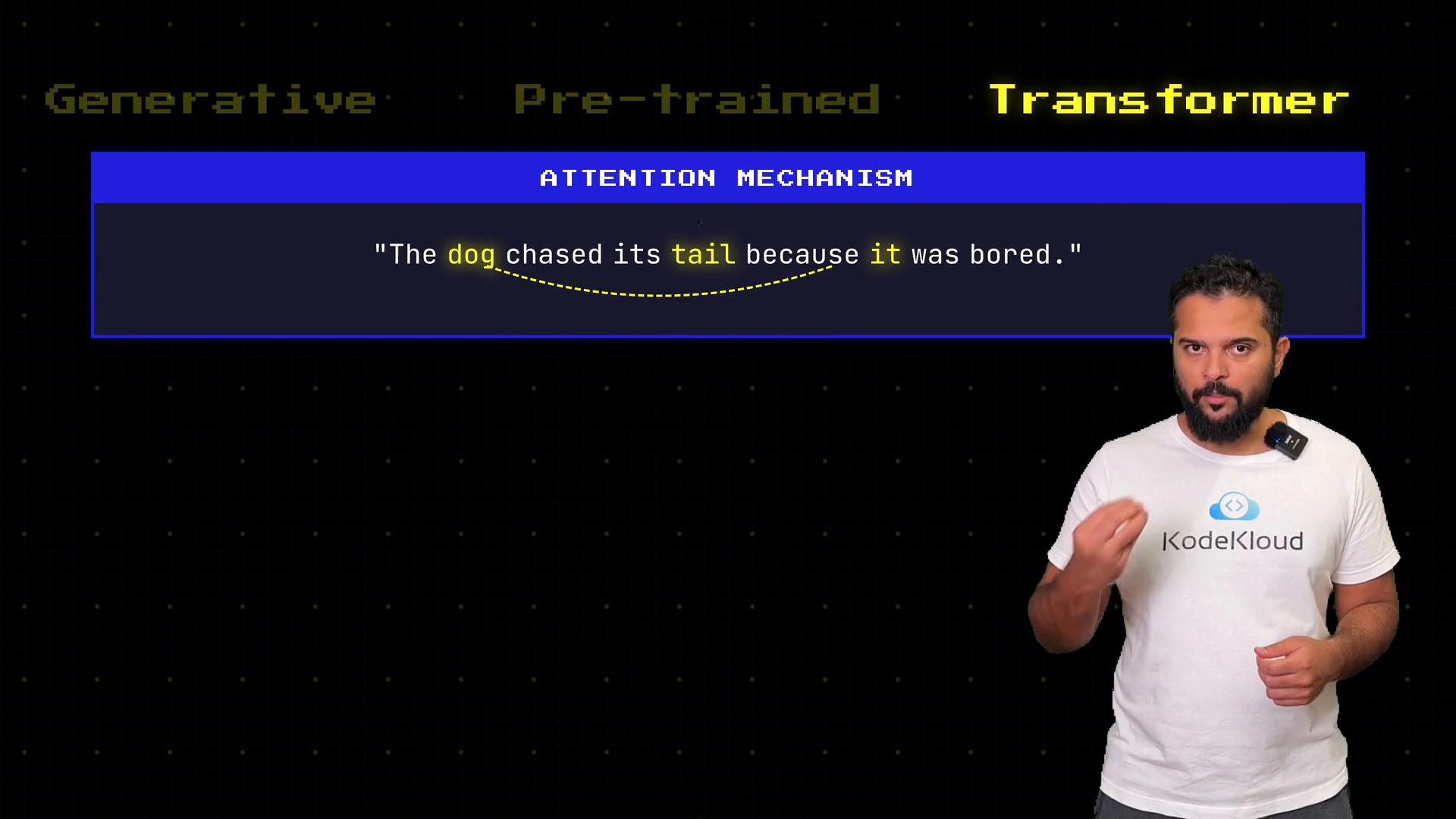
The technical advance that enabled transformers is attention—specifically self-attention. Self-attention lets the model consider every token (word or subword) in the input and compute how strongly each token should influence the representation of every other token. Modeling these pairwise relationships across the whole sequence is what lets transformers resolve many language phenomena earlier models found difficult.
Example — pronoun resolution:
"The dog chased its tail because it was bored."
Which does "it" refer to — the dog or the tail? Humans resolve this instantly (we know "it" refers to the dog). Transformers are much better at this because they can attend to the relationships among all words simultaneously.
## Attention (self-attention): the key idea
The technical advance that enabled transformers is attention—specifically self-attention. Self-attention lets the model consider every token (word or subword) in the input and compute how strongly each token should influence the representation of every other token. Modeling these pairwise relationships across the whole sequence is what lets transformers resolve many language phenomena earlier models found difficult.
Example — pronoun resolution:
"The dog chased its tail because it was bored."
Which does "it" refer to — the dog or the tail? Humans resolve this instantly (we know "it" refers to the dog). Transformers are much better at this because they can attend to the relationships among all words simultaneously.
 ## Pre-trained: learning from massive text corpora
"Pre-trained" means the model learns statistical patterns from a very large and diverse collection of text before it ever interacts with users. During pre-training, the model reads books, web pages, articles, code, and other text to learn how language typically flows.
The primary objective used for GPT-style models is next-token prediction: given a context, predict the next token. Through billions of examples the model adjusts its parameters to improve next-token prediction across many contexts. This is pattern learning, not memorization of facts.
Examples of next-token prediction patterns:
* Given "The capital of France is", a likely next token is "Paris".
* Given "The cat sat on the", a likely next token is "mat".
* Given "Water boils at 100 degrees", a likely next token is "Celsius".
Illustrative training-time predictions:
```bash theme={null}
# illustrative examples of model predictions during training
gpt:~/training$ predict "The capital of France is ___"
"Paris"
✓ Seen 2.3M times in training
gpt:~/training$ predict "The cat sat on the ___"
"mat"
✓ Common phrase pattern
gpt:~/training$ predict "Water boils at 100 degrees ___"
"Celsius"
✓ Scientific pattern match
```
Pre-training teaches the model statistical patterns across language. The model does not store a structured database of facts to "look up." Instead it generates text by sampling likely next tokens given the context it has learned.
## Generative: producing new text token-by-token
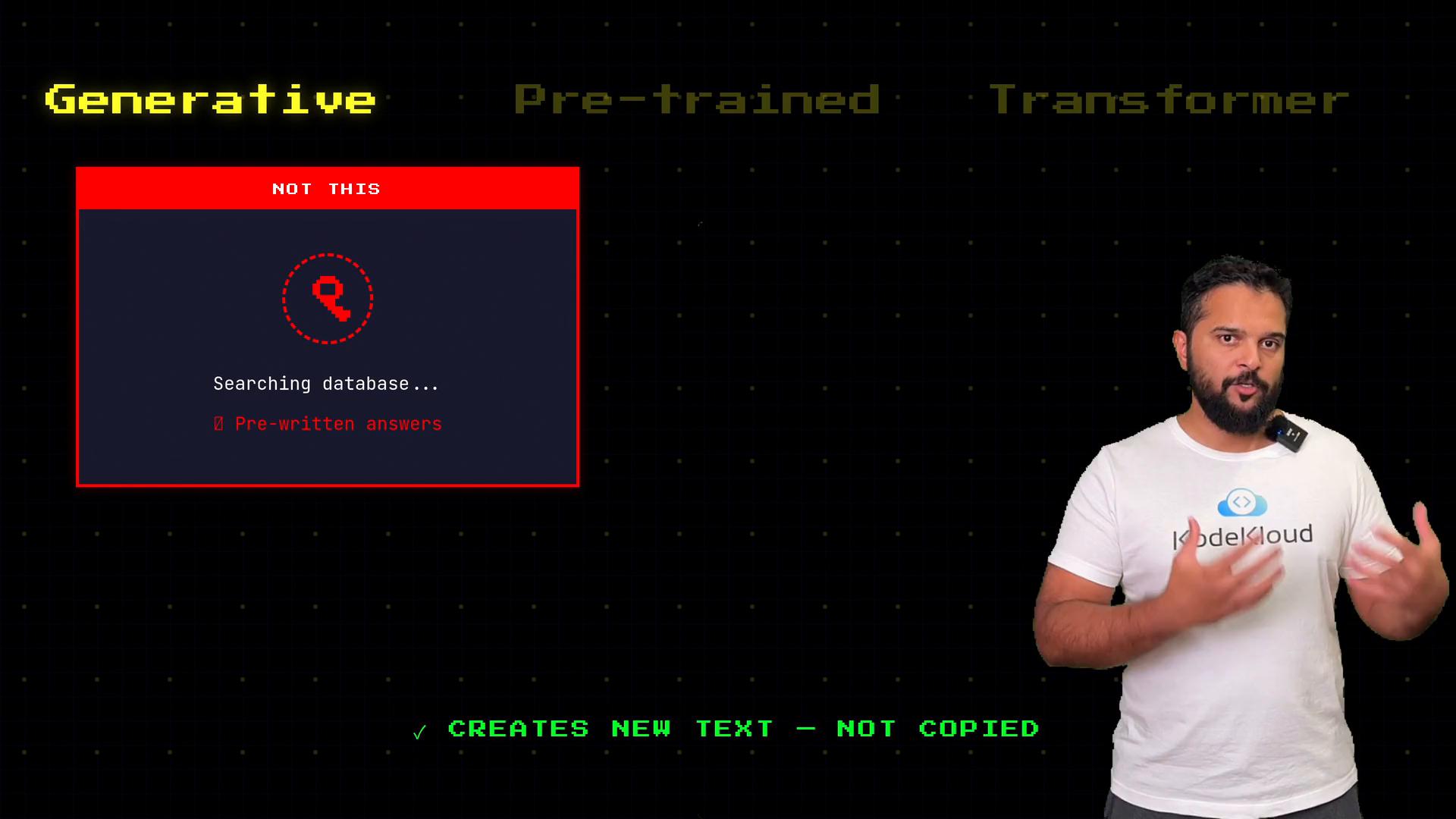
"Generative" simply means the model composes responses one token at a time rather than returning a pre-written answer. At inference, each next token is chosen according to the model's learned probabilities and the chosen decoding strategy (greedy, beam search, sampling, etc.).
Because the model generates text from learned patterns rather than consulting an authoritative source, it can produce incorrect or fabricated statements. These incorrect outputs are commonly called hallucinations — when the model's most probable continuation does not reflect reality or overgeneralizes from noisy training data.
## Pre-trained: learning from massive text corpora
"Pre-trained" means the model learns statistical patterns from a very large and diverse collection of text before it ever interacts with users. During pre-training, the model reads books, web pages, articles, code, and other text to learn how language typically flows.
The primary objective used for GPT-style models is next-token prediction: given a context, predict the next token. Through billions of examples the model adjusts its parameters to improve next-token prediction across many contexts. This is pattern learning, not memorization of facts.
Examples of next-token prediction patterns:
* Given "The capital of France is", a likely next token is "Paris".
* Given "The cat sat on the", a likely next token is "mat".
* Given "Water boils at 100 degrees", a likely next token is "Celsius".
Illustrative training-time predictions:
```bash theme={null}
# illustrative examples of model predictions during training
gpt:~/training$ predict "The capital of France is ___"
"Paris"
✓ Seen 2.3M times in training
gpt:~/training$ predict "The cat sat on the ___"
"mat"
✓ Common phrase pattern
gpt:~/training$ predict "Water boils at 100 degrees ___"
"Celsius"
✓ Scientific pattern match
```
Pre-training teaches the model statistical patterns across language. The model does not store a structured database of facts to "look up." Instead it generates text by sampling likely next tokens given the context it has learned.
## Generative: producing new text token-by-token
"Generative" simply means the model composes responses one token at a time rather than returning a pre-written answer. At inference, each next token is chosen according to the model's learned probabilities and the chosen decoding strategy (greedy, beam search, sampling, etc.).
Because the model generates text from learned patterns rather than consulting an authoritative source, it can produce incorrect or fabricated statements. These incorrect outputs are commonly called hallucinations — when the model's most probable continuation does not reflect reality or overgeneralizes from noisy training data.
 ## GPT family and other LLMs
GPT is a family of models that evolved over time. Each new generation typically used larger model sizes, more diverse data, and more compute during training to improve the model’s ability to predict plausible next tokens in many contexts.
| Model | Year | Notes |
| - | - | - |
| GPT-1 | 2018 | Proof of concept for transformer-based language modeling |
| GPT-2 | 2019 | Much larger; raised concerns about misuse due to fluency |
| GPT-3 | 2020 | Major capability jump; could produce essays, code, and more |
| GPT-3.5 | 2022 | Powered the original ChatGPT experience |
| [GPT-4](https://openai.com/research/gpt-4) | 2023 | More capable, multimodal (image inputs supported) |
| GPT-4o | 2024 | Focused on speed and improved voice/vision capabilities |
GPT is one family among many modern large language models (LLMs). Other notable models include [Anthropic's Claude](https://www.anthropic.com/product/claude), [Google's Gemini](https://gemini.google/), and [Meta's Llama](https://ai.meta.com/llama/) (open source). They share the same high-level ingredients: transformer architecture + large-scale pre-training + generative decoding.
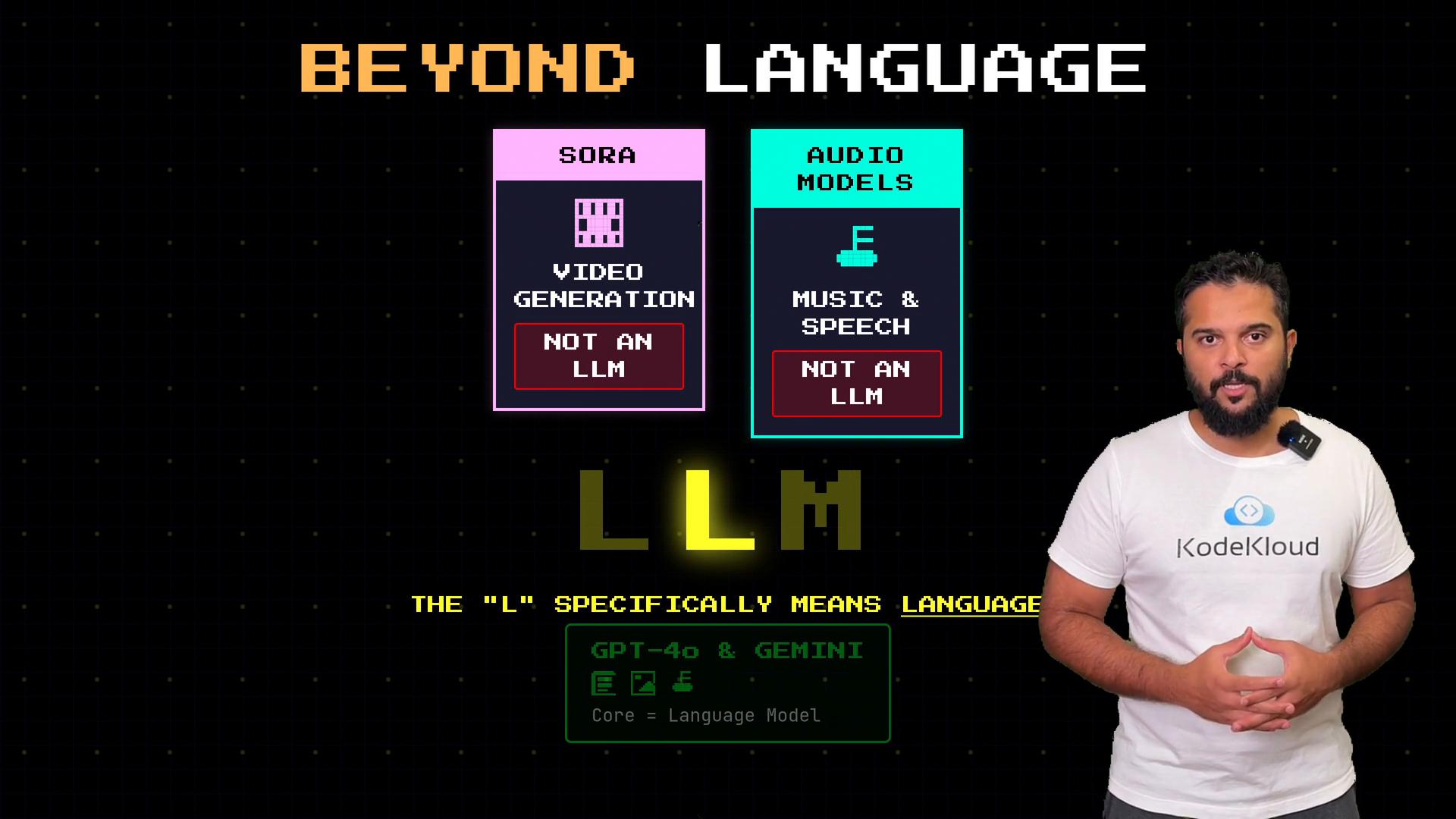
Transformers are used beyond text: variants support models for audio, images, and video. While some models are explicitly multimodal, the L in LLM denotes a specialization in language tasks.
## GPT family and other LLMs
GPT is a family of models that evolved over time. Each new generation typically used larger model sizes, more diverse data, and more compute during training to improve the model’s ability to predict plausible next tokens in many contexts.
| Model | Year | Notes |
| - | - | - |
| GPT-1 | 2018 | Proof of concept for transformer-based language modeling |
| GPT-2 | 2019 | Much larger; raised concerns about misuse due to fluency |
| GPT-3 | 2020 | Major capability jump; could produce essays, code, and more |
| GPT-3.5 | 2022 | Powered the original ChatGPT experience |
| [GPT-4](https://openai.com/research/gpt-4) | 2023 | More capable, multimodal (image inputs supported) |
| GPT-4o | 2024 | Focused on speed and improved voice/vision capabilities |
GPT is one family among many modern large language models (LLMs). Other notable models include [Anthropic's Claude](https://www.anthropic.com/product/claude), [Google's Gemini](https://gemini.google/), and [Meta's Llama](https://ai.meta.com/llama/) (open source). They share the same high-level ingredients: transformer architecture + large-scale pre-training + generative decoding.
Transformers are used beyond text: variants support models for audio, images, and video. While some models are explicitly multimodal, the L in LLM denotes a specialization in language tasks.
 ## Key takeaways
* Transformers and self-attention allow models to model relationships among all tokens in a sequence.
* Pre-training on massive corpora with a next-token objective teaches statistical language patterns.
* Because generation is pattern-based (not a lookup), models can hallucinate — verify critical facts.
* The GPT family evolved through successive generations; other LLMs use similar core ideas.
Because GPT-style models generate text from patterns learned during training, always verify critical facts against authoritative sources—especially for code, health, legal, or other high-stakes decisions.
## Links and references
* [Attention Is All You Need (Vaswani et al., 2017)](https://arxiv.org/abs/1706.03762)
* [GPT-4 research overview](https://openai.com/research/gpt-4)
* [Anthropic Claude](https://www.anthropic.com/product/claude)
* [Google Gemini](https://gemini.google/)
* [Meta Llama](https://ai.meta.com/llama/)
This documentation is built and hosted on [Mintlify](https://mintlify.com), a developer documentation platform.
## Key takeaways
* Transformers and self-attention allow models to model relationships among all tokens in a sequence.
* Pre-training on massive corpora with a next-token objective teaches statistical language patterns.
* Because generation is pattern-based (not a lookup), models can hallucinate — verify critical facts.
* The GPT family evolved through successive generations; other LLMs use similar core ideas.
Because GPT-style models generate text from patterns learned during training, always verify critical facts against authoritative sources—especially for code, health, legal, or other high-stakes decisions.
## Links and references
* [Attention Is All You Need (Vaswani et al., 2017)](https://arxiv.org/abs/1706.03762)
* [GPT-4 research overview](https://openai.com/research/gpt-4)
* [Anthropic Claude](https://www.anthropic.com/product/claude)
* [Google Gemini](https://gemini.google/)
* [Meta Llama](https://ai.meta.com/llama/)
This documentation is built and hosted on [Mintlify](https://mintlify.com), a developer documentation platform.