> ## Documentation Index
> Fetch the complete documentation index at: https://notes.kodekloud.com/llms.txt
> Use this file to discover all available pages before exploring further.
# Lab Walkthrough Test Your Agent
> Guide to a three-layer testing strategy for AI agents covering unit tests, mock-based integration tests, and end-to-end evaluation with setup, examples, and CI considerations.
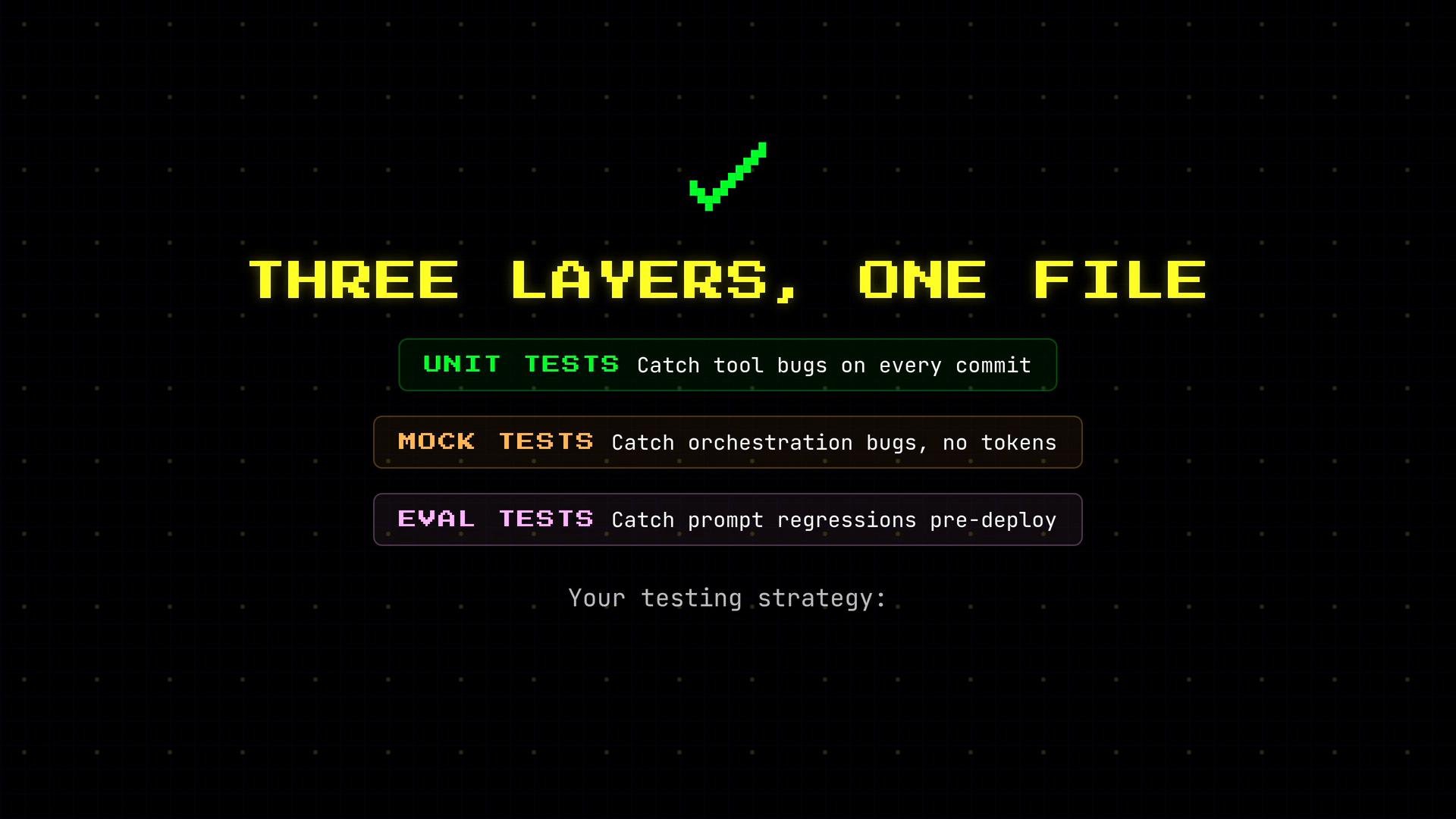
Time to write tests for your agent. This lesson walks through a three-layer test strategy that balances speed, determinism, and real-world coverage:
* Unit tests — fast, deterministic, no network or tokens
* Mock-based integration tests — validate orchestration without external calls
* Evaluation (end-to-end) tests — exercise the real model and tools before deployment
Each layer targets different classes of bugs. Together they increase confidence before deploying your agent.
***
## Setup
Prerequisites and assumptions:
* Python, a virtual environment, and the OpenAI SDK are pre-installed.
* Your working directory is `/root/code`.
* `agent_components.py` already exists and exposes `check_calendar` and `execute_tool`.
* Create a new file named `test_agent.py` in your working directory.
Create the imports at the top of `test_agent.py`. We'll use Python's `unittest` and `unittest.mock` to keep tests deterministic:
```python theme={null}
import os
import json
import unittest
from unittest.mock import MagicMock, patch
import agent_components
from agent_components import check_calendar, execute_tool
```
Keep tests small and focused. Unit tests should run in milliseconds and never talk to external services or consume API tokens.
***
## 1) Unit tests (fast, no network / no tokens)
Purpose: catch low-level tool bugs on every commit. Test only pure functions and interfaces—no network, no tokens.
Example unit-test class:
```python theme={null}
class TestUnit(unittest.TestCase):
def test_imports_and_callables(self):
# Ensure the functions we've been using actually exist and are callable.
self.assertTrue(callable(check_calendar))
self.assertTrue(callable(execute_tool))
```
Run unit tests quickly:
```bash theme={null}
python3 -m unittest
```
Unit tests should finish in milliseconds and provide fast feedback in CI on every commit.
***
## 2) Mock-based integration tests (orchestration, no tokens)
Purpose: simulate the agent loop and model/tool orchestration without calling the real API. These tests verify dispatch logic — when the model indicates a tool call, your code dispatches to `execute_tool` with the expected name and arguments.
Example mock-based integration test:
```python theme={null}
class TestAgentLoop(unittest.TestCase):
def test_tool_dispatch_on_tool_call(self):
# Patch the execute_tool function on the agent_components module so we can assert it was called.
with patch.object(agent_components, "execute_tool") as mock_execute_tool:
fake_tool_call = MagicMock()
fake_tool_call.function.name = "check_calendar"
# The model often returns tool arguments as a JSON string.
fake_tool_call.function.arguments = json.dumps({})
# Simulate what your orchestration logic would extract from the model response.
name = fake_tool_call.function.name
args = json.loads(fake_tool_call.function.arguments or "{}")
# Call the dispatch function (using the module reference to ensure we hit the patched function).
agent_components.execute_tool(name, args)
# Assert dispatch happened with the expected tool name and arguments.
mock_execute_tool.assert_called_with("check_calendar", {})
```
Why mocks?
* Validate your orchestration code without spending tokens
* Keep tests deterministic and fast
* Isolate failures to either orchestration or tools
***
## 3) Evaluation tests (end-to-end / integration with API)
Purpose: run an end-to-end scenario against the real OpenAI client to catch prompt regressions, wiring problems, or API compatibility issues before deployment. Run these sparingly (CI gate tests or local pre-deploy checks) because they call the real service and consume tokens.
Important: ensure environment variables are set (`OPENAI_API_KEY` and optionally `OPENAI_API_BASE`). If not set, skip the test early so CI doesn't fail unexpectedly.
```python theme={null}
class TestAgentEval(unittest.TestCase):
def test_agent_responds_to_calendar_query(self):
from openai import OpenAI
# Expect an environment variable with the API key. Fail early with a helpful message if missing.
api_key = os.environ.get("OPENAI_API_KEY")
if not api_key:
self.skipTest("OPENAI_API_KEY not set; skipping eval test")
base = os.environ.get("OPENAI_API_BASE")
# Create the client (include base_url only if provided).
client_kwargs = {"api_key": api_key}
if base:
client_kwargs["base_url"] = base
client = OpenAI(**client_kwargs)
# Send a calendar-related user message and include the calendar tool definition that your agent uses.
response = client.chat.completions.create(
model="openai/gpt-4.1-mini",
messages=[{"role": "user", "content": "What's on my calendar?"}],
tools=[agent_components.CHECK_CALENDAR_TOOL],
)
choice = response.choices[0]
# The model may indicate it wants to call a tool (finish_reason can vary across SDKs/versions),
# or it may reply directly. Accept multiple common finish_reason values used for tool/function calls.
made_tool_call = getattr(choice, "finish_reason", None) in ("tool_calls", "tool_call", "function_call")
# Extract content safely from the returned choice. Some SDK versions expose .message, others provide dicts.
content = ""
if hasattr(choice, "message"):
message = choice.message
raw = getattr(message, "content", "") or ""
if isinstance(raw, str):
content = raw
elif isinstance(raw, dict):
# Common patterns: plain text, or { "parts": [...] } structures.
content = raw.get("text") or " ".join(raw.get("parts", [])) or ""
else:
content = str(raw)
else:
# Fallback for dict-like choices
content = (getattr(choice, "get", lambda k, d=None: d)("message") or {}).get("content", "") or ""
content_lower = content.lower()
has_keyword = any(k in content_lower for k in ["calendar", "meeting", "standup"])
self.assertTrue(made_tool_call or has_keyword)
```
Eval tests hit the live API and consume tokens. Only run them in CI gates or as an explicit pre-deploy step. Ensure `OPENAI_API_KEY` is set and correct to avoid misleading failures.
Run the full test suite (verbose):
```bash theme={null}
python3 -m unittest -v
```
***
## Test Layers at a Glance
| Test Layer | Purpose | Characteristics |
| - | - | - |
| Unit tests | Catch tool-level bugs quickly | Fast, deterministic, no network |
| Mock-based integration tests | Validate orchestration and dispatch logic | Uses `unittest.mock`, no tokens |
| Evaluation tests | End-to-end prompt and tool wiring validation | Calls real API; requires `OPENAI_API_KEY` and optionally `OPENAI_API_BASE` |
***
## Summary
* Unit tests: fast feedback for function-level correctness.
* Mock-based integration tests: validate orchestration and dispatch without consuming tokens.
* Evaluation tests: ensure end-to-end correctness against the real model and tool definitions before deployment.
These three layers combined provide robust coverage for agent correctness and regression detection.
## Links & References
* [OpenAI API Documentation](https://platform.openai.com/docs)
* Python `unittest` — [https://docs.python.org/3/library/unittest.html](https://docs.python.org/3/library/unittest.html)
* `unittest.mock` — [https://docs.python.org/3/library/unittest.mock.html](https://docs.python.org/3/library/unittest.mock.html)
 This documentation is built and hosted on [Mintlify](https://mintlify.com), a developer documentation platform.