> ## Documentation Index
> Fetch the complete documentation index at: https://notes.kodekloud.com/llms.txt
> Use this file to discover all available pages before exploring further.
# Human in the Loop Approvals Checkpoints and Guardrails
> Guide to inserting human approvals, checkpoints, and technical guardrails into AI agent workflows to balance automation, safety, and auditability.
As we give AI agents more autonomy, a central design question emerges: where should a human still be involved? This guide explains patterns for inserting human judgment into agent-driven workflows so you get the right balance of automation, safety, and auditability.
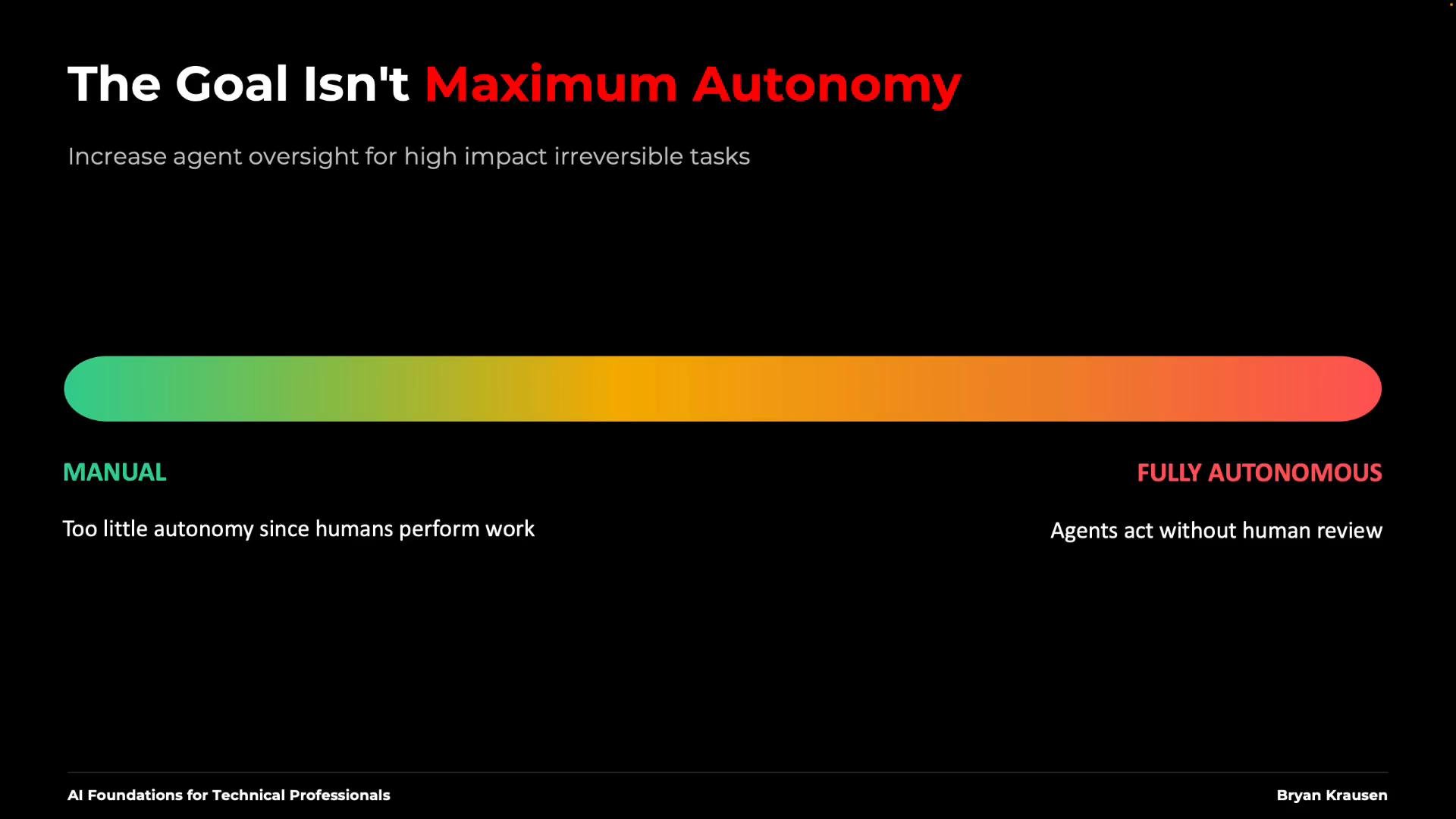
Human-in-the-loop (HITL) means the agent handles most routine work but pauses at selected points so a person can review, approve, or correct actions. The goal is not maximum autonomy—it is the right level of autonomy for the task, especially as the potential impact or irreversibility of an action increases.
 Overview of controls
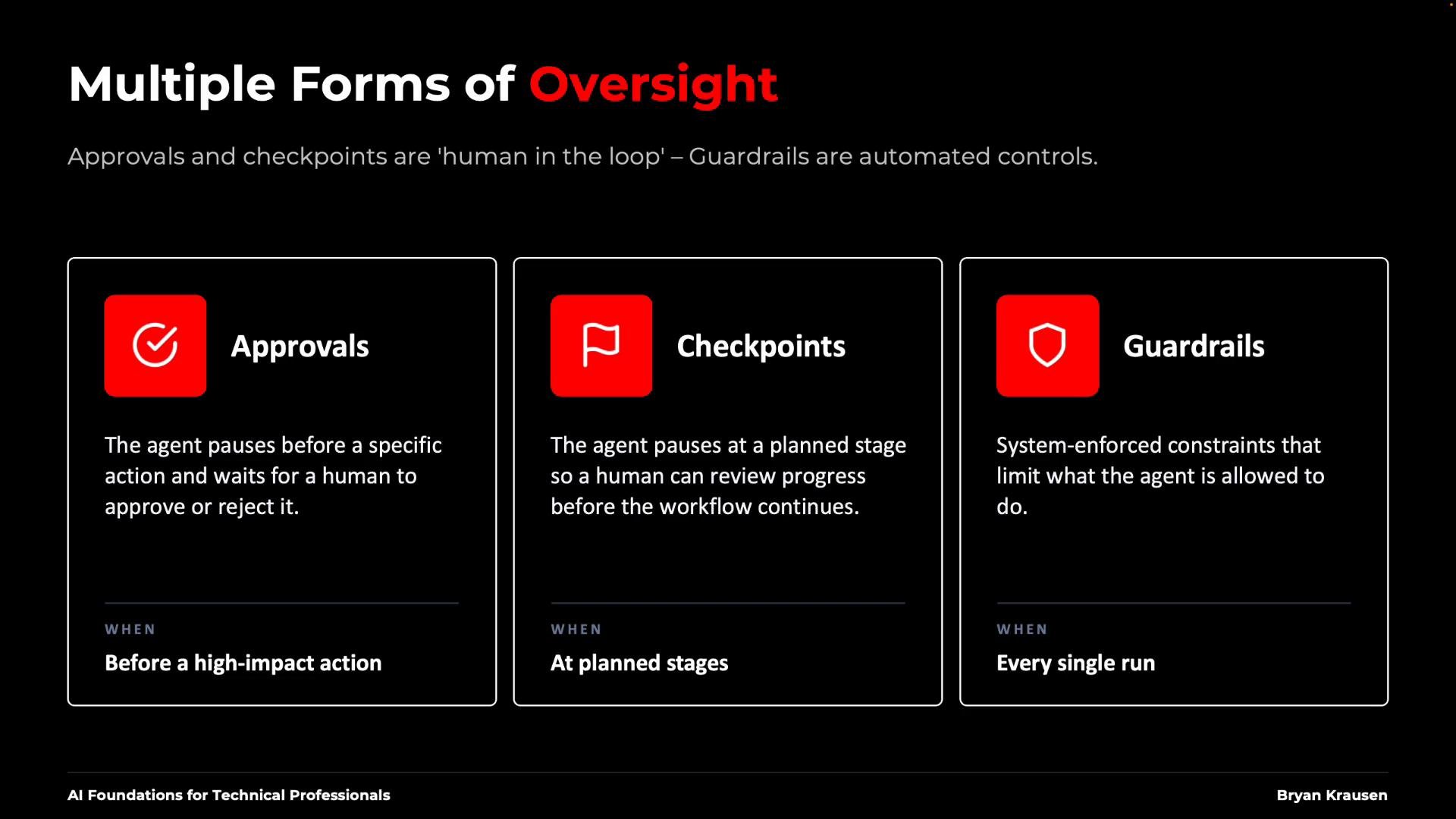
Three distinct controls are commonly used to insert human judgment or system limits into agent workflows: approvals, checkpoints, and guardrails. They differ in when the human or system intervenes, and how that intervention is applied.
| Control | When it applies | What it does | Typical use case |
| -: | -: | - | - |
| Approvals | Immediately before a specific action | Pauses execution until a human explicitly approves or rejects the prepared action | Financial transactions, destructive operations, production changes |
| Checkpoints | At planned stages of a multi-step workflow | Pauses to let a human inspect intermediate results before continuing | Bulk operations, staged rollouts, sampling-based validation |
| Guardrails | Enforced at the system, tool, or identity level | Automatically prevents disallowed actions regardless of model behavior | Permissions, allowlists, spending caps, restricted APIs |
These three patterns and their relationships are illustrated below.
Overview of controls
Three distinct controls are commonly used to insert human judgment or system limits into agent workflows: approvals, checkpoints, and guardrails. They differ in when the human or system intervenes, and how that intervention is applied.
| Control | When it applies | What it does | Typical use case |
| -: | -: | - | - |
| Approvals | Immediately before a specific action | Pauses execution until a human explicitly approves or rejects the prepared action | Financial transactions, destructive operations, production changes |
| Checkpoints | At planned stages of a multi-step workflow | Pauses to let a human inspect intermediate results before continuing | Bulk operations, staged rollouts, sampling-based validation |
| Guardrails | Enforced at the system, tool, or identity level | Automatically prevents disallowed actions regardless of model behavior | Permissions, allowlists, spending caps, restricted APIs |
These three patterns and their relationships are illustrated below.
 Approvals
 halt execution right before a concrete, consequential action. The agent can analyze the situation and prepare a proposed change, but it does not execute that change until a human reviewer explicitly signs off.
When to use approvals
* High-impact, irreversible, or customer-facing actions (refunds, deletion of records, production deployments).
* Any action where legal, financial, or reputational consequences require an auditable, human decision.
Example
* A support agent computes a \$200 refund and prepares a transaction. The refund is not executed until a support lead approves. If approved, the workflow continues and logs the decision; if rejected, the agent either stops or proposes an alternative.
Design tip
* Avoid approval fatigue. Requiring approval for low-risk, frequent tasks leads reviewers to approve automatically. Reserve approvals for genuinely consequential actions.
Checkpoints
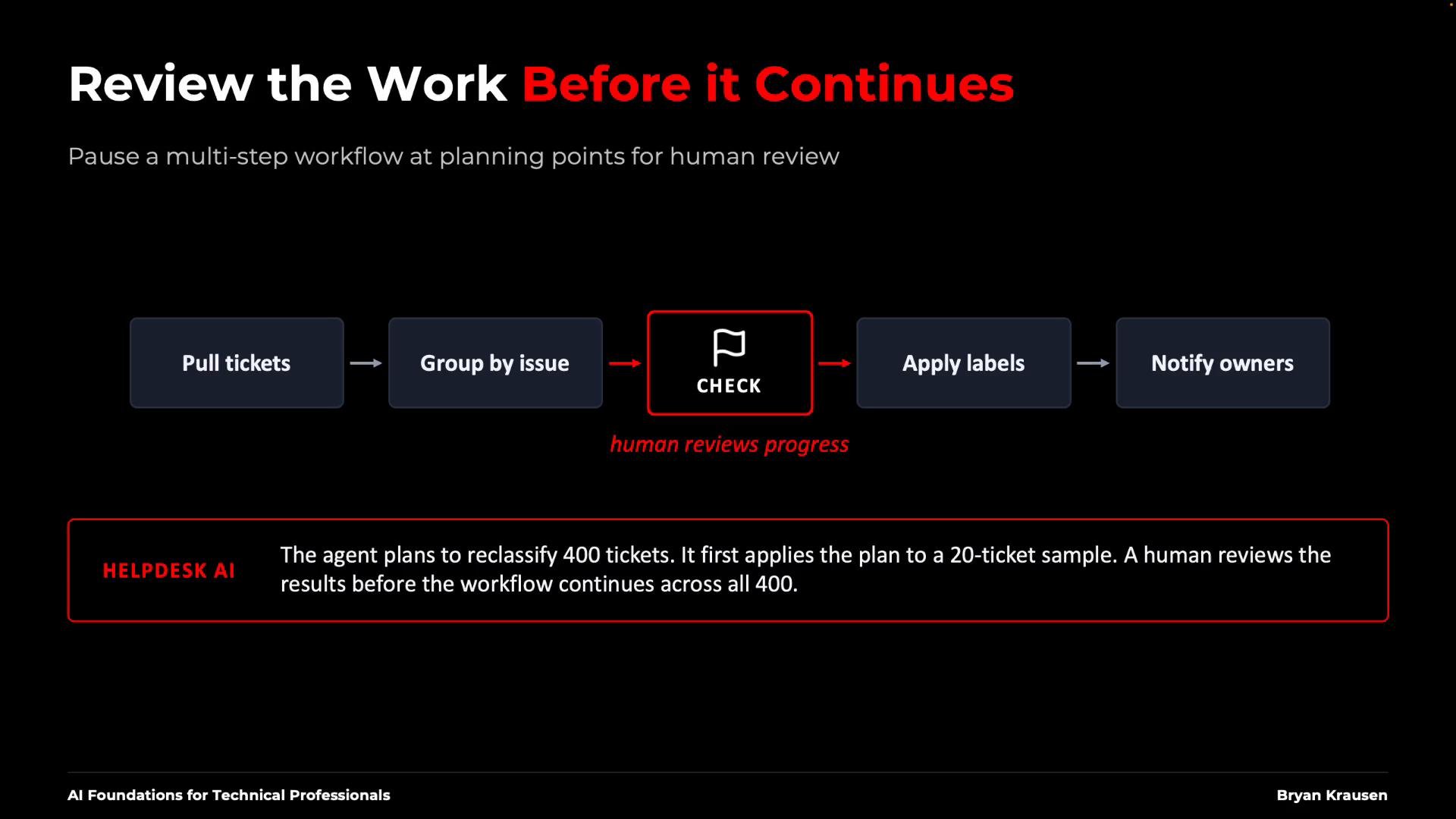
A checkpoint pauses a workflow at a planned staging point so a human can inspect intermediate outputs before the agent proceeds. This is ideal for multi-step tasks where an early mistake could cascade.
When to use checkpoints
* Bulk changes or staged operations where validating a sample reduces downstream risk.
* Complex multi-step workflows where intermediate validation prevents amplification of errors.
Example
* A helpdesk agent proposes reclassifying 400 tickets. It first processes a sample of 20 tickets and hits a checkpoint for a human review. If the sample is correct, the human approves and the agent applies the reclassification to the remaining tickets.
Approvals
Approvals halt execution right before a concrete, consequential action. The agent can analyze the situation and prepare a proposed change, but it does not execute that change until a human reviewer explicitly signs off.
When to use approvals
* High-impact, irreversible, or customer-facing actions (refunds, deletion of records, production deployments).
* Any action where legal, financial, or reputational consequences require an auditable, human decision.
Example
* A support agent computes a \$200 refund and prepares a transaction. The refund is not executed until a support lead approves. If approved, the workflow continues and logs the decision; if rejected, the agent either stops or proposes an alternative.
Design tip
* Avoid approval fatigue. Requiring approval for low-risk, frequent tasks leads reviewers to approve automatically. Reserve approvals for genuinely consequential actions.
Checkpoints
A checkpoint pauses a workflow at a planned staging point so a human can inspect intermediate outputs before the agent proceeds. This is ideal for multi-step tasks where an early mistake could cascade.
When to use checkpoints
* Bulk changes or staged operations where validating a sample reduces downstream risk.
* Complex multi-step workflows where intermediate validation prevents amplification of errors.
Example
* A helpdesk agent proposes reclassifying 400 tickets. It first processes a sample of 20 tickets and hits a checkpoint for a human review. If the sample is correct, the human approves and the agent applies the reclassification to the remaining tickets.
 Guardrails
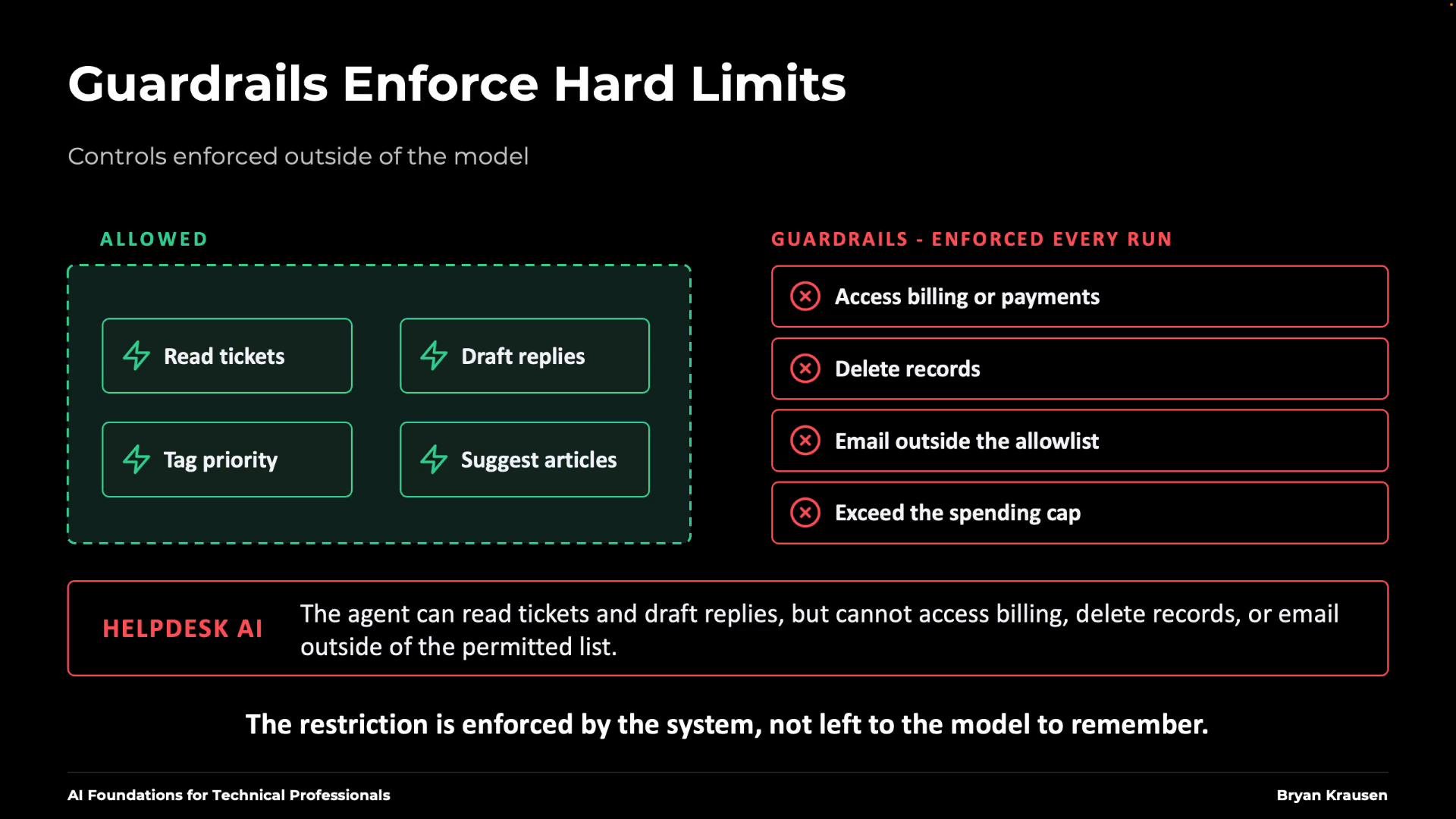
 are hard system limits enforced outside the model. They are implemented as permissions, policies, allowlists, quotas, or infrastructure constraints and remain effective even if the model is given malicious input or behaves unexpectedly.
Key properties
* Not just a prompt instruction—guardrails are technical controls applied to the agent's identity, tools, or infrastructure.
* Enforced automatically at runtime, independent of the model’s output.
Example for a helpdesk agent
* Allowed: read tickets, draft replies, tag priority, suggest knowledge-base articles.
* Prohibited by guardrail: access billing systems, delete records, send email outside an allowlist, exceed a spending cap.
Important distinction
* Saying “never delete records” in a prompt is guidance. Configuring the agent’s permissions so it cannot call any record-deletion API is a guardrail.
Guardrails
Guardrails are hard system limits enforced outside the model. They are implemented as permissions, policies, allowlists, quotas, or infrastructure constraints and remain effective even if the model is given malicious input or behaves unexpectedly.
Key properties
* Not just a prompt instruction—guardrails are technical controls applied to the agent's identity, tools, or infrastructure.
* Enforced automatically at runtime, independent of the model’s output.
Example for a helpdesk agent
* Allowed: read tickets, draft replies, tag priority, suggest knowledge-base articles.
* Prohibited by guardrail: access billing systems, delete records, send email outside an allowlist, exceed a spending cap.
Important distinction
* Saying “never delete records” in a prompt is guidance. Configuring the agent’s permissions so it cannot call any record-deletion API is a guardrail.
 Deciding how much human involvement is required
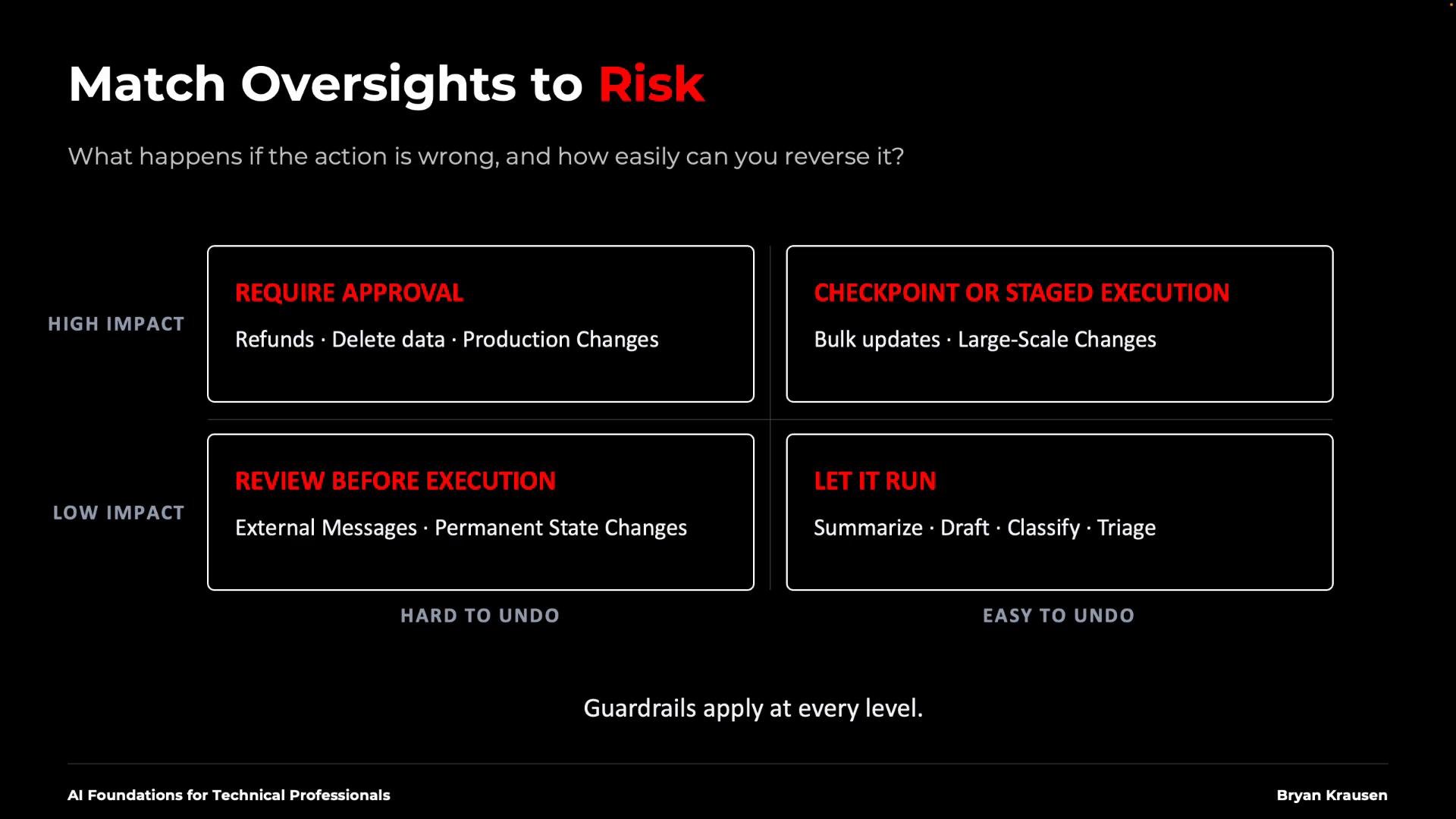
A simple decision framework asks two questions:
1. What happens if this action is wrong? (Impact)
2. How easy is it to reverse? (Reversibility)
Use this guidance to choose controls:
| Impact | Reversibility | Recommended control |
| - | - | - |
| High | Hard to undo | Require approval (refunds, data deletion, production changes) |
| High | Easy to undo | Checkpoint or staged execution with rollback capability |
| Low | Hard to undo | Review before execution |
| Low | Easy to undo | Allow autonomous execution (summaries, drafts, classification, triage) |
Always layer guardrails beneath these decisions so technical limits protect against model failure or misuse.
Deciding how much human involvement is required
A simple decision framework asks two questions:
1. What happens if this action is wrong? (Impact)
2. How easy is it to reverse? (Reversibility)
Use this guidance to choose controls:
| Impact | Reversibility | Recommended control |
| - | - | - |
| High | Hard to undo | Require approval (refunds, data deletion, production changes) |
| High | Easy to undo | Checkpoint or staged execution with rollback capability |
| Low | Hard to undo | Review before execution |
| Low | Easy to undo | Allow autonomous execution (summaries, drafts, classification, triage) |
Always layer guardrails beneath these decisions so technical limits protect against model failure or misuse.
 Production practices
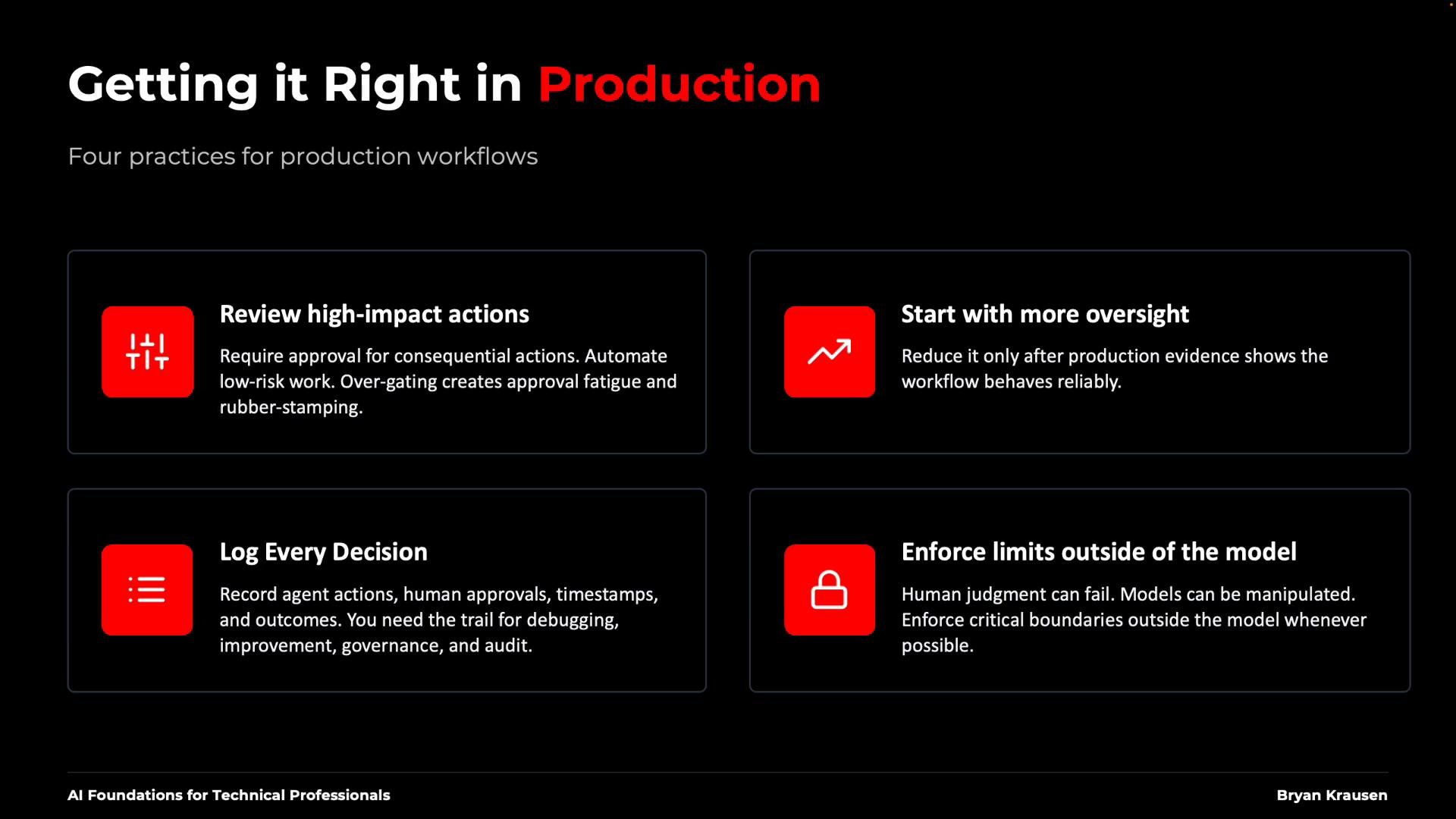
When deploying agentic workflows in production, follow these recommended practices:
* Focus human review on high-impact actions. Preserve automation for low-risk tasks so agents remain valuable.
* Start with conservative oversight for new workflows. Use production telemetry to measure reliability, then reduce supervision where safe.
* Log every decision: what the agent attempted, what was approved/rejected, timestamps, and final outcomes. These logs are critical for debugging, governance, and audits.
* Enforce critical limits outside the model: permissions, allowlists, spending caps, and infrastructure policy so the system doesn’t rely only on human reviewers or prompt constraints.
Production practices
When deploying agentic workflows in production, follow these recommended practices:
* Focus human review on high-impact actions. Preserve automation for low-risk tasks so agents remain valuable.
* Start with conservative oversight for new workflows. Use production telemetry to measure reliability, then reduce supervision where safe.
* Log every decision: what the agent attempted, what was approved/rejected, timestamps, and final outcomes. These logs are critical for debugging, governance, and audits.
* Enforce critical limits outside the model: permissions, allowlists, spending caps, and infrastructure policy so the system doesn’t rely only on human reviewers or prompt constraints.
 Summary
* Approvals: use when an explicit human decision is required before executing a consequential action.
* Checkpoints: use when staged review of intermediate results reduces the risk of cascading errors.
* Guardrails: implement as technical, system-level limits that the agent cannot bypass.
The objective is to automate what can be safely automated, while preserving human judgment and enforcing system-level constraints where consequences require it.
Design for risk: apply approvals and checkpoints for actions with higher impact or low reversibility, and always implement system-level guardrails and comprehensive logging to maintain safe, auditable workflows.
Links and references
* [NIST AI Risk Management Framework](https://www.nist.gov/itl/ai-risk-management)
* [Responsible AI principles and governance patterns](https://www.oecd.org/going-digital/ai/)
* Guidance on designing human-in-the-loop systems: academic and industry literature on HITL best practices and auditability
This documentation is built and hosted on [Mintlify](https://mintlify.com), a developer documentation platform.
Summary
* Approvals: use when an explicit human decision is required before executing a consequential action.
* Checkpoints: use when staged review of intermediate results reduces the risk of cascading errors.
* Guardrails: implement as technical, system-level limits that the agent cannot bypass.
The objective is to automate what can be safely automated, while preserving human judgment and enforcing system-level constraints where consequences require it.
Design for risk: apply approvals and checkpoints for actions with higher impact or low reversibility, and always implement system-level guardrails and comprehensive logging to maintain safe, auditable workflows.
Links and references
* [NIST AI Risk Management Framework](https://www.nist.gov/itl/ai-risk-management)
* [Responsible AI principles and governance patterns](https://www.oecd.org/going-digital/ai/)
* Guidance on designing human-in-the-loop systems: academic and industry literature on HITL best practices and auditability
This documentation is built and hosted on [Mintlify](https://mintlify.com), a developer documentation platform.