> ## Documentation Index
> Fetch the complete documentation index at: https://notes.kodekloud.com/llms.txt
> Use this file to discover all available pages before exploring further.
# The Agent Loop What Makes an Agent an Agent
> Explains the agent loop where models output textual decisions, tooling executes actions, observations feed back, and the cycle repeats to complete multi-step goals with safety and orchestration guidance.
Lately you’ve probably heard the word “agent” attached to many AI products and features. People often assume an agent is a different or inherently smarter model. It isn’t. An agent is defined by the workflow around a model — the repeated cycle that turns textual model outputs into external actions and then feeds back observations.
This article focuses on that workflow: how goals, model outputs, external actions, and observations form an iterative loop that enables multi-step tasks (also called the agent loop).
## Single-pass vs. multi-step tasks
The simple flow most people are familiar with is a single prompt → single response:
* Prompt: “What’s a good flight to New York City?”
* Model: returns a single answer.
That works for one-off questions. It breaks down when a task requires multiple steps, external systems, or conditional decision-making, for example:
* “Find me a flight to New York City for under \$300 and book it.”
This is not a single question; it’s a multi-step objective that requires planning, external API calls, checks, and follow-up decisions. That’s where the agent pattern applies.
## Core idea: start with a goal
An agent workflow starts with a goal (e.g., “flight \< \$300 and booked”). There is no single-model response that accomplishes this goal automatically. Instead the system must plan and coordinate actions over time.
High-level agent cycle:
* Decide (model produces a textual instruction about the next action).
* Act (a tooling/executor layer performs the action).
* Observe (results are returned to the model).
* Repeat (model uses the observation and goal to decide the next step).
This repeatable Decide → Act → Observe loop is what makes a system an agent.
## How the loop works in practice
1. Decide
* The model generates a textual instruction (for example, “Search flights for 2026-12-15 to 2026-12-20, return lowest fares”).
* Remember: pretrained LLMs are token-prediction engines — they output text. They do not by themselves perform network requests or invoke APIs.
2. Act (tooling/executor)
* A separate software component parses the model’s decision and executes it: API calls, web searches, database queries, booking APIs, etc.
* This component bridges the model’s text and the real-world operation.
3. Observe
* The executor returns structured results (observations) to the system (e.g., “cheapest flight found: \$340”).
* The model receives the observation and the original goal, then decides the next action (try different dates, another airline, or conclude).
4. Repeat
* This cycle continues until the model determines the goal is met or a stopping condition is reached.
Example pseudocode of a minimal agent loop:
```python theme={null}
goal = "book flight under $300"
state = {}
while True:
decision = model.plan(goal, state) # returns structured text describing next action
if decision.get("type") == "done":
break
result = executor.execute(decision) # perform API calls, searches, etc.
state.update(result) # observations fed back to the model
```
## Common decision patterns from models
Models often emit outputs in a structured form to make parsing reliable. Example formats include short natural-language steps, JSON objects describing an action, or pseudo-API calls. System designers should constrain and validate these outputs before executing them.
## Termination and stopping conditions
* The model will typically output an instruction that indicates completion (e.g., “Done: booked flight under $300” or “Done: unable to find a flight under $300”).
* Stopping conditions are often determined by the model’s judgment rather than an externally hard-coded counter like “stop after 3 tries.” This grants flexibility, but systems should still enforce external limits:
* maximum iterations
* timeouts
* rate limits
* safety filters
## Agent components at a glance
| Component | Responsibility | Example |
| - | - | - |
| Goal | Defines the objective for the loop | `book flight < $300` |
| Model (Decider) | Produces textual decisions/plans | “Search flights for dates X–Y; return lowest fare” |
| Tooling / Executor | Translates decisions into real-world actions | call flight API, perform payment |
| Observation | Results returned from actions | `{"cheapest": 340, "itinerary": {...}}` |
| Controller | Orchestrates loop, enforces limits and safety | timeouts, max iterations, human approvals |
## Why this distinction matters
* An agent is not a distinct model type — it’s a pattern: model decisions + external tool executions + returned observations in a loop.
* Any LLM can be part of an agent if it participates in this Decide → Act → Observe cycle.
* Because models can suggest actions with real-world effects, you must design safety controls:
* validate model outputs before execution
* sandbox or simulate risky actions
* require human approval for critical operations
* log actions and decisions for auditing
## Practical guidance for building safe agent executors
* Validate and sanitize every decision output before mapping to an API call.
* Limit the scope of actions the executor can perform.
* Implement role-based permissions and explicit human-in-the-loop checkpoints for sensitive tasks (payments, sensitive data access).
* Use timeouts and iteration caps to prevent runaway loops.
If you strip everything else away, the core idea is simple:
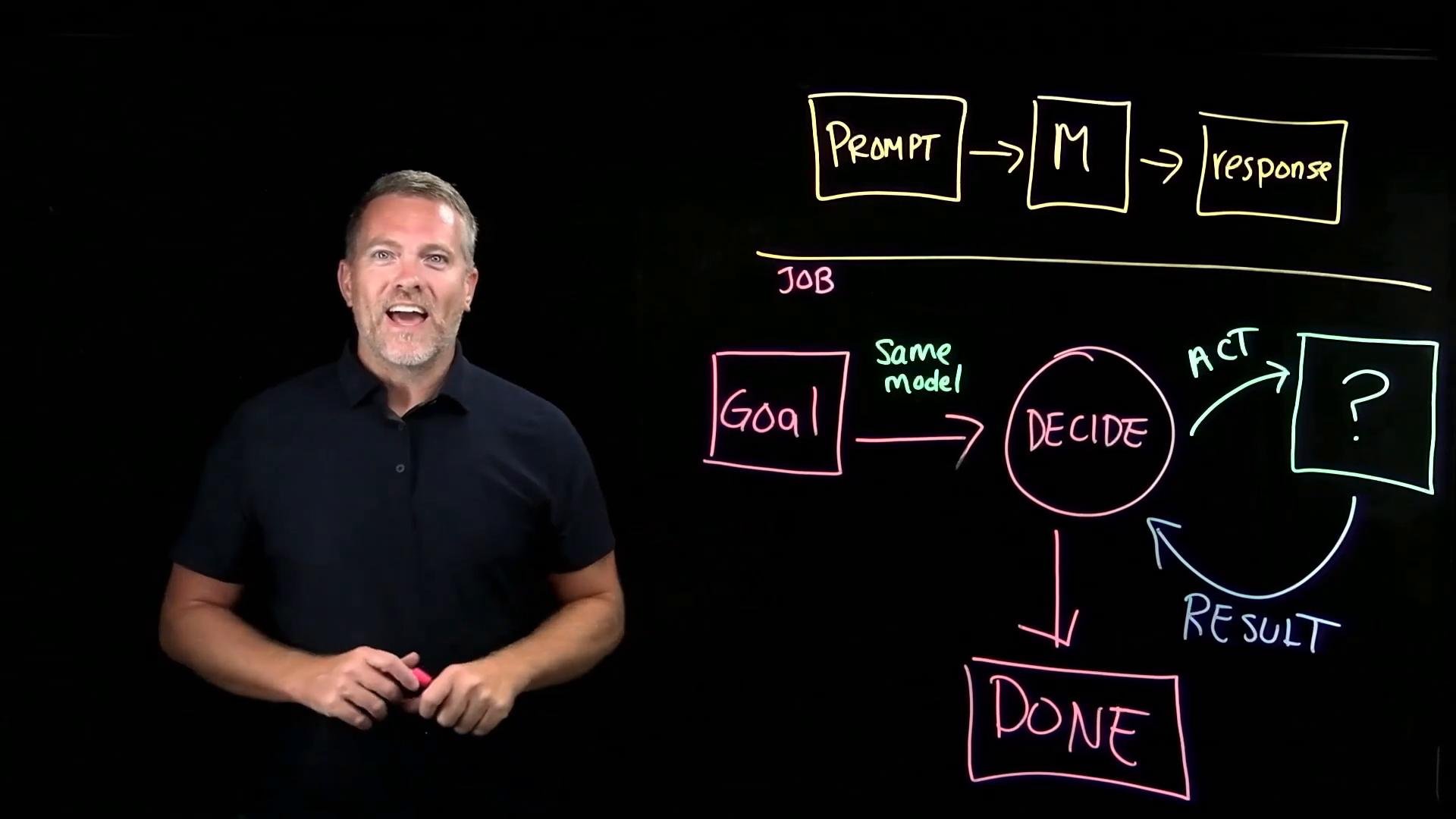 This one: the model answers. The loop finishes our job.
We will dive into how the model’s textual decisions are translated into real actions — the tooling/executor layer — and how to design it safely and correctly.
An agent is the repeated cycle of `decide` → `act` → `observe`. The model supplies decisions (text); a tooling layer executes those decisions and returns observations. The interaction of these components, not a special model, is what creates an agent.
Because the model’s decisions can trigger real-world effects, always design agent executors with safety constraints and consider a human-in-the-loop for critical actions.
## Links and references
* [ReAct: Synergizing Reasoning and Acting in Language Models](https://arxiv.org/abs/2210.03629)
* LangChain — tools and orchestration patterns for LLM agents: [https://langchain.com/](https://langchain.com/)
* Best practices for safe API design and auditing — apply standard security hygiene to agent executors.
This documentation is built and hosted on [Mintlify](https://mintlify.com), a developer documentation platform.
This one: the model answers. The loop finishes our job.
We will dive into how the model’s textual decisions are translated into real actions — the tooling/executor layer — and how to design it safely and correctly.
An agent is the repeated cycle of `decide` → `act` → `observe`. The model supplies decisions (text); a tooling layer executes those decisions and returns observations. The interaction of these components, not a special model, is what creates an agent.
Because the model’s decisions can trigger real-world effects, always design agent executors with safety constraints and consider a human-in-the-loop for critical actions.
## Links and references
* [ReAct: Synergizing Reasoning and Acting in Language Models](https://arxiv.org/abs/2210.03629)
* LangChain — tools and orchestration patterns for LLM agents: [https://langchain.com/](https://langchain.com/)
* Best practices for safe API design and auditing — apply standard security hygiene to agent executors.
This documentation is built and hosted on [Mintlify](https://mintlify.com), a developer documentation platform.