> ## Documentation Index
> Fetch the complete documentation index at: https://notes.kodekloud.com/llms.txt
> Use this file to discover all available pages before exploring further.
# Hosted APIs vs Running Your Own The Real Tradeoffs
> Compares trade-offs between using hosted AI APIs and self-hosting models, covering cost, data control, operational burden, latency, customization, and hybrid routing guidance.
If your team is using AI today, you’re most likely calling a hosted API: send a request, a vendor runs the model, and you get the response. That’s the default path for many organizations.
Eventually someone will ask, “Should we run our own model instead?” This article lays out the real trade-offs between hosted APIs and self-hosting, and gives practical guidance for choosing the right approach for each workload.
The same model can be delivered in two primary ways. On the left is the hosted API model: you call a vendor endpoint, pay per token or request, and the vendor operates the GPUs and servers. The downside is that requests and data leave your network. On the right is self-hosting: you run the model weights on your own GPUs inside your network or data center, so data stays under your control.
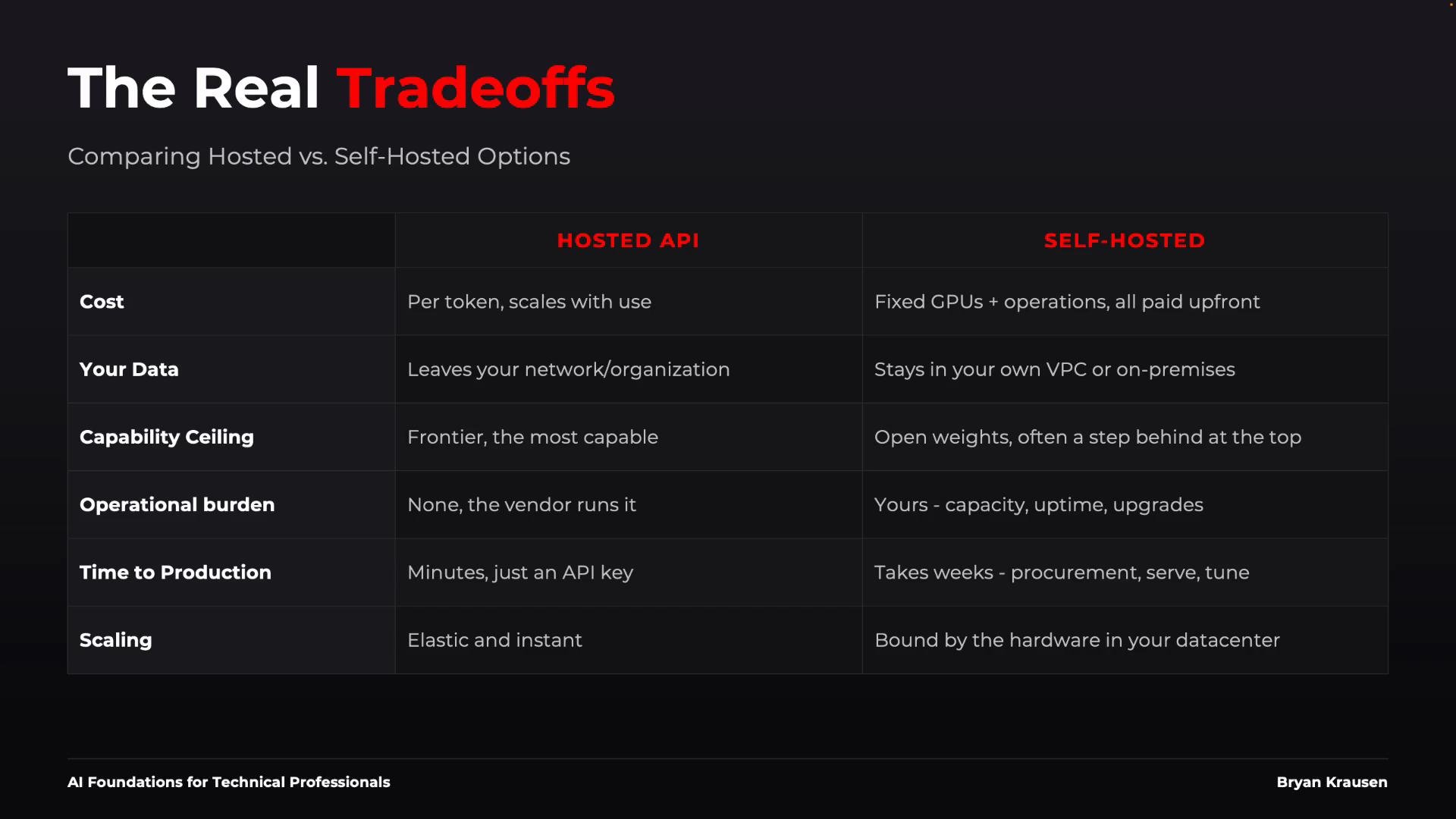 This slide highlights the evaluation dimensions you’ll use when choosing between hosted and self-hosted models: cost, data residency, capability ceiling, operational burden, time to production, and scaling. Key context:
* Cost: Hosted APIs are pay-as-you-go with little upfront cost. Self-hosting requires capital expenditure (GPUs, servers, networking) and personnel.
* Data residency: Hosted APIs typically send data outside your environment; self-hosting keeps data inside your network or data center.
* Operations & scaling: Vendors handle operations for hosted APIs. Self-hosting makes your team responsible for scaling, monitoring, patching, and reliability engineering.
* Time to production: Hosted APIs can be integrated in minutes; building a dependable self-hosted stack can take weeks or months.
All of these are trade-offs — similar to the decision between co-locating hardware and renting cloud infrastructure.
Cost is often misunderstood; visualize two cost curves: a hosted API with linear per-request costs, and a self-hosted curve with high upfront cost that amortizes over large, steady usage.
* Hosted: low initial cost, linear growth with usage (pay-per-request/token).
* Self-hosted: high up-front capital and operational overhead, then lower marginal cost as utilization increases.
* Break-even point: where the lines cross. Below it, renting is usually cheaper. Above it (and with high, consistent utilization), owning can be cheaper — but only if GPUs are kept busy and operational costs are contained.
Decision factors therefore include usage patterns, data sensitivity, control, and your willingness to accept operational responsibility.
Comparison at a glance
| Dimension | Hosted API | Self-hosted |
| - | - | - |
| Cost profile | Low upfront, pay-per-use | High upfront (hardware + ops), lower marginal cost at scale |
| Data residency | Data leaves your network | Data stays inside your environment |
| Capability ceiling | Access to latest frontier models | Limited to models you run; possible to fine-tune or modify |
| Operational burden | Vendor-managed | Your team manages infra, scaling, monitoring |
| Time to production | Minutes to hours | Weeks to months for reliable production |
| Best fit | Spiky, unpredictable, or low-volume workloads | High, steady throughput; strict compliance/latency needs |
When to reach for a hosted API
This slide highlights the evaluation dimensions you’ll use when choosing between hosted and self-hosted models: cost, data residency, capability ceiling, operational burden, time to production, and scaling. Key context:
* Cost: Hosted APIs are pay-as-you-go with little upfront cost. Self-hosting requires capital expenditure (GPUs, servers, networking) and personnel.
* Data residency: Hosted APIs typically send data outside your environment; self-hosting keeps data inside your network or data center.
* Operations & scaling: Vendors handle operations for hosted APIs. Self-hosting makes your team responsible for scaling, monitoring, patching, and reliability engineering.
* Time to production: Hosted APIs can be integrated in minutes; building a dependable self-hosted stack can take weeks or months.
All of these are trade-offs — similar to the decision between co-locating hardware and renting cloud infrastructure.
Cost is often misunderstood; visualize two cost curves: a hosted API with linear per-request costs, and a self-hosted curve with high upfront cost that amortizes over large, steady usage.
* Hosted: low initial cost, linear growth with usage (pay-per-request/token).
* Self-hosted: high up-front capital and operational overhead, then lower marginal cost as utilization increases.
* Break-even point: where the lines cross. Below it, renting is usually cheaper. Above it (and with high, consistent utilization), owning can be cheaper — but only if GPUs are kept busy and operational costs are contained.
Decision factors therefore include usage patterns, data sensitivity, control, and your willingness to accept operational responsibility.
Comparison at a glance
| Dimension | Hosted API | Self-hosted |
| - | - | - |
| Cost profile | Low upfront, pay-per-use | High upfront (hardware + ops), lower marginal cost at scale |
| Data residency | Data leaves your network | Data stays inside your environment |
| Capability ceiling | Access to latest frontier models | Limited to models you run; possible to fine-tune or modify |
| Operational burden | Vendor-managed | Your team manages infra, scaling, monitoring |
| Time to production | Minutes to hours | Weeks to months for reliable production |
| Best fit | Spiky, unpredictable, or low-volume workloads | High, steady throughput; strict compliance/latency needs |
When to reach for a hosted API
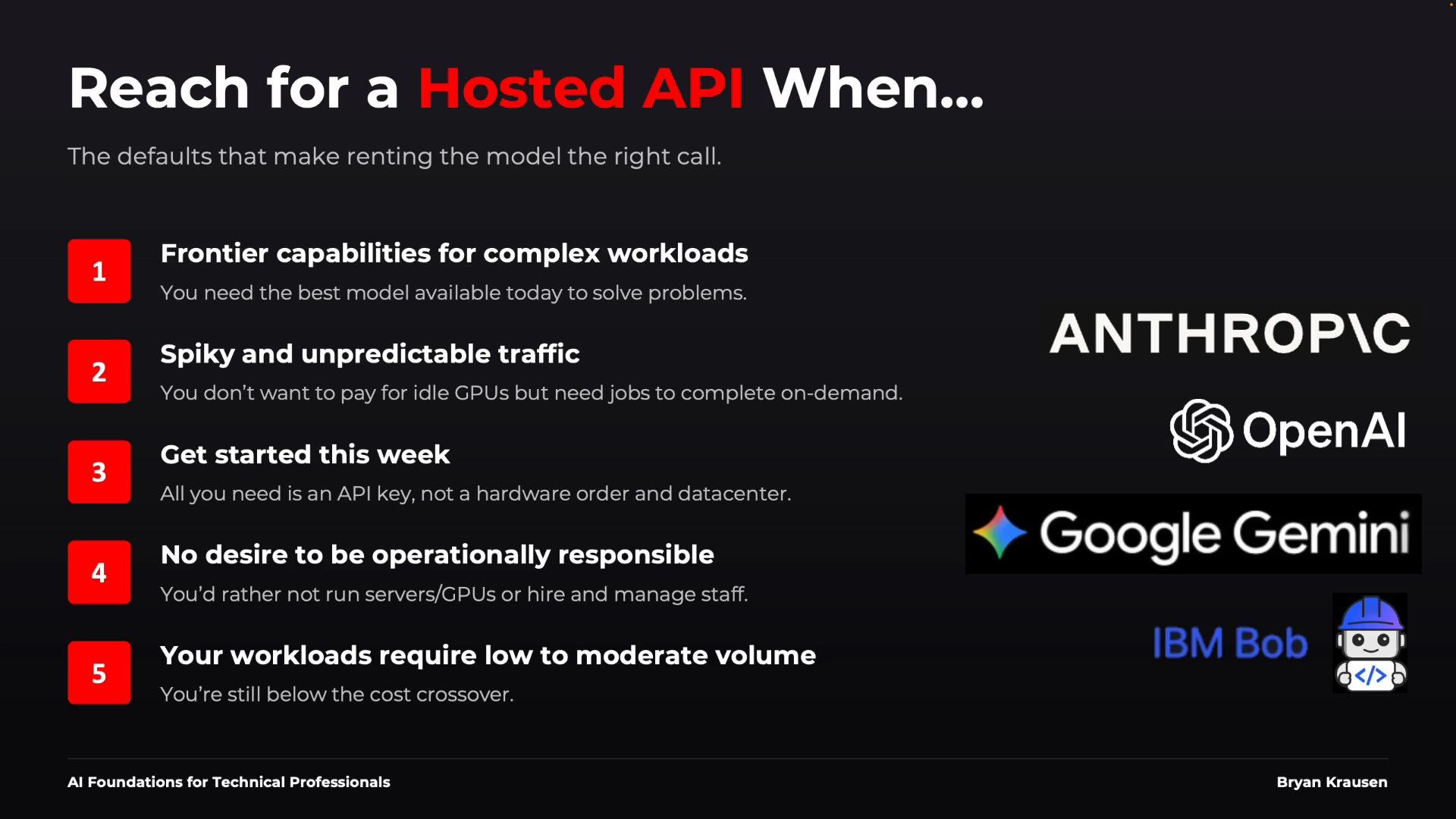 Choose a hosted API when you prioritize speed, flexibility, and minimizing ops work:
1. Frontier capabilities — you need the most advanced, frequently-updated models.
2. Spiky or unpredictable traffic — pay-as-you-go avoids paying for idle GPUs.
3. Fast time-to-market — integrate with an API key and ship quickly.
4. No operational responsibility — vendor handles scaling, monitoring, and patches.
5. Low-to-moderate or unpredictable overall volume — usually cheaper than owning.
When to run your own (self-host)
Choose a hosted API when you prioritize speed, flexibility, and minimizing ops work:
1. Frontier capabilities — you need the most advanced, frequently-updated models.
2. Spiky or unpredictable traffic — pay-as-you-go avoids paying for idle GPUs.
3. Fast time-to-market — integrate with an API key and ship quickly.
4. No operational responsibility — vendor handles scaling, monitoring, and patches.
5. Low-to-moderate or unpredictable overall volume — usually cheaper than owning.
When to run your own (self-host)
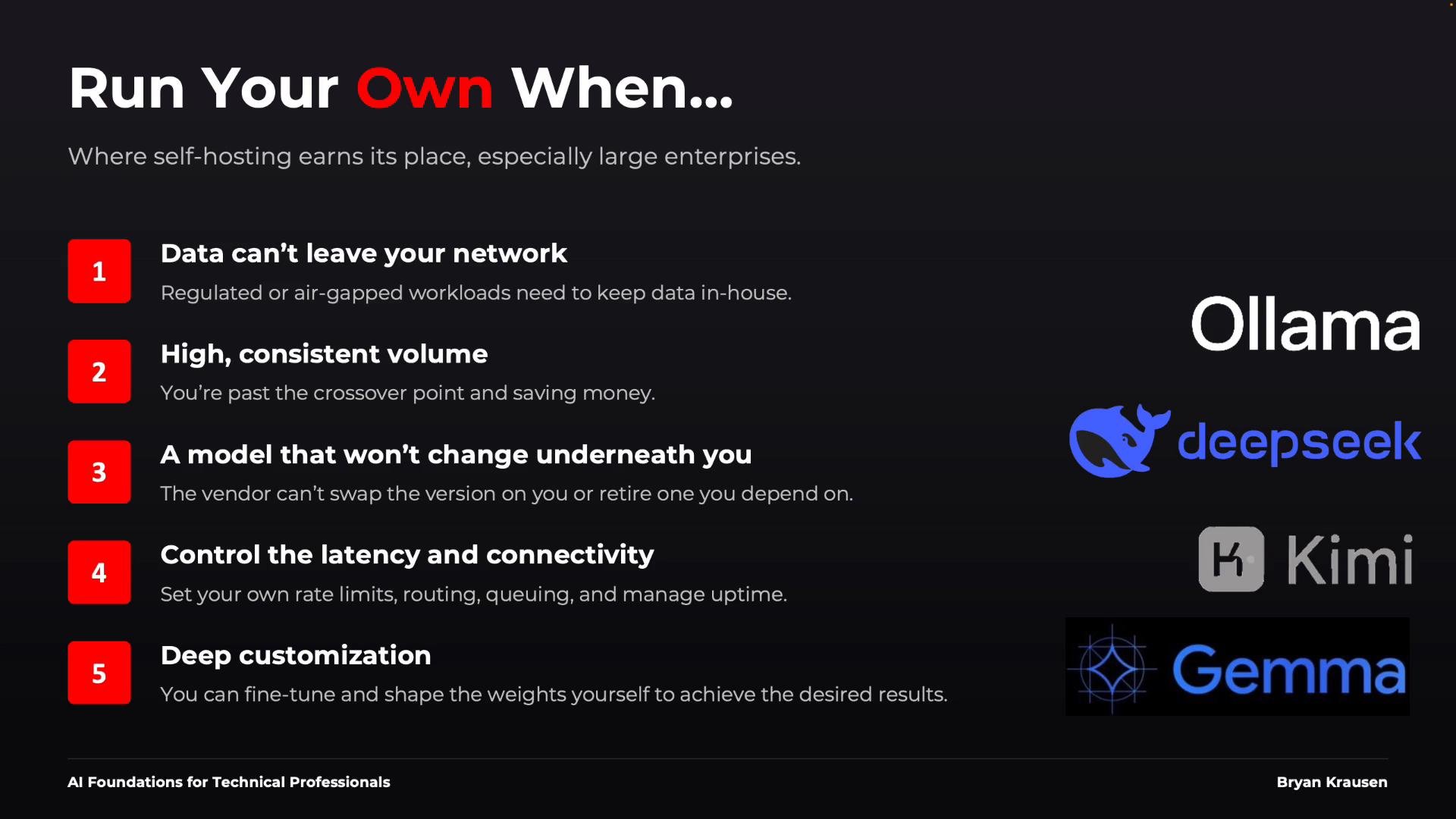 Self-host when control, compliance, and predictable volume matter:
1. Data cannot leave your network — regulatory, privacy, or air-gapped environments.
2. High, steady volume that exceeds the break-even point.
3. Model stability — you need the model behavior to remain unchanged over time.
4. Strict latency requirements — colocated inference reduces round-trip time.
5. Deep customization — fine-tuning or directly modifying model weights to meet application-specific needs.
These criteria are often driven by enterprise compliance and performance requirements rather than cost alone.
Hidden costs and operational realities of self-hosting
* GPU scarcity and acquisition: High demand can make procurement expensive and slow.
* Staffing and expertise: MLOps, infra engineers, and reliability specialists are required.
* Infrastructure complexity: Batching, autoscaling, observability, and fault-tolerance add engineering overhead.
* Idle capacity risk: Unused GPUs still incur power, cooling, and depreciation costs.
* Keeping pace with innovation: Frontier models advance quickly; your self-hosted model can lag without active upgrade planning.
Hybrid approach — combine the best of both worlds
Many organizations adopt a hybrid architecture that routes requests to the most appropriate backend based on policy:
* Route sensitive or high-volume requests to your self-hosted stack.
* Forward rare, capability-hungry, or exploratory requests to hosted vendor APIs (for frontier models).
* Make routing decisions per request so a single application can transparently use both.
Example pseudocode for a simple routing gateway:
```js theme={null}
// Basic routing decision example (pseudocode)
function routeRequest(request) {
if (request.isSensitive || request.volumeEstimate > HIGH_VOLUME_THRESHOLD) {
return callSelfHosted(request);
}
if (request.requiresFrontierCapability) {
return callHostedAPI(request);
}
// Default: try self-hosted first, fallback to hosted API
return trySelfHostedThenFallback(request);
}
```
Choose the deployment approach that matches each workload: use hosted APIs for speed, flexibility, and low operational overhead; self-host for control, compliance, and predictable high volume. Hybrid routing lets you combine both where appropriate.
Summary — key takeaways
* Hosted APIs: fastest route to the best public models, minimal upfront cost, vendor-managed operations, data typically leaves your network.
* Self-hosted: full control of data and stack, potentially lower unit cost at high scale, requires capital investment, talent, and ongoing operations.
* Many organizations run a mix and route workloads per request; re-evaluate as volumes, regulatory needs, and model capabilities evolve.
Further reading and references
* [Kubernetes Basics](https://kubernetes.io/docs/concepts/overview/what-is-kubernetes/)
* [MLOps best practices overview](https://ml-ops.org/)
* [Practical GPU procurement and cost strategies](https://www.nvidia.com/)
In the next article we’ll move from theory to practice: take a model and run it end-to-end on a local machine.
This documentation is built and hosted on [Mintlify](https://mintlify.com), a developer documentation platform.
Self-host when control, compliance, and predictable volume matter:
1. Data cannot leave your network — regulatory, privacy, or air-gapped environments.
2. High, steady volume that exceeds the break-even point.
3. Model stability — you need the model behavior to remain unchanged over time.
4. Strict latency requirements — colocated inference reduces round-trip time.
5. Deep customization — fine-tuning or directly modifying model weights to meet application-specific needs.
These criteria are often driven by enterprise compliance and performance requirements rather than cost alone.
Hidden costs and operational realities of self-hosting
* GPU scarcity and acquisition: High demand can make procurement expensive and slow.
* Staffing and expertise: MLOps, infra engineers, and reliability specialists are required.
* Infrastructure complexity: Batching, autoscaling, observability, and fault-tolerance add engineering overhead.
* Idle capacity risk: Unused GPUs still incur power, cooling, and depreciation costs.
* Keeping pace with innovation: Frontier models advance quickly; your self-hosted model can lag without active upgrade planning.
Hybrid approach — combine the best of both worlds
Many organizations adopt a hybrid architecture that routes requests to the most appropriate backend based on policy:
* Route sensitive or high-volume requests to your self-hosted stack.
* Forward rare, capability-hungry, or exploratory requests to hosted vendor APIs (for frontier models).
* Make routing decisions per request so a single application can transparently use both.
Example pseudocode for a simple routing gateway:
```js theme={null}
// Basic routing decision example (pseudocode)
function routeRequest(request) {
if (request.isSensitive || request.volumeEstimate > HIGH_VOLUME_THRESHOLD) {
return callSelfHosted(request);
}
if (request.requiresFrontierCapability) {
return callHostedAPI(request);
}
// Default: try self-hosted first, fallback to hosted API
return trySelfHostedThenFallback(request);
}
```
Choose the deployment approach that matches each workload: use hosted APIs for speed, flexibility, and low operational overhead; self-host for control, compliance, and predictable high volume. Hybrid routing lets you combine both where appropriate.
Summary — key takeaways
* Hosted APIs: fastest route to the best public models, minimal upfront cost, vendor-managed operations, data typically leaves your network.
* Self-hosted: full control of data and stack, potentially lower unit cost at high scale, requires capital investment, talent, and ongoing operations.
* Many organizations run a mix and route workloads per request; re-evaluate as volumes, regulatory needs, and model capabilities evolve.
Further reading and references
* [Kubernetes Basics](https://kubernetes.io/docs/concepts/overview/what-is-kubernetes/)
* [MLOps best practices overview](https://ml-ops.org/)
* [Practical GPU procurement and cost strategies](https://www.nvidia.com/)
In the next article we’ll move from theory to practice: take a model and run it end-to-end on a local machine.
This documentation is built and hosted on [Mintlify](https://mintlify.com), a developer documentation platform.