> ## Documentation Index
> Fetch the complete documentation index at: https://notes.kodekloud.com/llms.txt
> Use this file to discover all available pages before exploring further.
# Hallucinations Why Models Make Things Up
> Explains why language models hallucinate, how next-token prediction produces plausible but false details, associated risks, and mitigation methods like retrieval, verification, and human oversight
A short true story to frame this topic:
A lawyer once submitted a federal court brief that cited six earlier cases. The citations looked legitimate — page numbers, quotes, and case numbers — but when the judge checked the sources none of those cases existed. The lawyer had asked an AI chatbot to do his research; the chatbot had invented all six citations.
This illustrates a core fact: the model wasn’t malfunctioning — it was doing exactly what it was designed to do. Understanding the mechanics behind that behavior makes clear why hallucinations never disappear entirely.
## How these models work (high level)
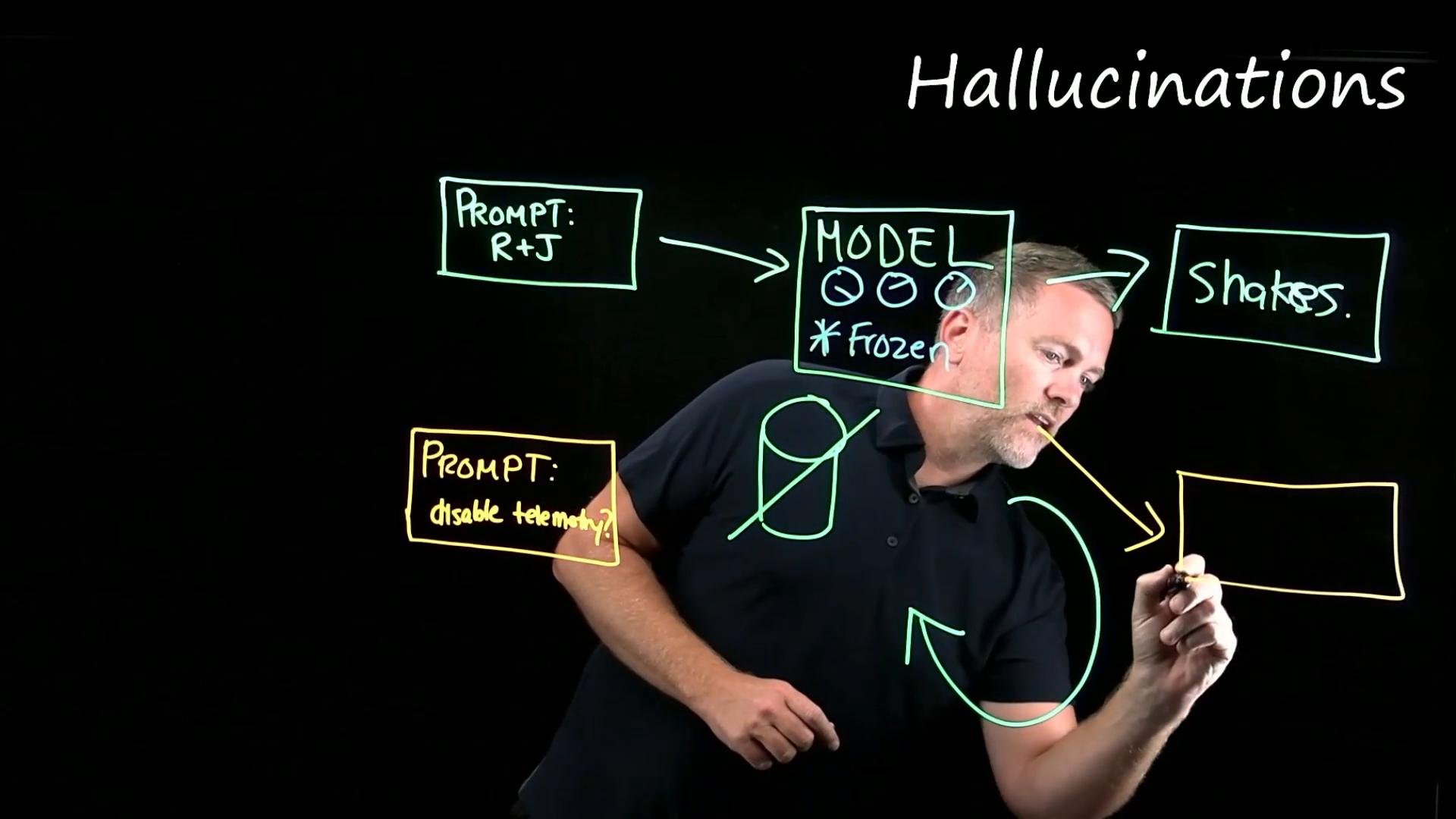
* A pretrained language model is a frozen set of learned parameters (weights) captured when training ended. It does not contain a live database, search index, or an internal table of facts.
* Its fundamental mechanism is next-token prediction: given a prompt, it repeatedly predicts the most likely next token to generate text.
* That prediction loop has no built-in truth-checker or “no results found” gate. The base model generates continuations that look plausible based on patterns seen during training.
* Many deployments add retrieval, tool use, or verification layers which alter behavior, but those are external systems built around the model — not part of the core prediction loop.
Example: a common question vs. a niche question
* Common question:
* Prompt: “Who wrote Romeo and Juliet?”
* This appears frequently across books and guides, so the model reliably outputs: Shakespeare.
* Niche question:
* Prompt: “Is there a flag to disable telemetry in `internal-tool`?”
* Training data likely contains little or nothing about this private tool. The model has seen many examples of command-line flags and will finish the pattern with something plausible (e.g., `--no-telemetry`) — formatted and confident but possibly fabricated.
The same base model and the same next-token loop produce both answers. Nothing in the model explicitly marks one answer as true and another as false — it completes patterns rather than verifies facts.
 Concrete illustration (prompts and outputs)
```text theme={null}
Prompt: "Who wrote Romeo and Juliet?"
Model output: "Shakespeare"
Prompt: "Is there a flag to disable telemetry in `internal-tool`?"
Model output: "--no-telemetry"
```
## Key takeaways about hallucinations
* The model is a plausibility machine: it predicts what comes next based on learned patterns, not by looking up facts.
* Plausible does not equal true — fluent and confident text can still be incorrect.
* Hallucinations are more likely for:
* Niche or internal facts (private tools, internal APIs),
* Specifics such as URLs, citations, quotes, and version numbers,
* Information created after the model’s training cutoff.
* Confidence or fluent tone is not a reliable indicator of correctness.
## Can we eliminate hallucinations?
* You can reduce hallucinations but you cannot remove them completely.
* Newer and better models tend to hallucinate less, but they are still error-prone.
* Adding retrieval, grounding, or verification systems reduces risk: these components supply up-to-date, authoritative evidence that the model can cite.
* There is no single “hallucination module” you can unplug — the same model that handles common facts will invent details on thin topics unless supported by external verification.
## Practical mitigations — checklist and techniques
| Mitigation | When to use | Notes / examples |
| -: | -: | - |
| Retrieval-augmented generation (RAG) | Whenever accuracy matters | Provide the model relevant documents or a searchable index so it can cite sources. See [RAG fundamentals](https://learn.kodekloud.com/user/courses/fundamentals-of-rag). |
| Require sources | High-risk outputs (legal, medical, citations) | Ask for URLs, DOIs, or direct quotes and verify them independently. |
| Tooling & external verification | Dynamic or recent information | Use search, knowledge bases, or APIs to confirm specifics (versions, endpoints). |
| Human review | Any high-impact decision | Treat model output as a draft; validate with experts. |
| Explicit refusal instructions | When model is uncertain | Instruct the model to reply “I don’t know” or decline when evidence is missing. |
Practical tips:
* Validate any high-risk outputs (citations, URLs, legal/medical facts, software flags) with authoritative sources.
* Prefer direct verification for things after the model’s cutoff date.
* Treat model-generated specifics as drafts that require human validation.
Remember: prediction, not lookup. Most of the time plausible outputs are correct — which is why these models are useful — but the rare incorrect outputs are dangerous because they sound convincing. Always verify critical specifics.
## References and further reading
* Fundamentals of RAG — [https://learn.kodekloud.com/user/courses/fundamentals-of-rag](https://learn.kodekloud.com/user/courses/fundamentals-of-rag)
* Hallucination (artificial intelligence) — [https://en.wikipedia.org/wiki/Hallucination\_(artificial\_intelligence)](https://en.wikipedia.org/wiki/Hallucination_\(artificial_intelligence\))
This documentation is built and hosted on [Mintlify](https://mintlify.com), a developer documentation platform.
Concrete illustration (prompts and outputs)
```text theme={null}
Prompt: "Who wrote Romeo and Juliet?"
Model output: "Shakespeare"
Prompt: "Is there a flag to disable telemetry in `internal-tool`?"
Model output: "--no-telemetry"
```
## Key takeaways about hallucinations
* The model is a plausibility machine: it predicts what comes next based on learned patterns, not by looking up facts.
* Plausible does not equal true — fluent and confident text can still be incorrect.
* Hallucinations are more likely for:
* Niche or internal facts (private tools, internal APIs),
* Specifics such as URLs, citations, quotes, and version numbers,
* Information created after the model’s training cutoff.
* Confidence or fluent tone is not a reliable indicator of correctness.
## Can we eliminate hallucinations?
* You can reduce hallucinations but you cannot remove them completely.
* Newer and better models tend to hallucinate less, but they are still error-prone.
* Adding retrieval, grounding, or verification systems reduces risk: these components supply up-to-date, authoritative evidence that the model can cite.
* There is no single “hallucination module” you can unplug — the same model that handles common facts will invent details on thin topics unless supported by external verification.
## Practical mitigations — checklist and techniques
| Mitigation | When to use | Notes / examples |
| -: | -: | - |
| Retrieval-augmented generation (RAG) | Whenever accuracy matters | Provide the model relevant documents or a searchable index so it can cite sources. See [RAG fundamentals](https://learn.kodekloud.com/user/courses/fundamentals-of-rag). |
| Require sources | High-risk outputs (legal, medical, citations) | Ask for URLs, DOIs, or direct quotes and verify them independently. |
| Tooling & external verification | Dynamic or recent information | Use search, knowledge bases, or APIs to confirm specifics (versions, endpoints). |
| Human review | Any high-impact decision | Treat model output as a draft; validate with experts. |
| Explicit refusal instructions | When model is uncertain | Instruct the model to reply “I don’t know” or decline when evidence is missing. |
Practical tips:
* Validate any high-risk outputs (citations, URLs, legal/medical facts, software flags) with authoritative sources.
* Prefer direct verification for things after the model’s cutoff date.
* Treat model-generated specifics as drafts that require human validation.
Remember: prediction, not lookup. Most of the time plausible outputs are correct — which is why these models are useful — but the rare incorrect outputs are dangerous because they sound convincing. Always verify critical specifics.
## References and further reading
* Fundamentals of RAG — [https://learn.kodekloud.com/user/courses/fundamentals-of-rag](https://learn.kodekloud.com/user/courses/fundamentals-of-rag)
* Hallucination (artificial intelligence) — [https://en.wikipedia.org/wiki/Hallucination\_(artificial\_intelligence)](https://en.wikipedia.org/wiki/Hallucination_\(artificial_intelligence\))
This documentation is built and hosted on [Mintlify](https://mintlify.com), a developer documentation platform.