> ## Documentation Index
> Fetch the complete documentation index at: https://notes.kodekloud.com/llms.txt
> Use this file to discover all available pages before exploring further.
# Why Load Balancing Breaks
> Explains why traditional load balancers fail for LLM serving due to KV-cache state and variable request costs, urging cache- and load-aware routing and scheduling
When you serve a real large language model (LLM) across a fleet of GPU-backed machines, the routing layer becomes critical. The instinctive fix—putting a traditional load balancer in front of the fleet and round-robin-ing requests—works for stateless web traffic but breaks LLM serving for two fundamental reasons: stateful caching (the model’s KV cache) and highly variable request cost.
A typical deployment runs many identical servers, each holding a copy of the model and its own GPU. The router’s job is to map each incoming request to one of those servers. For conventional web apps this is fine; for LLMs, it discards important contextual state and fails to account for per-request compute variability.
## 1) Stateful requests and the KV cache
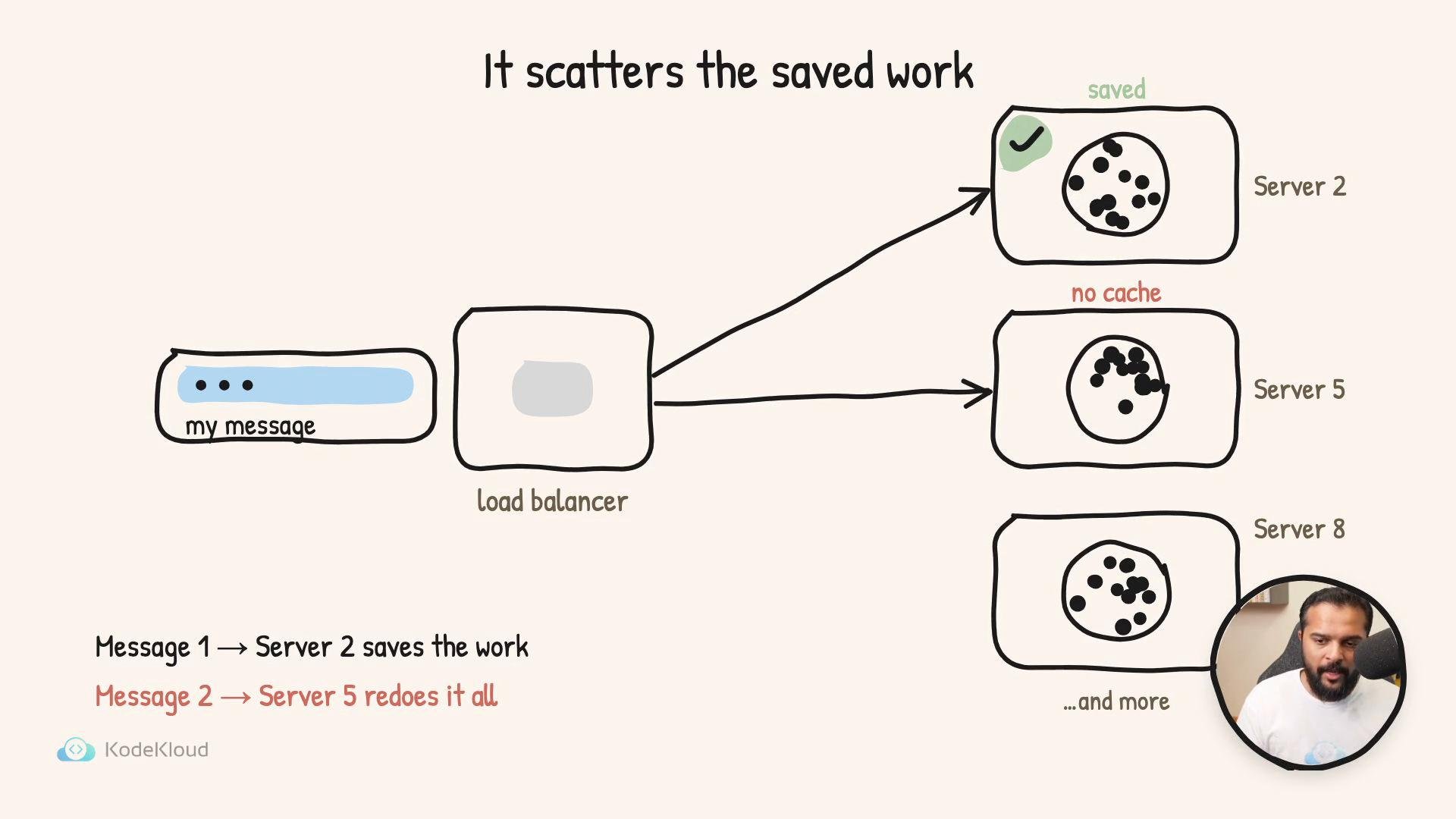
When a conversation is processed, the model computes per-token key/value pairs and stores them in the KV (key-value) cache. This cached state is the saved work that makes generation of subsequent tokens fast. If message A is routed to server-2 and fills server-2’s KV cache, then message B in the same conversation must land on server-2 to reuse that cached work.
If the next message is instead routed to server-5, server-5 has no KV cache for that conversation and must re-run a full prefill over the entire context to rebuild the keys and values. That recomputation wastes GPU cycles, memory, and latency — effectively throwing away perfectly good cached work.
 ## 2) Requests vary enormously in compute cost
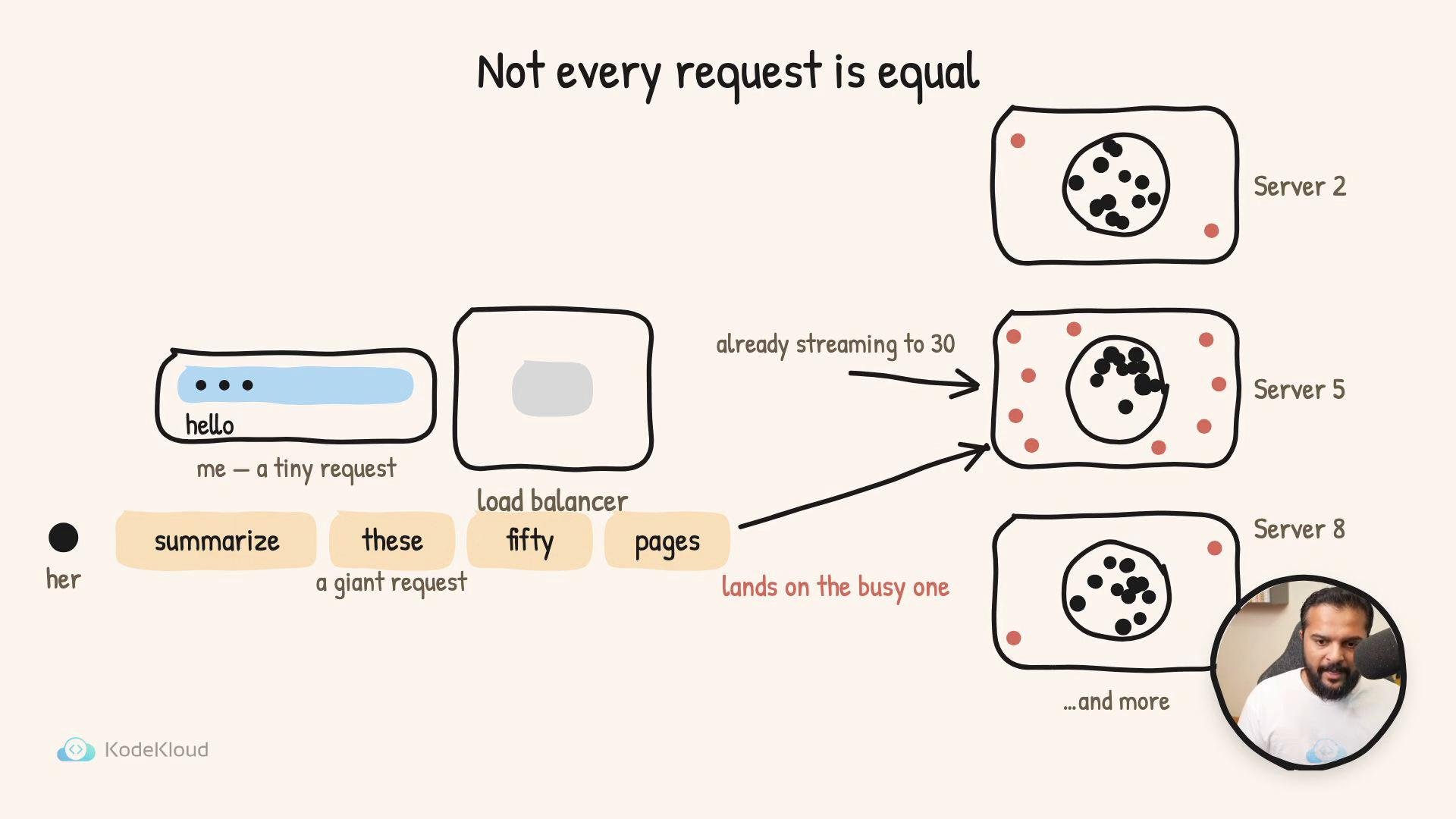
LLM requests are not uniformly expensive: a short prompt like “hello” is cheap, while summarizing 50 pages or generating long streams is extremely heavy. Classic load balancers (L4/L7) typically make decisions based on network metadata and headers; they don’t see per-server KV cache contents, queue lengths, or real-time GPU utilization. They also can’t reliably predict a request’s internal compute cost.
As a result, a balancer may send a very heavy request to a server that is already busy streaming many responses, creating a hotspot. This causes long-tail latencies and head-of-line blocking that a naive balancer cannot avoid.
## 2) Requests vary enormously in compute cost
LLM requests are not uniformly expensive: a short prompt like “hello” is cheap, while summarizing 50 pages or generating long streams is extremely heavy. Classic load balancers (L4/L7) typically make decisions based on network metadata and headers; they don’t see per-server KV cache contents, queue lengths, or real-time GPU utilization. They also can’t reliably predict a request’s internal compute cost.
As a result, a balancer may send a very heavy request to a server that is already busy streaming many responses, creating a hotspot. This causes long-tail latencies and head-of-line blocking that a naive balancer cannot avoid.
 ## Quick comparison
| Concern | Traditional load balancer | Cache- and load-aware router |
| - | -: | - |
| Knows per-conversation KV cache location | No | Yes |
| Observes server GPU utilization and queues | No | Yes |
| Predicts per-request computational cost | No | Yes (via heuristics or profiling) |
| Avoids wasted prefill recomputation | No | Yes (sticky/conversation-aware routing) |
| Mitigates head-of-line blocking from heavy requests | No | Yes (scheduling, admission control) |
Because the balancer cannot see the KV cache, queues, or per-request compute cost, it cannot make the routing decisions needed to preserve cached state or avoid overloaded GPUs. Serving LLMs effectively therefore requires a smarter front layer — one that is both cache-aware and load-aware — rather than treating every server as interchangeable.
Use sticky or cache-aware routing (for example, hashing requests by conversation ID) and a scheduler that factors in GPU utilization and estimated request cost. This reduces wasted prefill work, prevents hotspots, and improves end-to-end latency for LLM serving.
This documentation is built and hosted on [Mintlify](https://mintlify.com), a developer documentation platform.
## Quick comparison
| Concern | Traditional load balancer | Cache- and load-aware router |
| - | -: | - |
| Knows per-conversation KV cache location | No | Yes |
| Observes server GPU utilization and queues | No | Yes |
| Predicts per-request computational cost | No | Yes (via heuristics or profiling) |
| Avoids wasted prefill recomputation | No | Yes (sticky/conversation-aware routing) |
| Mitigates head-of-line blocking from heavy requests | No | Yes (scheduling, admission control) |
Because the balancer cannot see the KV cache, queues, or per-request compute cost, it cannot make the routing decisions needed to preserve cached state or avoid overloaded GPUs. Serving LLMs effectively therefore requires a smarter front layer — one that is both cache-aware and load-aware — rather than treating every server as interchangeable.
Use sticky or cache-aware routing (for example, hashing requests by conversation ID) and a scheduler that factors in GPU utilization and estimated request cost. This reduces wasted prefill work, prevents hotspots, and improves end-to-end latency for LLM serving.
This documentation is built and hosted on [Mintlify](https://mintlify.com), a developer documentation platform.