> ## Documentation Index
> Fetch the complete documentation index at: https://notes.kodekloud.com/llms.txt
> Use this file to discover all available pages before exploring further.
# Training and Fine tuning Process for Foundation Models
> Overview of adapting foundation models through pre-training, fine-tuning, continuous pre-training, PEFT and RLHF plus practical tooling and best practices for data, evaluation, and deployment
In this lesson we deepen the practical understanding of how foundation models are adapted from general-purpose capabilities to task- or domain-specific behavior. You already know the base vocabulary — pre-training and fine-tuning — and here we clarify those processes, introduce continuous pre-training, and summarize production-ready techniques and tools (with AWS examples such as [SageMaker](https://learn.kodekloud.com/user/courses/aws-sagemaker) and [Bedrock](https://learn.kodekloud.com/user/courses/introduction-to-amazon-bedrock)).
This article presents a concise technical overview of customizing foundation models—focusing on practical patterns, trade-offs, and tooling rather than detailed mathematics. Use it as a checklist when designing model adaptation pipelines.
Quick taxonomy
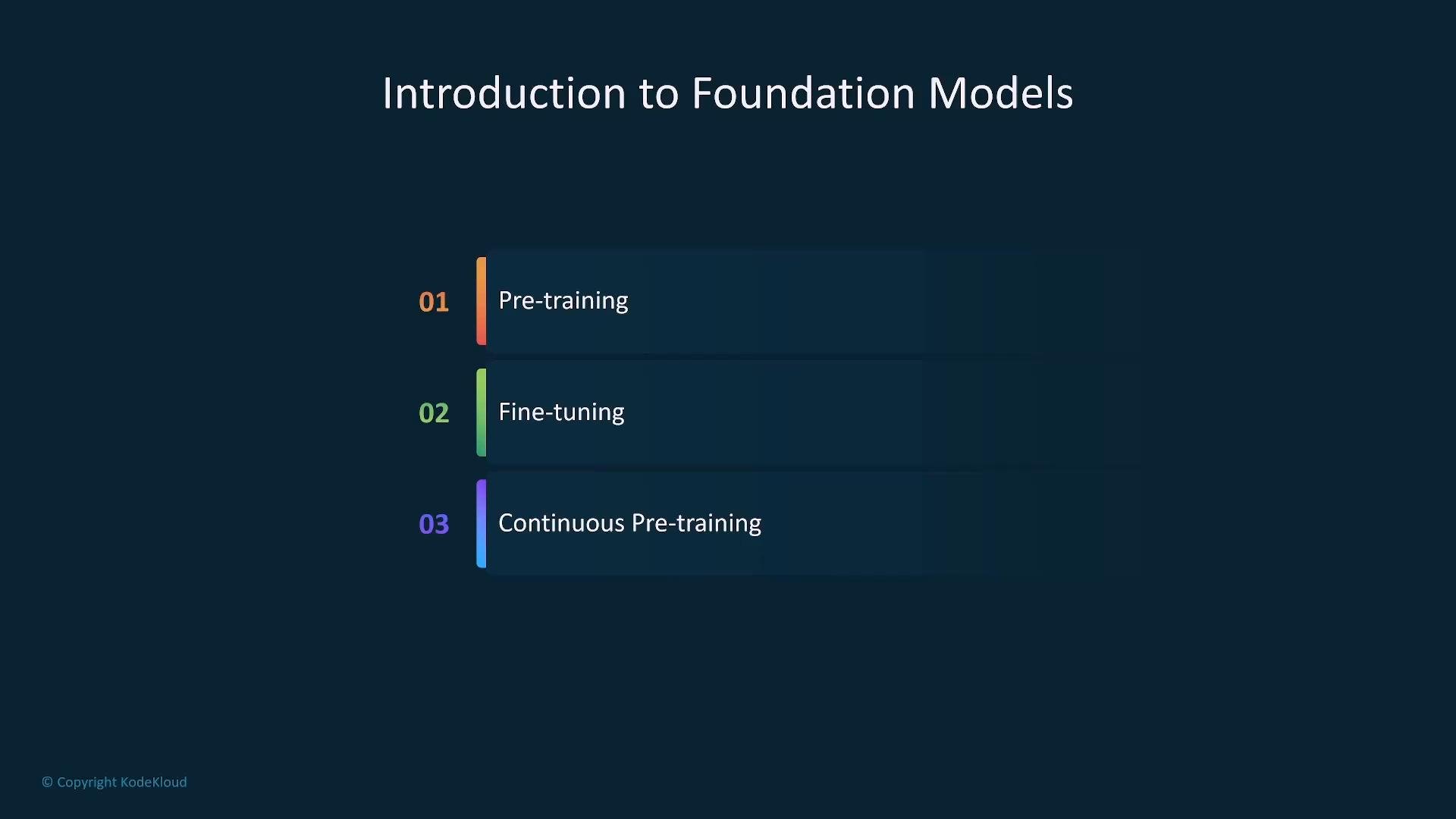
* Pre-training: Train a large model on massive, mostly unstructured data to learn general representations.
* Fine-tuning: Adapt a pre-trained model to a specific task or domain using labeled or instruction-style data.
* Continuous pre-training: Periodically retrain (or adapt) a foundation model on new data to keep it current and reduce model drift.
 What is pre-training?
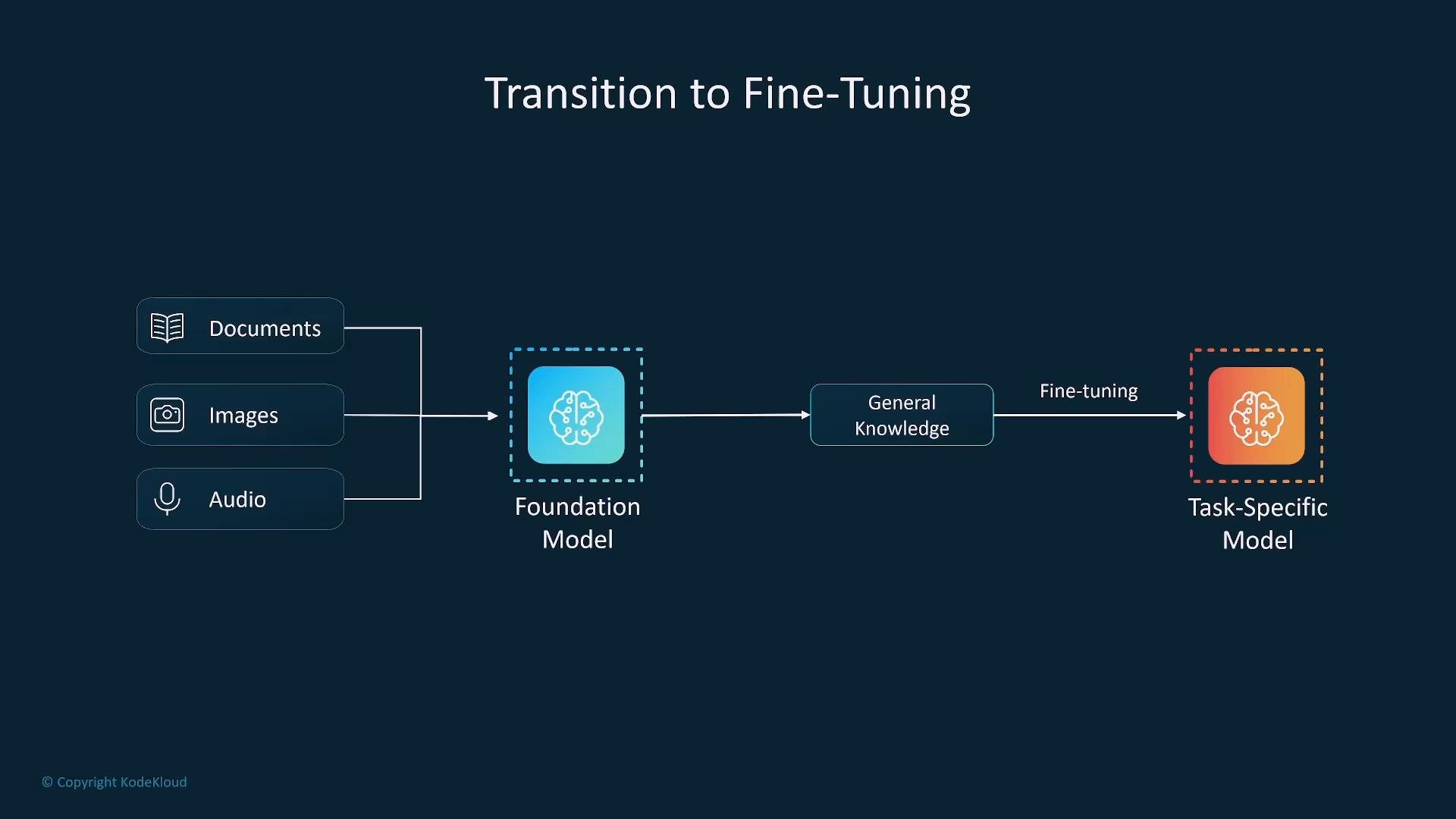
* Pre-training is the compute- and data-intensive phase where the model learns broad, general-purpose knowledge from very large corpora (text, images, audio, etc.).
* Typical self-supervised objectives include next-token prediction and masked-token prediction for language models, contrastive objectives for vision, and multimodal alignment losses for cross-modal models.
* Outcome: rich, transferable representations that serve as the backbone for many downstream tasks. High token counts and long training runs are common.
What is fine-tuning?
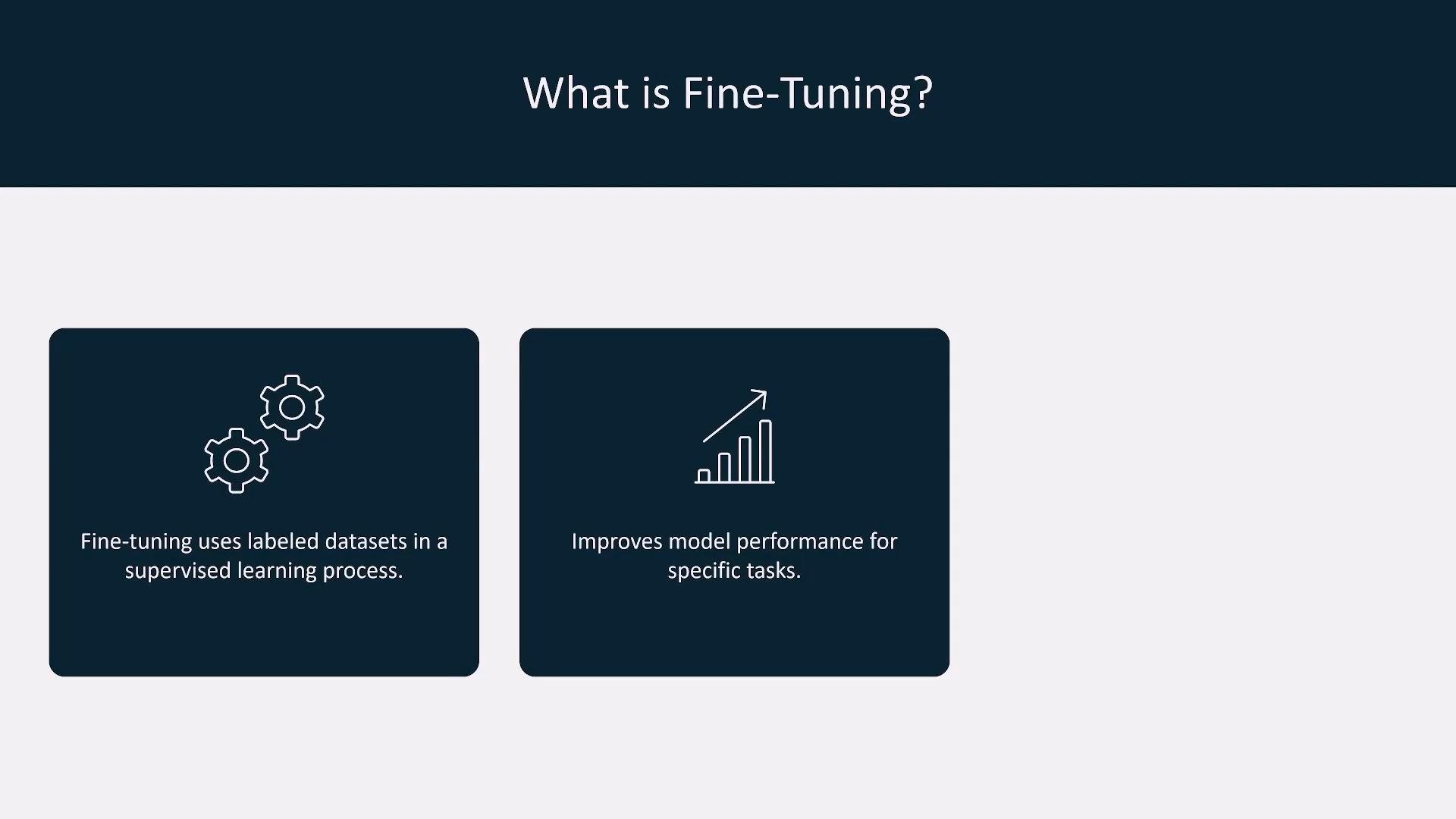
* Fine-tuning adapts a pre-trained model to a narrower task or vertical. It usually uses supervised labeled data, but instruction-based examples and preference data are also common.
* Fine-tuning is substantially cheaper than full pre-training and can yield large performance gains on target tasks when hyperparameters and data are well-chosen.
* Common use cases: classification, summarization, domain-adapted language, code generation, and retrieval-augmented generation.
 Fine-tuning characteristics
* Use-case specificity: Fine-tuning focuses model capacity on a defined task (e.g., translation, summarization, classification), usually via labeled examples.
* Reduced compute: Less expensive than pre-training, but requires careful tuning of learning rate, batch size, scheduling, and early stopping.
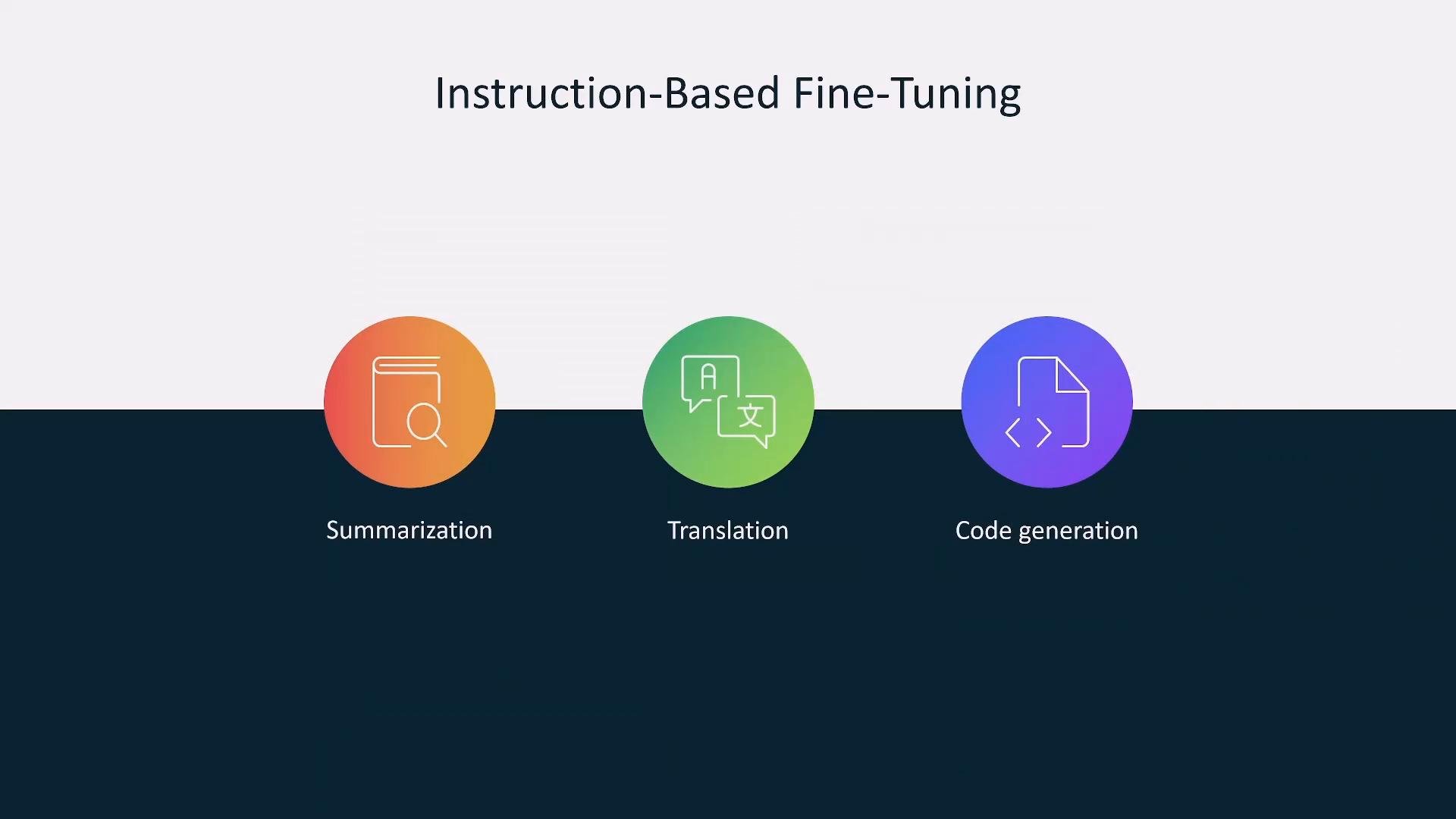
* Instruction-based fine-tuning: Training with instruction–response pairs helps models follow natural-language directives across multiple tasks.
 Pre-training vs. fine-tuning — quick comparison
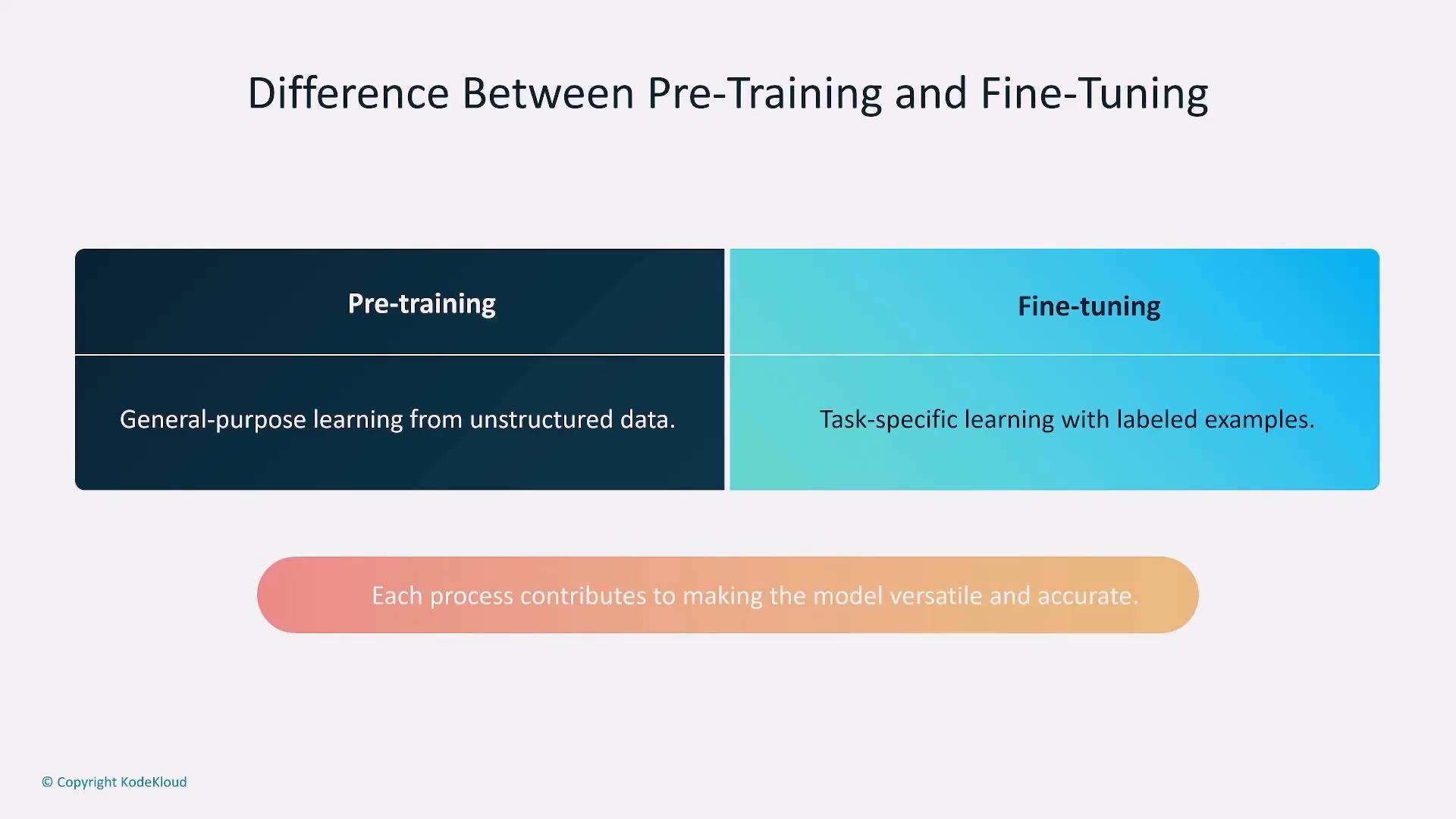
* Pre-training: broad, general-purpose learning from unstructured or weakly labeled data; large compute and long runs.
* Fine-tuning: targeted adaptation using supervised or instruction-style examples; shorter runs and smaller compute footprint.
 Comparison table — when to use each
| Stage | Typical objective | Compute & data | Best for |
| - | - | - | - |
| Pre-training | Learn general representations from massive corpora | Very high compute, huge token counts | Building a new foundation model or large cross-domain capabilities |
| Fine-tuning | Specialize model for a task or domain | Moderate compute, focused dataset | Task-specific performance (classification, summarization, domain language) |
| Continuous pre-training | Keep base model up-to-date on new data | Varies (scheduled retraining) | Data freshness, adapting to evolving domains |
Instruction-based fine-tuning
* Instruction tuning trains the model on many input–output pairs that explicitly include a human-style instruction, improving the model’s ability to follow directives (summarize, translate, generate code, answer questions).
* This method often yields more useful and controllable outputs for end-users than task-only supervised fine-tuning.
 Catastrophic forgetting
* Over-specializing a model to a single task can overwrite the general knowledge learned during pre-training; this is called catastrophic forgetting.
* The trade-off: higher performance on the target task vs. losing broad capabilities that may be needed later.
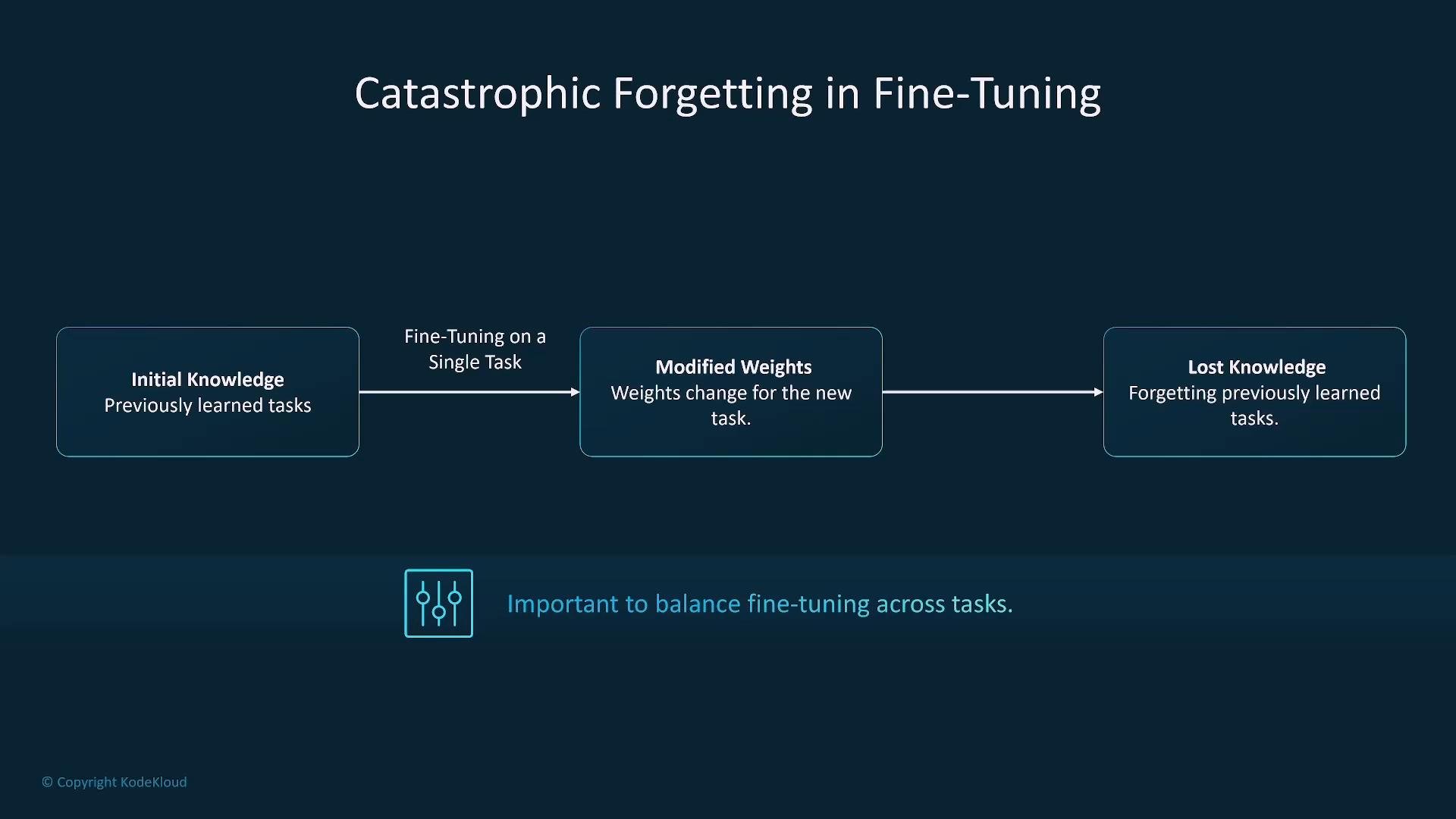 Catastrophic forgetting can degrade multi-task performance if not managed. Mitigation strategies include multi-task training, regularization (e.g., weight decay, elastic weight consolidation), and parameter-efficient fine-tuning so that base weights remain largely intact.
Parameter-Efficient Fine-Tuning (PEFT)
* PEFT updates a small subset of parameters (or adds small trainable modules) instead of re-training all weights, dramatically reducing compute, storage, and deployment costs.
* Popular PEFT families:
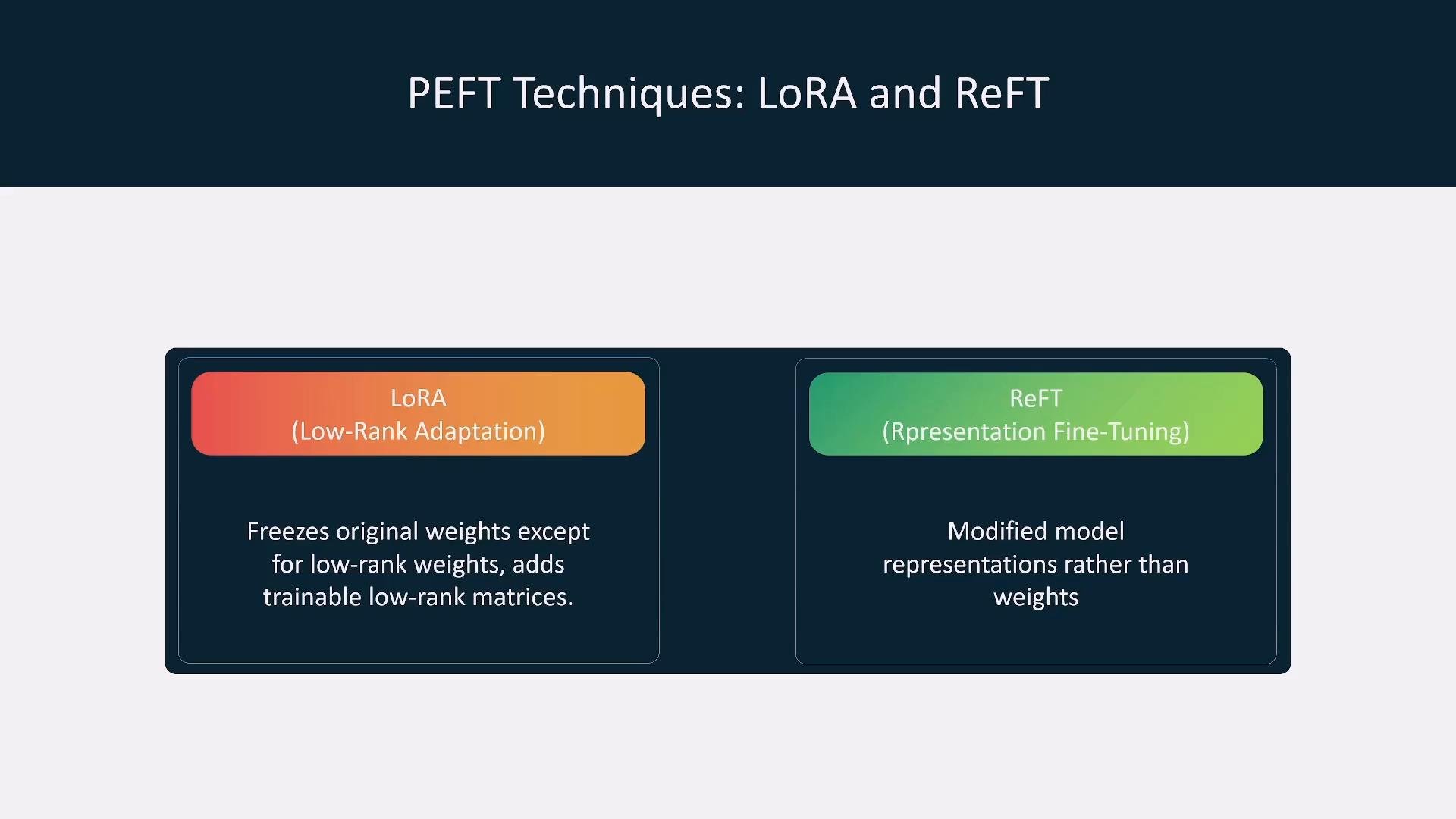
* Low-Rank Adaptation (LoRA): Keep backbone weights frozen and add low-rank trainable matrices (A, B) that inject a low-rank delta into targeted layers—efficient for many downstream tasks.
* Adapters / Prefix Tuning / Prompt Tuning: Insert small trainable modules or learnable prompts into the model architecture or token stream.
* Representation Fine-Tuning (ReFT): Modify internal activations/representational patterns rather than bulk parameter matrices; can help on structured reasoning tasks.
 Notes on LoRA vs ReFT
* LoRA: excellent for low-cost fine-tuning across many tasks with limited compute; adapter weights are small and easy to store/deploy.
* ReFT and adapter-style methods: may produce better results for tasks requiring structured outputs or complex internal transformations; empirical performance depends on the problem and dataset.
Multitask fine-tuning
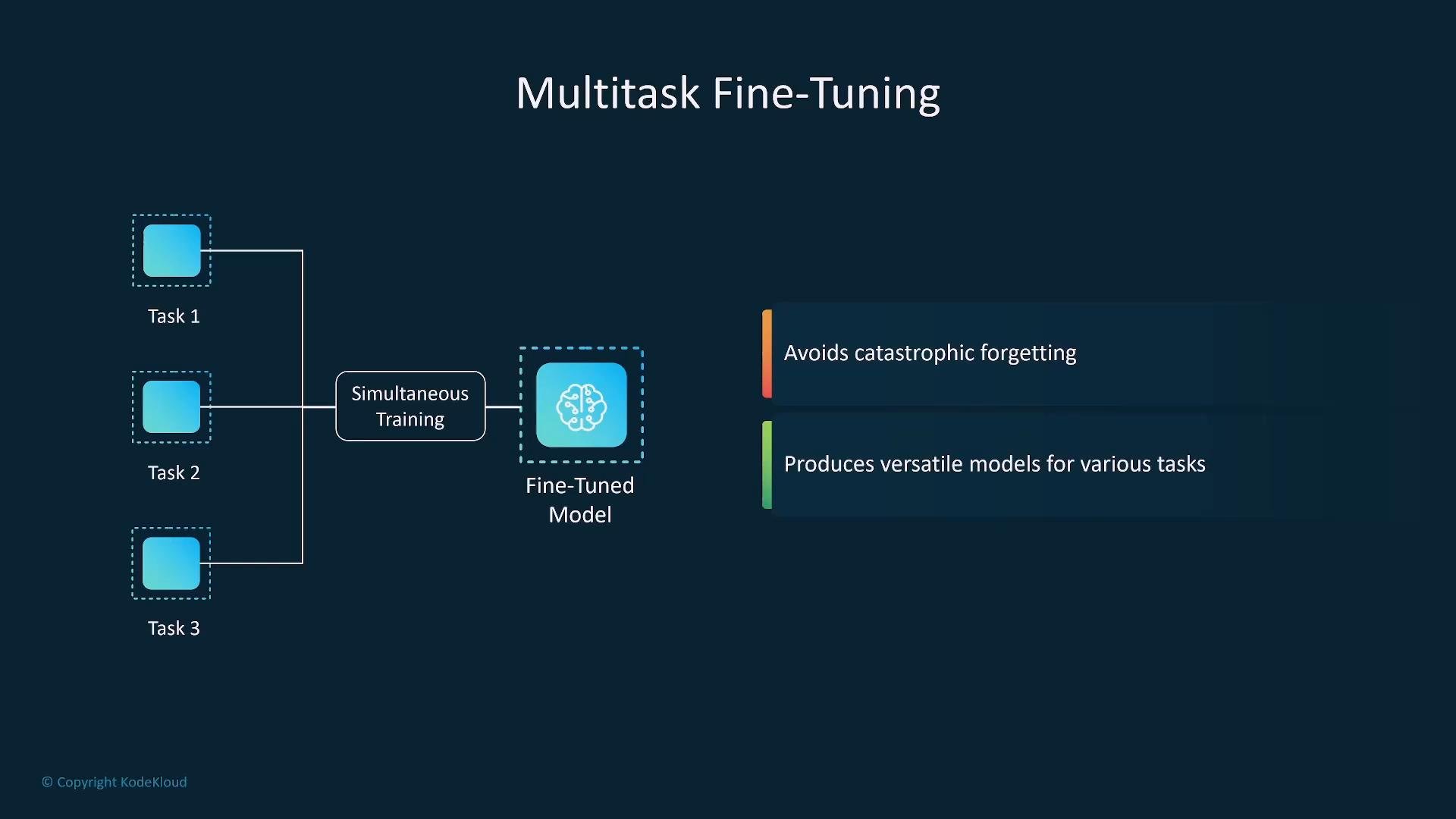
* Train on multiple tasks in parallel (each with labeled examples) to maintain generality and reduce catastrophic forgetting.
* Benefits: shared representations across tasks, better transfer, and a single adaptable model for related subtasks.
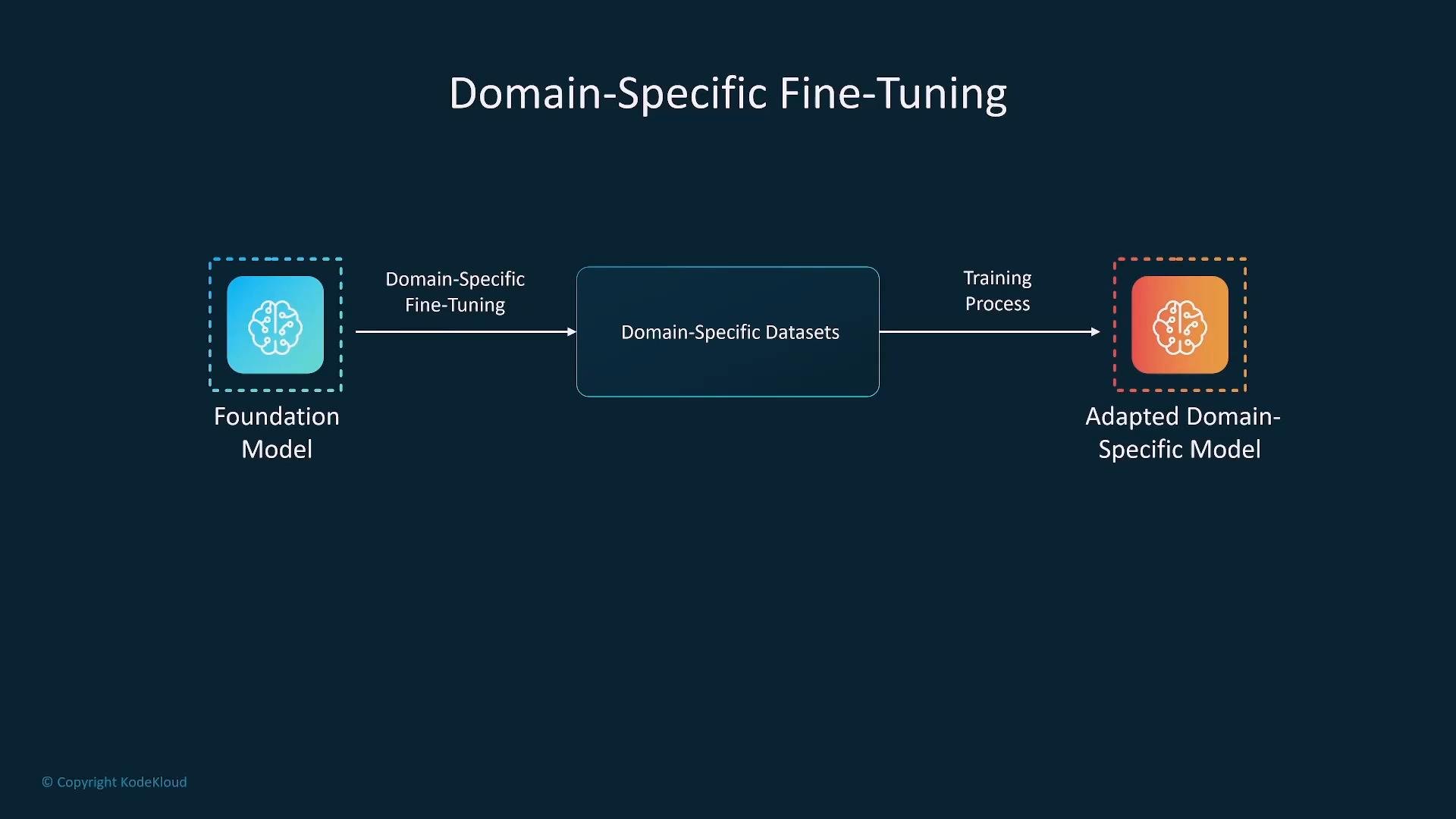
 Domain-specific fine-tuning
* Domain fine-tuning specializes models to verticals (finance, healthcare, legal). This focuses on terminology, style, constraints, and common subtasks so the model understands domain-specific nuance and compliance requirements.
* Domain adaptation often includes both supervised signals and curated unlabeled corpora for targeted continuous pre-training.
 Practical tools and workflows (AWS examples)
Use the table below to map common tooling to the tasks in a model customization pipeline.
| Tool | Primary purpose | Notes / links |
| - | - | - |
| SageMaker JumpStart | Example notebooks & fine-tuning recipes | Pre-built examples for common models — [JumpStart](https://learn.kodekloud.com/user/courses/aws-sagemaker) |
| Bedrock | Host foundation models & customization | Managed model hosting and customization workflows — [Bedrock](https://learn.kodekloud.com/user/courses/introduction-to-amazon-bedrock) |
| SageMaker Studio | Interactive experimentation & notebooks | Fast iteration and data munging — [Studio](https://learn.kodekloud.com/user/courses/aws-sagemaker) |
| Data Wrangler / Athena / Glue / EMR | ETL and large-scale data prep | Use for collecting, cleaning, and transforming training corpora |
| SageMaker Feature Store | Centralized feature storage | Shareable features for training and inference — [Feature Store](https://learn.kodekloud.com/user/courses/aws-sagemaker) |
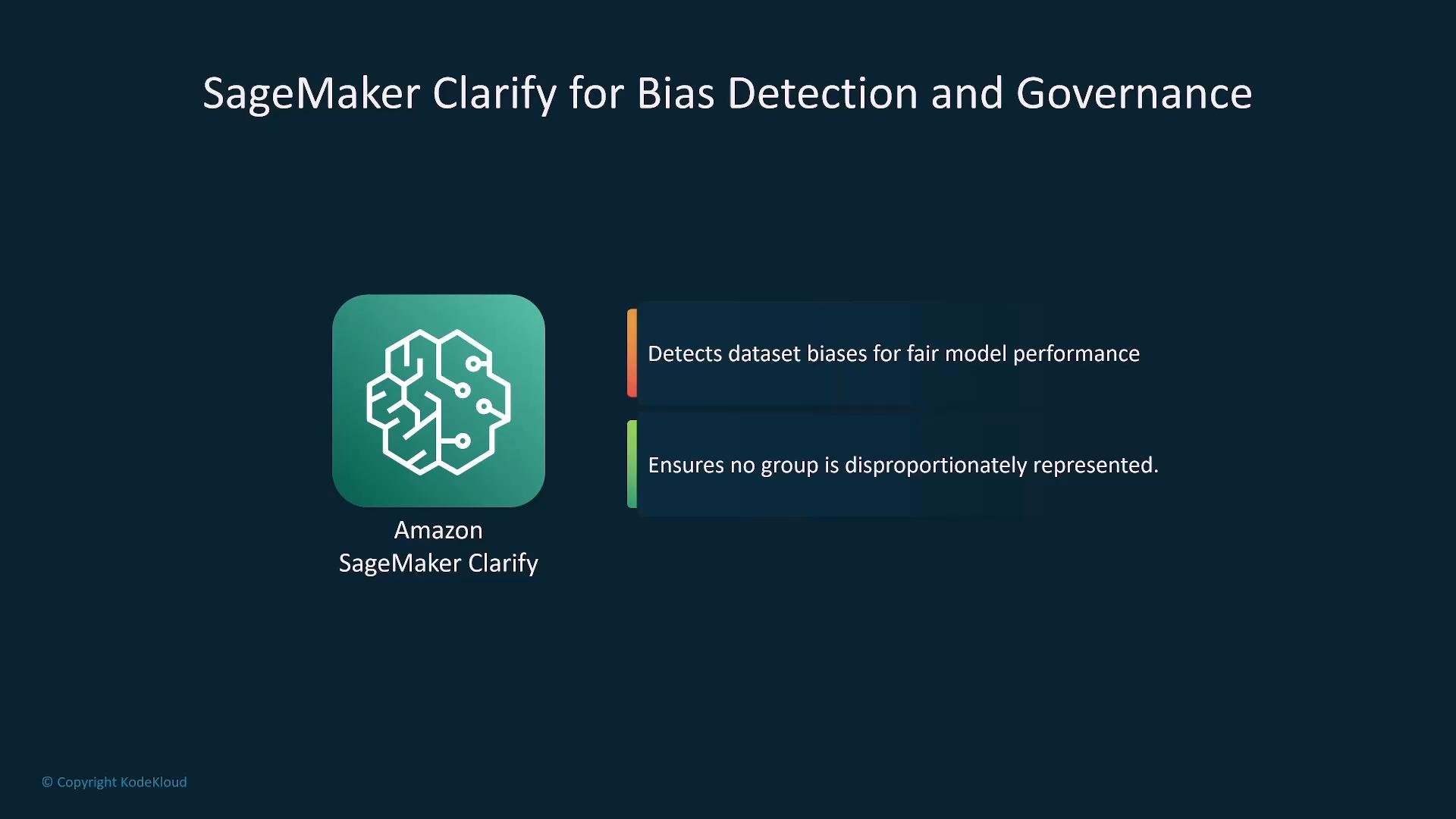
| SageMaker Clarify | Bias detection & explainability | Detect dataset/model bias and generate reports — [Clarify](https://learn.kodekloud.com/user/courses/aws-sagemaker) |
| SageMaker Ground Truth | Managed data labeling | Labeling workflows for supervised datasets — [Ground Truth](https://learn.kodekloud.com/user/courses/aws-sagemaker) |
 Reinforcement Learning from Human Feedback (RLHF)
* RLHF shapes model outputs through human preference data: raters compare outputs, a reward model is trained, and reinforcement learning updates the model to maximize the learned reward.
* Commonly used to align models with human preferences, safety constraints, and style guidelines (e.g., helpfulness and harmlessness).
Data preparation and lifecycle
High-quality data is the foundation of reliable fine-tuning and continuous pre-training. Key practices:
* Clean, deduplicate, and validate data sources.
* Ensure correct and consistent labeling for supervised tasks.
* Design prompt templates and instruction examples carefully for instruction tuning.
* Maintain dataset splits: training, validation (for hyperparameter tuning), and a held-out test set for final evaluation.
* Track loss curves, validation metrics, and use early stopping to avoid overfitting.
* For continuous pre-training, implement a curated pipeline to vet and version incoming data.
Best practices for evaluation
* Choose metrics appropriate to the task: accuracy, F1, BLEU, ROUGE, perplexity, exact match, or custom business KPIs.
* Monitor validation loss and task metrics during training.
* Evaluate final models on a never-seen test set and perform human evaluation when automated metrics are insufficient.
* Use fairness and bias detection tools (e.g., SageMaker Clarify) and incorporate safety checks.
Operational considerations
* Version control: track model checkpoints, PEFT adapters, and dataset versions.
* Efficient storage: store PEFT adapters independently of backbone weights so many variants don’t duplicate the full model.
* Deployment and monitoring: log model outputs, detect drift, and schedule retraining or continuous pre-training according to data freshness needs and business SLAs.
Closing summary
* Pre-training creates general-purpose capabilities; fine-tuning (including PEFT) efficiently tailors those capabilities to tasks and domains.
* Continuous pre-training helps maintain model relevance but requires strict data curation and governance.
* Choose tuning approaches (full fine-tune, PEFT, multi-task, RLHF) based on compute budget, desired model behavior, and acceptable risk; always start with data quality and evaluation criteria.
When planning customizations, start with data curation and clear evaluation metrics. Align your approach (full fine-tune vs. PEFT vs. RLHF) to your compute constraints, deployment strategy, and the complexity of the behavior you need the model to produce.
This documentation is built and hosted on [Mintlify](https://mintlify.com), a developer documentation platform.