While many teams race to build faster with AI and modern frameworks, success ultimately depends on delivering software reliably, securely, and at scale. Behind every zero-downtime release and resilient system is a DevOps pipeline that automates builds, tests, deployments, monitoring, and incident response. This lesson is part of the AWS Certified DevOps Engineer – Professional certification course. It focuses on real-world practices for designing, automating, and operating highly reliable cloud systems and specifically prepares you for the DOP‑C02 exam. Here’s what you’ll master. Domain 1 — SDLC Automation
  • Build end-to-end CI/CD pipelines using AWS-native tooling and third-party integrations.
  • Manage version control workflows, automated builds, artifact storage, and secure secrets handling.
  • Implement test automation and deployment strategies across VMs, containers, and serverless platforms.
  • Apply advanced deployment patterns and troubleshoot pipeline failures.
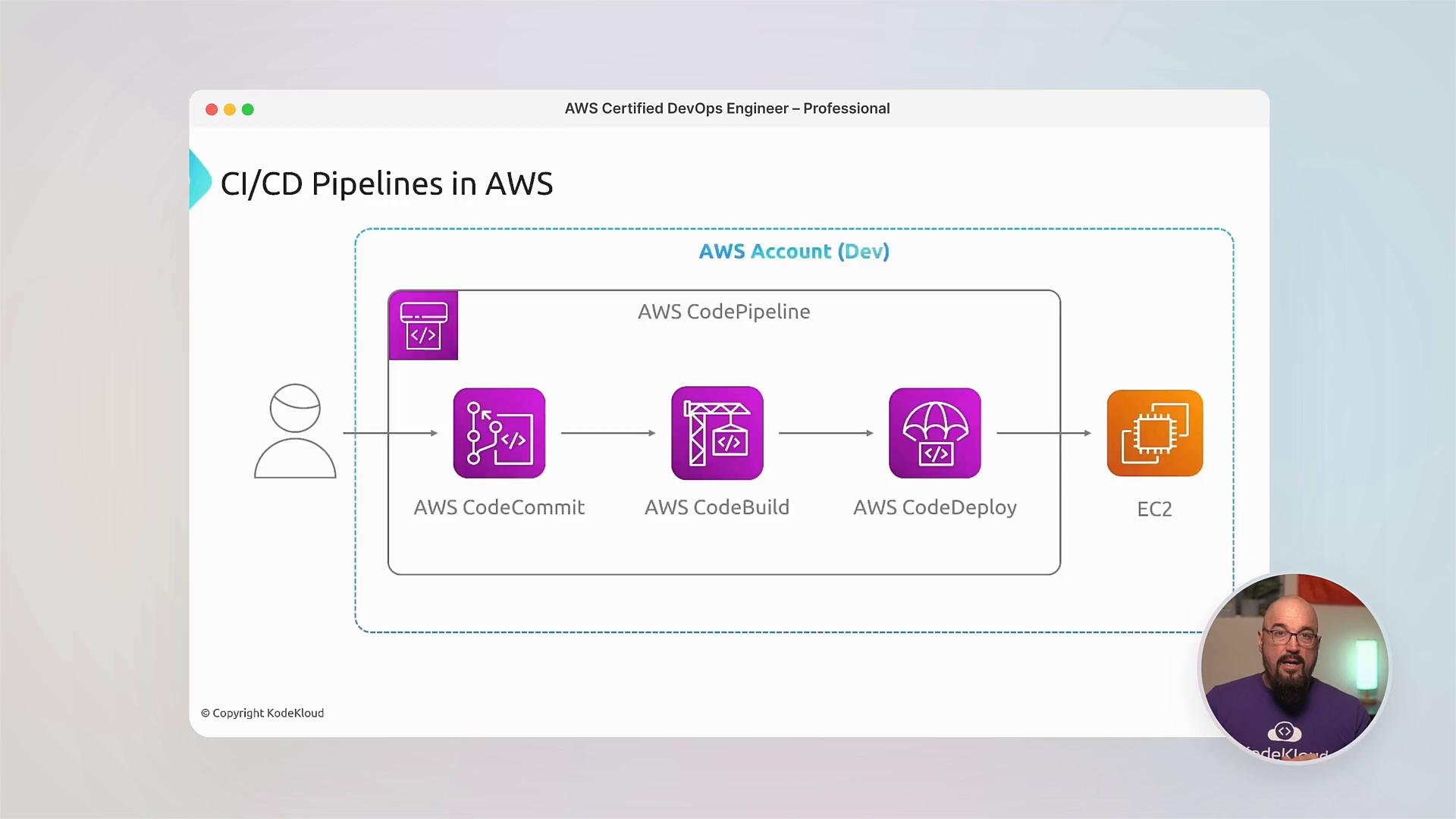
A slide titled "CI/CD Pipelines in AWS" showing an AWS CodePipeline workflow: AWS CodeCommit → AWS CodeBuild → AWS CodeDeploy deploying to an EC2 instance. A small presenter video thumbnail appears in the lower-right corner.
You’ll learn deployment strategies such as blue/green and canary releases, and how to validate and roll back safely when needed.
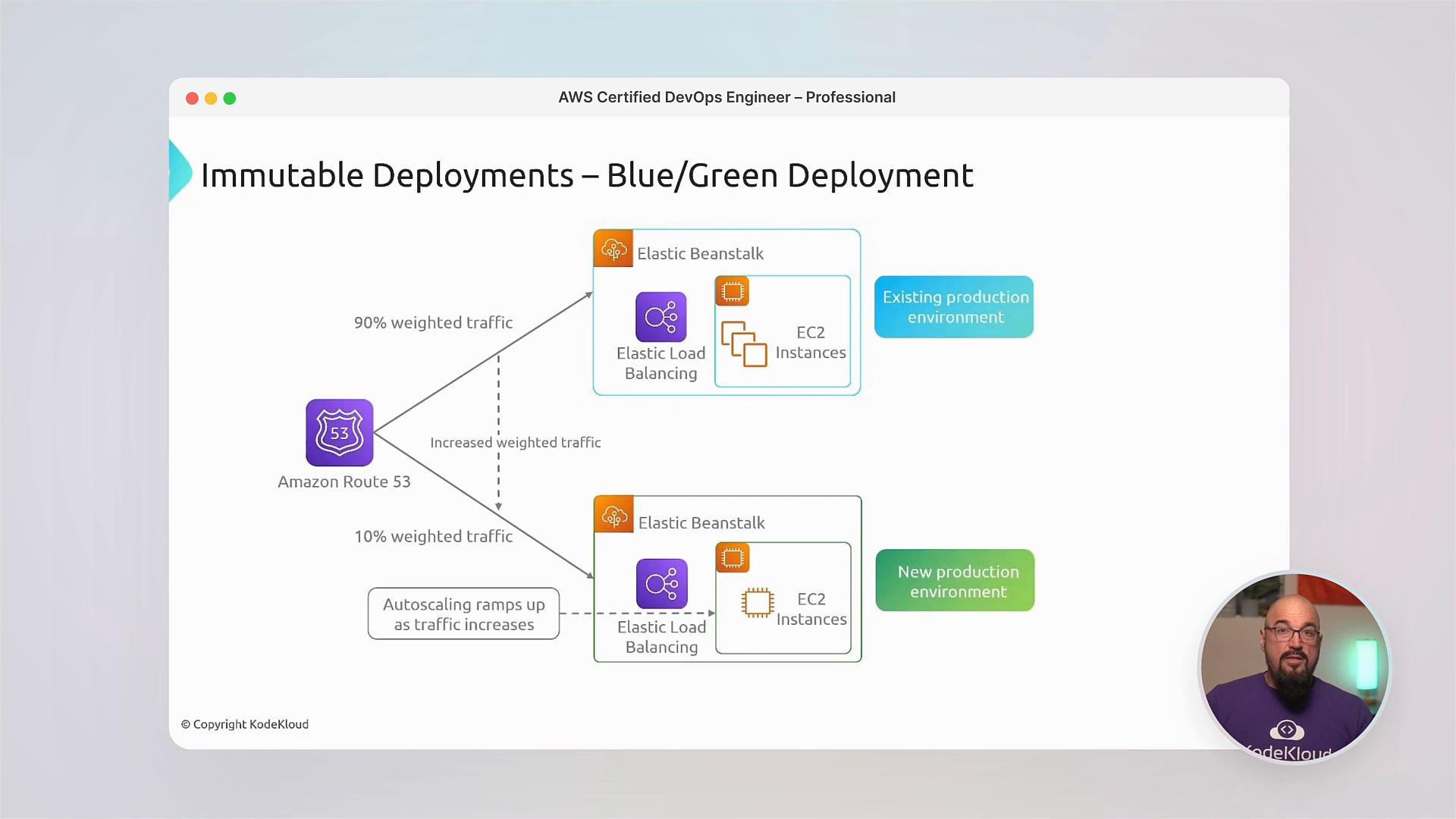
A presentation slide illustrating immutable blue/green deployments on AWS, showing Route 53 weighted traffic routing to Elastic Beanstalk environments with Elastic Load Balancing and EC2 instances. A small presenter video thumbnail appears in the bottom-right.
Domain 2 — Configuration Management and Infrastructure as Code
  • Design and manage infrastructure using AWS CloudFormation and the AWS Cloud Development Kit (CDK).
  • Build reusable patterns for multi-account and multi-region deployments with consistent governance.
  • Use configuration management tools and AWS Systems Manager to keep systems consistent and auditable.
  • Embed security and compliance controls directly into infrastructure-as-code.
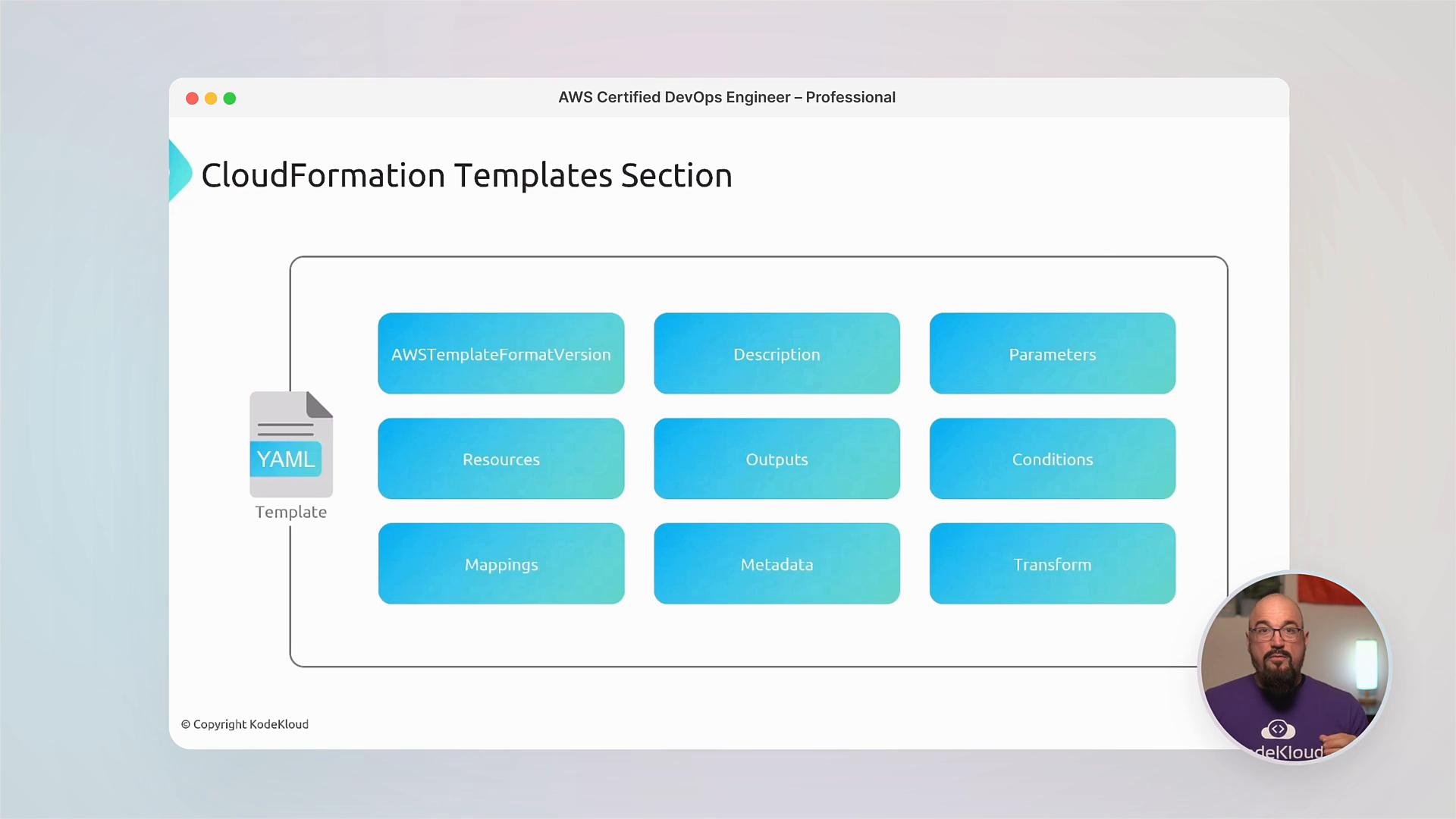
A presentation slide titled "CloudFormation Templates Section" showing a diagram of YAML template components (AWSTemplateFormatVersion, Description, Parameters, Resources, Outputs, Conditions, Mappings, Metadata, Transform). A small circular video feed of the presenter appears in the bottom-right.
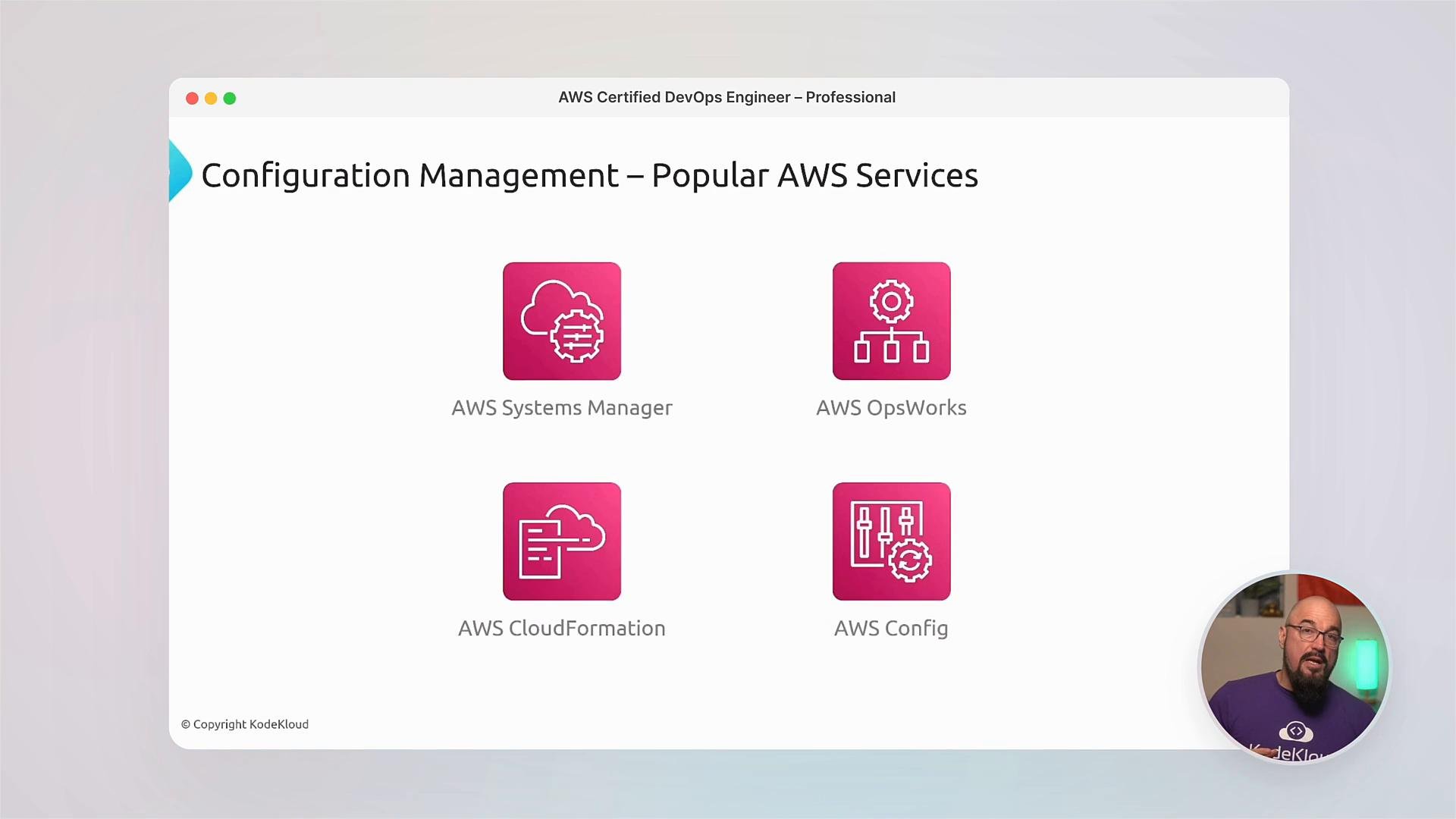
A presentation slide titled "Configuration Management – Popular AWS Services" showing pink icons and labels for AWS Systems Manager, AWS OpsWorks, AWS CloudFormation, and AWS Config. A small circular video overlay of an instructor appears in the bottom-right.
Domain 3 — Resilient Cloud Solutions
  • Design highly available, fault-tolerant systems across compute, data, containers, and serverless services.
  • Architect scalable networking and disaster recovery strategies to ensure business continuity.
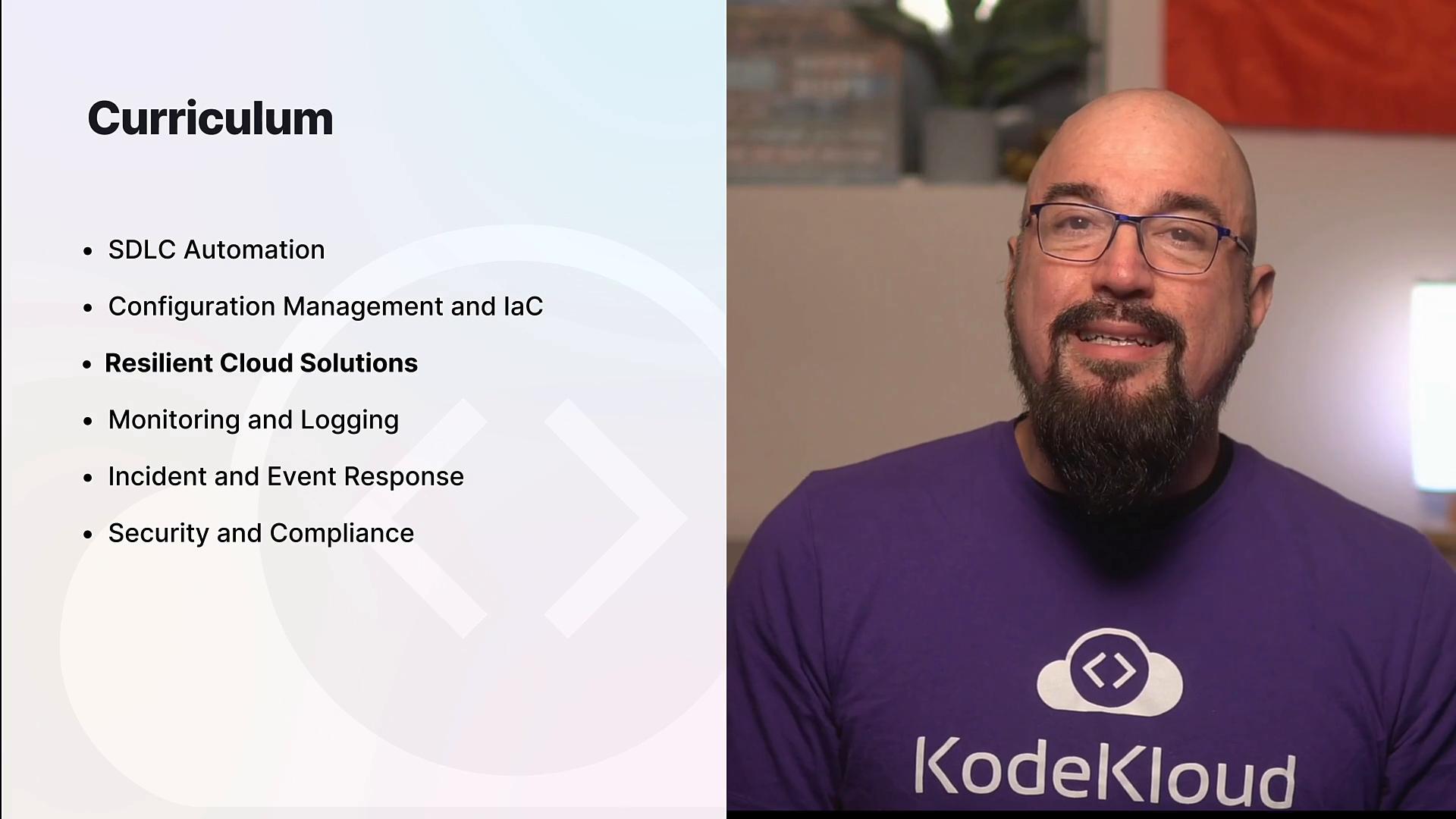
A split-screen image showing a presentation slide titled "Curriculum" with bulleted DevOps/cloud topics on the left, and on the right a smiling bald man with glasses wearing a purple KodeKloud T-shirt.
Domain 4 — Monitoring and Logging
  • Build observability practices by collecting, processing, and analyzing logs and metrics at scale.
  • Create dashboards, configure alarms, and use tracing to pinpoint performance bottlenecks.
  • Integrate service-native ingestion and custom agents for reliable telemetry.
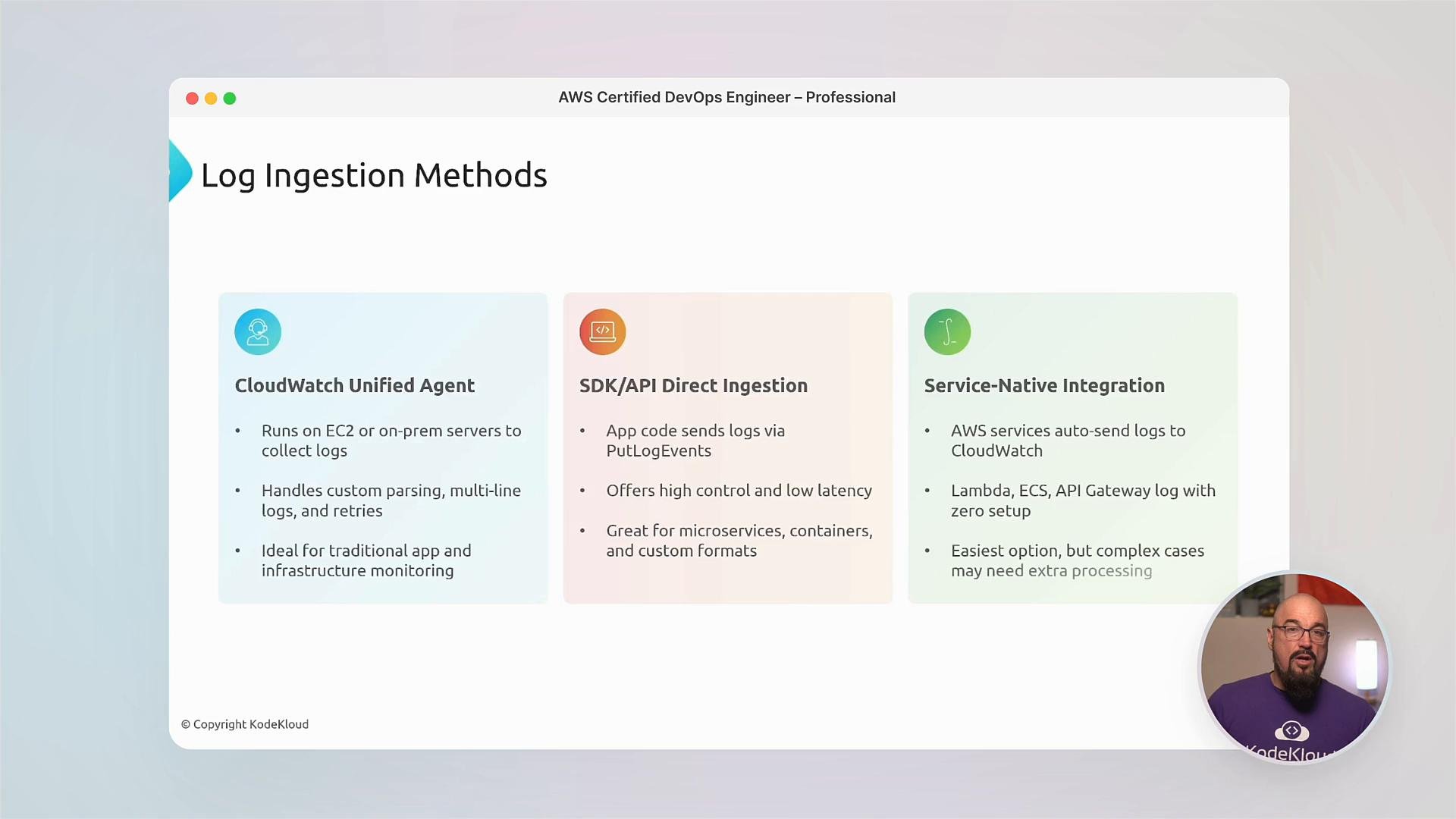
A presentation slide titled "Log Ingestion Methods" showing three colored panels for CloudWatch Unified Agent, SDK/API Direct Ingestion, and Service‑Native Integration with brief bullet points. A small circular video of a presenter appears over the bottom-right corner.
Domain 5 — Incident and Event Response
  • Detect and respond to incidents, automate remediation workflows, and orchestrate runbooks.
  • Design event-driven architectures that trigger automated recovery with EventBridge, Lambda, and Systems Manager.
  • Apply chaos engineering techniques to validate operational readiness and resilience.
Domain 6 — Security and Compliance
  • Implement AWS security best practices across accounts and environments.
  • Manage IAM at scale, secure access, and protect sensitive data with encryption and key management.
  • Automate governance, threat detection, vulnerability assessment, and auditing workflows.
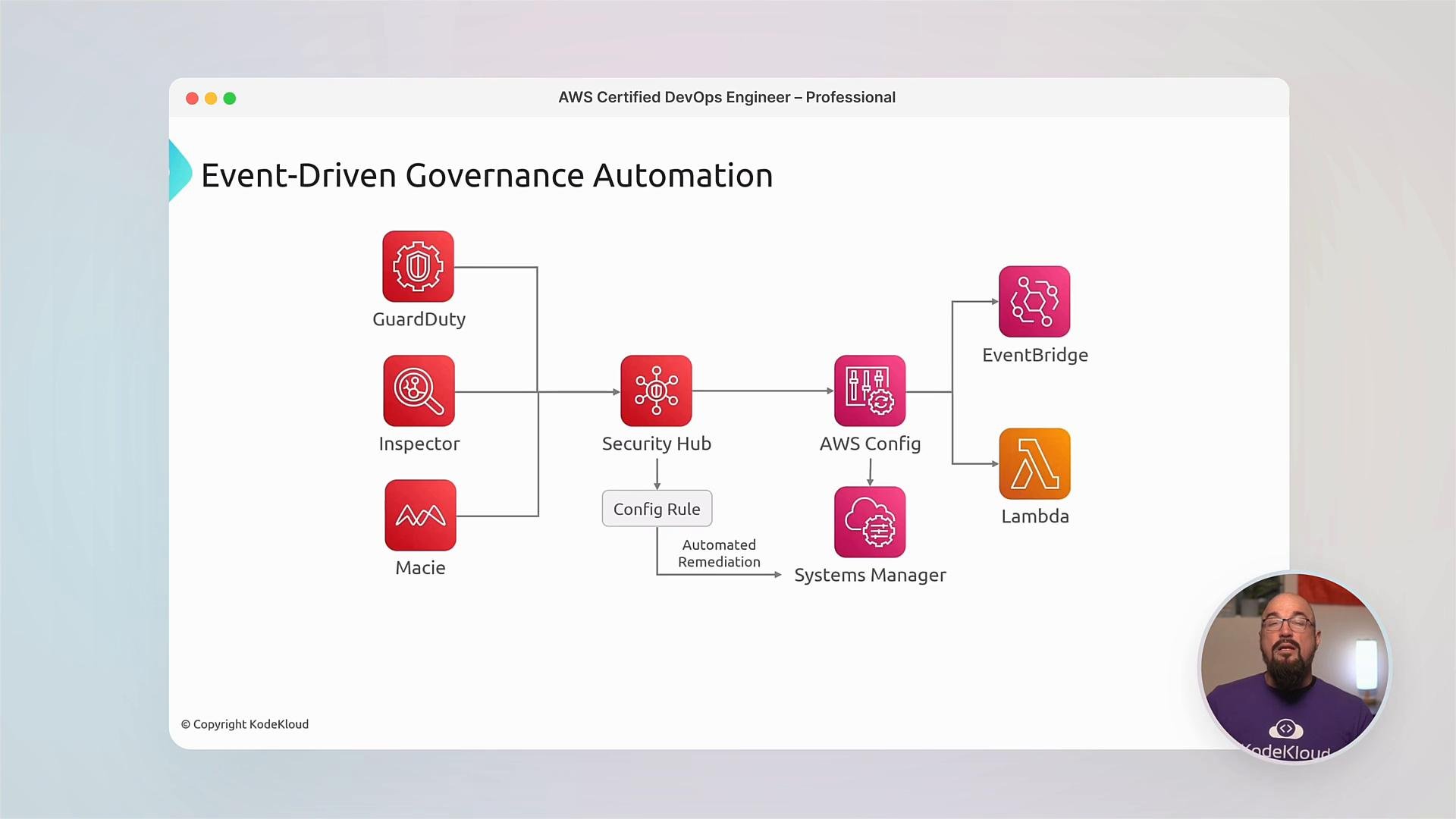
A presentation slide titled "Event-Driven Governance Automation" showing an AWS architecture diagram where GuardDuty, Inspector, and Macie feed into Security Hub, which connects to AWS Config, EventBridge, Lambda, and Systems Manager for automated remediation. A small circular video inset of a speaker appears in the bottom-right corner.
Course domains at a glance
Hands-on practice is essential. Expect guided labs that step through pipeline creation, infrastructure-as-code deployments, observability setups, and incident remediation exercises to solidify theory with real-world scenarios.
Quick example: configuring Git user identity before committing changes
You’ll also join an active learning community where you can ask questions, share insights, and grow with other learners. Modern DevOps is not just about speed — it’s about delivering reliable, secure, and scalable systems in an increasingly complex cloud environment. Every organization needs skilled DevOps engineers who can bridge development and operations while ensuring systems run smoothly. Are you ready to earn your AWS Certified DevOps Engineer – Professional certification? Links and References

Watch Video