> ## Documentation Index
> Fetch the complete documentation index at: https://notes.kodekloud.com/llms.txt
> Use this file to discover all available pages before exploring further.
# Summary of Domain 1 Data Preparation for ML
> Overview of data preparation for machine learning, covering cleaning, transformation, feature engineering, labeling, validation, security, and AWS tools for scalable, reproducible pipelines and production-ready models.
This summary covers the essential steps to convert raw data into high-quality inputs for machine learning (ML) models. Effective data preparation improves model accuracy, reduces bias, and ensures reproducible, production-ready ML pipelines.
High-quality data is the foundation of reliable ML: "Garbage In, Garbage Out" — thorough data preparation is essential for meaningful results.
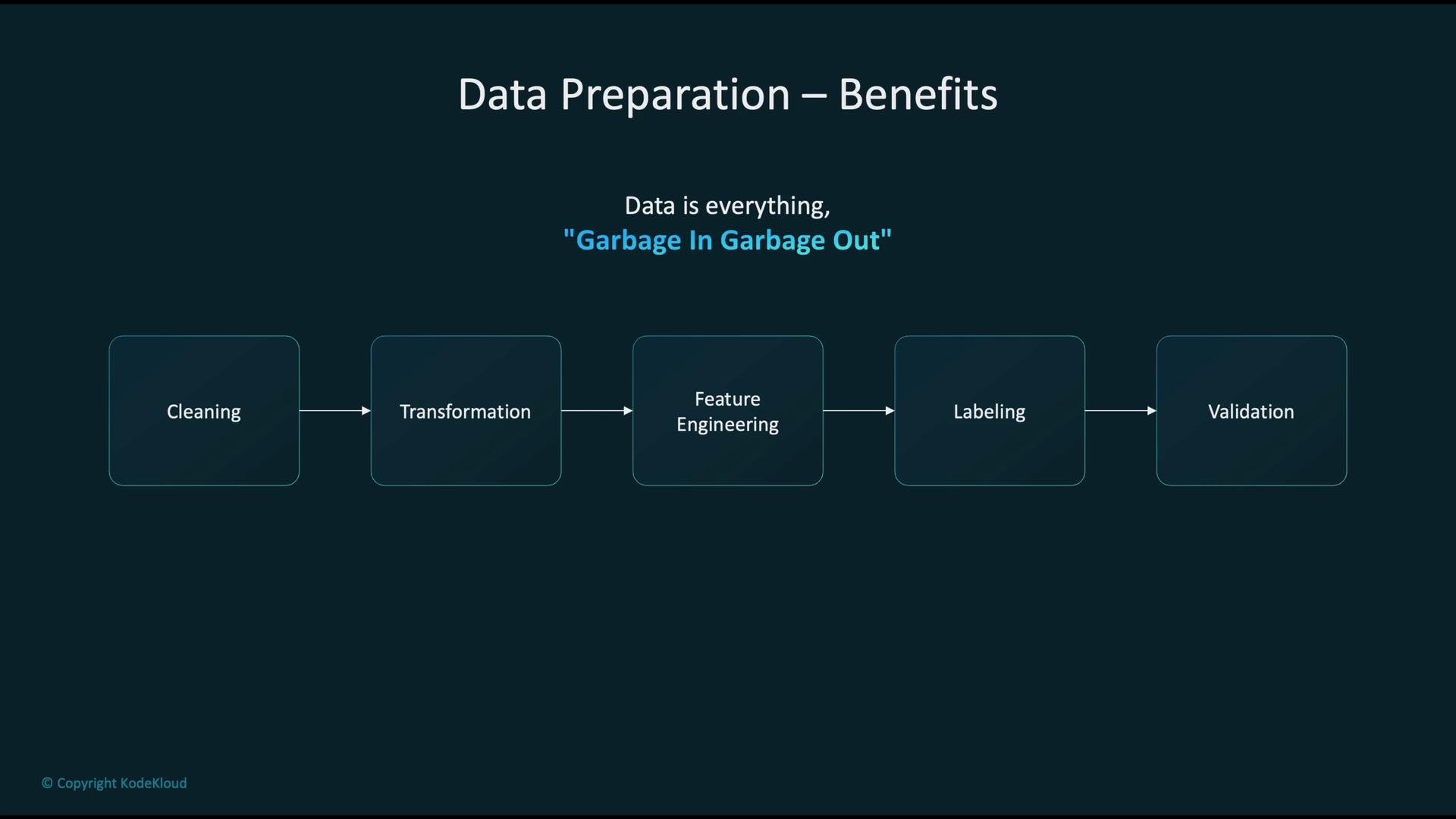
The data-preparation workflow is a sequence of stages that progressively refine raw data into training-ready datasets:
* Cleaning — remove or correct inaccuracies, duplicates, and inconsistent values.
* Transformation — reshape and encode data into formats suitable for models.
* Feature engineering — create, aggregate, and select informative signals.
* Labeling — provide ground-truth annotations for supervised learning.
* Validation — verify dataset quality, distributional assumptions, and readiness to train.
 Feature engineering should be driven by the problem statement and the characteristics of available data. Typical activities include:
* Derive features from raw signals (e.g., time-window aggregations, ratios).
* Convert features into modeling-friendly representations (numeric, normalized).
* Perform feature selection to keep signals that improve predictive power.
* Validate features for stability over time and guard against data leakage.
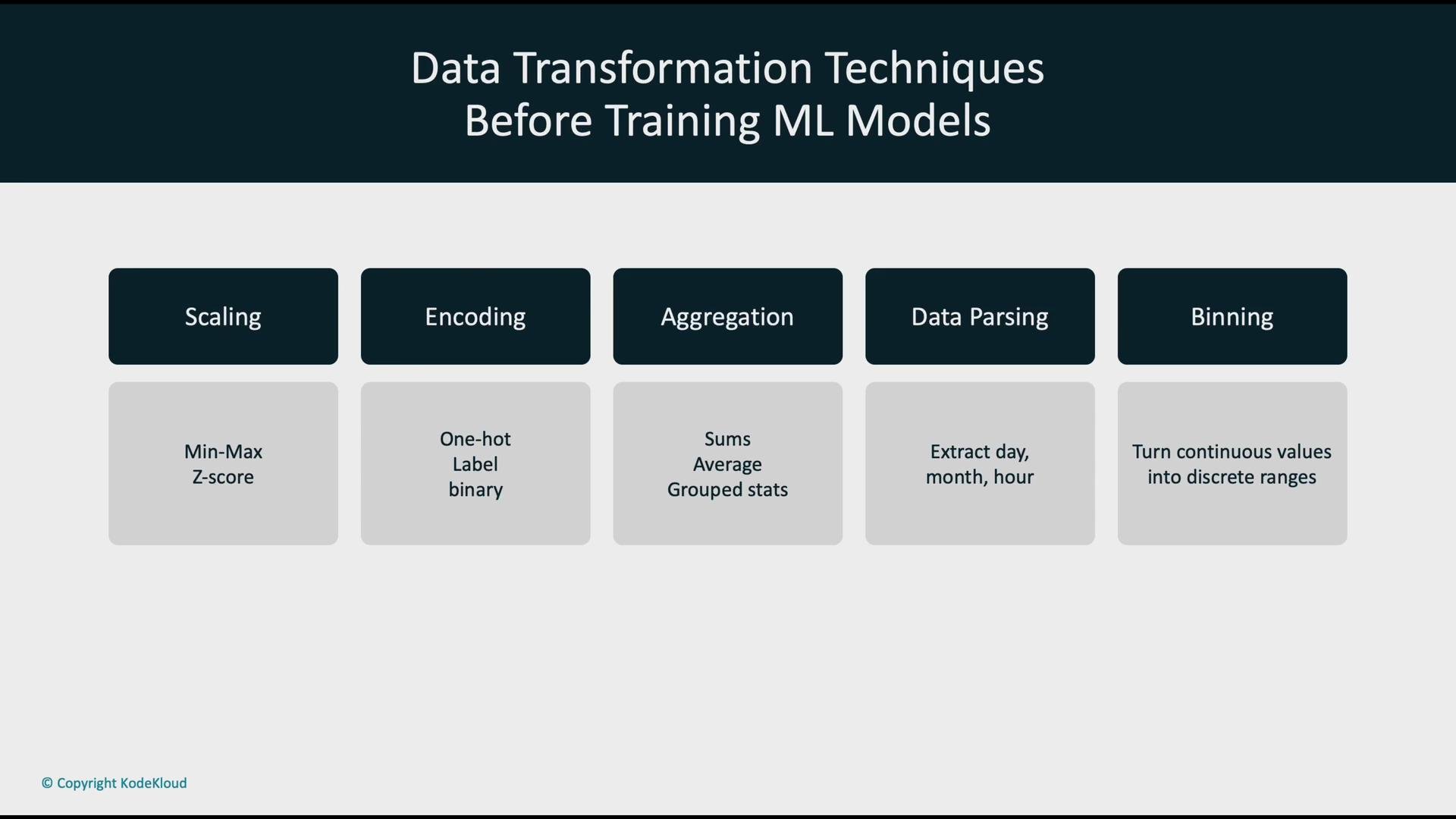
Common transformation techniques used before training:
| Technique | Typical methods / examples |
| ----------- | ------------------------------------------------------------------------- |
| Scaling | Min–max scaling, z-score (standard) normalization |
| Encoding | One-hot encoding, label encoding, target/binary encoding for categoricals |
| Aggregation | Group-level statistics: sum, count, mean, median |
| Parsing | Extract structured parts: day/month/hour from timestamps, JSON fields |
| Binning | Discretize continuous variables into ordinal ranges |
Feature engineering should be driven by the problem statement and the characteristics of available data. Typical activities include:
* Derive features from raw signals (e.g., time-window aggregations, ratios).
* Convert features into modeling-friendly representations (numeric, normalized).
* Perform feature selection to keep signals that improve predictive power.
* Validate features for stability over time and guard against data leakage.
Common transformation techniques used before training:
| Technique | Typical methods / examples |
| ----------- | ------------------------------------------------------------------------- |
| Scaling | Min–max scaling, z-score (standard) normalization |
| Encoding | One-hot encoding, label encoding, target/binary encoding for categoricals |
| Aggregation | Group-level statistics: sum, count, mean, median |
| Parsing | Extract structured parts: day/month/hour from timestamps, JSON fields |
| Binning | Discretize continuous variables into ordinal ranges |
 A practical feature engineering workflow:
1. Define the business problem and inventory data sources (logs, databases, events).
2. Clean and preprocess raw inputs (handle missing values, deduplicate, normalize).
3. Generate candidate features via derivation and aggregation.
4. Transform features into numeric, normalized, or encoded forms for modeling.
5. Select and validate the final feature set (cross-validation, importance, stability).
6. Deploy the model with a reproducible feature pipeline and maintain it in production.
A practical feature engineering workflow:
1. Define the business problem and inventory data sources (logs, databases, events).
2. Clean and preprocess raw inputs (handle missing values, deduplicate, normalize).
3. Generate candidate features via derivation and aggregation.
4. Transform features into numeric, normalized, or encoded forms for modeling.
5. Select and validate the final feature set (cross-validation, importance, stability).
6. Deploy the model with a reproducible feature pipeline and maintain it in production.
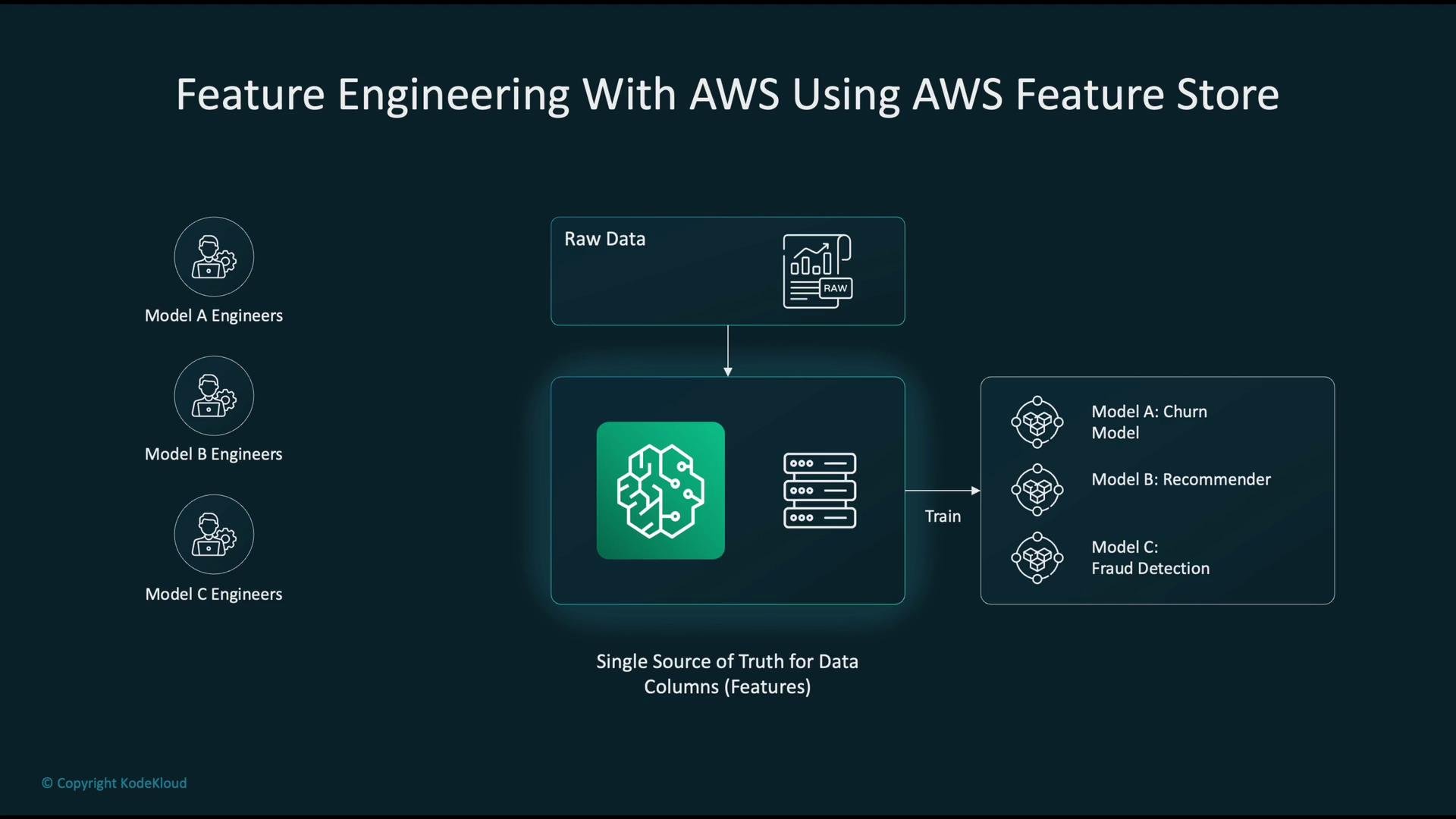 AWS Feature Store centralizes feature storage and enables consistent feature reuse across teams and environments. Raw source data is processed into feature values, stored in Feature Store, and then retrieved for training and inference — providing a single source of truth and reducing feature drift.
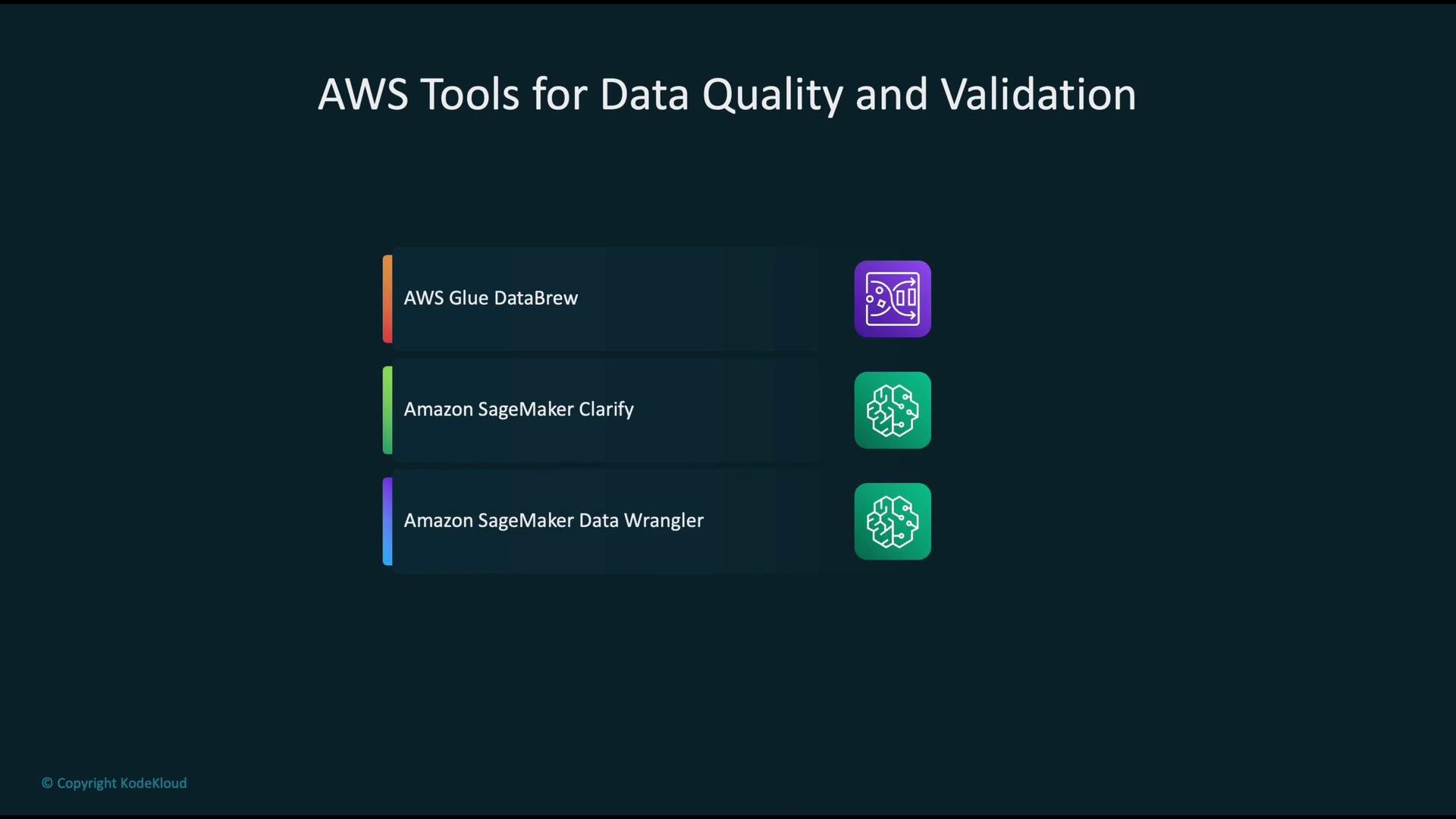
For data quality and validation on AWS, the following services are commonly used:
* [AWS Glue DataBrew](https://docs.aws.amazon.com/databrew/latest/userguide/what-is-databrew.html) — interactive data cleaning and visual transformations.
* [Amazon SageMaker Clarify](https://docs.aws.amazon.com/sagemaker/latest/dg/clarify.html) — bias detection, feature importance, and explainability.
* [Amazon SageMaker Data Wrangler](https://docs.aws.amazon.com/sagemaker/latest/dg/data-wrangler.html) — interactive and automated data preparation for ML.
AWS Feature Store centralizes feature storage and enables consistent feature reuse across teams and environments. Raw source data is processed into feature values, stored in Feature Store, and then retrieved for training and inference — providing a single source of truth and reducing feature drift.
For data quality and validation on AWS, the following services are commonly used:
* [AWS Glue DataBrew](https://docs.aws.amazon.com/databrew/latest/userguide/what-is-databrew.html) — interactive data cleaning and visual transformations.
* [Amazon SageMaker Clarify](https://docs.aws.amazon.com/sagemaker/latest/dg/clarify.html) — bias detection, feature importance, and explainability.
* [Amazon SageMaker Data Wrangler](https://docs.aws.amazon.com/sagemaker/latest/dg/data-wrangler.html) — interactive and automated data preparation for ML.
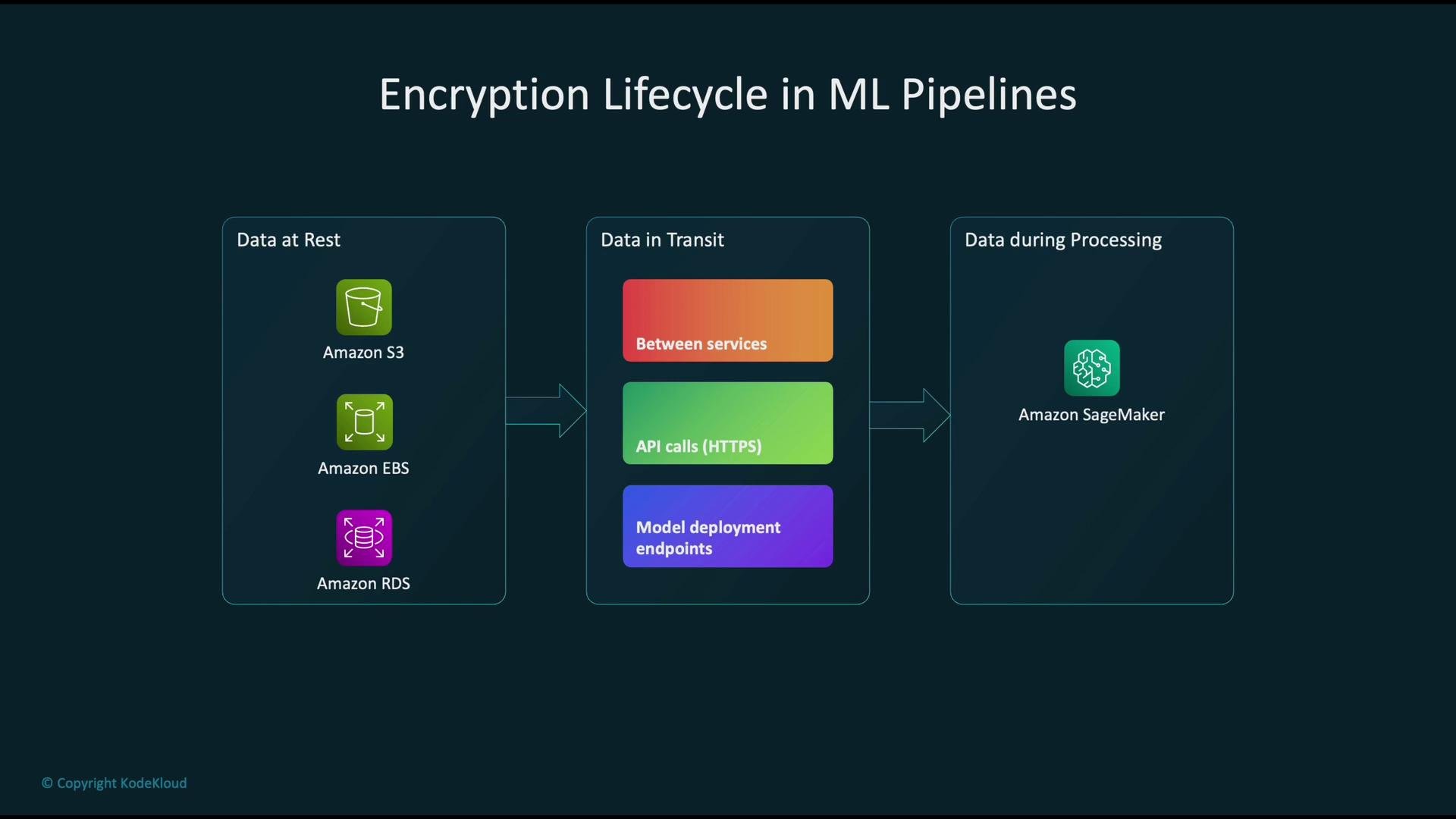
 Security and privacy must be incorporated through the entire data lifecycle:
* Encrypt data at rest (S3, EBS, RDS) and in transit (HTTPS, service endpoints).
* Protect data during processing and training (for example, when using Amazon SageMaker).
* Apply fine-grained access controls (IAM), auditing, and monitoring to prevent unauthorized access.
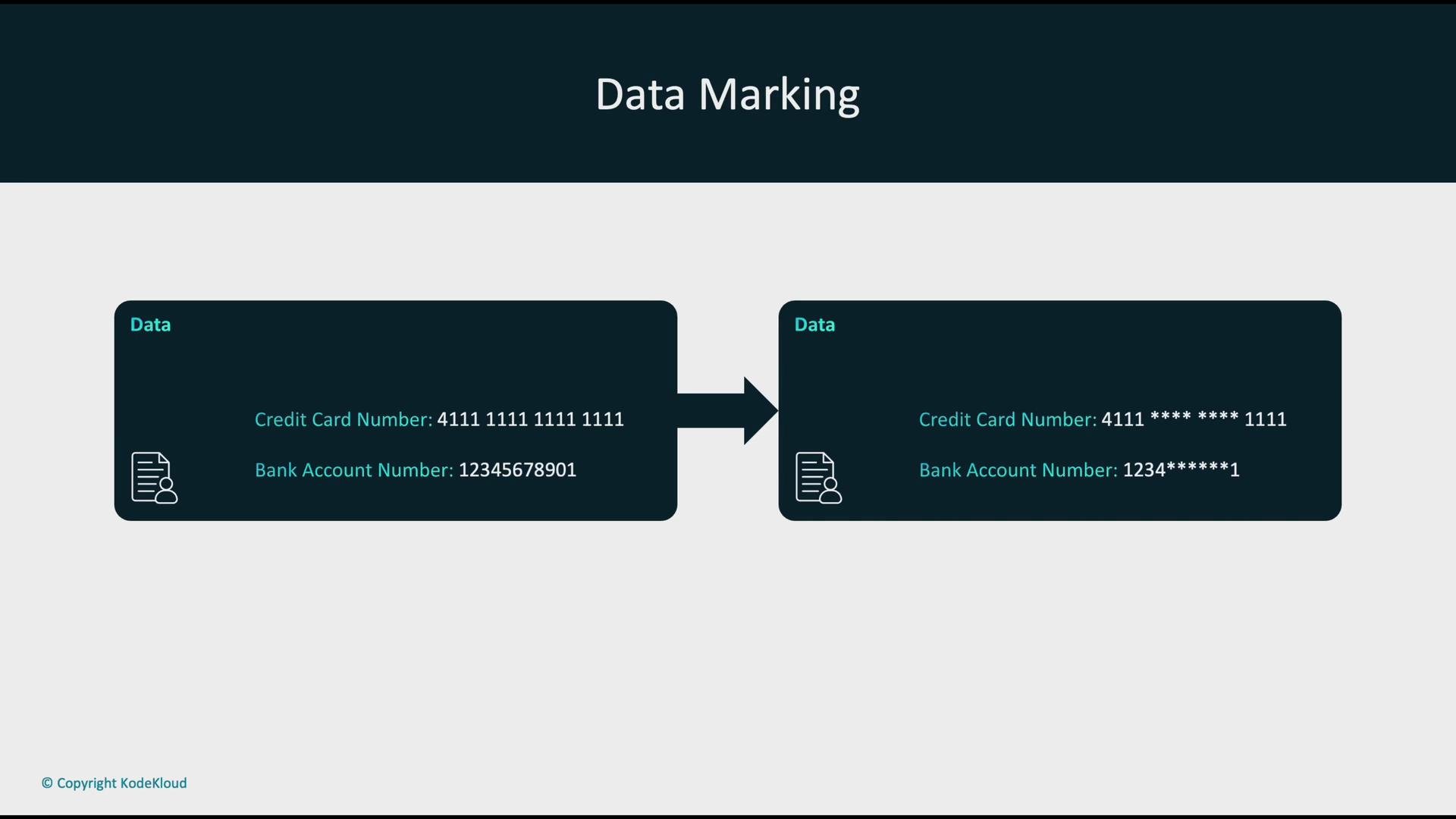
* Use masking or tokenization to remove or obscure sensitive fields for development and testing.
Security and privacy must be incorporated through the entire data lifecycle:
* Encrypt data at rest (S3, EBS, RDS) and in transit (HTTPS, service endpoints).
* Protect data during processing and training (for example, when using Amazon SageMaker).
* Apply fine-grained access controls (IAM), auditing, and monitoring to prevent unauthorized access.
* Use masking or tokenization to remove or obscure sensitive fields for development and testing.
 Data masking (redaction or tokenization) helps preserve dataset utility while protecting sensitive values. Masking replaces critical parts of values (for example, credit card or account numbers) so teams can develop and test without exposing real PII.
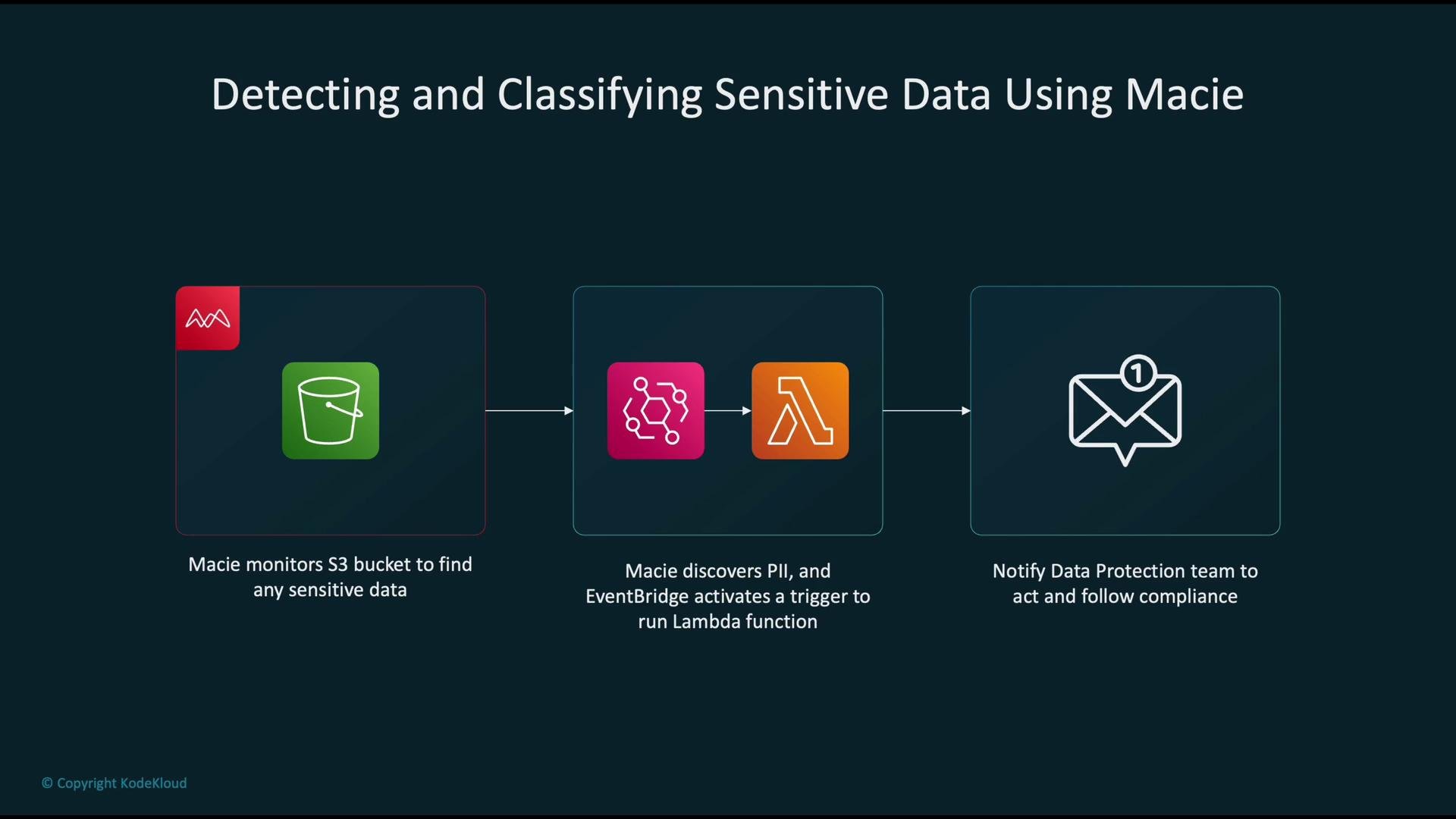
 Detecting and automating responses to sensitive data can be implemented using AWS services like Amazon Macie. A typical automated workflow:
1. Macie scans S3 buckets and detects PII or other sensitive content.
2. Macie sends findings to Amazon EventBridge.
3. EventBridge triggers an AWS Lambda to notify or remediate (notify data protection/compliance teams).
Detecting and automating responses to sensitive data can be implemented using AWS services like Amazon Macie. A typical automated workflow:
1. Macie scans S3 buckets and detects PII or other sensitive content.
2. Macie sends findings to Amazon EventBridge.
3. EventBridge triggers an AWS Lambda to notify or remediate (notify data protection/compliance teams).
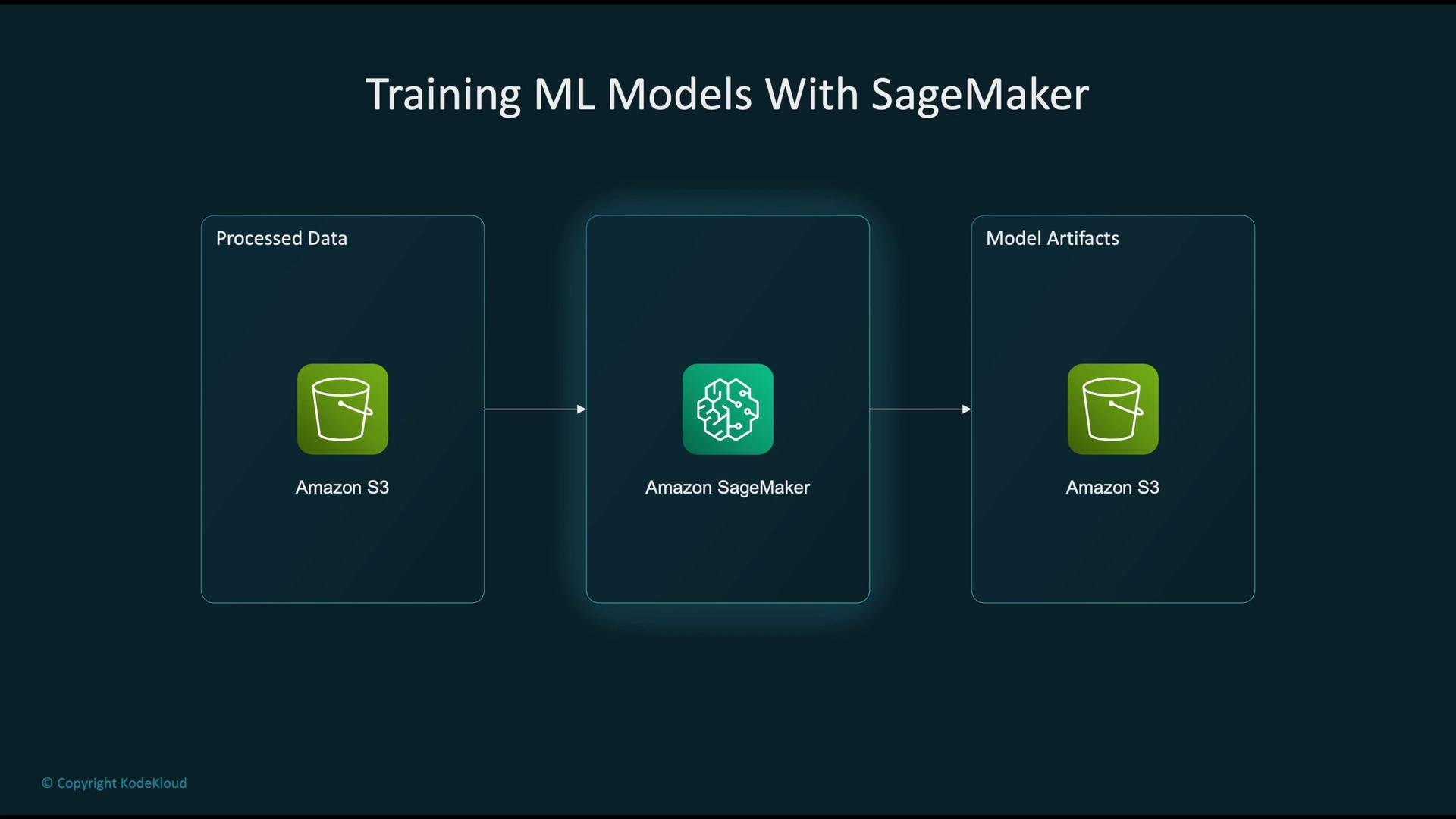
 Training workflows with Amazon SageMaker commonly use Amazon S3 as the central data and artifact store:
* Store processed training datasets and feature artifacts in S3.
* SageMaker pulls training data and executes training jobs (single-node or distributed).
* Save model artifacts (checkpoints and final models) back to S3 for deployment and reproducibility.
Training workflows with Amazon SageMaker commonly use Amazon S3 as the central data and artifact store:
* Store processed training datasets and feature artifacts in S3.
* SageMaker pulls training data and executes training jobs (single-node or distributed).
* Save model artifacts (checkpoints and final models) back to S3 for deployment and reproducibility.
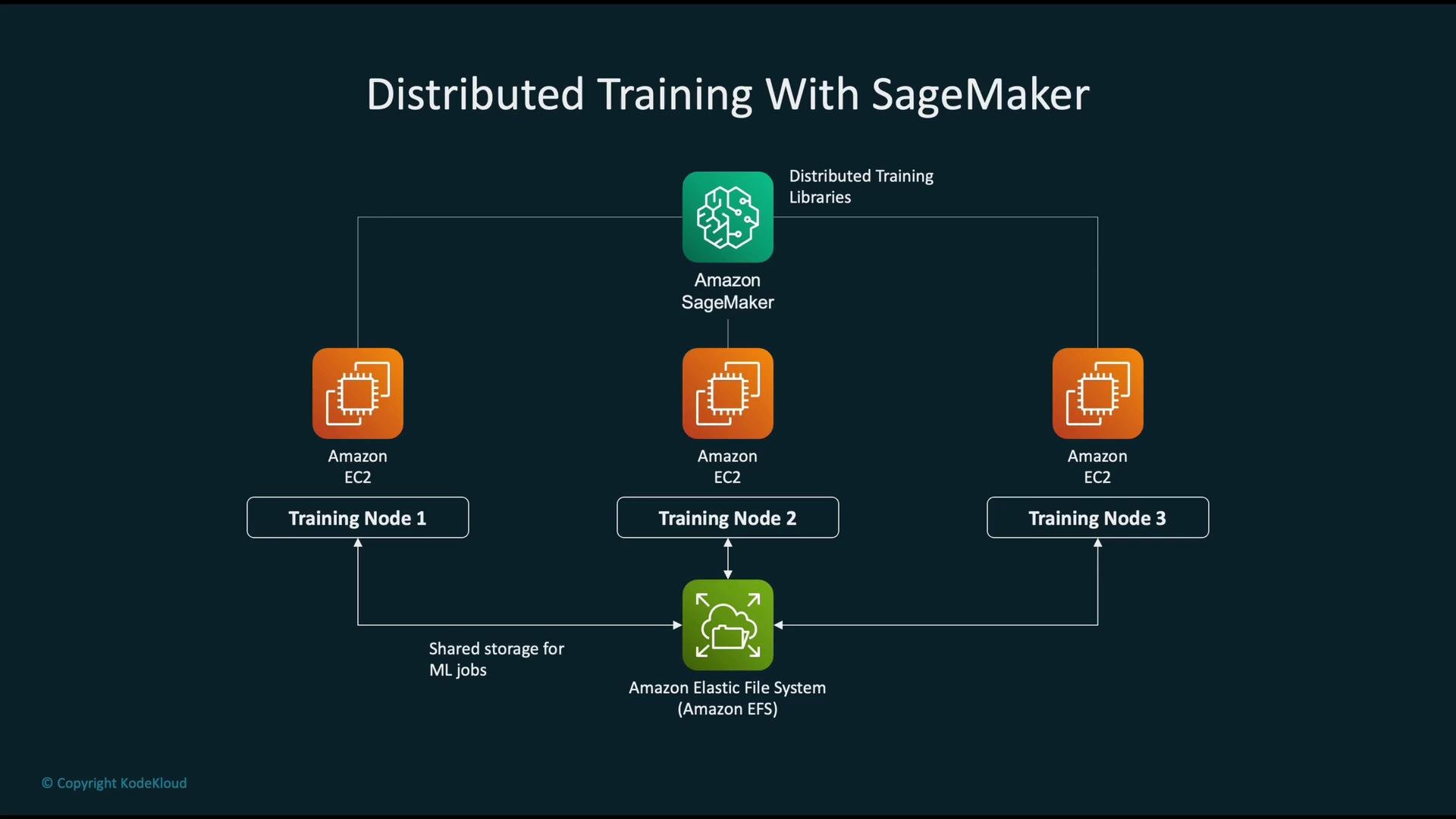
 For large-scale or distributed training, SageMaker can provision multiple instances (EC2 nodes) running in parallel and rely on shared storage such as Amazon EFS to host datasets, checkpoints, and logs.
 For real-time and streaming data ingestion, consider the Amazon Kinesis family:
* Kinesis Video Streams — capture and process video streams.
* Kinesis Data Streams — ingest and store real-time records.
* Kinesis Data Firehose — reliably load streaming data into AWS destinations.
* Kinesis Data Analytics — run SQL or Apache Flink applications on streaming data.
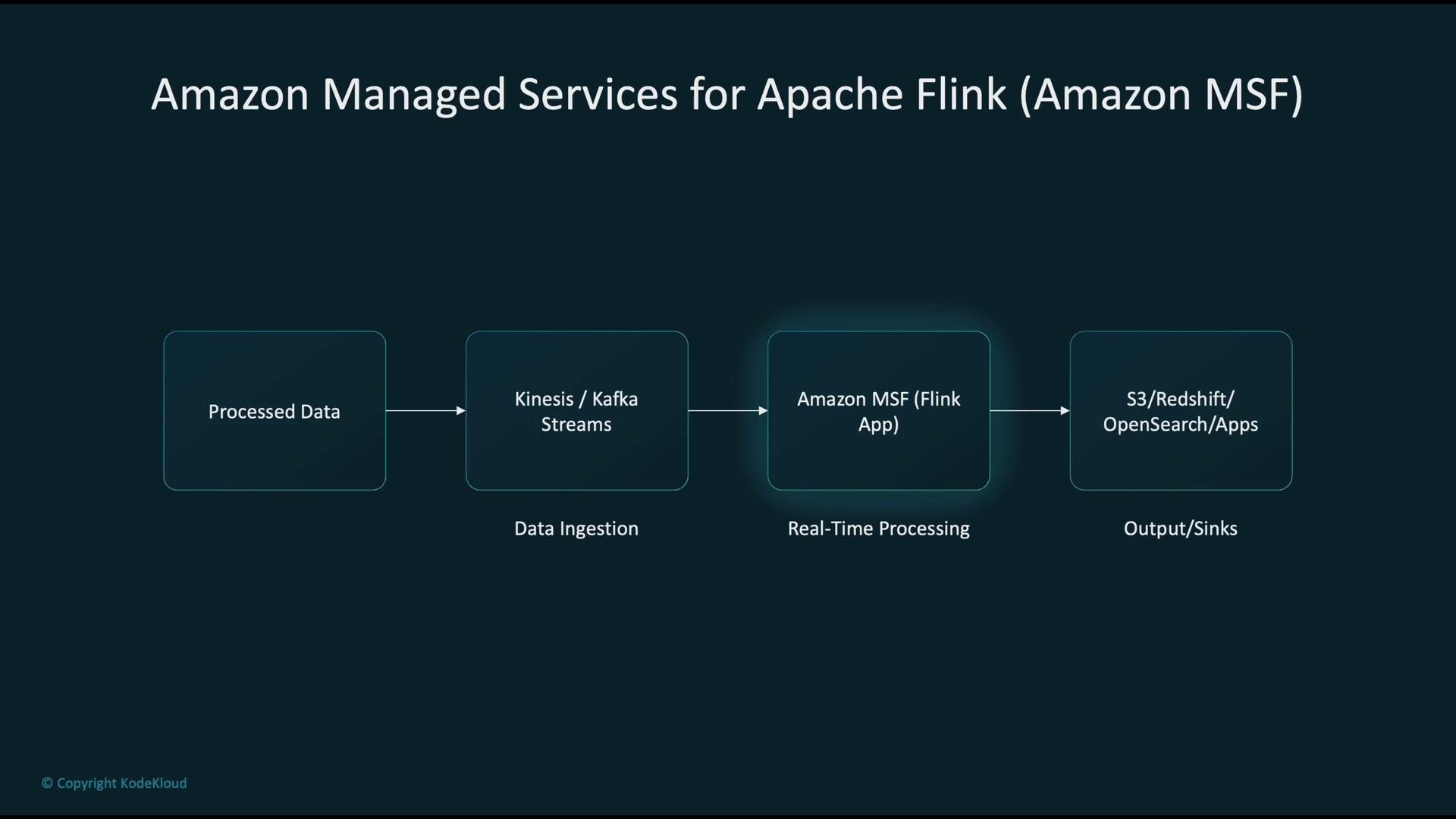
You can build streaming pipelines using Amazon Kinesis Data Analytics (Apache Flink): consume from Kinesis or Kafka, run real-time transformations with Flink, and write results to sinks such as S3, Redshift, or OpenSearch.
For real-time and streaming data ingestion, consider the Amazon Kinesis family:
* Kinesis Video Streams — capture and process video streams.
* Kinesis Data Streams — ingest and store real-time records.
* Kinesis Data Firehose — reliably load streaming data into AWS destinations.
* Kinesis Data Analytics — run SQL or Apache Flink applications on streaming data.
You can build streaming pipelines using Amazon Kinesis Data Analytics (Apache Flink): consume from Kinesis or Kafka, run real-time transformations with Flink, and write results to sinks such as S3, Redshift, or OpenSearch.
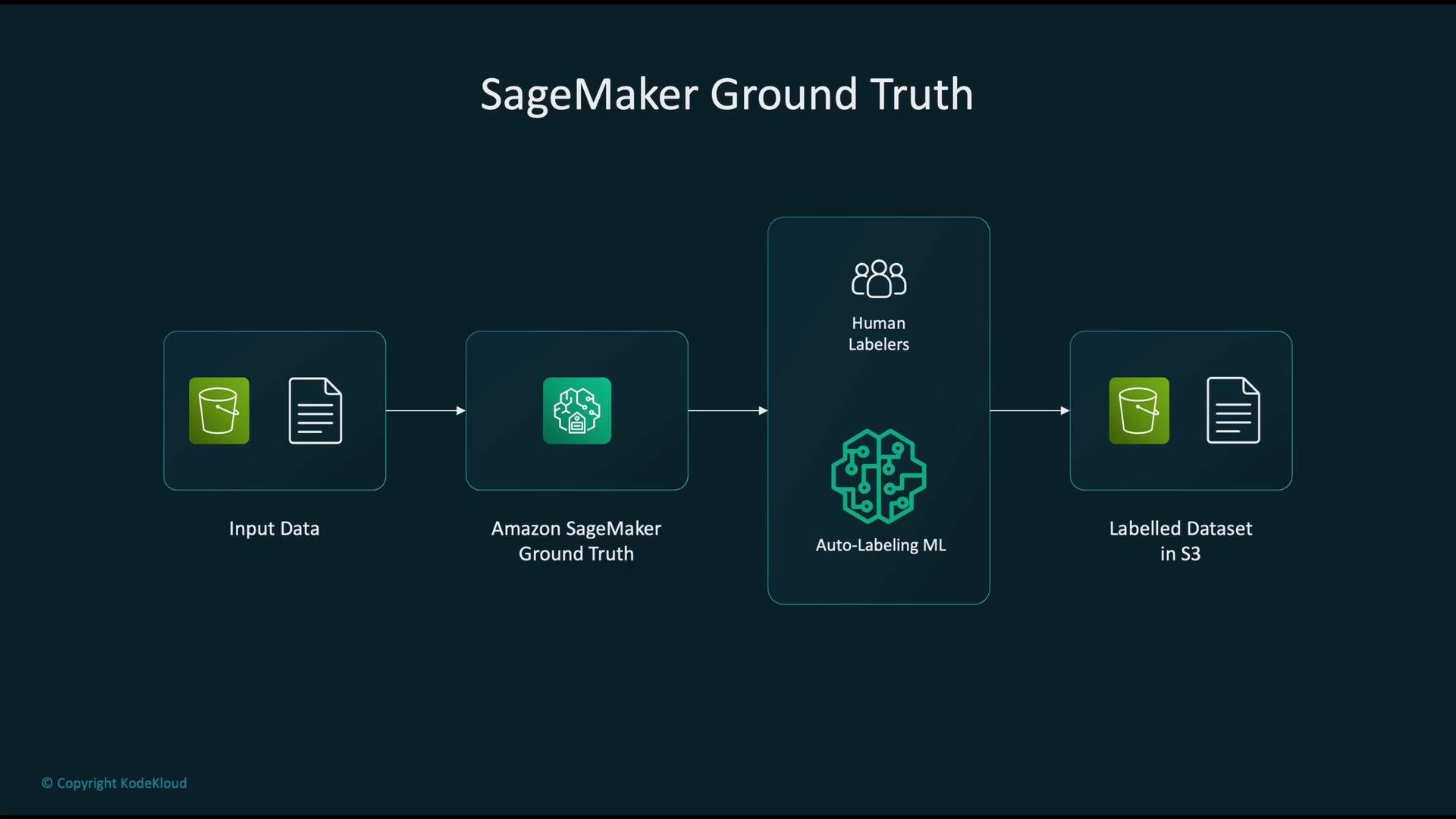
 Labeling is a critical step for supervised ML. Amazon SageMaker Ground Truth streamlines labeling by combining human labelers with automated model-assisted labeling to generate high-quality labeled datasets stored in S3.
 Because ML datasets often contain sensitive or regulated information, implement security and compliance controls appropriate to your domain. Common standards include:
* PCI DSS — payment card data protection.
* HIPAA — protected health information (PHI) controls.
* GDPR — data protection and subject rights for EU personal data.
Because ML datasets often contain sensitive or regulated information, implement security and compliance controls appropriate to your domain. Common standards include:
* PCI DSS — payment card data protection.
* HIPAA — protected health information (PHI) controls.
* GDPR — data protection and subject rights for EU personal data.
 Key takeaways
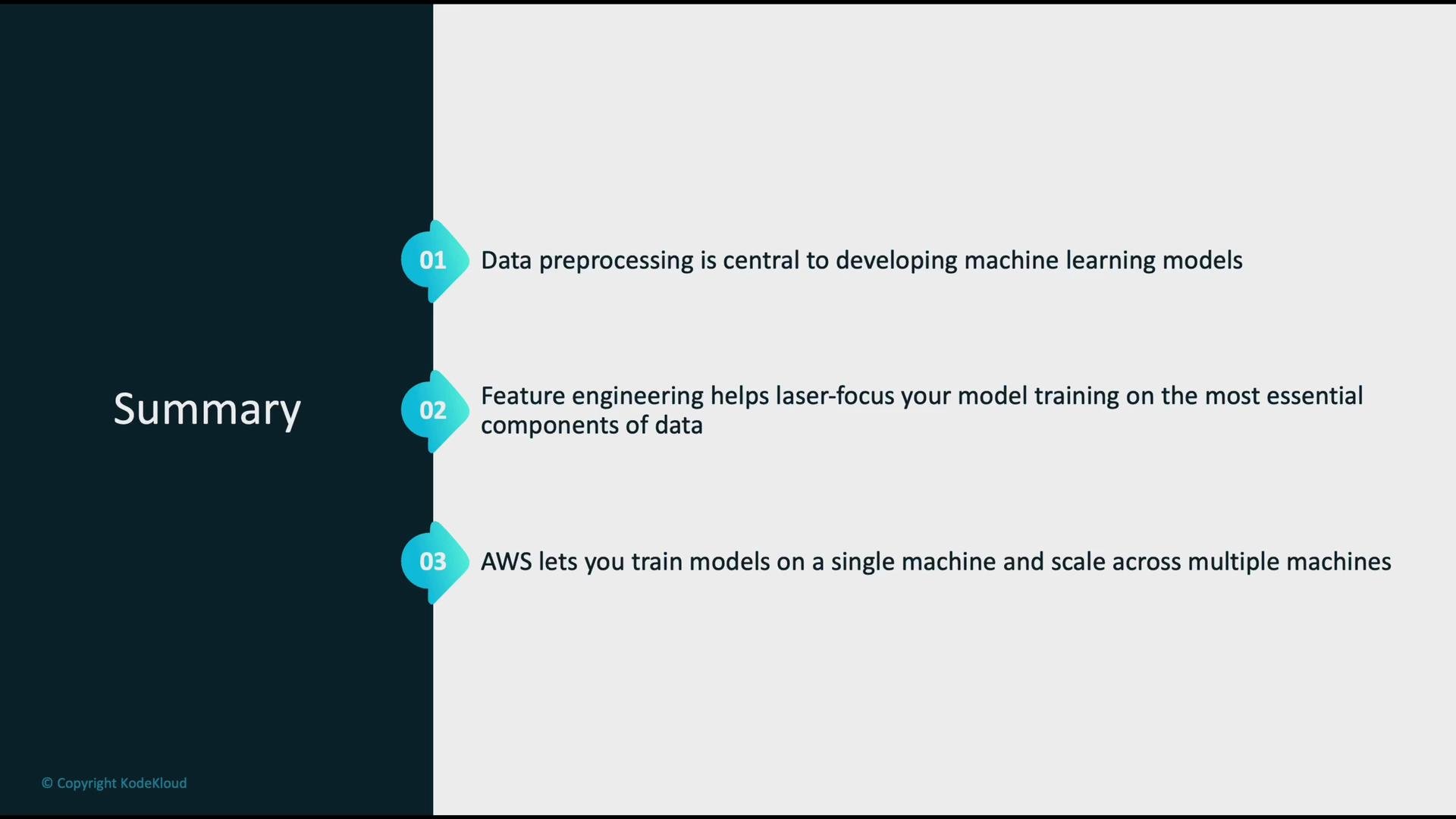
* Data preparation is critical: careful preprocessing and validation directly improve model performance and reliability.
* Feature engineering concentrates modeling effort on the most informative and stable signals.
* AWS offers services that support local experimentation, managed pipelines, distributed training, streaming analytics, and reusable features to scale from prototypes to production.
Key takeaways
* Data preparation is critical: careful preprocessing and validation directly improve model performance and reliability.
* Feature engineering concentrates modeling effort on the most informative and stable signals.
* AWS offers services that support local experimentation, managed pipelines, distributed training, streaming analytics, and reusable features to scale from prototypes to production.
 Amazon SageMaker Ground Truth supports human-in-the-loop labeling for many supervised tasks. In addition to labeling, AWS provides integrated tooling across the data lifecycle to help maintain security, ensure compliance, and automate feature reuse and streaming analytics.