> ## Documentation Index
> Fetch the complete documentation index at: https://notes.kodekloud.com/llms.txt
> Use this file to discover all available pages before exploring further.
# Encoding Techniques for ML Data
> Overview of categorical encoding techniques for machine learning, their pros and cons, selection guidance, leakage precautions, and AWS tools for implementing and operationalizing encoding workflows
When NASA sends instructions to a lunar rover, those instructions are not transmitted as English sentences — they are encoded into binary signals the hardware can interpret. Similarly, machine learning models operate on numeric structures: vectors, matrices, and tensors. Raw text such as "moon rover" has no intrinsic meaning to a model until it is converted into a numeric representation that preserves the data's structure and relationships.
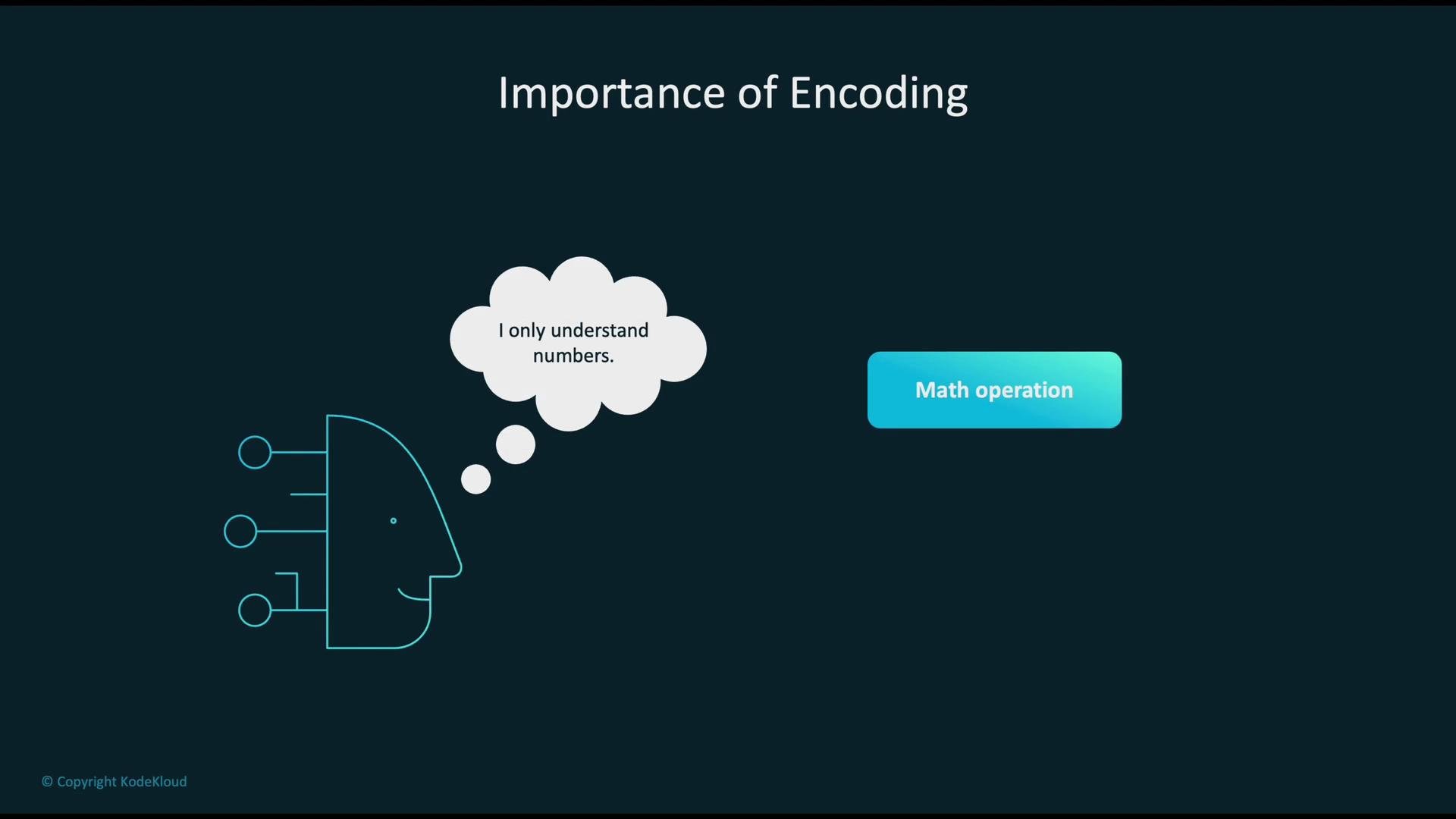
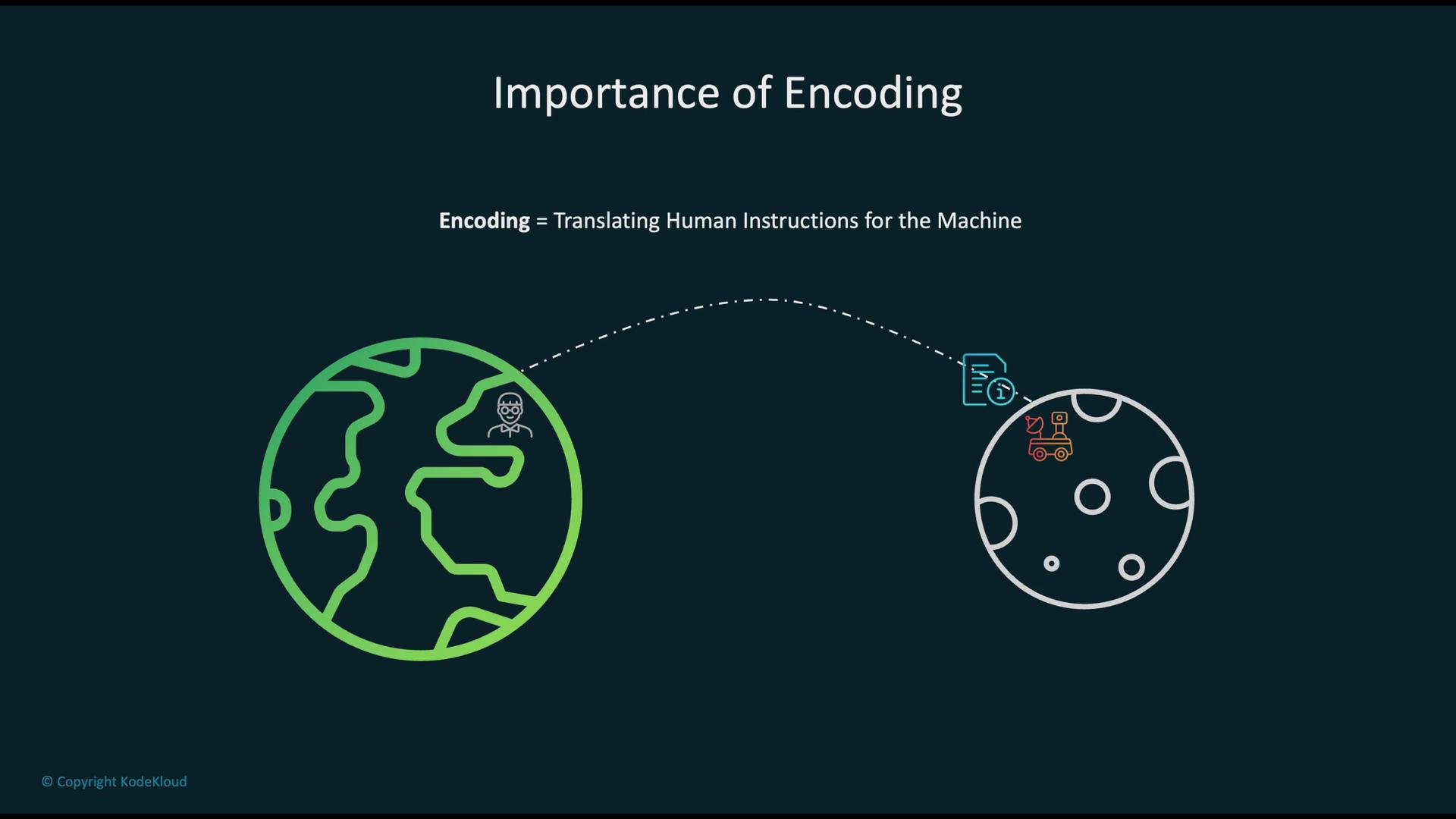 Most ML algorithms expect numeric inputs because core computations—dot products, distance metrics, gradient updates, and matrix multiplications—operate on numbers. Converting human-readable data into a numeric form is therefore a fundamental step in feature engineering and data preparation.
 Why encoding matters
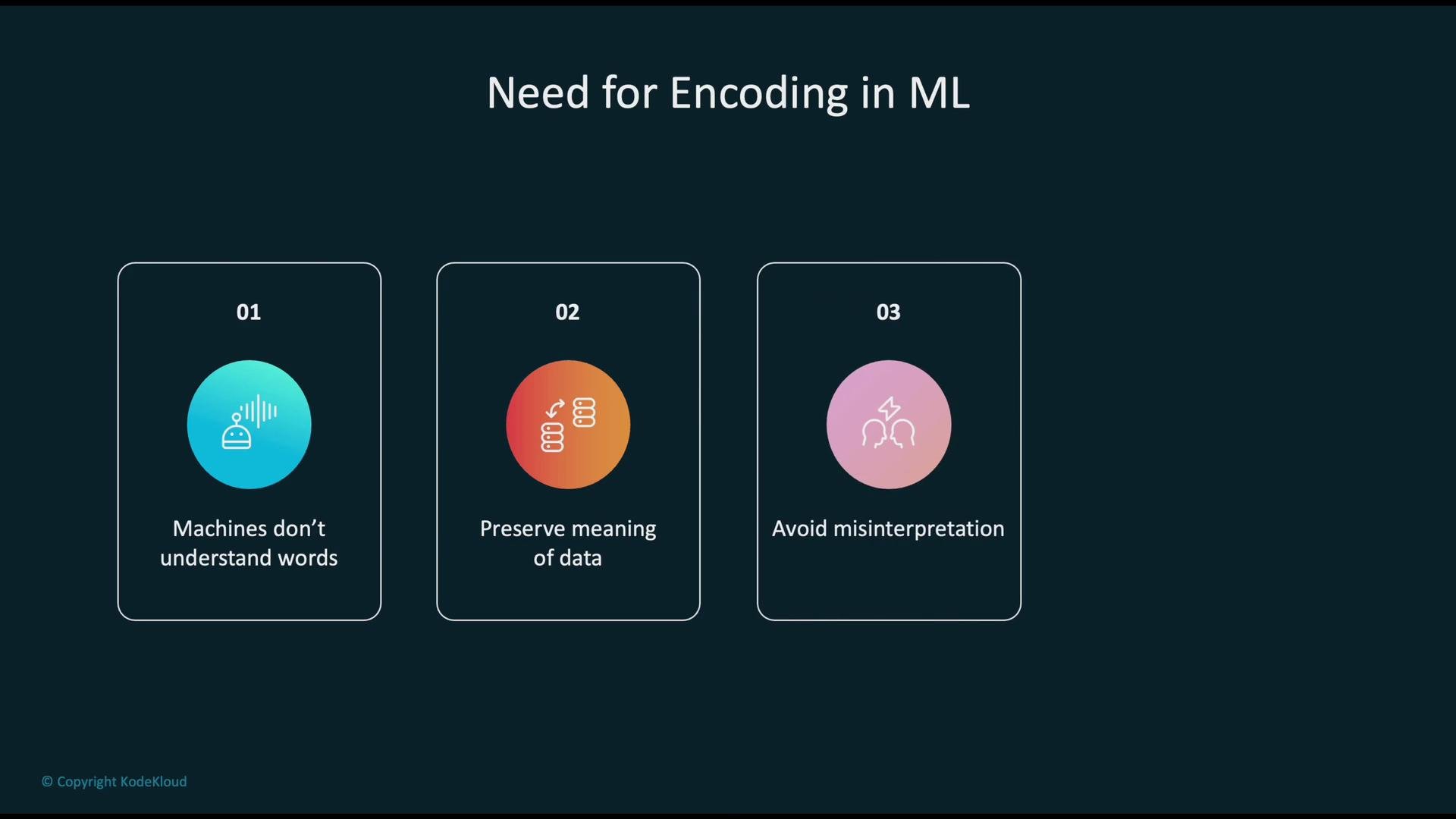
* Models require numeric inputs to perform linear algebra and optimization.
* Proper encoding preserves meaningful relationships between categories (similarity, ordering).
* Incorrect encodings can mislead algorithms—for example, implying an order where none exists.
* Effective encodings improve training speed, stability, and predictive performance.
Why encoding matters
* Models require numeric inputs to perform linear algebra and optimization.
* Proper encoding preserves meaningful relationships between categories (similarity, ordering).
* Incorrect encodings can mislead algorithms—for example, implying an order where none exists.
* Effective encodings improve training speed, stability, and predictive performance.
 Common categorical encoding techniques
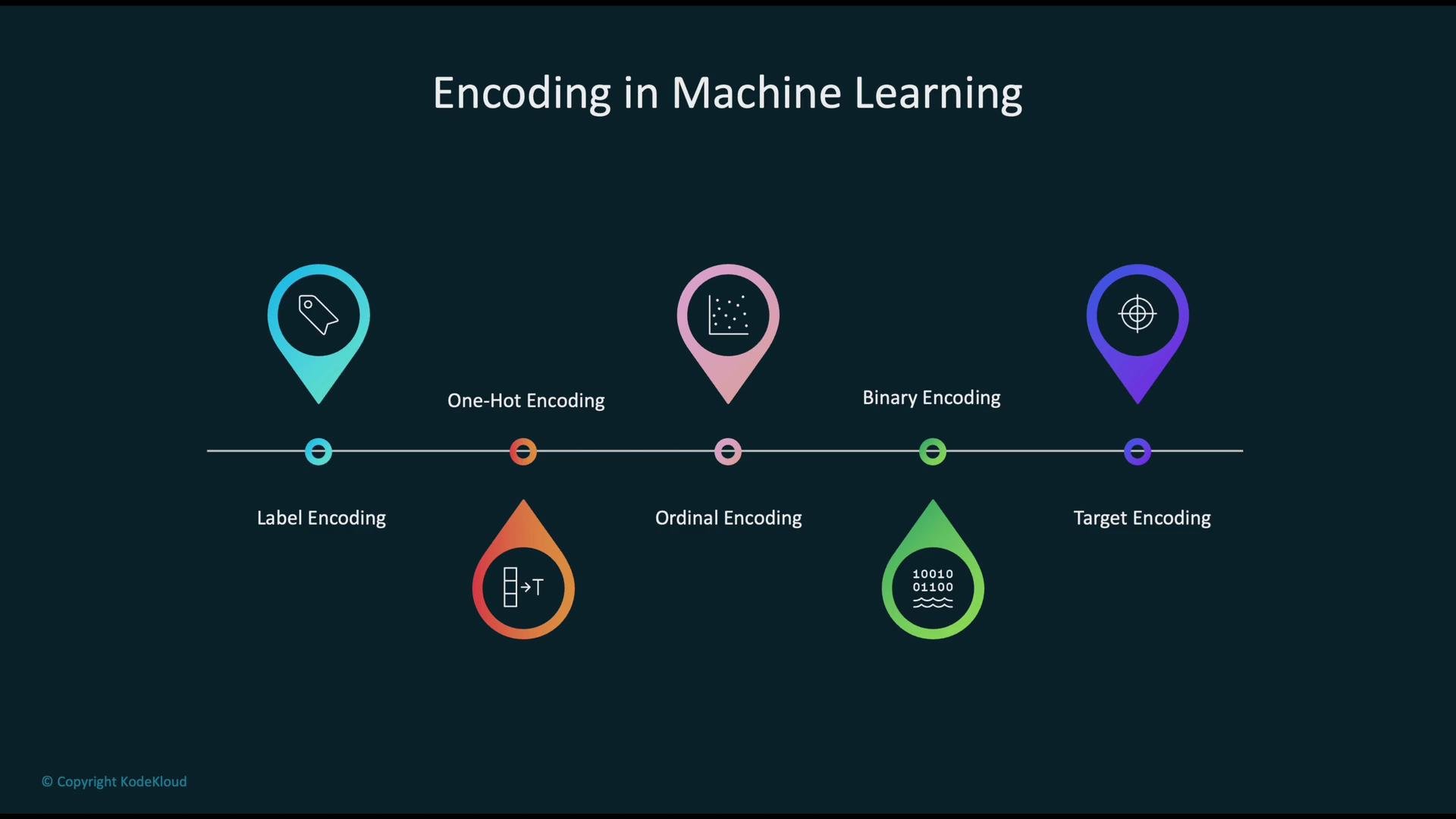
* Label encoding: assign a unique integer to each category.
* One-hot encoding: convert each category into a binary indicator column.
* Ordinal encoding: map categories to integers that reflect a meaningful order.
* Binary encoding: represent categories with binary digits to reduce dimensionality versus one-hot.
* Target encoding (mean encoding): replace categories with a statistic derived from the target (e.g., mean target value per category).
Common categorical encoding techniques
* Label encoding: assign a unique integer to each category.
* One-hot encoding: convert each category into a binary indicator column.
* Ordinal encoding: map categories to integers that reflect a meaningful order.
* Binary encoding: represent categories with binary digits to reduce dimensionality versus one-hot.
* Target encoding (mean encoding): replace categories with a statistic derived from the target (e.g., mean target value per category).
 Concise reference table
| Encoding Type | When to Use | Pros | Cons / Cautions |
| ---------------- | ----------------------------------------------------------------------------------------------------------------------------------- | ----------------------------------------------------------- | -------------------------------------------------- |
| Label encoding | Low-cardinality categorical features; algorithms that can interpret order (tree-based models can handle labels but may infer order) | Compact representation (`{'expedition': 0, 'research': 1}`) | Can imply ordinal relationships that don't exist |
| One-hot encoding | Nominal categories with manageable cardinality | No implied order; straightforward for linear models | High dimensionality for many categories |
| Ordinal encoding | Categories with a true rank (e.g., severity levels) | Captures ordering with single column | Must only be used when order is meaningful |
| Binary encoding | High-cardinality features when one-hot is too large | Reduced dimensionality compared to one-hot | Loses some interpretability |
| Target encoding | When category-target relationship is predictive | Often strong signal; compact | Risk of target leakage—requires careful validation |
Encoding techniques explained with a space-mission metaphor
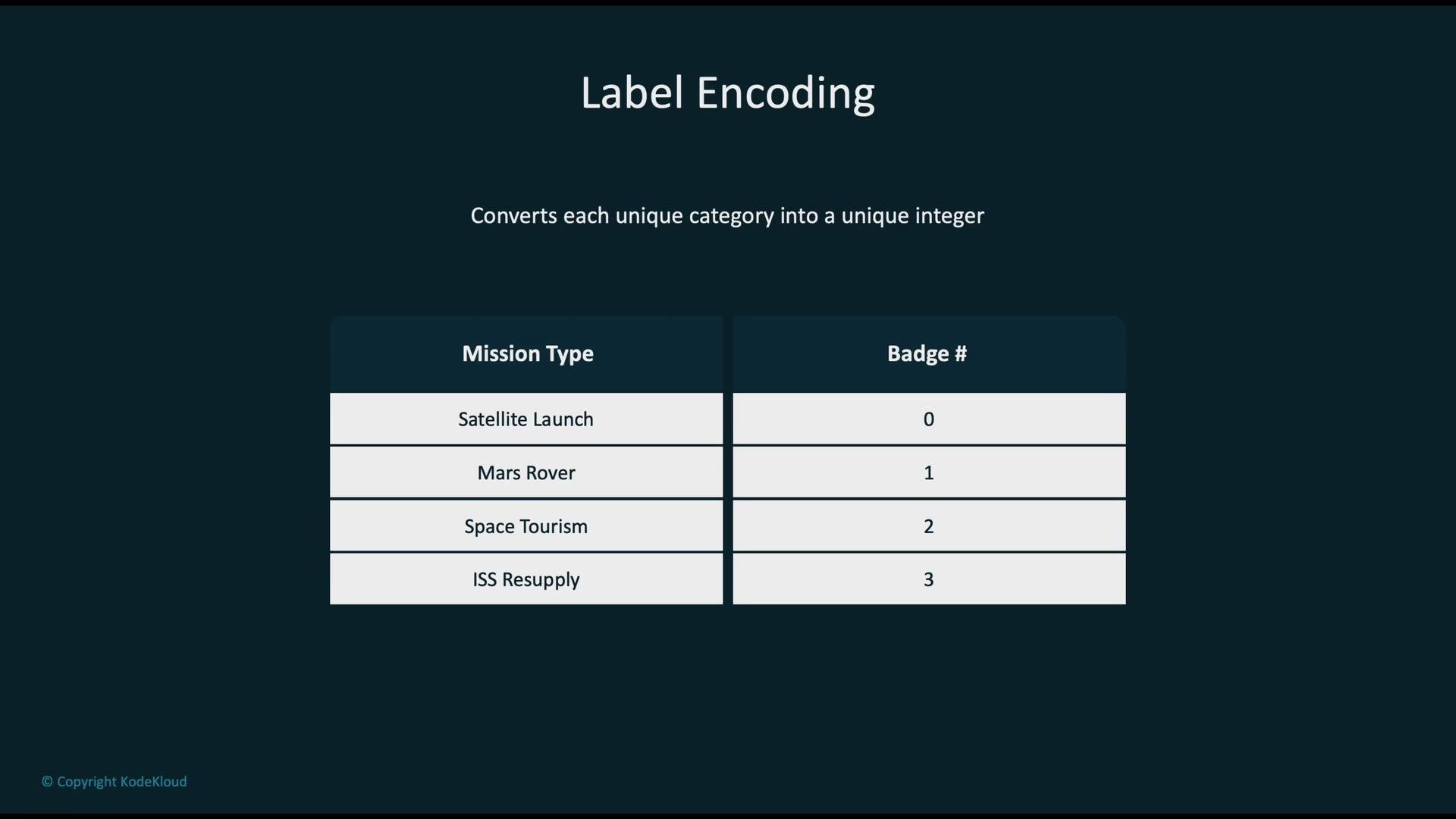
Label encoding
* Imagine assigning each mission type a unique badge number (an ID). That maps each category to an integer.
* Drawback: badge ordering may be misinterpreted by some models as meaningful magnitude.
Concise reference table
| Encoding Type | When to Use | Pros | Cons / Cautions |
| ---------------- | ----------------------------------------------------------------------------------------------------------------------------------- | ----------------------------------------------------------- | -------------------------------------------------- |
| Label encoding | Low-cardinality categorical features; algorithms that can interpret order (tree-based models can handle labels but may infer order) | Compact representation (`{'expedition': 0, 'research': 1}`) | Can imply ordinal relationships that don't exist |
| One-hot encoding | Nominal categories with manageable cardinality | No implied order; straightforward for linear models | High dimensionality for many categories |
| Ordinal encoding | Categories with a true rank (e.g., severity levels) | Captures ordering with single column | Must only be used when order is meaningful |
| Binary encoding | High-cardinality features when one-hot is too large | Reduced dimensionality compared to one-hot | Loses some interpretability |
| Target encoding | When category-target relationship is predictive | Often strong signal; compact | Risk of target leakage—requires careful validation |
Encoding techniques explained with a space-mission metaphor
Label encoding
* Imagine assigning each mission type a unique badge number (an ID). That maps each category to an integer.
* Drawback: badge ordering may be misinterpreted by some models as meaningful magnitude.
 One-hot encoding
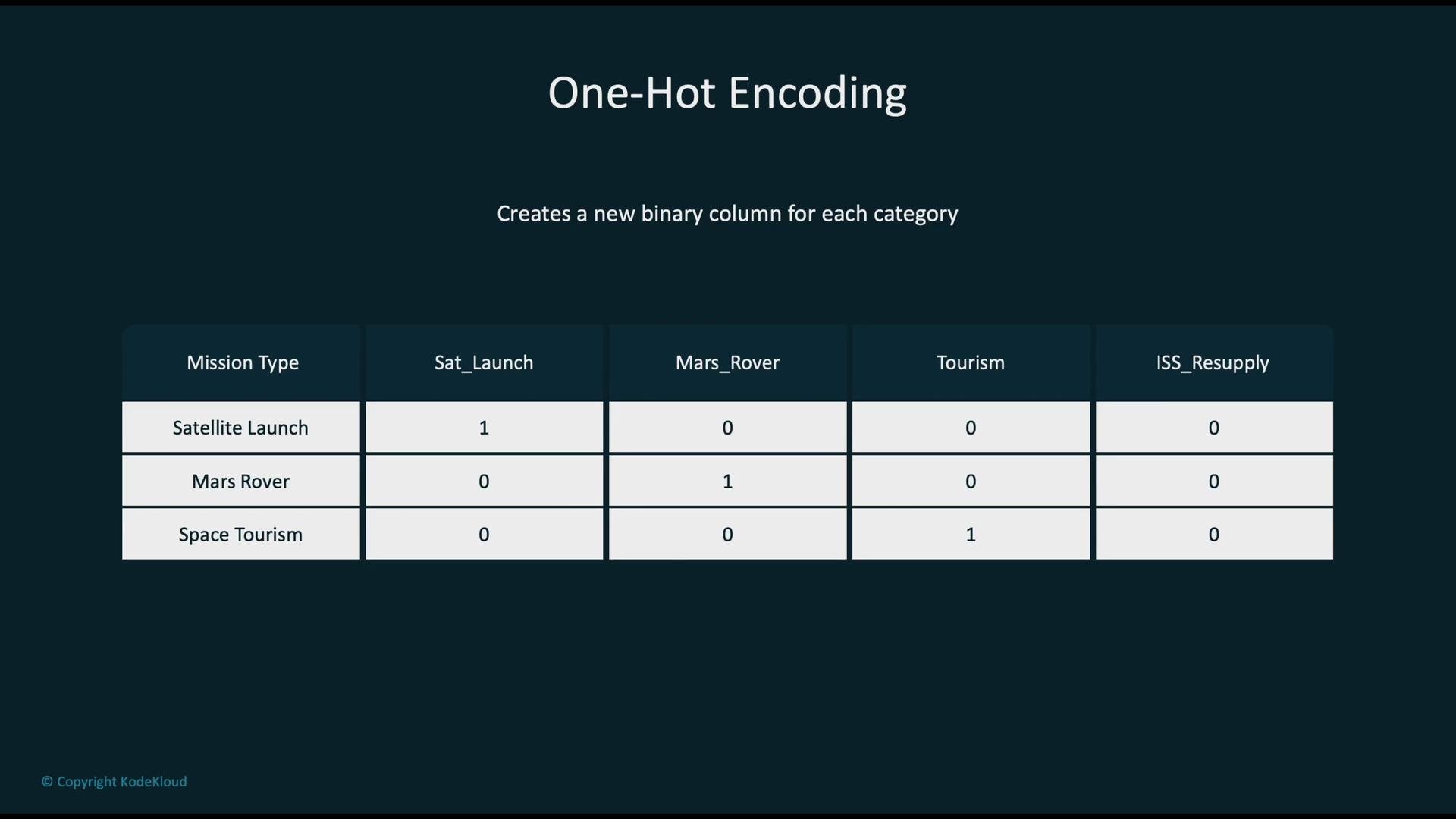
* Imagine a wall of flags where each mission raises the relevant flag; every category becomes a separate binary column.
* Ideal for unordered (nominal) categories and for models that can tolerate increased dimensionality.
One-hot encoding
* Imagine a wall of flags where each mission raises the relevant flag; every category becomes a separate binary column.
* Ideal for unordered (nominal) categories and for models that can tolerate increased dimensionality.
 Ordinal encoding
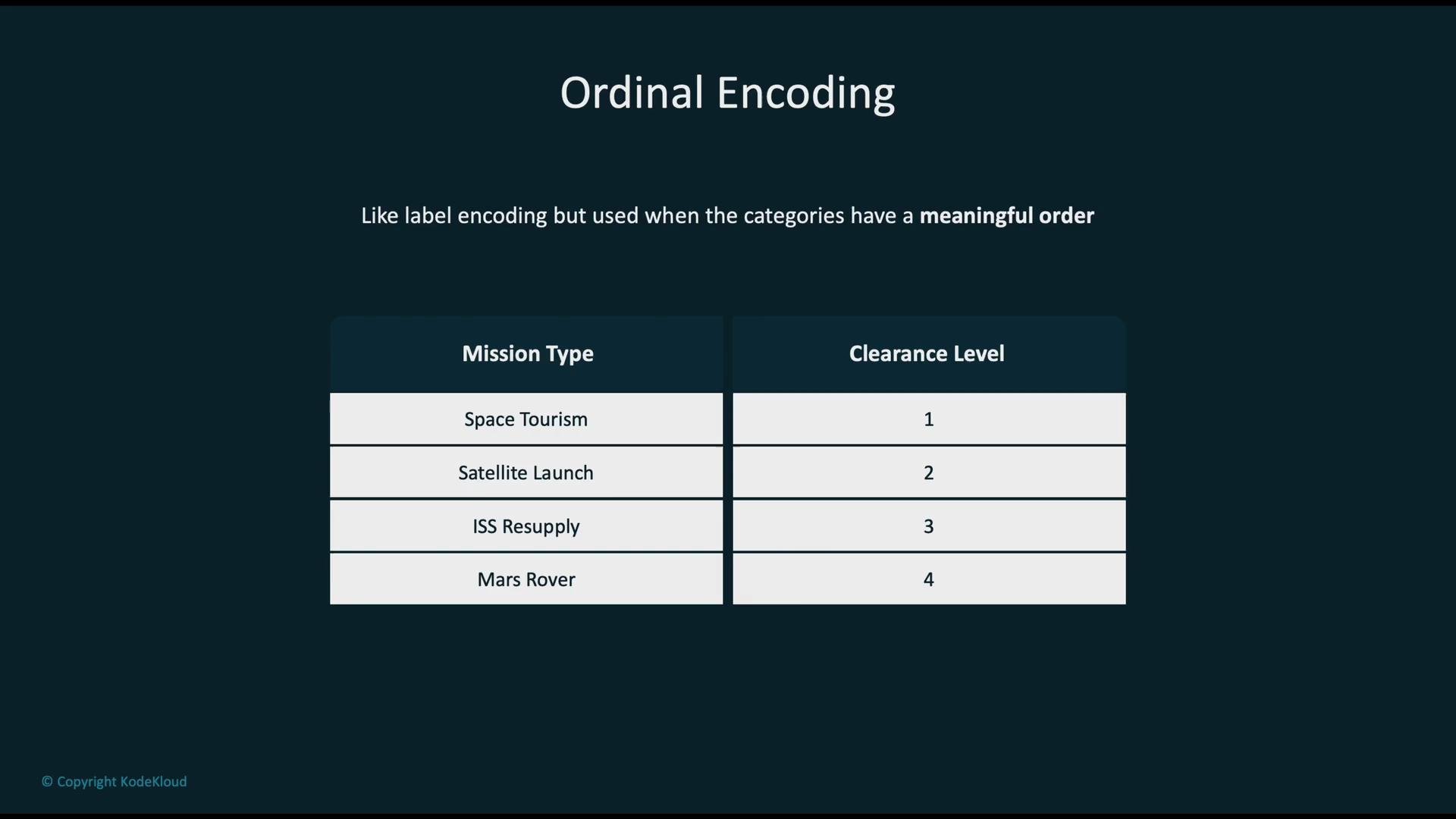
* Use when categories have an inherent order (e.g., clearance levels, mission priority).
* Encode ranks as integers so the model can learn the monotonic relationship.
Ordinal encoding
* Use when categories have an inherent order (e.g., clearance levels, mission priority).
* Encode ranks as integers so the model can learn the monotonic relationship.
 Binary encoding
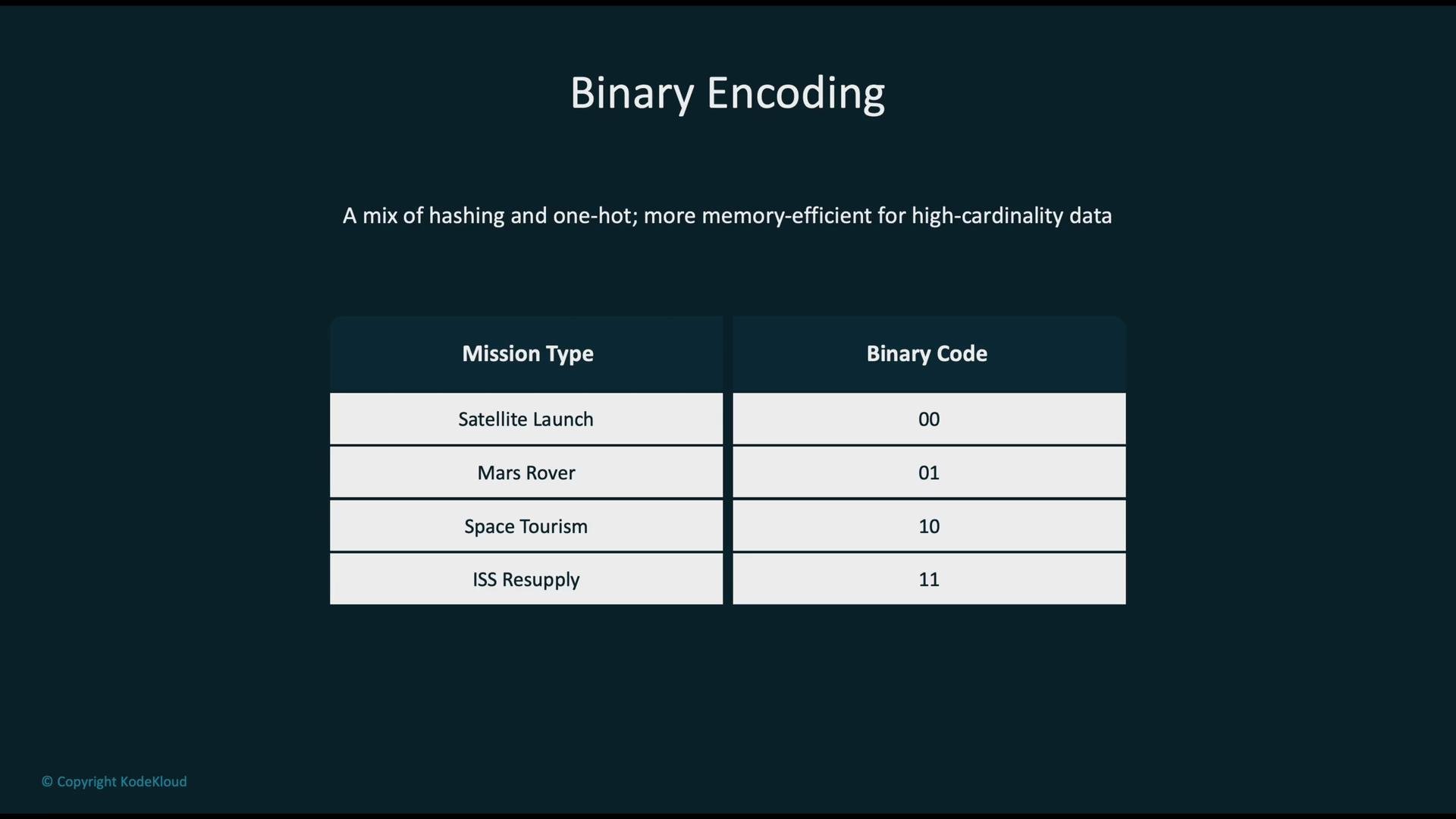
* Instead of sequential badge numbers, encode each category as a compact binary barcode.
* Good trade-off when there are many categories and you need to reduce feature space compared to one-hot.
Binary encoding
* Instead of sequential badge numbers, encode each category as a compact binary barcode.
* Good trade-off when there are many categories and you need to reduce feature space compared to one-hot.
 Target encoding (mean encoding)
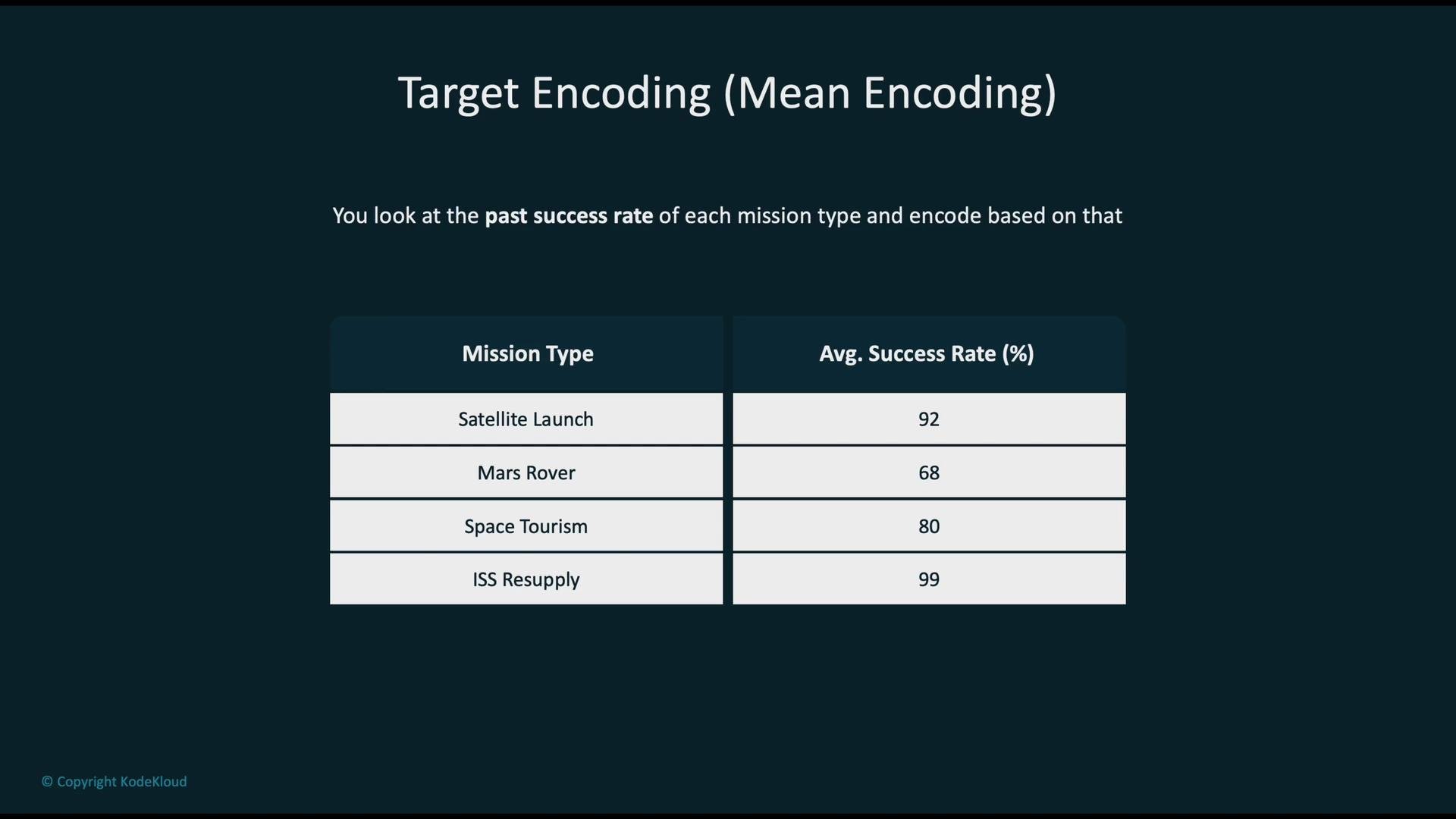
* Replace each category with a statistic derived from historic target values (for example, average mission success rate).
* This often yields a strong predictive signal but must be implemented carefully to avoid leaking information from the target into training.
Target encoding can introduce data leakage if the statistic is computed on the same data used to train the model. Use proper cross-validation, smoothing, and regularization (or out-of-fold approaches) to mitigate leakage and overfitting.
Target encoding (mean encoding)
* Replace each category with a statistic derived from historic target values (for example, average mission success rate).
* This often yields a strong predictive signal but must be implemented carefully to avoid leaking information from the target into training.
Target encoding can introduce data leakage if the statistic is computed on the same data used to train the model. Use proper cross-validation, smoothing, and regularization (or out-of-fold approaches) to mitigate leakage and overfitting.
 How to choose the right encoding
* One-hot: use for nominal categories with a manageable number of unique values.
* Ordinal: use only when category order is meaningful and informative to the model.
* Binary or hashing-based encodings: use for very high-cardinality features to save memory and reduce dimensionality.
* Target encoding: use when category-target correlation is strong — but always protect against leakage via out-of-fold strategies and smoothing.
AWS tooling that supports encoding workflows
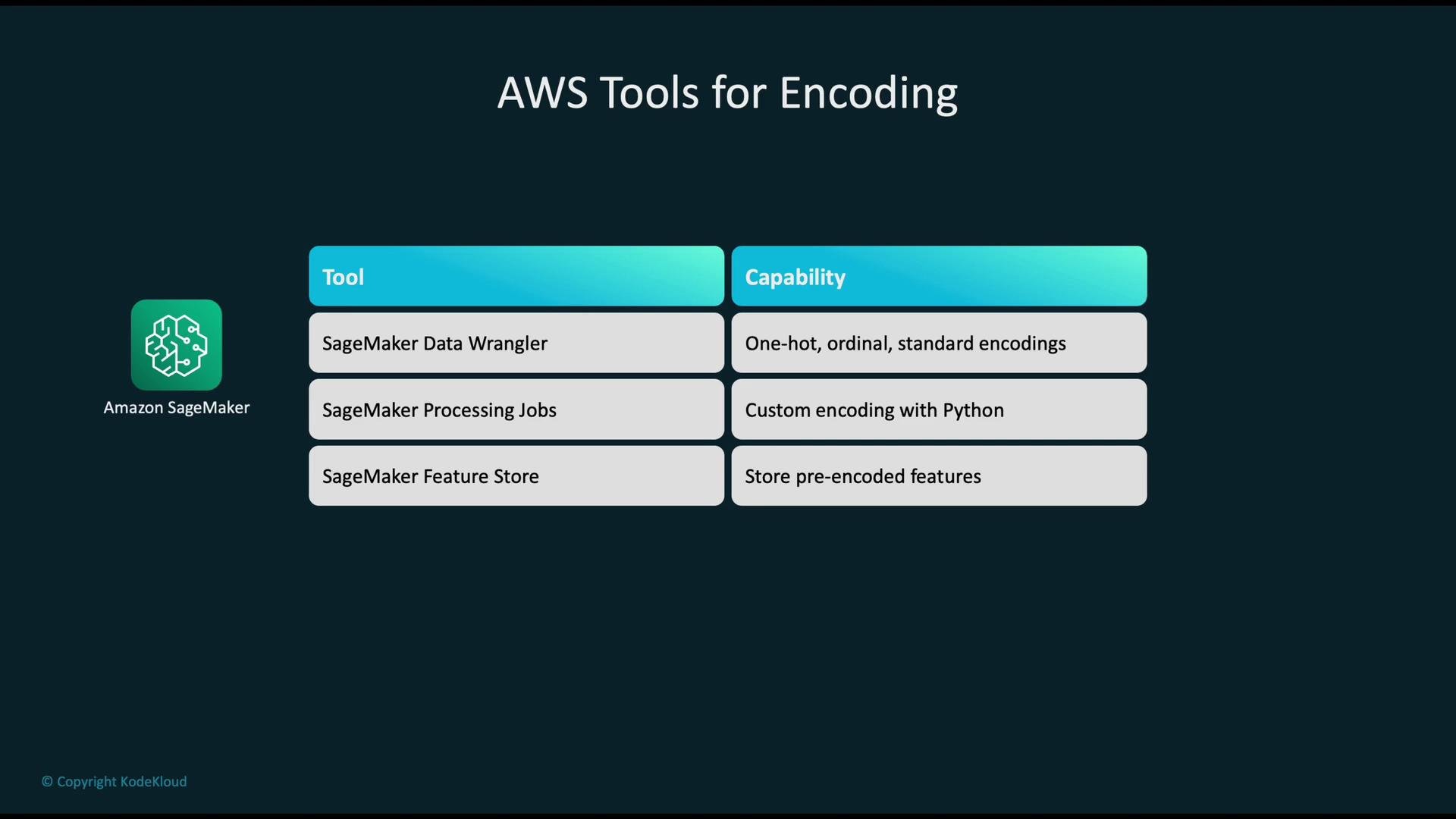
* [SageMaker Data Wrangler](https://learn.kodekloud.com/user/courses/aws-sagemaker): visual, no-code/low-code transformations with built-in encodings for fast exploration and preprocessing.
* [SageMaker Processing Jobs](https://learn.kodekloud.com/user/courses/aws-sagemaker): run custom Python or PySpark code for repeatable, reproducible encoding logic as part of ML pipelines.
* [SageMaker Feature Store](https://learn.kodekloud.com/user/courses/aws-sagemaker): store precomputed features (including encoded features) for consistent reuse across training and inference.
* [AWS Glue](https://aws.amazon.com/glue/): large-scale distributed ETL (PySpark/Glue jobs) to encode and transform massive datasets at scale; integrates with `Amazon S3`, the Glue Data Catalog, and downstream ML workflows.
How to choose the right encoding
* One-hot: use for nominal categories with a manageable number of unique values.
* Ordinal: use only when category order is meaningful and informative to the model.
* Binary or hashing-based encodings: use for very high-cardinality features to save memory and reduce dimensionality.
* Target encoding: use when category-target correlation is strong — but always protect against leakage via out-of-fold strategies and smoothing.
AWS tooling that supports encoding workflows
* [SageMaker Data Wrangler](https://learn.kodekloud.com/user/courses/aws-sagemaker): visual, no-code/low-code transformations with built-in encodings for fast exploration and preprocessing.
* [SageMaker Processing Jobs](https://learn.kodekloud.com/user/courses/aws-sagemaker): run custom Python or PySpark code for repeatable, reproducible encoding logic as part of ML pipelines.
* [SageMaker Feature Store](https://learn.kodekloud.com/user/courses/aws-sagemaker): store precomputed features (including encoded features) for consistent reuse across training and inference.
* [AWS Glue](https://aws.amazon.com/glue/): large-scale distributed ETL (PySpark/Glue jobs) to encode and transform massive datasets at scale; integrates with `Amazon S3`, the Glue Data Catalog, and downstream ML workflows.
 Final notes and best practices
* Treat encoding as part of feature engineering: choose techniques that match the feature semantics and target problem.
* Always validate encoding strategies with proper cross-validation and holdout sets to prevent overfitting.
* For production, persist encoding rules or pre-encoded features (e.g., in a feature store) to ensure training and inference use the same transformations.
* When working with large, high-cardinality categorical data, balance predictive power against computational cost and interpretability.
Summary
* Encoding converts human-readable categories into numeric formats that ML algorithms can ingest.
* Select the encoding based on category type (nominal vs ordinal), cardinality, model family, and leakage risk.
* Leverage AWS services like SageMaker and AWS Glue to implement, scale, and operationalize encoding workflows with reproducibility.
Links and references
* [SageMaker Data Wrangler](https://learn.kodekloud.com/user/courses/aws-sagemaker)
* [SageMaker Processing Jobs](https://learn.kodekloud.com/user/courses/aws-sagemaker)
* [SageMaker Feature Store](https://learn.kodekloud.com/user/courses/aws-sagemaker)
* [AWS Glue](https://aws.amazon.com/glue/)
* For a deeper dive on categorical encodings and leakage prevention, search for terms such as "target encoding leakage", "one-hot vs binary encoding", and "feature engineering categorical variables".
Final notes and best practices
* Treat encoding as part of feature engineering: choose techniques that match the feature semantics and target problem.
* Always validate encoding strategies with proper cross-validation and holdout sets to prevent overfitting.
* For production, persist encoding rules or pre-encoded features (e.g., in a feature store) to ensure training and inference use the same transformations.
* When working with large, high-cardinality categorical data, balance predictive power against computational cost and interpretability.
Summary
* Encoding converts human-readable categories into numeric formats that ML algorithms can ingest.
* Select the encoding based on category type (nominal vs ordinal), cardinality, model family, and leakage risk.
* Leverage AWS services like SageMaker and AWS Glue to implement, scale, and operationalize encoding workflows with reproducibility.
Links and references
* [SageMaker Data Wrangler](https://learn.kodekloud.com/user/courses/aws-sagemaker)
* [SageMaker Processing Jobs](https://learn.kodekloud.com/user/courses/aws-sagemaker)
* [SageMaker Feature Store](https://learn.kodekloud.com/user/courses/aws-sagemaker)
* [AWS Glue](https://aws.amazon.com/glue/)
* For a deeper dive on categorical encodings and leakage prevention, search for terms such as "target encoding leakage", "one-hot vs binary encoding", and "feature engineering categorical variables".