> ## Documentation Index
> Fetch the complete documentation index at: https://notes.kodekloud.com/llms.txt
> Use this file to discover all available pages before exploring further.
# Importance of Data Preparation in Machine Learning
> The importance of data preparation for reliable machine learning, covering cleaning, transformation, feature engineering, labeling, validation, and techniques to improve model accuracy and reduce bias.
Data preparation is the foundation of reliable machine learning. Models—no matter how sophisticated—depend on high-quality, well-structured inputs to learn meaningful patterns. When raw data is messy, incomplete, or inconsistent, even the best algorithms can produce inaccurate or unfair results.
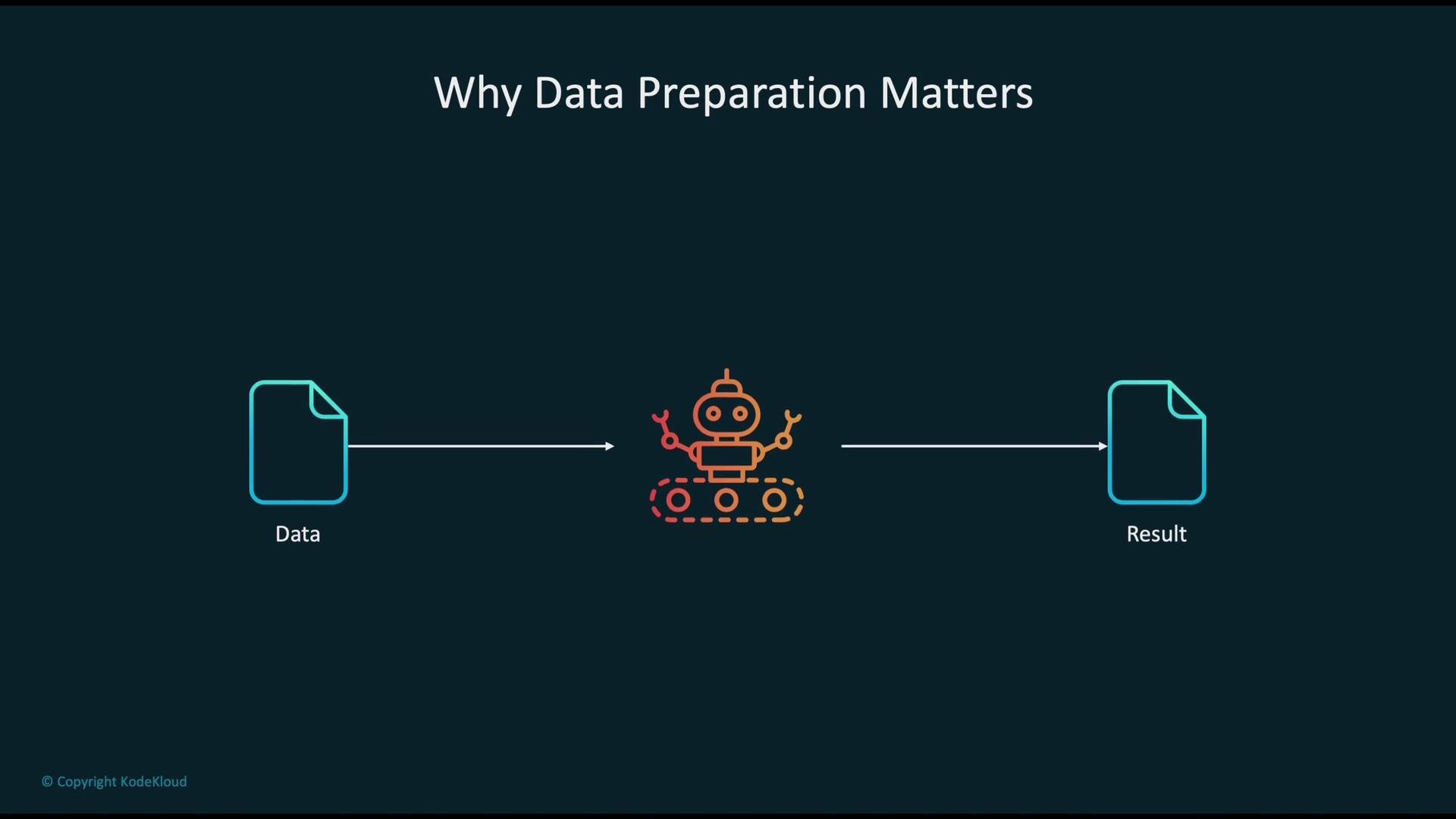 In practice, real-world datasets often contain missing values, format mismatches, duplicates, and noise. Addressing these issues early prevents downstream model failures and reduces expensive rework during training and deployment.
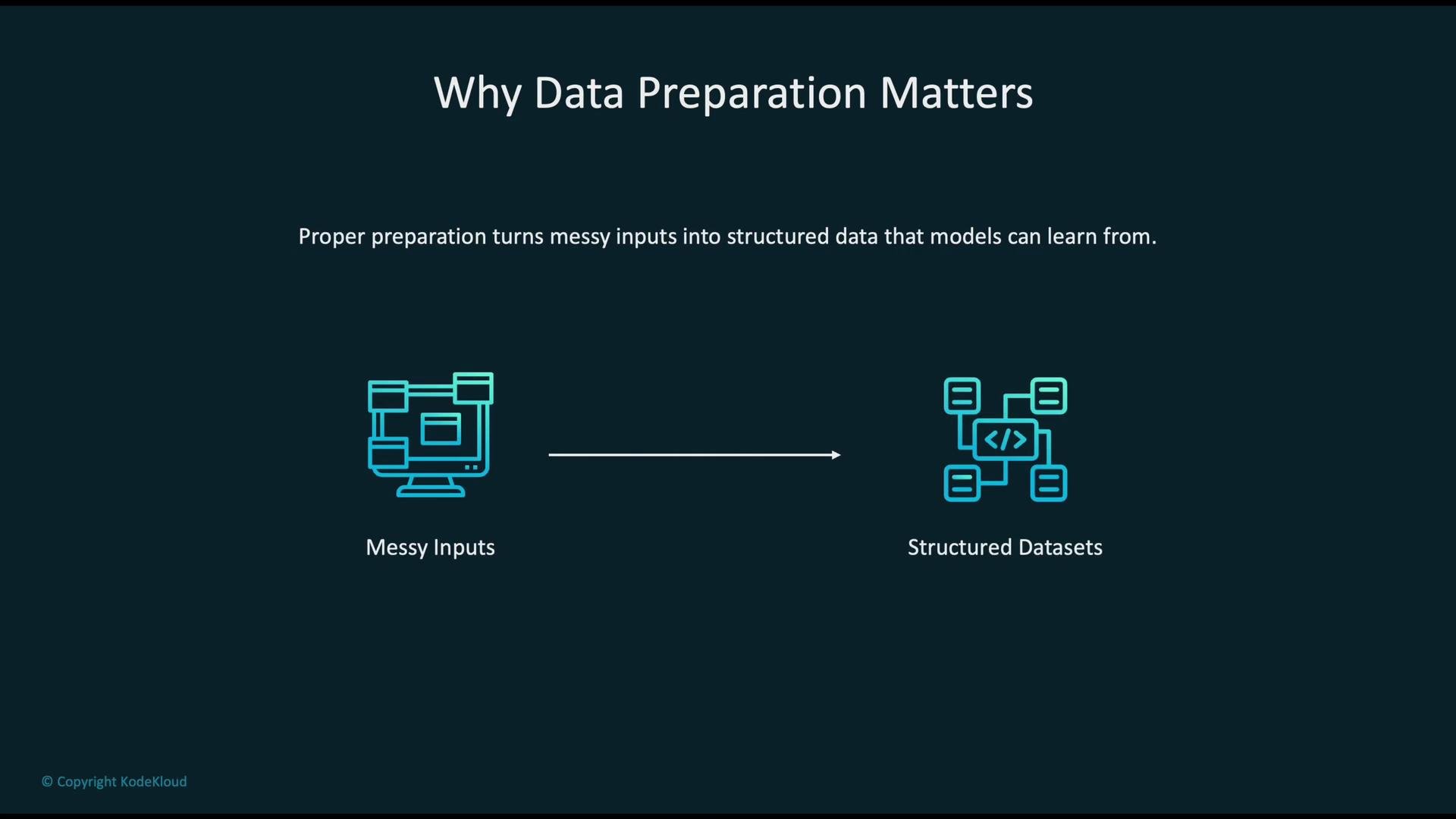
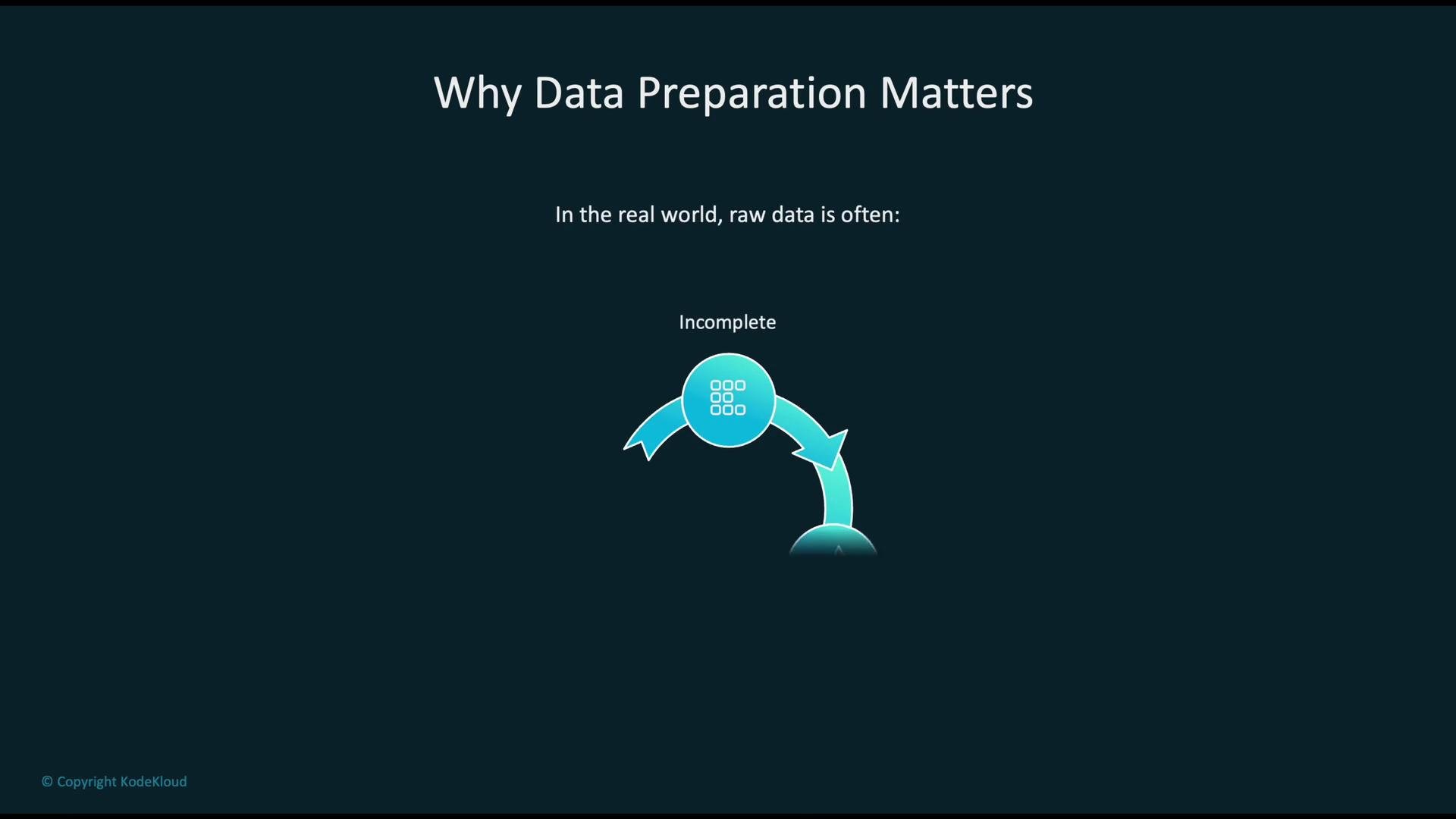 Transforming raw inputs into consistent, structured datasets enables models to converge faster and generalize better. In short: better data leads to better models.
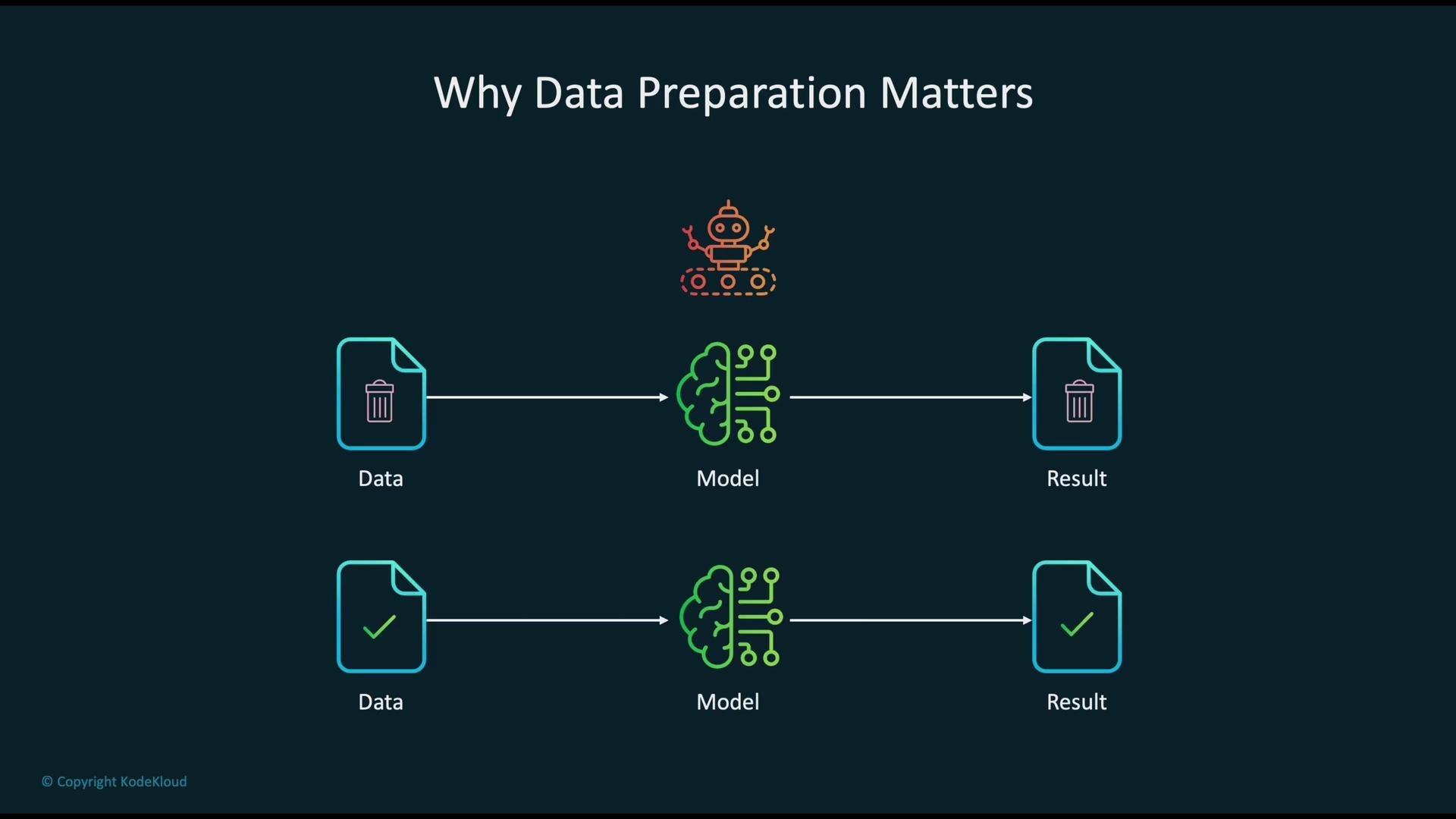
 The principle is simple: garbage in, garbage out. Clean, well-prepared data helps algorithms discover true signal; poor data misleads them.
 A majority of ML project time is spent on data preparation rather than modeling. That investment improves model accuracy, reduces bias, and speeds up deployment.
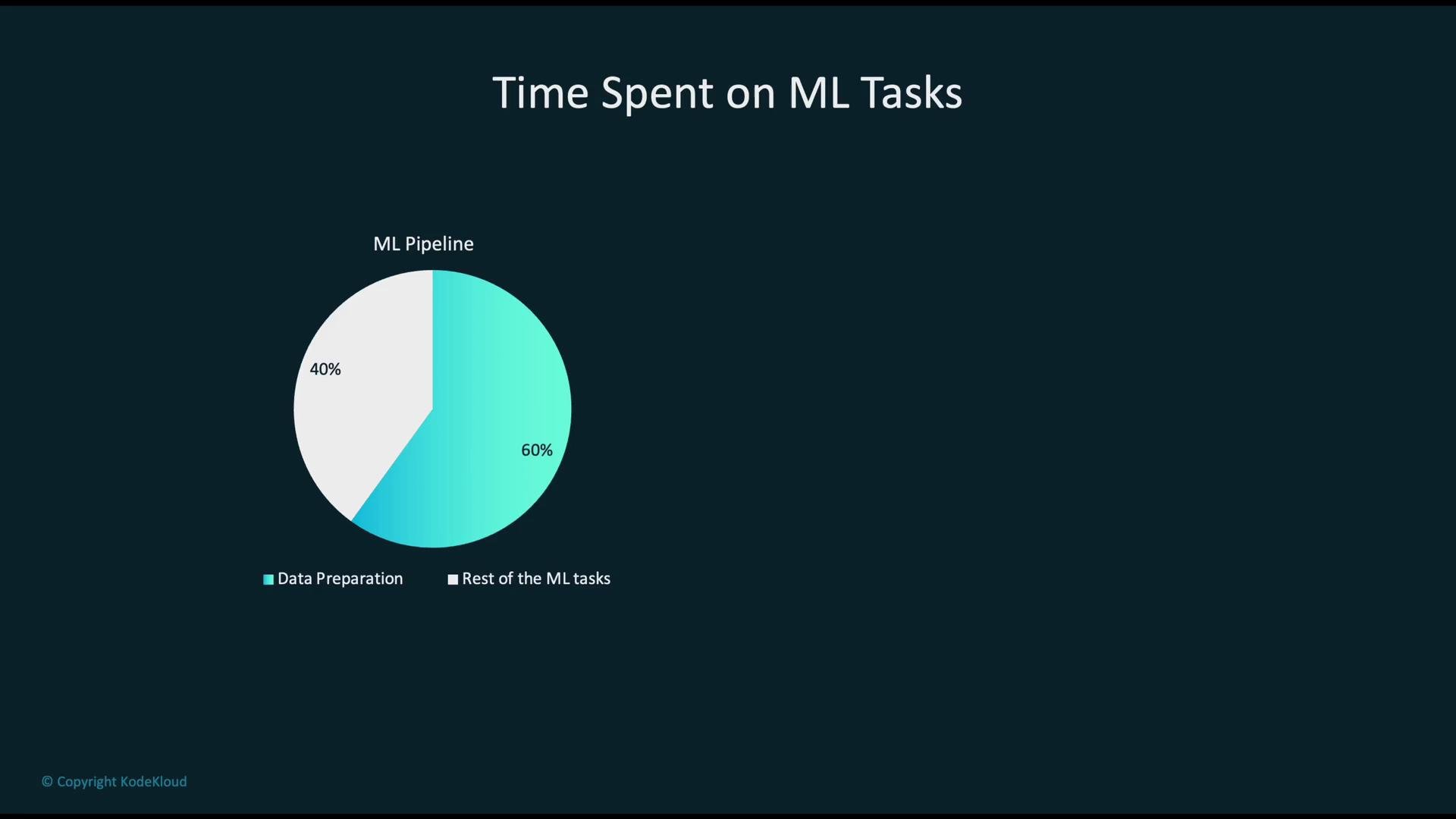 Investing time in data preparation reduces rework, improves reproducibility, and often yields greater performance gains than tuning model hyperparameters.
Key benefits of careful data preparation
* Improved model accuracy and robustness
* Consistent, reliable inputs for training and inference
* Easier feature engineering and richer representations
* Reduced overfitting and faster training convergence
* Mitigated bias and fairer model behavior
Common data quality issues to watch for
| Issue | Why it matters | Typical action |
| -------------------- | ------------------------------------------------ | ---------------------------------------------------- |
| Missing values | Can bias statistics and model estimates | Impute, add missing flags, or remove features/rows |
| Duplicates | Inflate apparent sample size and skew results | Deduplicate at source or with strict keys |
| Inconsistent formats | Parsing failures and incorrect feature types | Normalize date/time, numeric formats, categories |
| Outliers | Can dominate loss functions and distort patterns | Winsorize, transform, or detect & handle separately |
| Class imbalance | Models favor majority classes | Resampling, class weights, or specialized algorithms |
Recognizing these problems early prevents setbacks during training and improves downstream evaluation.
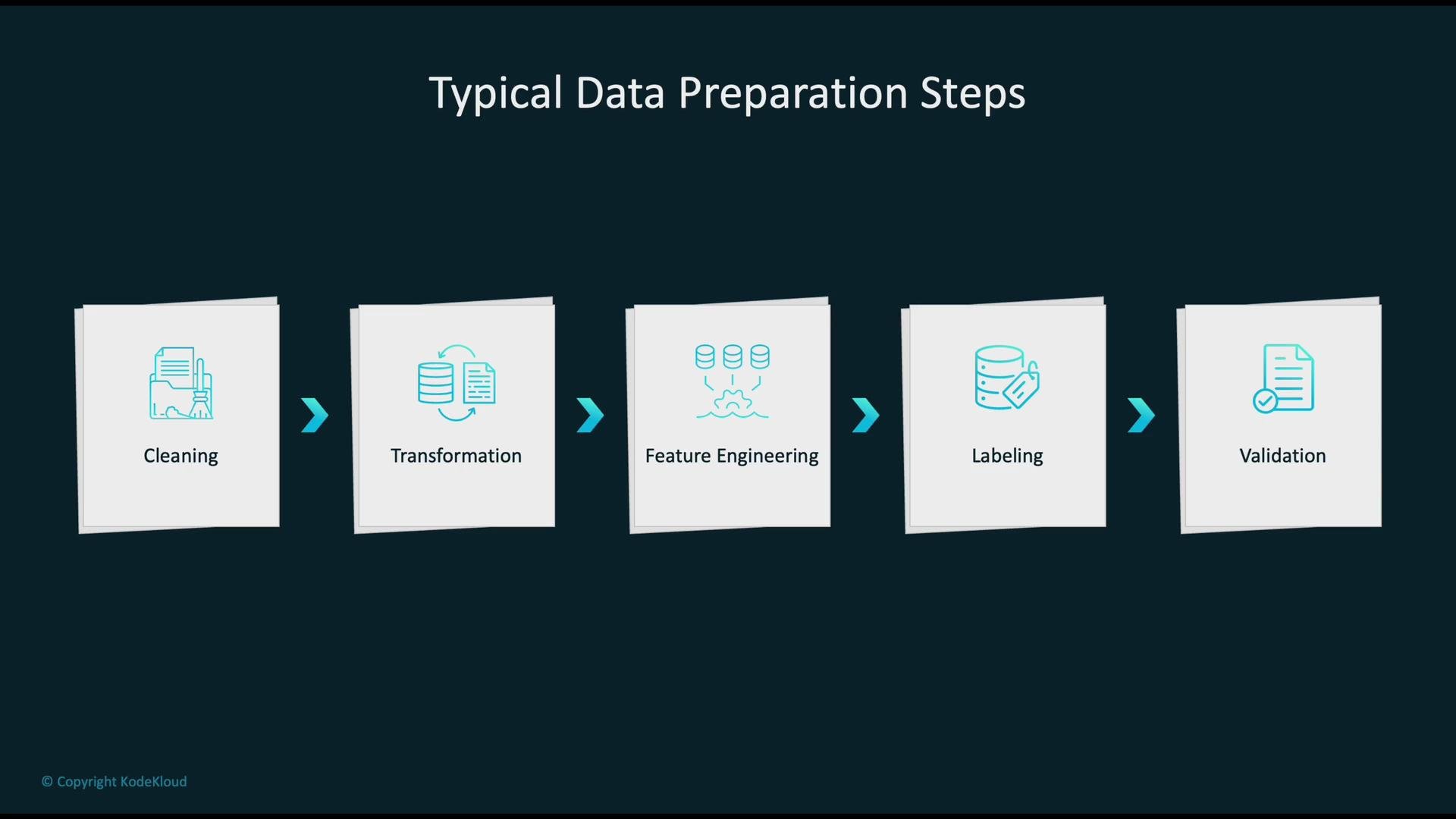
Typical data preparation workflow
1. Cleaning — Correct typos, impute missing values, remove duplicates, standardize formats.
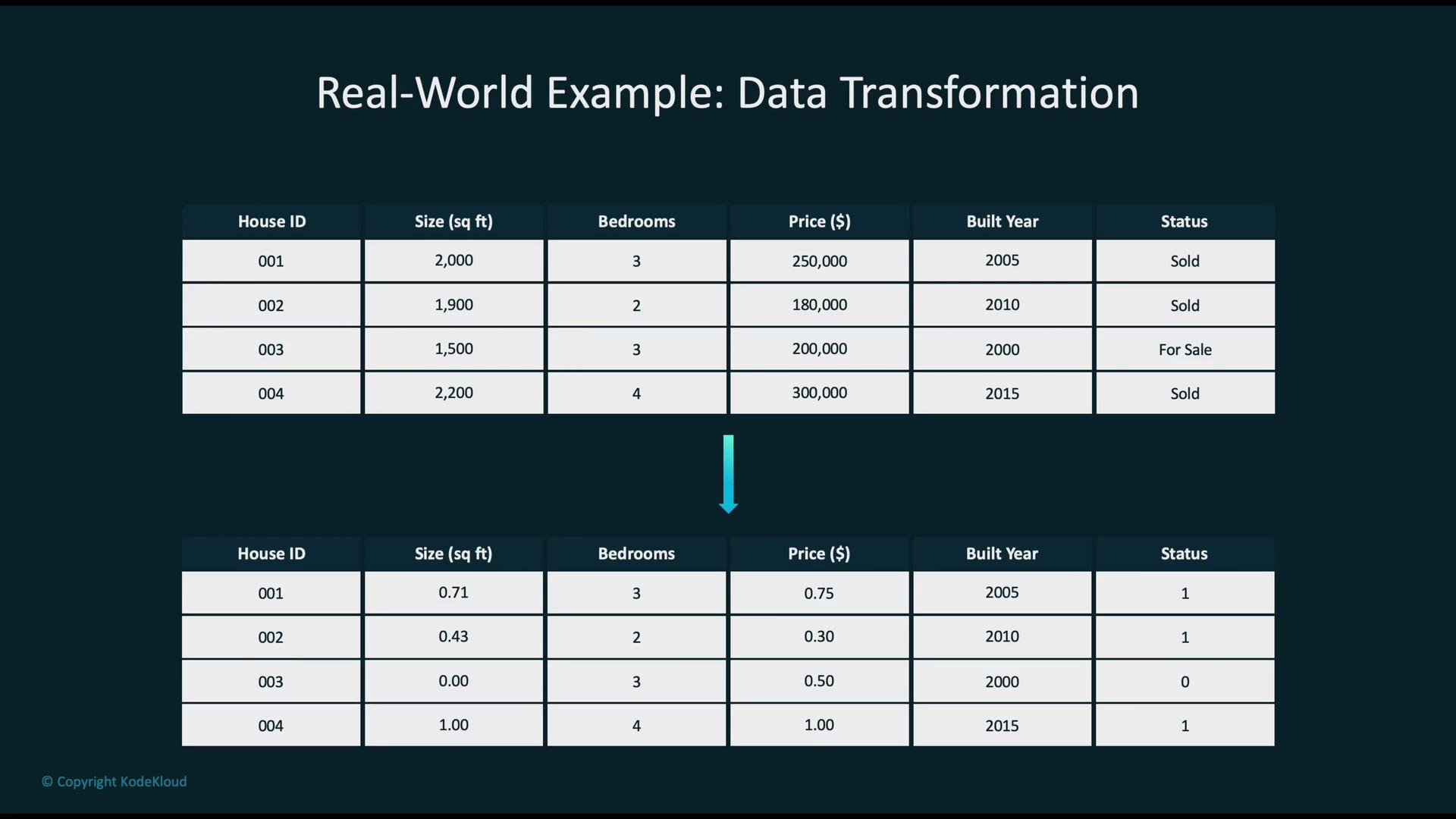
2. Transformation — Scale or normalize numeric features; convert types (e.g., strings → numeric).
3. Feature engineering — Derive informative features from raw columns.
4. Labeling — Ensure accurate and consistent target values for supervised learning.
5. Validation — Test prepared data with holdouts, cross-validation, and drift checks.
Each step builds on the previous one: cleaning ensures consistency; transformation readies data for algorithms; feature engineering boosts signal; labeling provides ground truth; validation confirms generalization.
Investing time in data preparation reduces rework, improves reproducibility, and often yields greater performance gains than tuning model hyperparameters.
Key benefits of careful data preparation
* Improved model accuracy and robustness
* Consistent, reliable inputs for training and inference
* Easier feature engineering and richer representations
* Reduced overfitting and faster training convergence
* Mitigated bias and fairer model behavior
Common data quality issues to watch for
| Issue | Why it matters | Typical action |
| -------------------- | ------------------------------------------------ | ---------------------------------------------------- |
| Missing values | Can bias statistics and model estimates | Impute, add missing flags, or remove features/rows |
| Duplicates | Inflate apparent sample size and skew results | Deduplicate at source or with strict keys |
| Inconsistent formats | Parsing failures and incorrect feature types | Normalize date/time, numeric formats, categories |
| Outliers | Can dominate loss functions and distort patterns | Winsorize, transform, or detect & handle separately |
| Class imbalance | Models favor majority classes | Resampling, class weights, or specialized algorithms |
Recognizing these problems early prevents setbacks during training and improves downstream evaluation.
Typical data preparation workflow
1. Cleaning — Correct typos, impute missing values, remove duplicates, standardize formats.
2. Transformation — Scale or normalize numeric features; convert types (e.g., strings → numeric).
3. Feature engineering — Derive informative features from raw columns.
4. Labeling — Ensure accurate and consistent target values for supervised learning.
5. Validation — Test prepared data with holdouts, cross-validation, and drift checks.
Each step builds on the previous one: cleaning ensures consistency; transformation readies data for algorithms; feature engineering boosts signal; labeling provides ground truth; validation confirms generalization.
 Practical techniques and examples
* Imputation
* Numeric: replace missing values with mean/median or use model-based imputation.
* Categorical: replace with mode or a special category such as `"missing"`.
* Scaling
* Standardize (z-score) or normalize (min-max) features like price or area so they contribute proportionally.
* Encoding
* One-hot encoding for low-cardinality categories; ordinal encoding for ordered categories; target or binary encoding for high-cardinality features.
* Handling class imbalance
* Oversample minority class (SMOTE), undersample majority class, or apply class weights in the loss function.
Example: typical pandas transformations
```python theme={null}
import pandas as pd
from sklearn.impute import SimpleImputer
from sklearn.preprocessing import StandardScaler
df = pd.read_csv("housing.csv")
# Replace "N A" with NaN and impute size with column mean
df['size'] = pd.to_numeric(df['size'].replace("N A", pd.NA))
df['size'] = df['size'].fillna(df['size'].mean())
# Fill missing bedrooms with median
df['bedrooms'] = df['bedrooms'].fillna(df['bedrooms'].median())
# Normalize price and size
scaler = StandardScaler()
df[['price', 'size']] = scaler.fit_transform(df[['price', 'size']])
```
Practical techniques and examples
* Imputation
* Numeric: replace missing values with mean/median or use model-based imputation.
* Categorical: replace with mode or a special category such as `"missing"`.
* Scaling
* Standardize (z-score) or normalize (min-max) features like price or area so they contribute proportionally.
* Encoding
* One-hot encoding for low-cardinality categories; ordinal encoding for ordered categories; target or binary encoding for high-cardinality features.
* Handling class imbalance
* Oversample minority class (SMOTE), undersample majority class, or apply class weights in the loss function.
Example: typical pandas transformations
```python theme={null}
import pandas as pd
from sklearn.impute import SimpleImputer
from sklearn.preprocessing import StandardScaler
df = pd.read_csv("housing.csv")
# Replace "N A" with NaN and impute size with column mean
df['size'] = pd.to_numeric(df['size'].replace("N A", pd.NA))
df['size'] = df['size'].fillna(df['size'].mean())
# Fill missing bedrooms with median
df['bedrooms'] = df['bedrooms'].fillna(df['bedrooms'].median())
# Normalize price and size
scaler = StandardScaler()
df[['price', 'size']] = scaler.fit_transform(df[['price', 'size']])
```
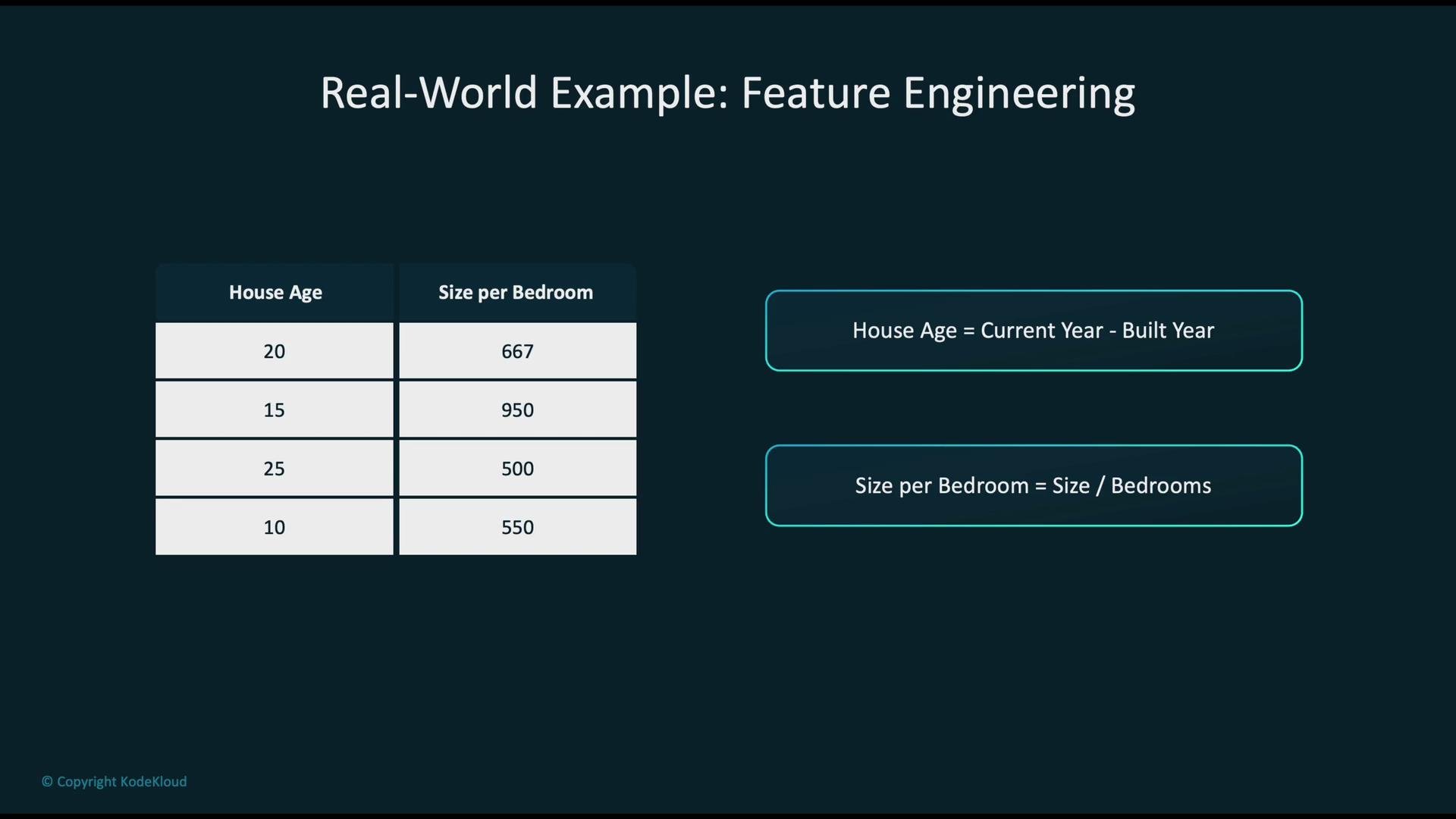
 Feature engineering — example derivatives for housing data
* House age = current year − year built
* Size per bedroom = total area ÷ number of bedrooms
These derived features often encode domain knowledge that improves predictive power.
Feature engineering — example derivatives for housing data
* House age = current year − year built
* Size per bedroom = total area ÷ number of bedrooms
These derived features often encode domain knowledge that improves predictive power.
 Additional practical tips
* Preserve a raw data snapshot so you can re-run preparation if assumptions change.
* Automate and version your preprocessing (e.g., with pipelines) to ensure reproducibility.
* Validate assumptions continuously (missingness patterns, covariate shift, label quality).
* Monitor models in production for data drift and trigger re-preparation when distributions change.
Avoid data leakage: do not compute statistics (e.g., scaling parameters or imputation values) using the full dataset including test/validation sets. Fit transformers on training data only and apply them to validation/test sets.
Summary
* Cleaning removes errors and harmonizes formats.
* Transformation converts raw values into model-ready features.
* Feature engineering creates context-rich inputs that improve learning.
* Labeling provides correct targets for supervised models.
* Validation ensures data quality and model generalizability.
Further reading and references
* [Kaggle: Data Cleaning](https://www.kaggle.com/learn/data-cleaning)
* [Scikit-learn: Preprocessing](https://scikit-learn.org/stable/modules/preprocessing.html)
* [UCI Machine Learning Repository](https://archive.ics.uci.edu/)
Careful data preparation is not optional—it's essential for building fair, accurate, and maintainable machine learning systems.
Additional practical tips
* Preserve a raw data snapshot so you can re-run preparation if assumptions change.
* Automate and version your preprocessing (e.g., with pipelines) to ensure reproducibility.
* Validate assumptions continuously (missingness patterns, covariate shift, label quality).
* Monitor models in production for data drift and trigger re-preparation when distributions change.
Avoid data leakage: do not compute statistics (e.g., scaling parameters or imputation values) using the full dataset including test/validation sets. Fit transformers on training data only and apply them to validation/test sets.
Summary
* Cleaning removes errors and harmonizes formats.
* Transformation converts raw values into model-ready features.
* Feature engineering creates context-rich inputs that improve learning.
* Labeling provides correct targets for supervised models.
* Validation ensures data quality and model generalizability.
Further reading and references
* [Kaggle: Data Cleaning](https://www.kaggle.com/learn/data-cleaning)
* [Scikit-learn: Preprocessing](https://scikit-learn.org/stable/modules/preprocessing.html)
* [UCI Machine Learning Repository](https://archive.ics.uci.edu/)
Careful data preparation is not optional—it's essential for building fair, accurate, and maintainable machine learning systems.