> ## Documentation Index
> Fetch the complete documentation index at: https://notes.kodekloud.com/llms.txt
> Use this file to discover all available pages before exploring further.
# Automating Data Ingestion with Orchestration Services
> Guide to automating ML and analytics data ingestion on AWS using Glue, Step Functions, EventBridge, and Lambda, covering architectures, event-driven patterns, monitoring, CI/CD, and best practices.
This guide explains how to automate data ingestion for machine learning and analytics using AWS orchestration services. It covers common architectures, recommended services, example event and state-machine patterns, monitoring, CI/CD, and operational best practices to build reliable, scalable ingestion pipelines.
Agenda:
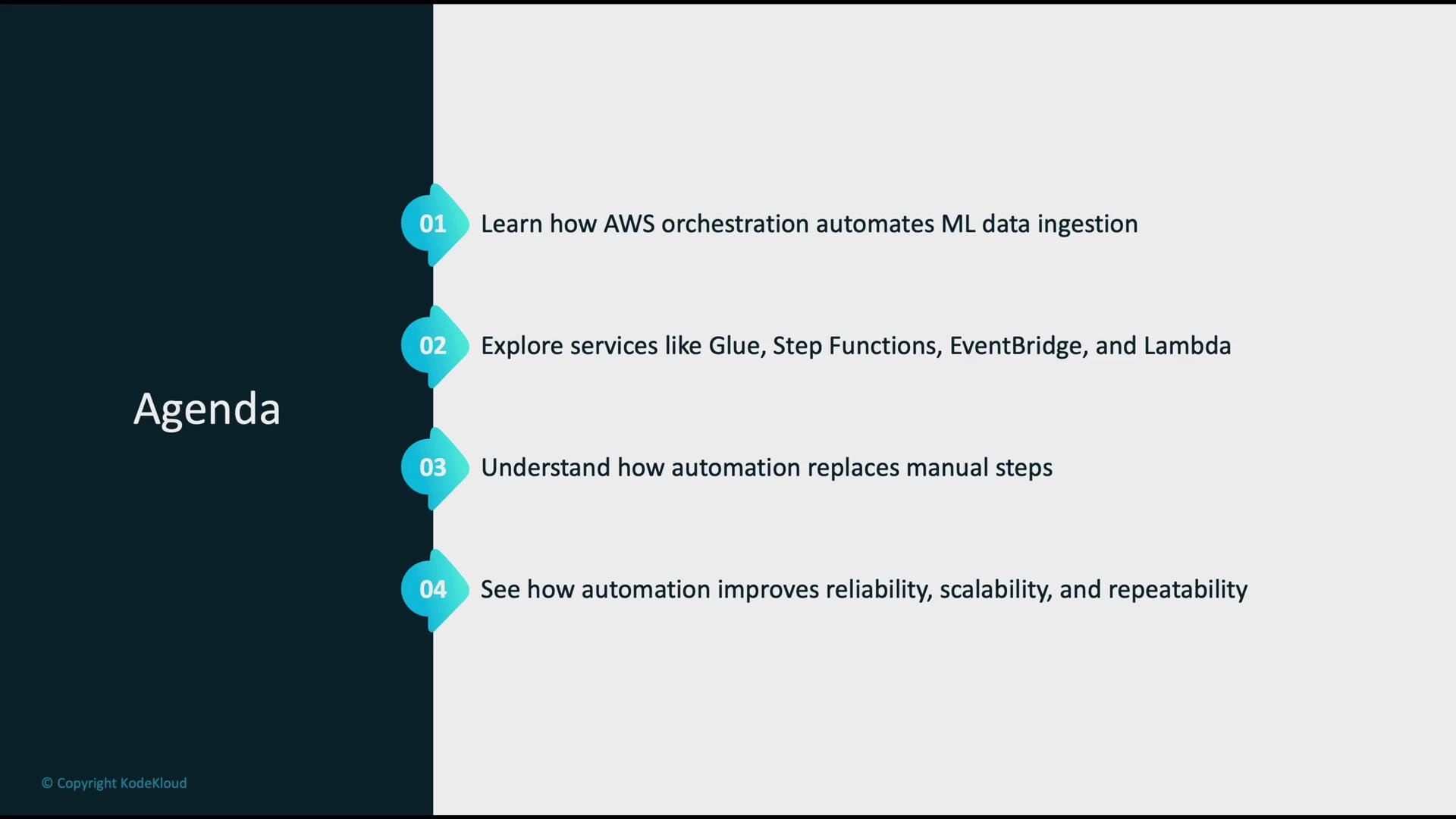
* How AWS orchestration automates the ML data-ingestion lifecycle
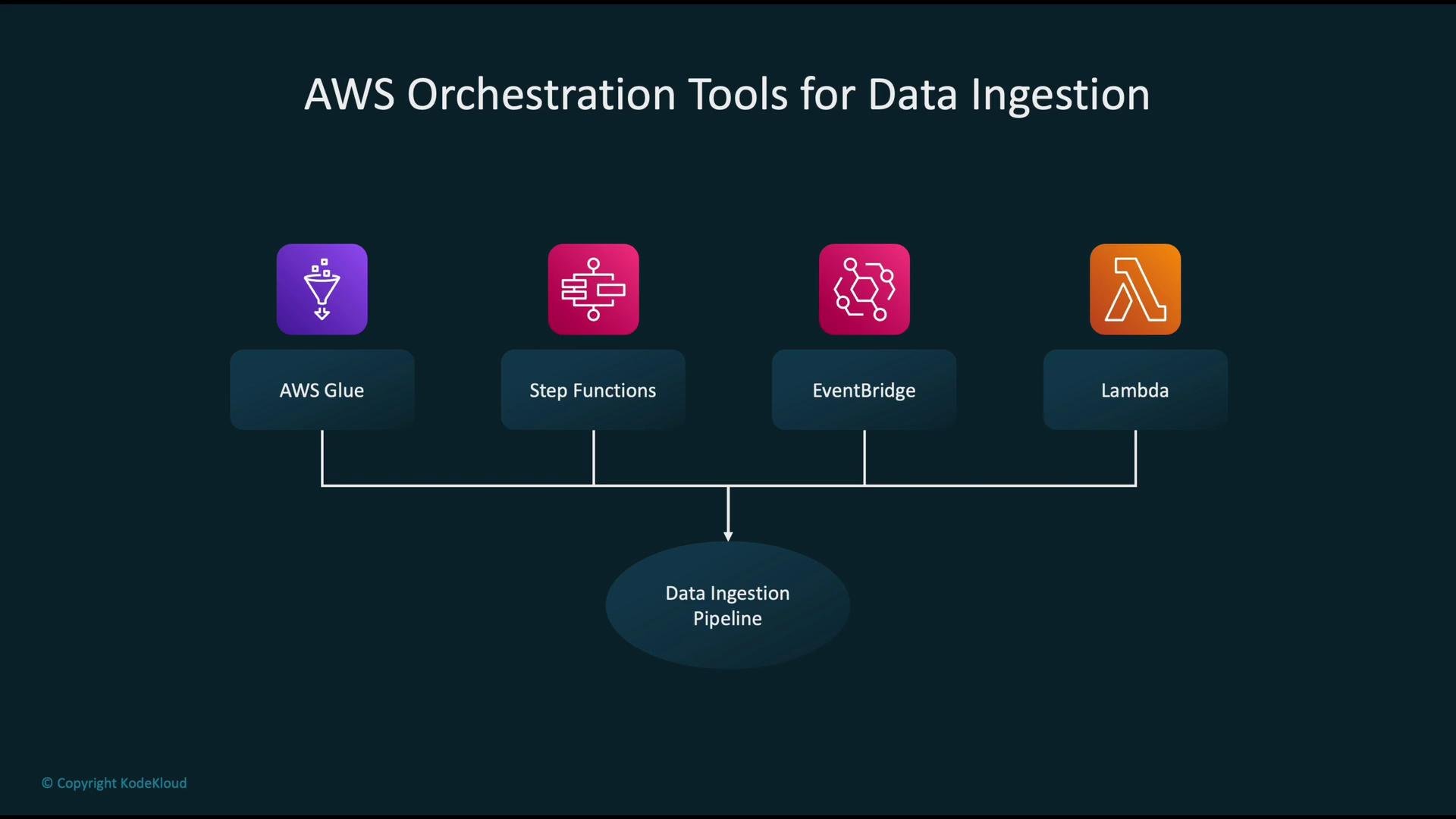
* Key AWS services: Glue, Step Functions, EventBridge, Lambda
* How automation replaces manual tasks in ingestion workflows
* Benefits: reliability, scalability, and repeatability
 Why automate ingestion?
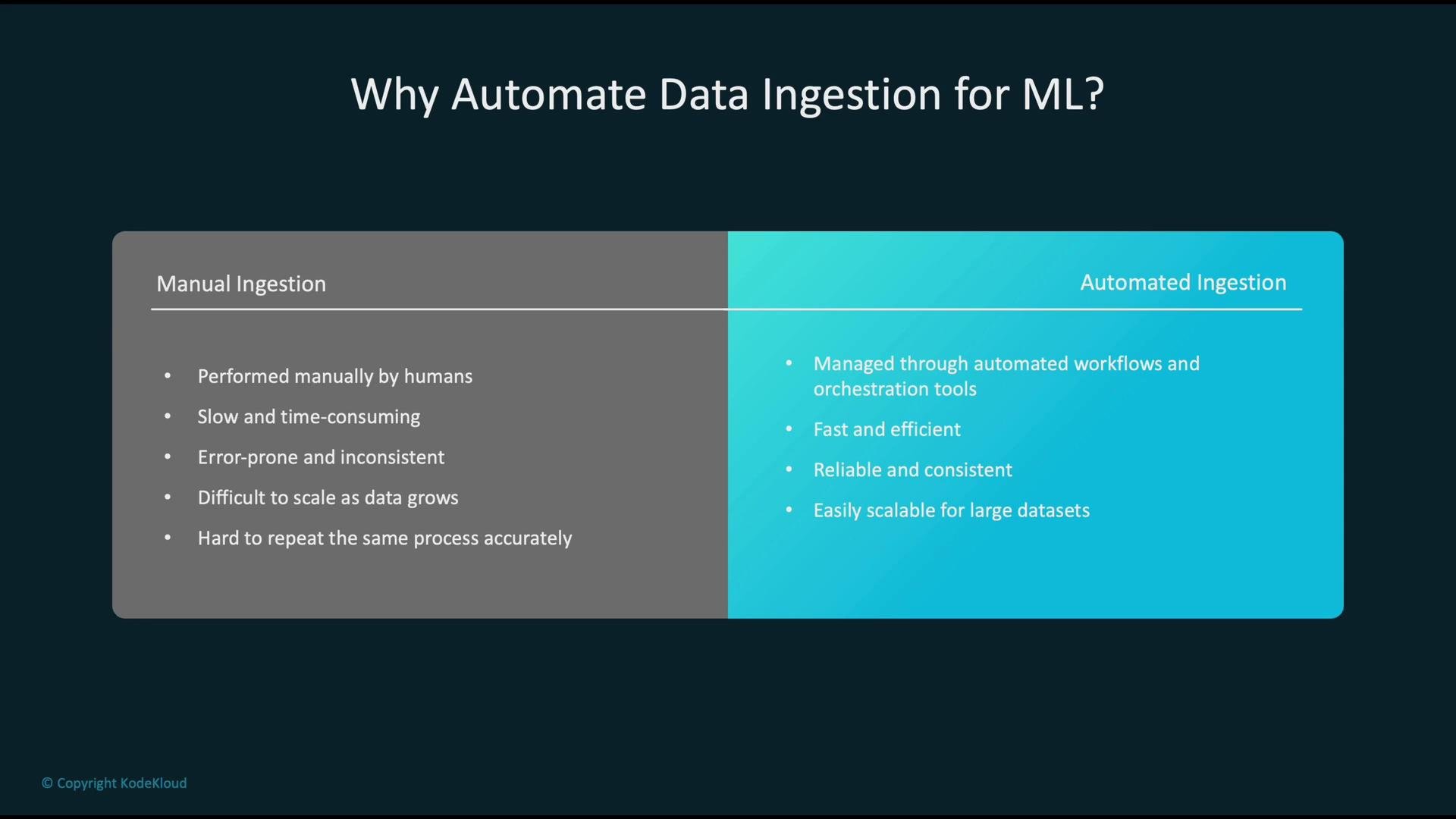
* Manual ingestion is slow, error-prone, hard to scale, and difficult to reproduce.
* Automated ingestion provides consistent, repeatable pipelines that scale, reduce human error, and enable near-real-time processing when needed.
* Automation also enables observability, retries, and rollback strategies which are essential for production ML workflows.
Why automate ingestion?
* Manual ingestion is slow, error-prone, hard to scale, and difficult to reproduce.
* Automated ingestion provides consistent, repeatable pipelines that scale, reduce human error, and enable near-real-time processing when needed.
* Automation also enables observability, retries, and rollback strategies which are essential for production ML workflows.
 Key AWS services for ingestion orchestration
| Service | Primary use case | Short example / note |
| ------------------ | ---------------------------------------------------------: | ----------------------------------------------------------------------------------------------------------- |
| AWS Glue | Serverless ETL, data catalog, batch & streaming ETL | Use Glue jobs or Glue Studio to run Spark jobs that transform raw S3 data and write normalized outputs. |
| AWS Step Functions | Orchestrate tasks and services into a state machine | Coordinate Glue jobs, Lambdas, external APIs, and retries with visual workflow and built-in error handling. |
| Amazon EventBridge | Event routing for decoupled, event-driven architectures | Route events from S3, SaaS sources, or custom apps to targets like Step Functions, Lambda, or Glue. |
| AWS Lambda | Lightweight, real-time processing and enrichment | Handle per-file processing, metadata extraction, or quick transformations before writing to S3/Kinesis. |
| AWS Glue DataBrew | Visual data preparation, profiling, and cleaning | Profile datasets and apply transformations without writing Spark code. |
| Amazon S3 | Landing zone for raw data and integration point for events | Use S3 events or EventBridge notifications to trigger pipelines. |
Key AWS services for ingestion orchestration
| Service | Primary use case | Short example / note |
| ------------------ | ---------------------------------------------------------: | ----------------------------------------------------------------------------------------------------------- |
| AWS Glue | Serverless ETL, data catalog, batch & streaming ETL | Use Glue jobs or Glue Studio to run Spark jobs that transform raw S3 data and write normalized outputs. |
| AWS Step Functions | Orchestrate tasks and services into a state machine | Coordinate Glue jobs, Lambdas, external APIs, and retries with visual workflow and built-in error handling. |
| Amazon EventBridge | Event routing for decoupled, event-driven architectures | Route events from S3, SaaS sources, or custom apps to targets like Step Functions, Lambda, or Glue. |
| AWS Lambda | Lightweight, real-time processing and enrichment | Handle per-file processing, metadata extraction, or quick transformations before writing to S3/Kinesis. |
| AWS Glue DataBrew | Visual data preparation, profiling, and cleaning | Profile datasets and apply transformations without writing Spark code. |
| Amazon S3 | Landing zone for raw data and integration point for events | Use S3 events or EventBridge notifications to trigger pipelines. |
 Architectural pattern: Glue-centric ingestion
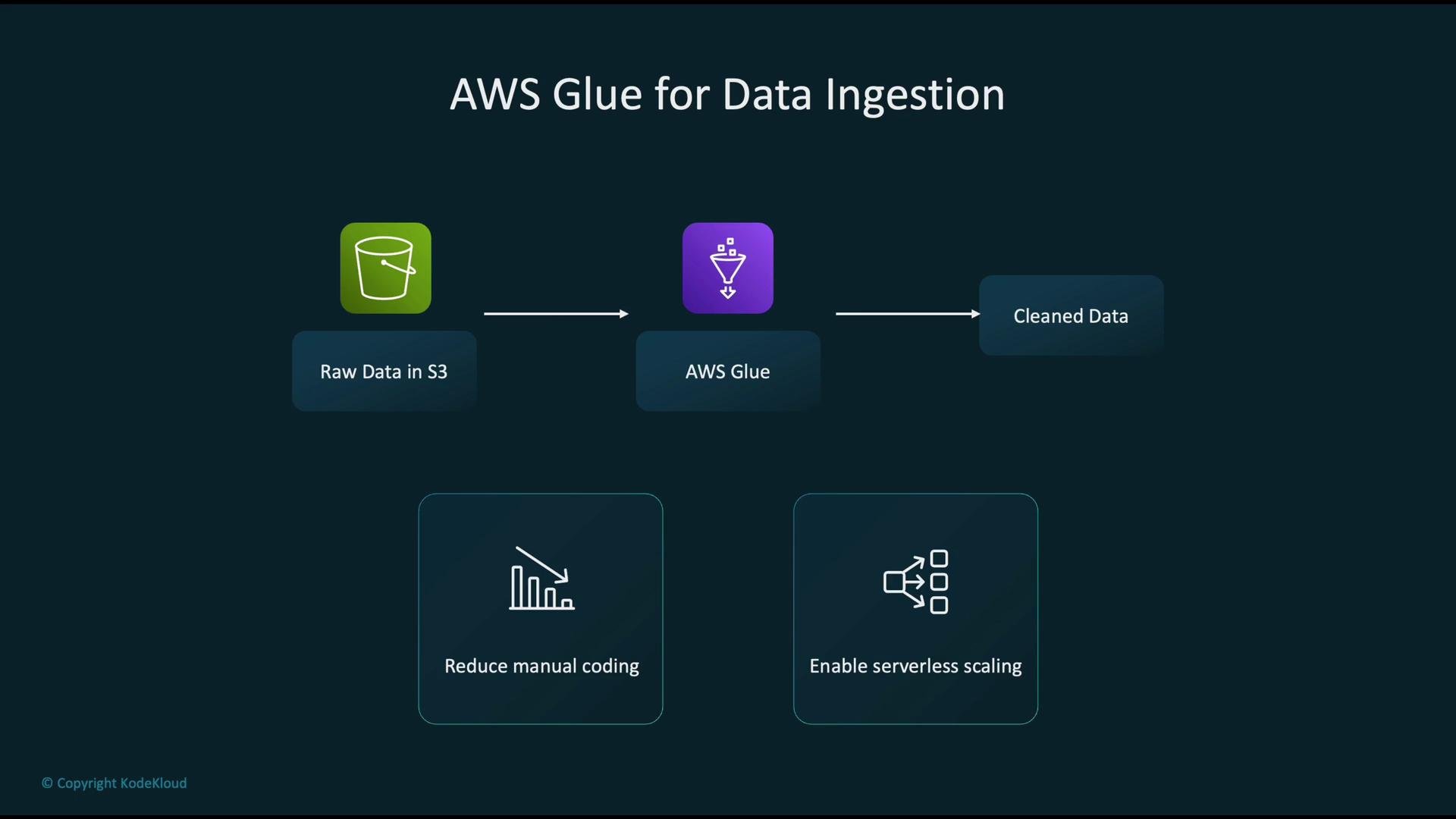
* Raw data lands in S3 (ingress from apps, devices, partners, or streams).
* Glue jobs (Spark/Python) read raw files, transform/clean them, and write processed data back to S3, Redshift, or another datastore.
* Glue Data Catalog registers schemas and partitions to make downstream discovery and querying consistent.
Benefits: reduced custom ETL code, serverless scaling, centralized metadata in the Glue Data Catalog.
Architectural pattern: Glue-centric ingestion
* Raw data lands in S3 (ingress from apps, devices, partners, or streams).
* Glue jobs (Spark/Python) read raw files, transform/clean them, and write processed data back to S3, Redshift, or another datastore.
* Glue Data Catalog registers schemas and partitions to make downstream discovery and querying consistent.
Benefits: reduced custom ETL code, serverless scaling, centralized metadata in the Glue Data Catalog.
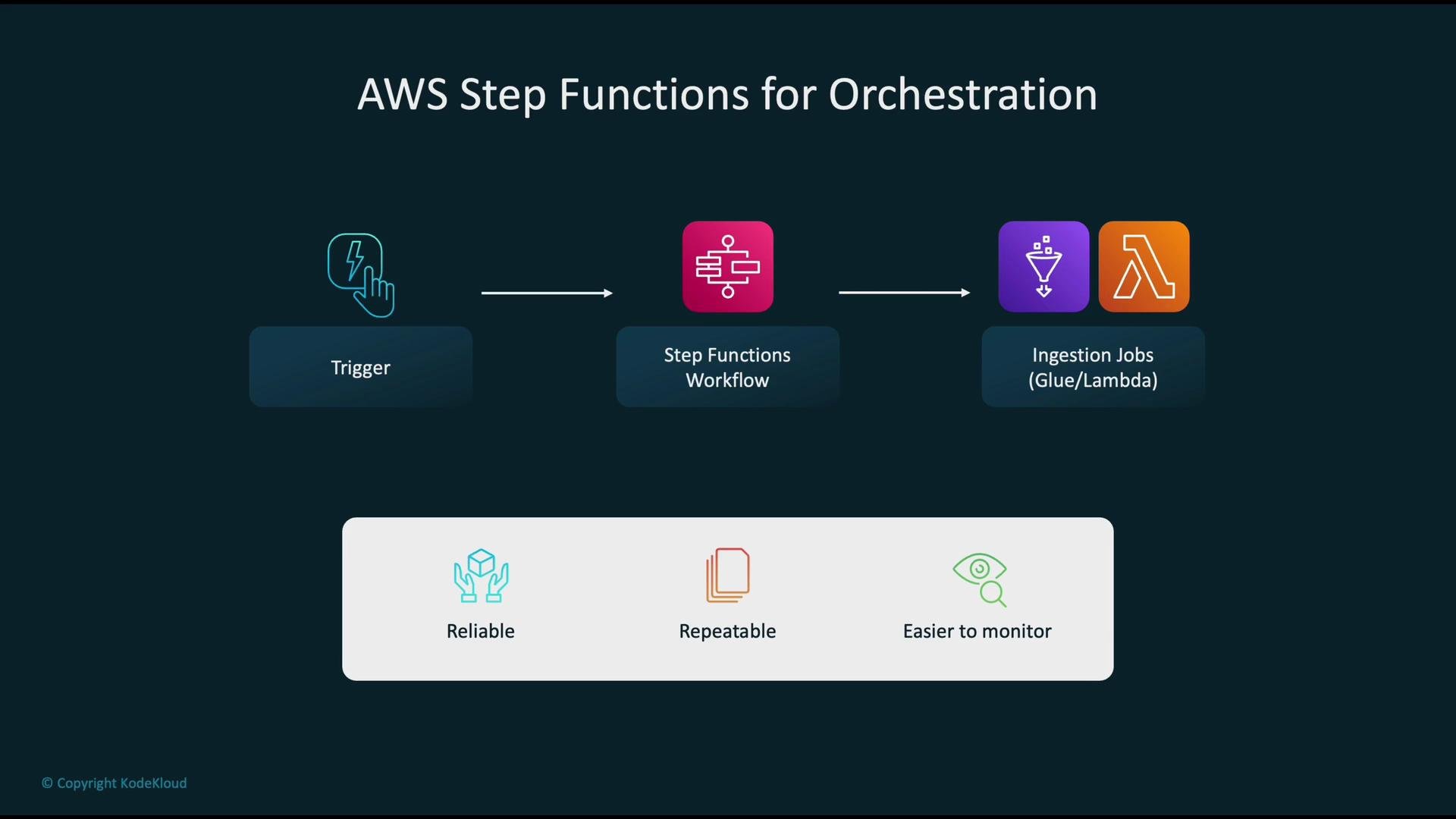
 Orchestration with AWS Step Functions
* A trigger (S3 event, schedule, external API) starts a Step Functions state machine.
* The state machine sequences tasks such as starting Glue jobs, invoking Lambda functions, performing checks, and sending notifications.
* Step Functions provide built-in retry logic, error handling, and visual observability for pipeline runs.
Example minimal Step Functions task (Start a Glue job via service integration):
```json theme={null}
{
"StartGlueJob": {
"Type": "Task",
"Resource": "arn:aws:states:::glue:startJobRun.sync",
"Parameters": {
"JobName": "my-glue-job",
"Arguments": {
"--input_path": "s3://my-bucket/raw/",
"--output_path": "s3://my-bucket/processed/"
}
},
"Next": "ValidateOutput"
}
}
```
Orchestration with AWS Step Functions
* A trigger (S3 event, schedule, external API) starts a Step Functions state machine.
* The state machine sequences tasks such as starting Glue jobs, invoking Lambda functions, performing checks, and sending notifications.
* Step Functions provide built-in retry logic, error handling, and visual observability for pipeline runs.
Example minimal Step Functions task (Start a Glue job via service integration):
```json theme={null}
{
"StartGlueJob": {
"Type": "Task",
"Resource": "arn:aws:states:::glue:startJobRun.sync",
"Parameters": {
"JobName": "my-glue-job",
"Arguments": {
"--input_path": "s3://my-bucket/raw/",
"--output_path": "s3://my-bucket/processed/"
}
},
"Next": "ValidateOutput"
}
}
```
 S3 event triggers and event-driven ingestion
* When a new file uploads to S3, S3 can emit an event or create an EventBridge event.
* Consumers (Lambda, SQS, SNS, or Step Functions via EventBridge) process the event and start ingestion or validation jobs.
* This replaces polling with push-based notifications and supports near-real-time pipelines.
Example S3-created EventBridge pattern:
```json theme={null}
{
"source": ["aws.s3"],
"detail-type": ["Object Created"],
"detail": {
"bucket": {
"name": ["my-ingest-bucket"]
}
}
}
```
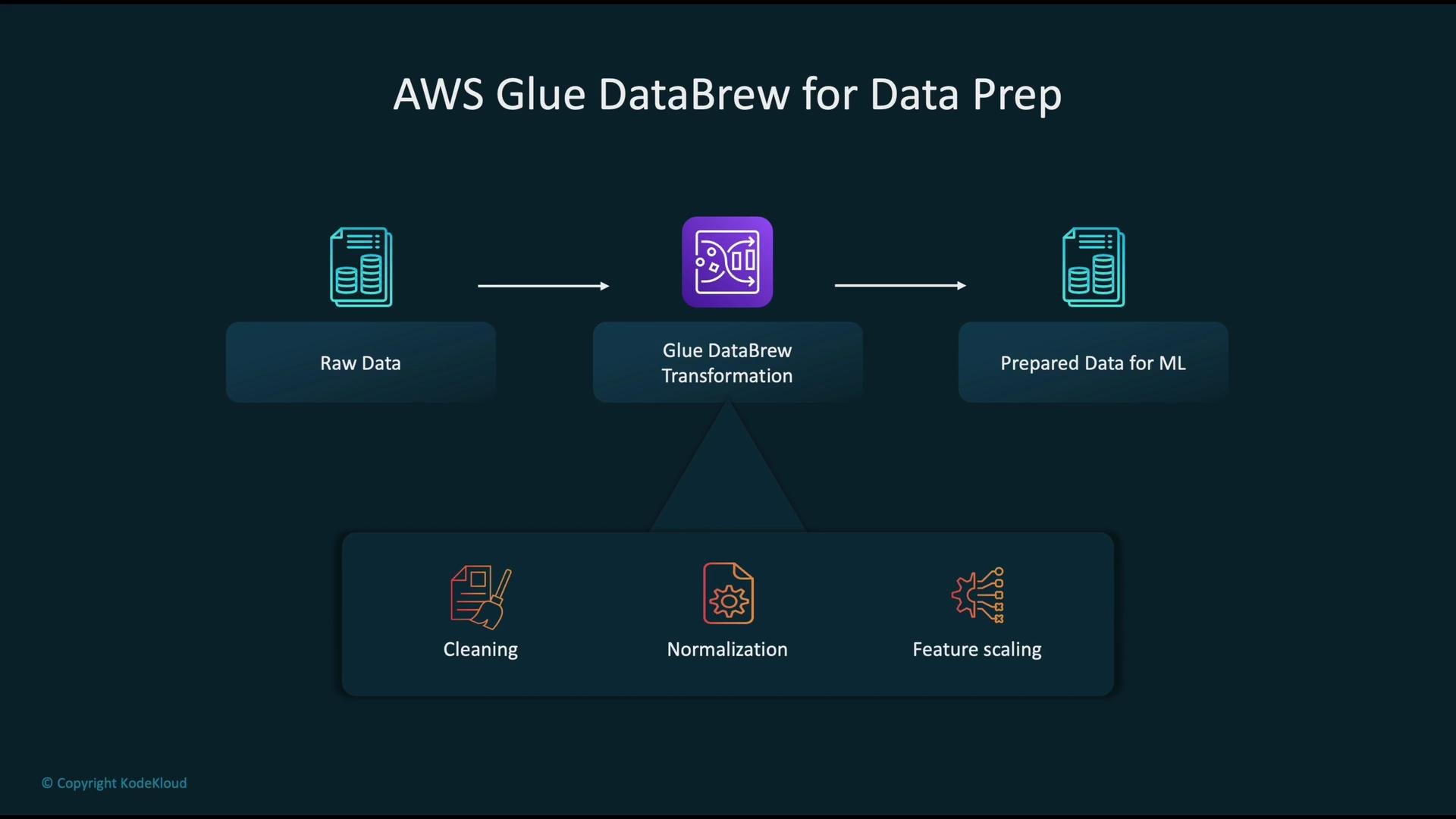
Data preparation with AWS Glue DataBrew
* Use DataBrew to profile, clean, and normalize raw datasets without writing Spark code.
* Apply common transformations (type conversion, missing-value handling, scaling) and export prepared data for training or analytics.
* DataBrew is useful for rapid iteration and data exploration before production ETL is implemented.
S3 event triggers and event-driven ingestion
* When a new file uploads to S3, S3 can emit an event or create an EventBridge event.
* Consumers (Lambda, SQS, SNS, or Step Functions via EventBridge) process the event and start ingestion or validation jobs.
* This replaces polling with push-based notifications and supports near-real-time pipelines.
Example S3-created EventBridge pattern:
```json theme={null}
{
"source": ["aws.s3"],
"detail-type": ["Object Created"],
"detail": {
"bucket": {
"name": ["my-ingest-bucket"]
}
}
}
```
Data preparation with AWS Glue DataBrew
* Use DataBrew to profile, clean, and normalize raw datasets without writing Spark code.
* Apply common transformations (type conversion, missing-value handling, scaling) and export prepared data for training or analytics.
* DataBrew is useful for rapid iteration and data exploration before production ETL is implemented.
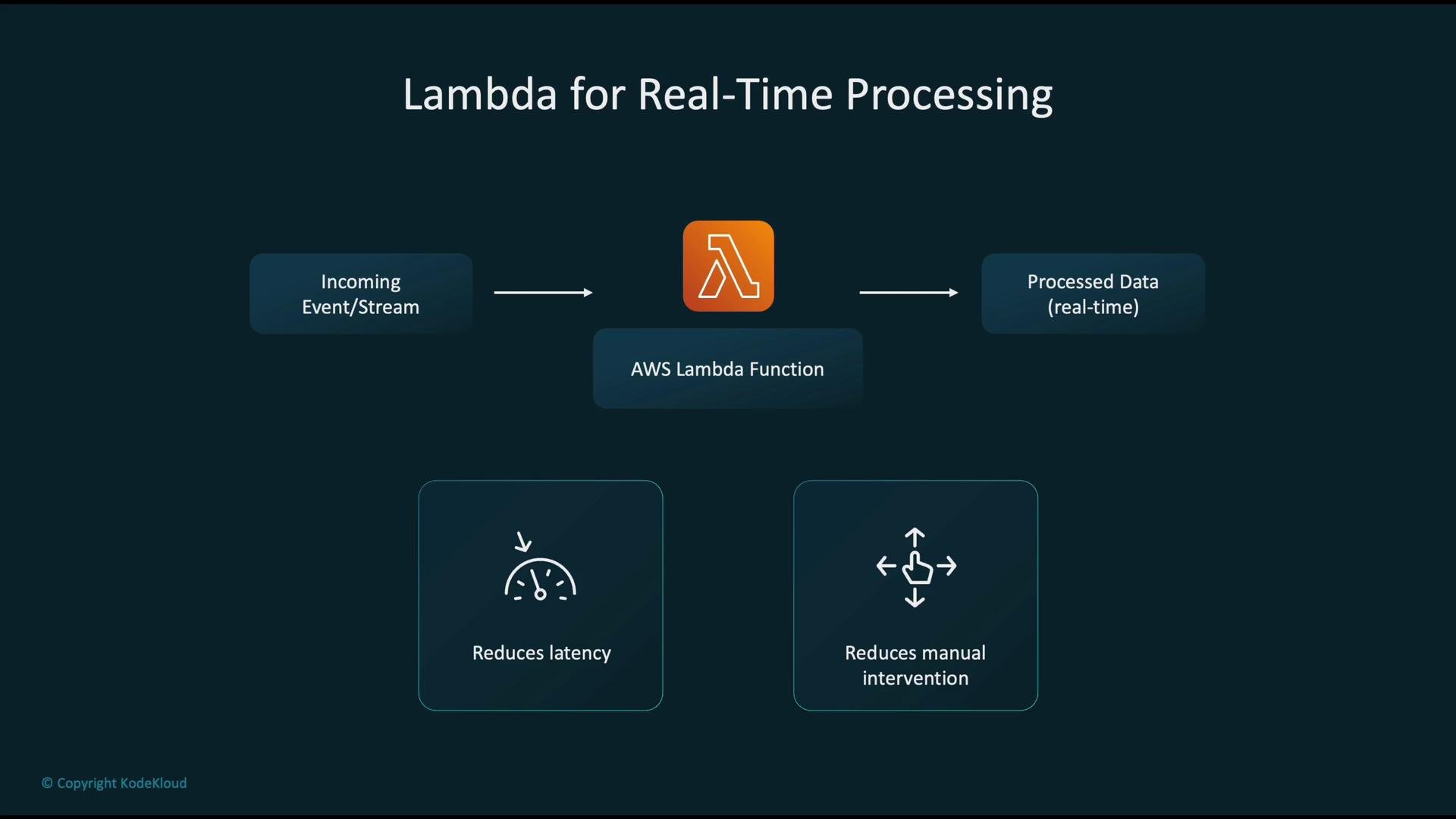
 Real-time processing with AWS Lambda
* Events or streaming records trigger Lambda for lightweight transformations, enrichment, or routing.
* Use Lambda to extract metadata, validate schema, split or aggregate records, and forward to Kinesis, S3, or downstream APIs.
* Lambdas reduce ingestion latency and keep operational overhead low.
Real-time processing with AWS Lambda
* Events or streaming records trigger Lambda for lightweight transformations, enrichment, or routing.
* Use Lambda to extract metadata, validate schema, split or aggregate records, and forward to Kinesis, S3, or downstream APIs.
* Lambdas reduce ingestion latency and keep operational overhead low.
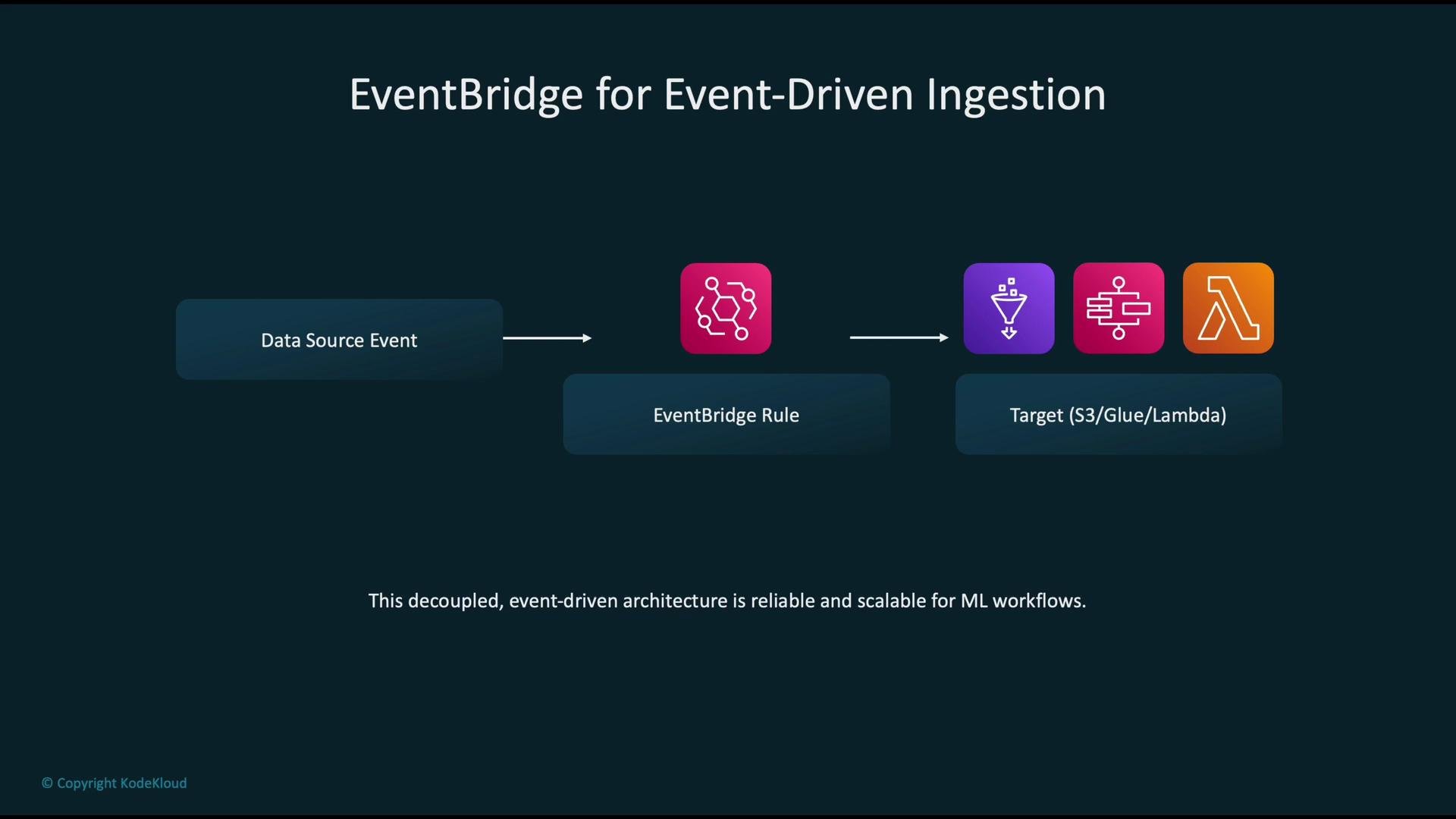
 Event-driven ingestion with Amazon EventBridge
* Data producers emit events (e.g., dataset-ready, external webhook).
* EventBridge rules match event patterns and route events to targets like Lambda, Step Functions, Glue, SNS, SQS, or API Destinations.
* This decoupled model scales well and improves the resilience of ingestion flows.
Event-driven ingestion with Amazon EventBridge
* Data producers emit events (e.g., dataset-ready, external webhook).
* EventBridge rules match event patterns and route events to targets like Lambda, Step Functions, Glue, SNS, SQS, or API Destinations.
* This decoupled model scales well and improves the resilience of ingestion flows.
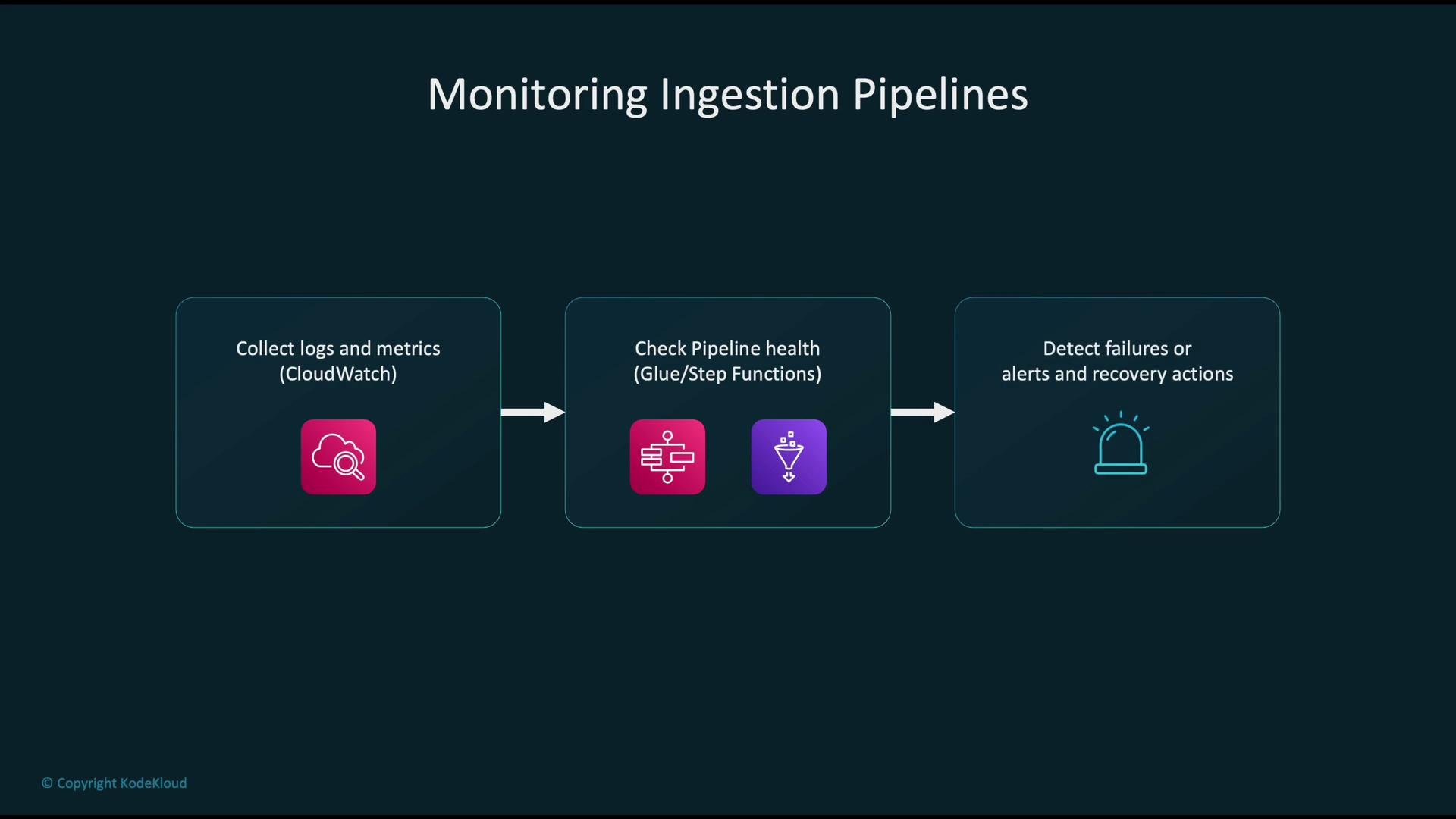
 Monitoring ingestion pipelines — essential steps
1. Collect logs, traces, and metrics
* CloudWatch Logs for Glue job logs and Lambda logs.
* CloudWatch Metrics for Glue job runtimes, Step Functions executions, and Lambda errors.
* X-Ray for distributed tracing where applicable.
2. Evaluate pipeline health
* Dashboards for step success/failure rates, job durations, and data latency.
* Automated checks: use Step Functions or Lambda health checks to validate outputs after processing.
3. Alerting and recovery
* Configure alarms (CloudWatch Alarms) to notify operators via SNS or pager services.
* Implement automated retries and compensation workflows (e.g., Step Functions retry, disaster recovery job).
Key metrics to track:
* Glue job run success/failure, duration, DPU usage
* Step Functions executions, failed vs. succeeded
* Lambda invocation errors, throttles, duration
* Data freshness/latency and throughput
Monitoring ingestion pipelines — essential steps
1. Collect logs, traces, and metrics
* CloudWatch Logs for Glue job logs and Lambda logs.
* CloudWatch Metrics for Glue job runtimes, Step Functions executions, and Lambda errors.
* X-Ray for distributed tracing where applicable.
2. Evaluate pipeline health
* Dashboards for step success/failure rates, job durations, and data latency.
* Automated checks: use Step Functions or Lambda health checks to validate outputs after processing.
3. Alerting and recovery
* Configure alarms (CloudWatch Alarms) to notify operators via SNS or pager services.
* Implement automated retries and compensation workflows (e.g., Step Functions retry, disaster recovery job).
Key metrics to track:
* Glue job run success/failure, duration, DPU usage
* Step Functions executions, failed vs. succeeded
* Lambda invocation errors, throttles, duration
* Data freshness/latency and throughput
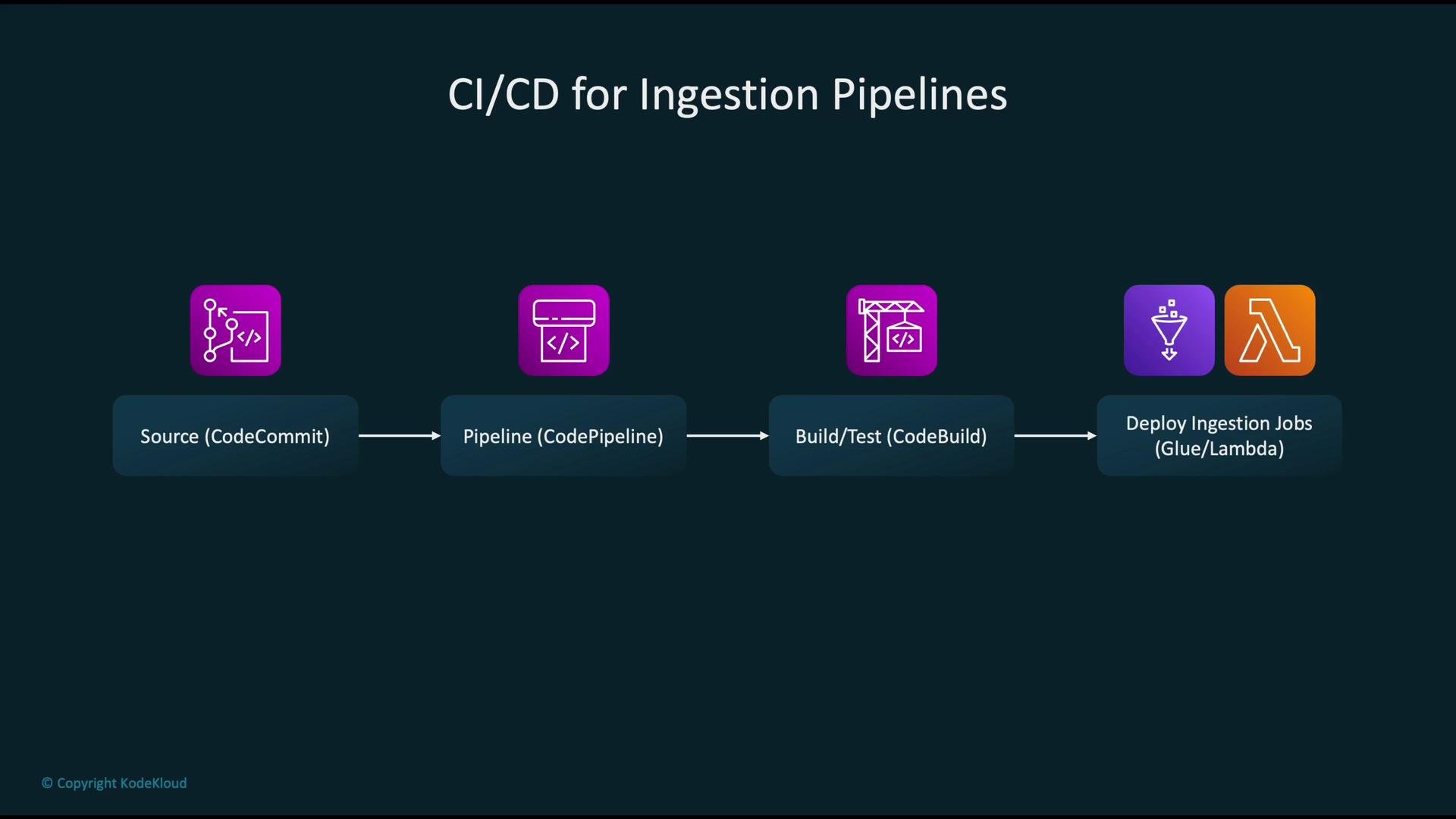
 CI/CD for ingestion jobs
* Store ingestion code and Glue job definitions in source control (e.g., CodeCommit, GitHub).
* Use CodePipeline to orchestrate build and deployment when code changes are merged.
* CodeBuild runs tests, linters, and packages artifacts; successful builds promote artifacts to staging or production.
* Deploy updated Glue jobs, Lambda functions, and Step Functions definitions via IaC (CloudFormation, CDK, SAM, or Terraform).
CI/CD workflow in brief:
| Stage | Purpose |
| ------------ | ------------------------------------------------------------------------------ |
| Source | Store ingestion code, Glue scripts, and infra as code in Git |
| Build & Test | CodeBuild runs unit tests, linters, and packaging |
| Deploy | CodePipeline/CloudFormation deploys Glue/Lambda/state machines to environments |
| Verify | Post-deploy smoke tests and integration checks before promoting |
CI/CD for ingestion jobs
* Store ingestion code and Glue job definitions in source control (e.g., CodeCommit, GitHub).
* Use CodePipeline to orchestrate build and deployment when code changes are merged.
* CodeBuild runs tests, linters, and packages artifacts; successful builds promote artifacts to staging or production.
* Deploy updated Glue jobs, Lambda functions, and Step Functions definitions via IaC (CloudFormation, CDK, SAM, or Terraform).
CI/CD workflow in brief:
| Stage | Purpose |
| ------------ | ------------------------------------------------------------------------------ |
| Source | Store ingestion code, Glue scripts, and infra as code in Git |
| Build & Test | CodeBuild runs unit tests, linters, and packaging |
| Deploy | CodePipeline/CloudFormation deploys Glue/Lambda/state machines to environments |
| Verify | Post-deploy smoke tests and integration checks before promoting |
 Anti-patterns and how to avoid them
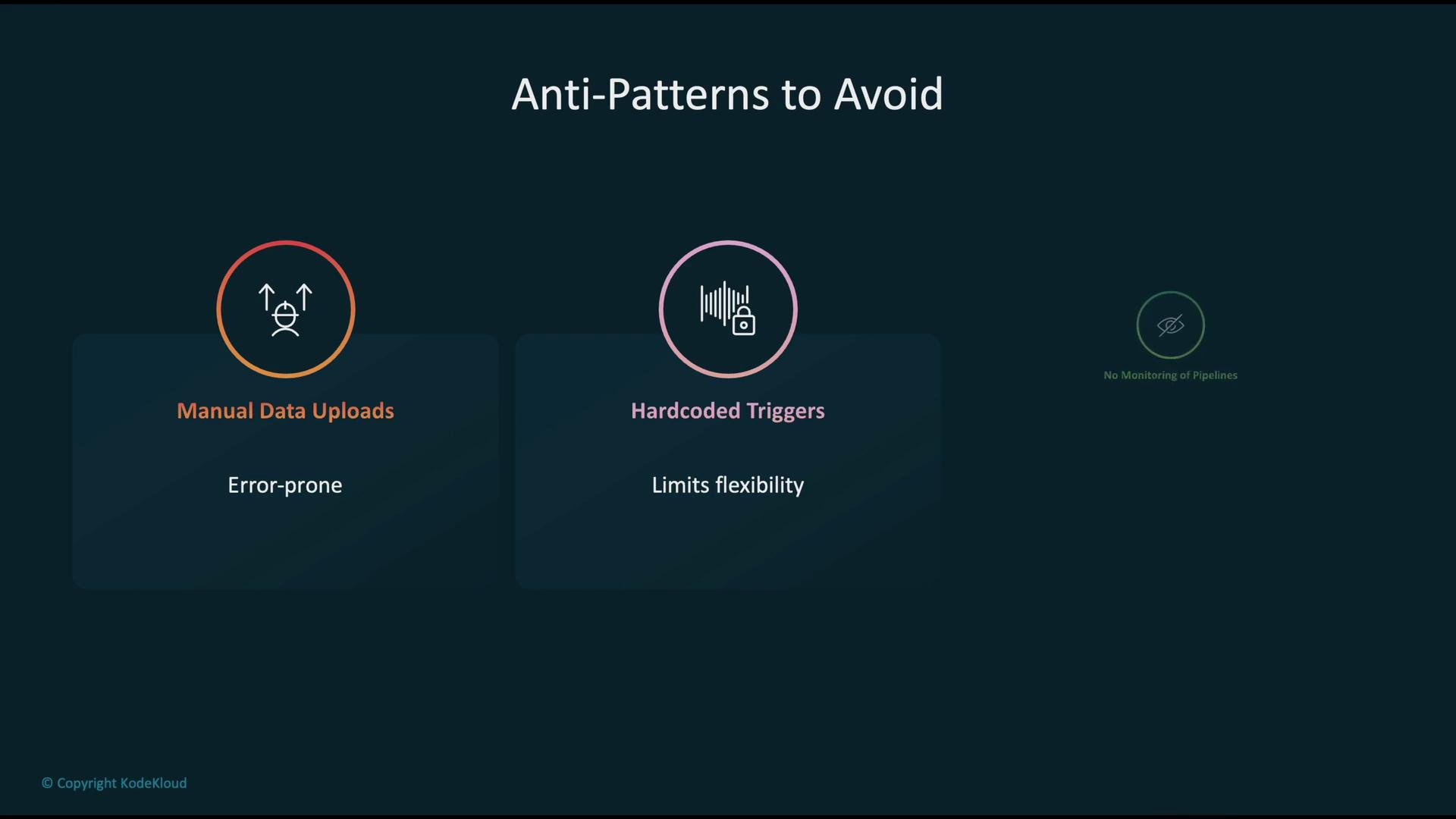
Avoid these anti-patterns: manual uploads, hard-coded triggers/configs, and lack of monitoring. Each can cause silent failures and increase operational risk.
Common anti-patterns to avoid:
* Manual data uploads — automate ingestion and validate inputs.
* Hard-coded triggers and configuration — use parameterization, environment-aware configs, and centralized configuration stores (e.g., SSM Parameter Store, Secrets Manager).
* No monitoring or alerting — instrument pipelines with logs, metrics, and automated alerts.
| Anti-pattern | Risk | Recommended fix |
| -------------------------- | -----------------------------: | ----------------------------------------------------------------- |
| Manual uploads | Human error, inconsistent data | Automate with S3 events or API-driven uploads and validation jobs |
| Hard-coded triggers/config | Low flexibility, slow ops | Use environment variables, parameter store, and IaC templates |
| No monitoring | Silent failures | Add CloudWatch logs/metrics, dashboards, alarms, and runbooks |
Anti-patterns and how to avoid them
Avoid these anti-patterns: manual uploads, hard-coded triggers/configs, and lack of monitoring. Each can cause silent failures and increase operational risk.
Common anti-patterns to avoid:
* Manual data uploads — automate ingestion and validate inputs.
* Hard-coded triggers and configuration — use parameterization, environment-aware configs, and centralized configuration stores (e.g., SSM Parameter Store, Secrets Manager).
* No monitoring or alerting — instrument pipelines with logs, metrics, and automated alerts.
| Anti-pattern | Risk | Recommended fix |
| -------------------------- | -----------------------------: | ----------------------------------------------------------------- |
| Manual uploads | Human error, inconsistent data | Automate with S3 events or API-driven uploads and validation jobs |
| Hard-coded triggers/config | Low flexibility, slow ops | Use environment variables, parameter store, and IaC templates |
| No monitoring | Silent failures | Add CloudWatch logs/metrics, dashboards, alarms, and runbooks |
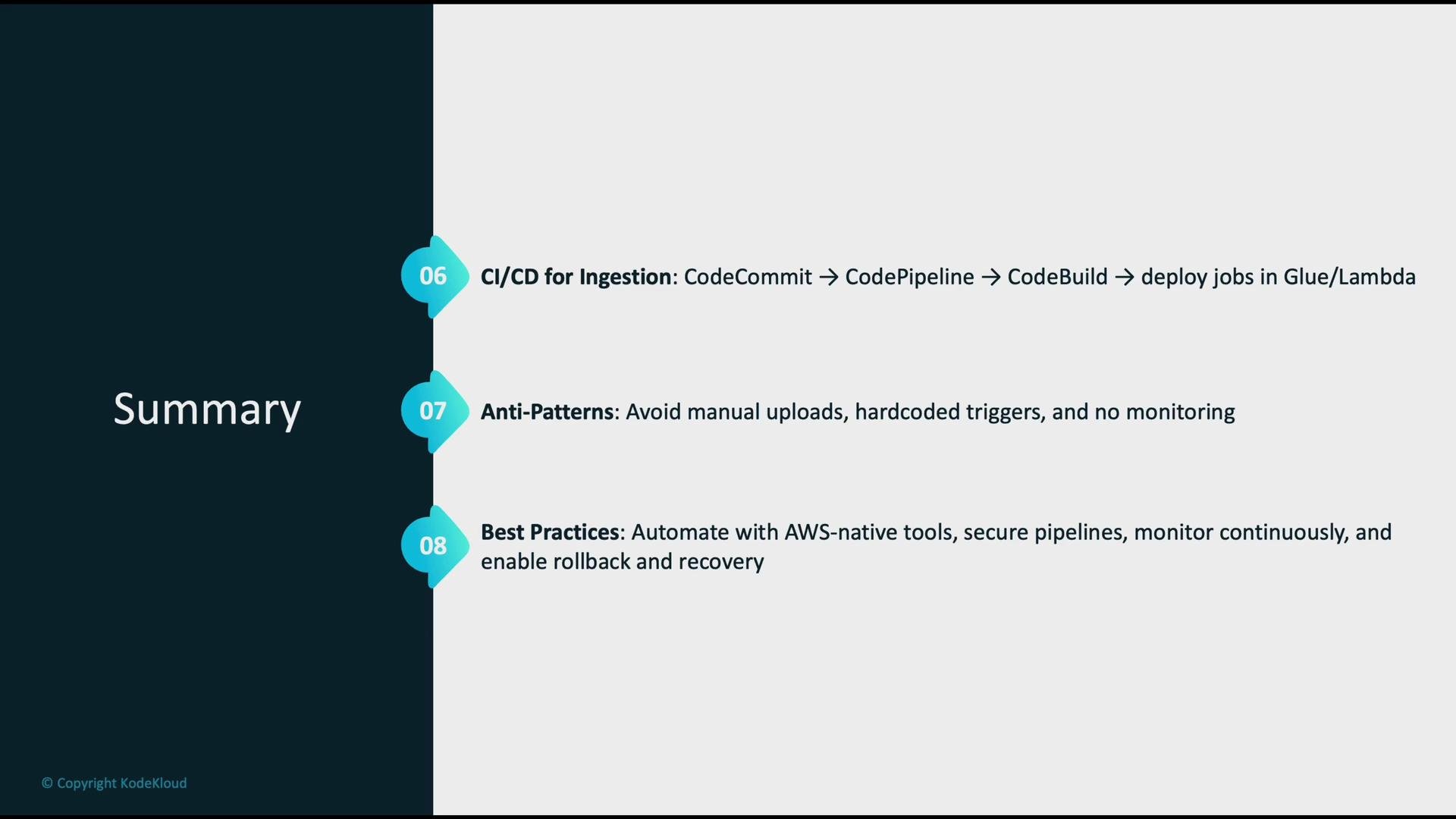
 Key takeaways
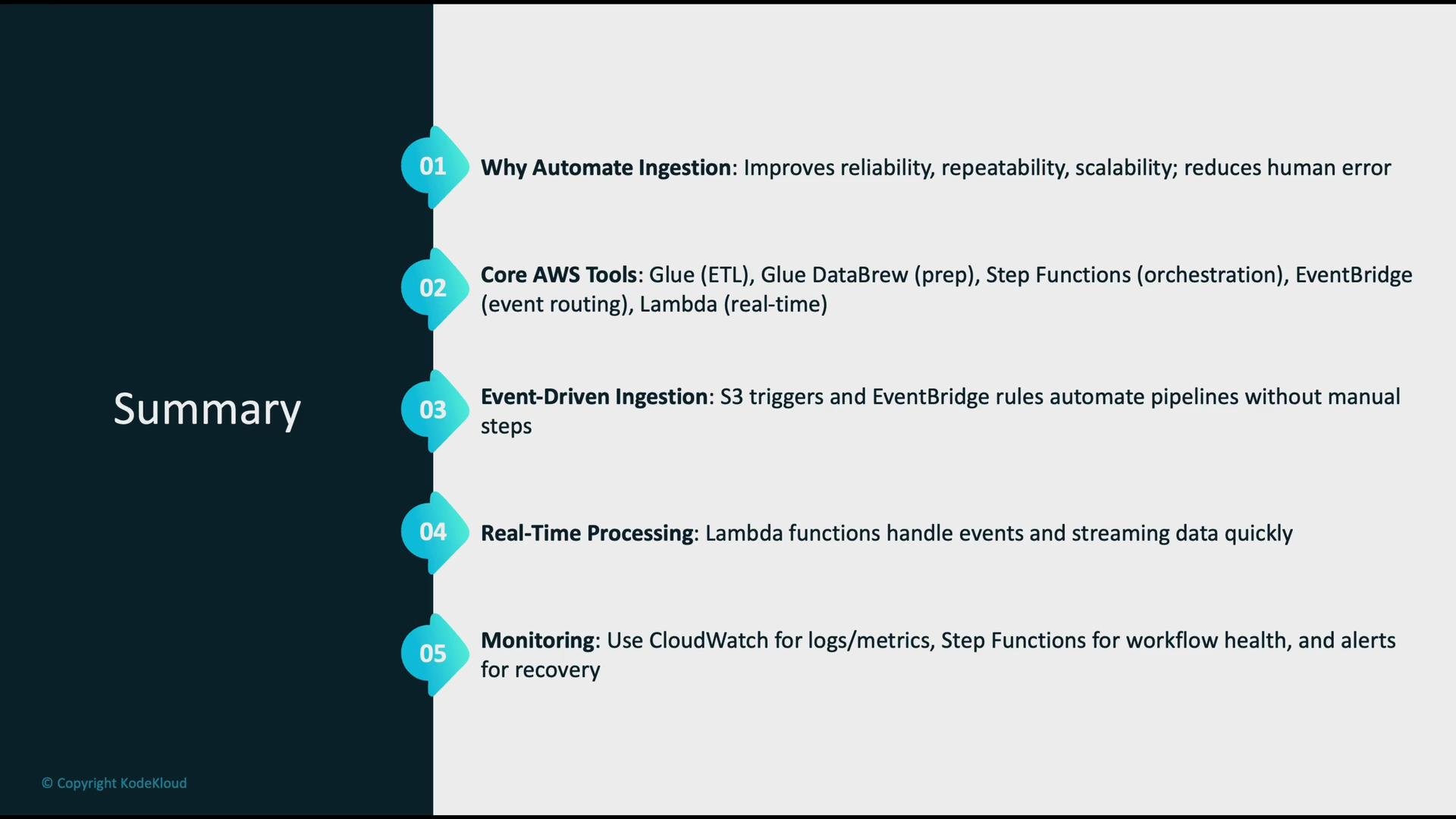
* Automating ingestion increases reliability, repeatability, and scalability while lowering human error.
* Core AWS building blocks: Glue for ETL, Step Functions for orchestration, Lambda for real-time processing, and EventBridge/S3 events for event-driven triggers.
* Implement comprehensive monitoring (CloudWatch, X-Ray, Step Functions) and automated recovery paths to keep workflows healthy.
* Use CI/CD to version, test, and safely deploy ingestion logic; manage infrastructure and job definitions as code.
* Avoid anti-patterns: automate uploads, parameterize configurations, and instrument everything for observability.
Key takeaways
* Automating ingestion increases reliability, repeatability, and scalability while lowering human error.
* Core AWS building blocks: Glue for ETL, Step Functions for orchestration, Lambda for real-time processing, and EventBridge/S3 events for event-driven triggers.
* Implement comprehensive monitoring (CloudWatch, X-Ray, Step Functions) and automated recovery paths to keep workflows healthy.
* Use CI/CD to version, test, and safely deploy ingestion logic; manage infrastructure and job definitions as code.
* Avoid anti-patterns: automate uploads, parameterize configurations, and instrument everything for observability.
 Operational checklist for resilient ingestion
* Use source control and CI/CD for all ingestion job definitions and infra.
* Prefer event-driven triggers over polling (S3 events → EventBridge → Step Functions/Lambda).
* Add retries and compensating transactions for transient failures.
* Secure data in transit and at rest and lock down IAM permissions to least privilege.
* Create alerts and runbooks for common failure modes to speed recovery.
Operational checklist for resilient ingestion
* Use source control and CI/CD for all ingestion job definitions and infra.
* Prefer event-driven triggers over polling (S3 events → EventBridge → Step Functions/Lambda).
* Add retries and compensating transactions for transient failures.
* Secure data in transit and at rest and lock down IAM permissions to least privilege.
* Create alerts and runbooks for common failure modes to speed recovery.
 Automate ingestion end-to-end where possible: use event-driven triggers, orchestrate with Step Functions, process with Glue/Lambda, monitor with CloudWatch, and deploy via CI/CD. This pattern minimizes manual toil and maximizes pipeline reliability.
Links and references
* AWS Glue: [https://aws.amazon.com/glue/](https://aws.amazon.com/glue/)
* AWS Step Functions: [https://aws.amazon.com/step-functions/](https://aws.amazon.com/step-functions/)
* Amazon EventBridge: [https://aws.amazon.com/eventbridge/](https://aws.amazon.com/eventbridge/)
* AWS Lambda: [https://aws.amazon.com/lambda/](https://aws.amazon.com/lambda/)
* AWS Glue DataBrew: [https://aws.amazon.com/glue/features/databrew/](https://aws.amazon.com/glue/features/databrew/)
Automate ingestion end-to-end where possible: use event-driven triggers, orchestrate with Step Functions, process with Glue/Lambda, monitor with CloudWatch, and deploy via CI/CD. This pattern minimizes manual toil and maximizes pipeline reliability.
Links and references
* AWS Glue: [https://aws.amazon.com/glue/](https://aws.amazon.com/glue/)
* AWS Step Functions: [https://aws.amazon.com/step-functions/](https://aws.amazon.com/step-functions/)
* Amazon EventBridge: [https://aws.amazon.com/eventbridge/](https://aws.amazon.com/eventbridge/)
* AWS Lambda: [https://aws.amazon.com/lambda/](https://aws.amazon.com/lambda/)
* AWS Glue DataBrew: [https://aws.amazon.com/glue/features/databrew/](https://aws.amazon.com/glue/features/databrew/)