> ## Documentation Index
> Fetch the complete documentation index at: https://notes.kodekloud.com/llms.txt
> Use this file to discover all available pages before exploring further.
# ML Deployment Best Practices
> Best practices for production-ready ML deployment focusing on reliability, security, cost optimization, testing, monitoring, automation, environment isolation, and gradual rollouts
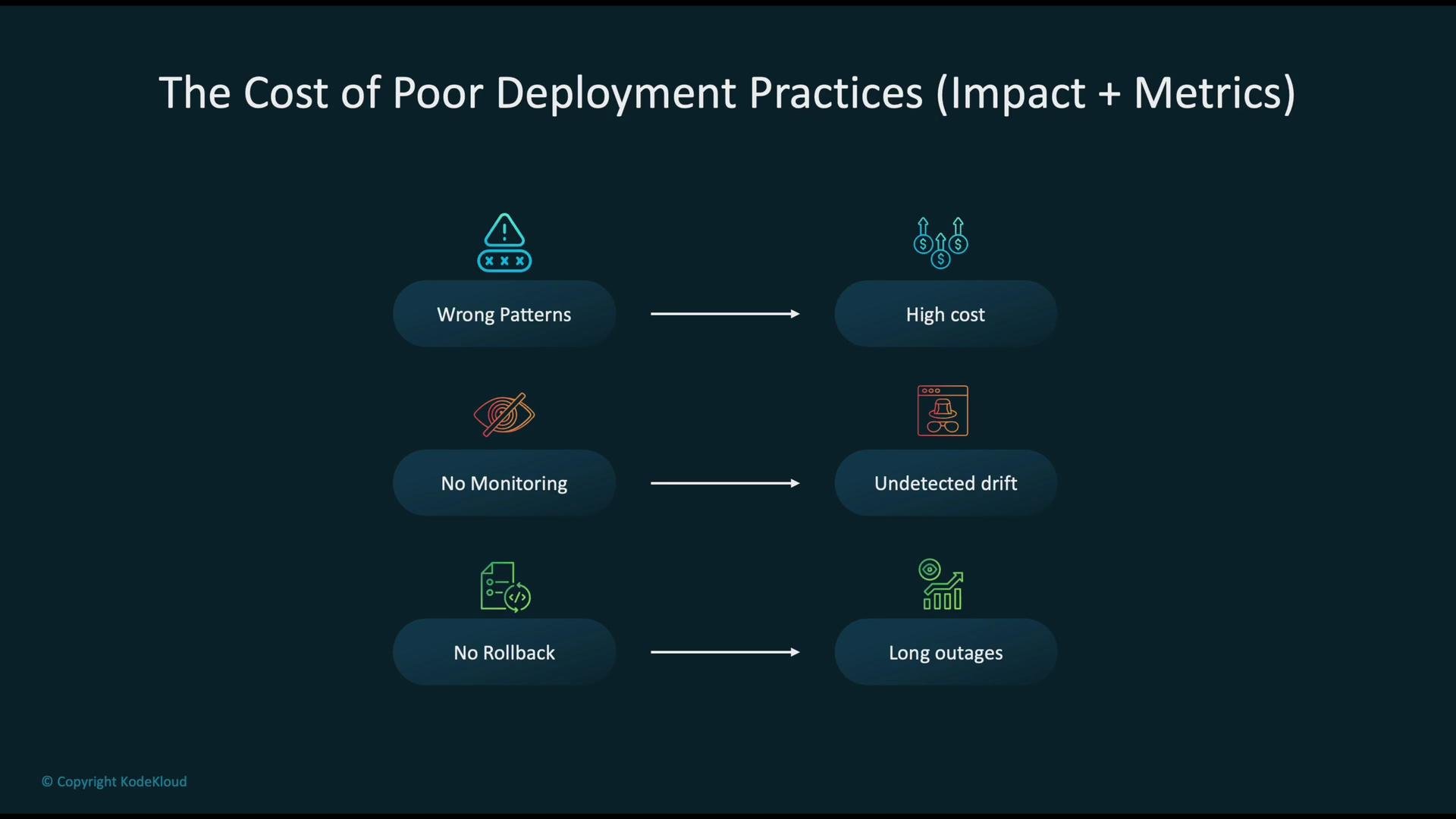
In this lesson we cover production-ready machine learning deployment best practices, focusing on reliability, security, cost efficiency, reproducibility, and automation. Poor deployment patterns increase operational risk and cloud spend: missing monitoring allows data drift to go unnoticed, lack of gating prevents safe rollbacks, and brittle manual processes prolong outages. Applying these best practices reduces incidents, lowers cost, and improves system stability.
 ## ML deployment maturity
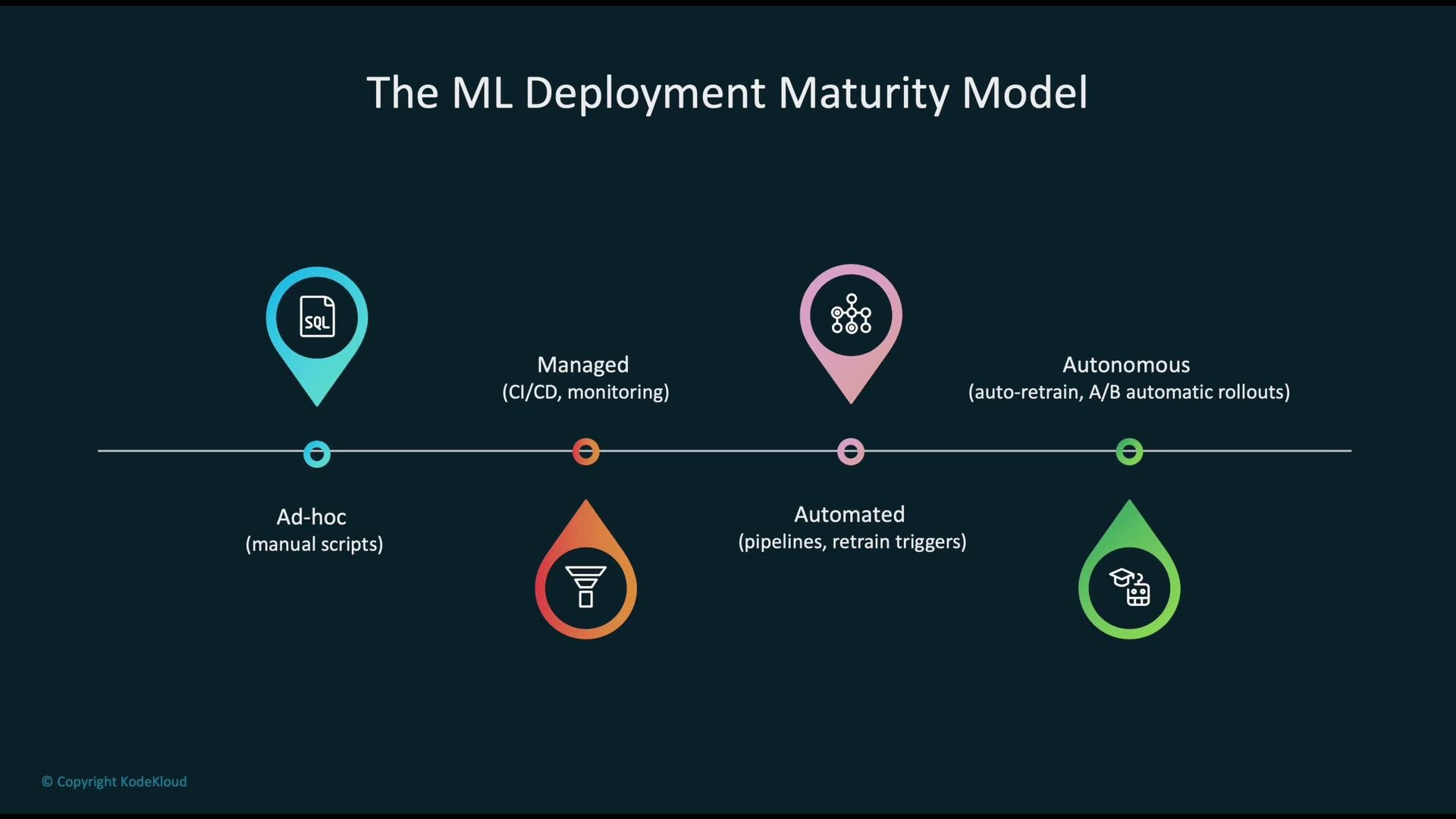
ML deployment maturity typically progresses from manual, ad-hoc scripts to fully autonomous, self-healing systems. Understanding this path helps teams prioritize improvements:
* Ad-hoc: manual scripts, one-off runs, high operational risk.
* Managed: CI/CD pipelines, basic monitoring, improved repeatability.
* Automated: end-to-end pipelines, retraining triggers, test gates, reduced manual steps.
* Autonomous: continuous evaluation, automated A/B rollouts, auto-retraining, and automated rollback.
Evaluating your current maturity level helps prioritize investments in automation, monitoring, and governance.
## ML deployment maturity
ML deployment maturity typically progresses from manual, ad-hoc scripts to fully autonomous, self-healing systems. Understanding this path helps teams prioritize improvements:
* Ad-hoc: manual scripts, one-off runs, high operational risk.
* Managed: CI/CD pipelines, basic monitoring, improved repeatability.
* Automated: end-to-end pipelines, retraining triggers, test gates, reduced manual steps.
* Autonomous: continuous evaluation, automated A/B rollouts, auto-retraining, and automated rollback.
Evaluating your current maturity level helps prioritize investments in automation, monitoring, and governance.
 ## Environment isolation: separate dev, test, staging, prod
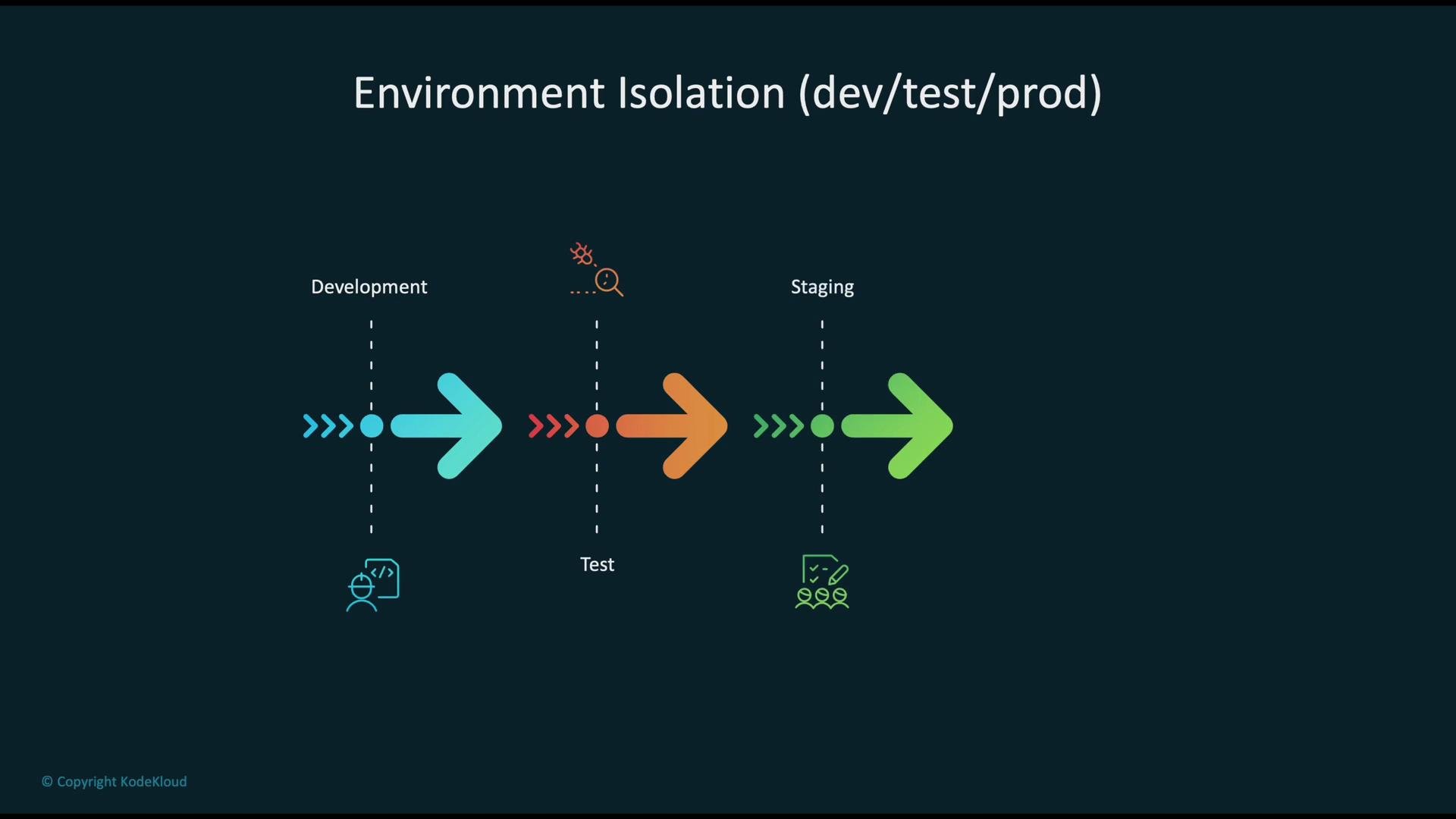
Isolating environments reduces risk by validating changes progressively. Typical responsibilities and goals by environment:
| Environment | Primary Use Case | Key Controls |
| ----------- | ----------------------------------------------------- | ----------------------------------------------------------- |
| Development | Fast iteration, feature branches, experiments | Lightweight infra, reproducible local runs |
| Test | Automated unit/integration tests, data validation | CI test suites, synthetic data, test data pipelines |
| Staging | Production-like validation (performance, integration) | Mirrors production infra, load testing |
| Production | Serve live traffic with monitoring & rollback | High-availability, alerting, autoscaling, secure networking |
Isolated environments support safe promotion of artifacts and help prevent accidental cross-contamination.
## Environment isolation: separate dev, test, staging, prod
Isolating environments reduces risk by validating changes progressively. Typical responsibilities and goals by environment:
| Environment | Primary Use Case | Key Controls |
| ----------- | ----------------------------------------------------- | ----------------------------------------------------------- |
| Development | Fast iteration, feature branches, experiments | Lightweight infra, reproducible local runs |
| Test | Automated unit/integration tests, data validation | CI test suites, synthetic data, test data pipelines |
| Staging | Production-like validation (performance, integration) | Mirrors production infra, load testing |
| Production | Serve live traffic with monitoring & rollback | High-availability, alerting, autoscaling, secure networking |
Isolated environments support safe promotion of artifacts and help prevent accidental cross-contamination.
 ## Automated testing for ML (code + data)
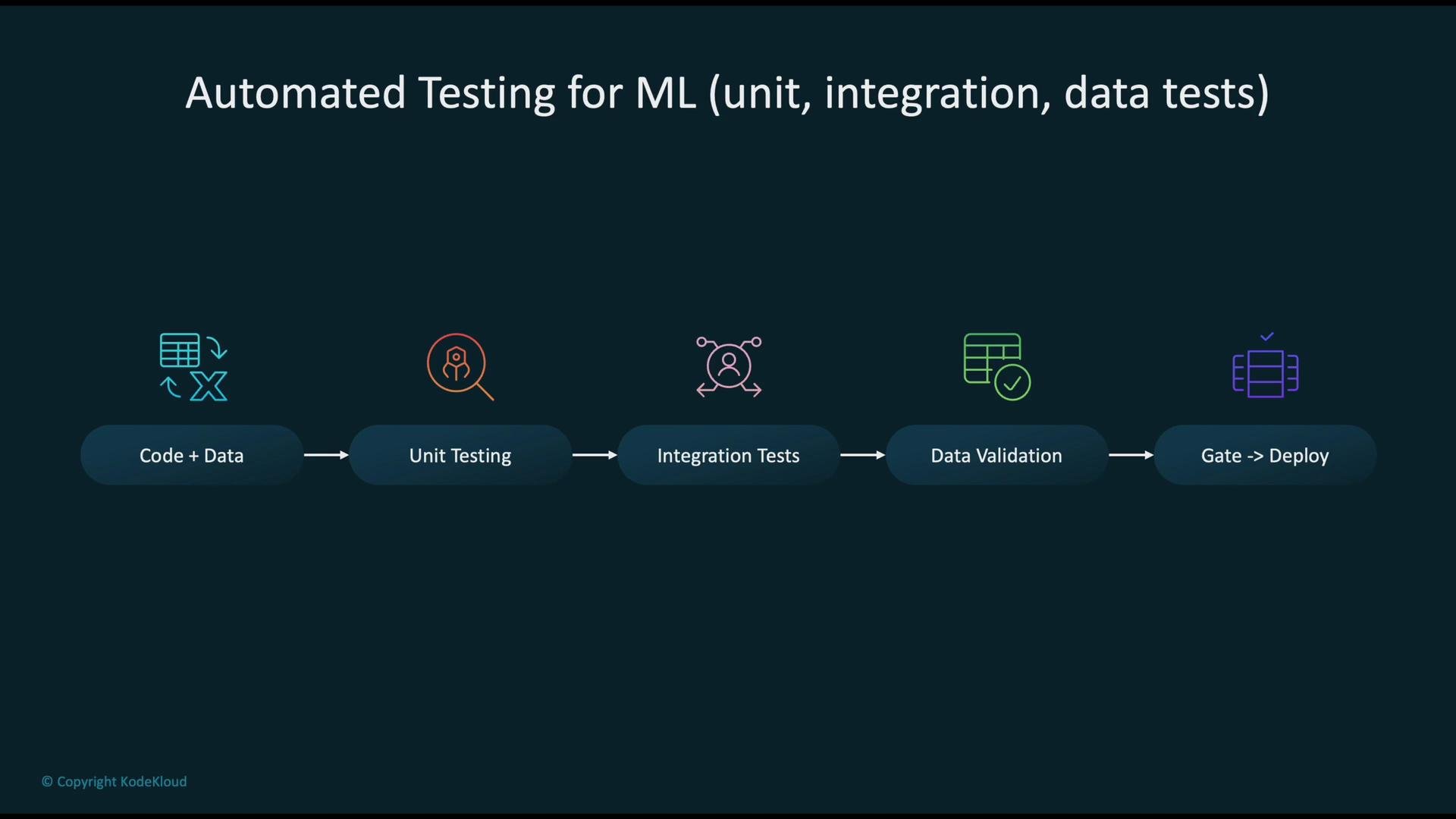
Automated testing must cover both code correctness and data integrity. A clear progression of tests helps establish deployment gates:
| Test Type | Purpose | Examples |
| ----------------- | --------------------------------------------- | ---------------------------------------------------------- |
| Unit tests | Verify isolated functions and scoring logic | Model scoring function tests, feature transform unit tests |
| Integration tests | Ensure system components work together | Feature pipeline + model + infra integration tests |
| Data validation | Detect schema changes and distribution shifts | Schema checks, statistical tests vs. training data |
| Deployment gates | Prevent promotion of failing artifacts | Require all tests and data checks to pass before deploy |
These gates reduce incidents caused by code bugs or data regressions and protect production model quality.
## Automated testing for ML (code + data)
Automated testing must cover both code correctness and data integrity. A clear progression of tests helps establish deployment gates:
| Test Type | Purpose | Examples |
| ----------------- | --------------------------------------------- | ---------------------------------------------------------- |
| Unit tests | Verify isolated functions and scoring logic | Model scoring function tests, feature transform unit tests |
| Integration tests | Ensure system components work together | Feature pipeline + model + infra integration tests |
| Data validation | Detect schema changes and distribution shifts | Schema checks, statistical tests vs. training data |
| Deployment gates | Prevent promotion of failing artifacts | Require all tests and data checks to pass before deploy |
These gates reduce incidents caused by code bugs or data regressions and protect production model quality.
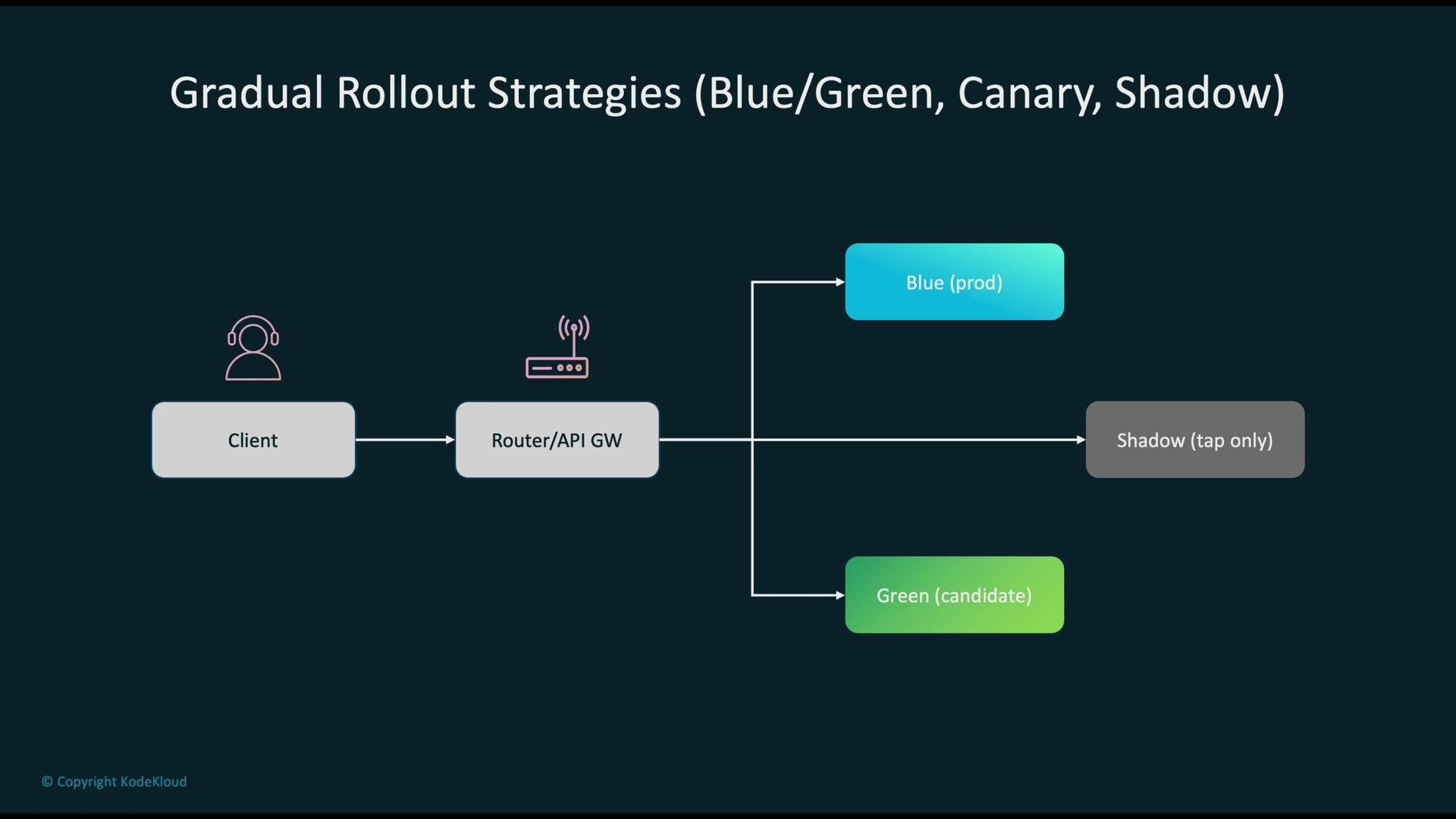
 ## Gradual rollout strategies (reduce blast radius)
Use staged rollout strategies to validate new models on live traffic safely:
* Canary: route a small percentage of traffic to the new model for real-world validation.
* Blue-Green: keep two complete production environments and switch traffic atomically for fast rollback.
* Shadow (dark launch): run the new model in parallel on live inputs without affecting responses; useful for side-by-side evaluation and metrics collection.
A router or API gateway controls traffic splits and provides observability to evaluate the candidate model before full promotion.
## Gradual rollout strategies (reduce blast radius)
Use staged rollout strategies to validate new models on live traffic safely:
* Canary: route a small percentage of traffic to the new model for real-world validation.
* Blue-Green: keep two complete production environments and switch traffic atomically for fast rollback.
* Shadow (dark launch): run the new model in parallel on live inputs without affecting responses; useful for side-by-side evaluation and metrics collection.
A router or API gateway controls traffic splits and provides observability to evaluate the candidate model before full promotion.
 ## Monitoring and observability
Monitoring is essential to detect data drift, prediction quality regressions, and latency issues. Collect logs and metrics from model predictions, feature inputs, and infrastructure:
* Track input and output distributions to detect drift.
* Compute application-level metrics (latency, error rates) and model-level metrics (accuracy, calibration).
* Use anomaly detection to trigger alerts and automated workflows.
Services such as SageMaker Model Monitor can surface data and prediction drift; alerts routed via Amazon CloudWatch or Amazon EventBridge can trigger human investigation or automated remediation (e.g., retraining or rollback).
## Monitoring and observability
Monitoring is essential to detect data drift, prediction quality regressions, and latency issues. Collect logs and metrics from model predictions, feature inputs, and infrastructure:
* Track input and output distributions to detect drift.
* Compute application-level metrics (latency, error rates) and model-level metrics (accuracy, calibration).
* Use anomaly detection to trigger alerts and automated workflows.
Services such as SageMaker Model Monitor can surface data and prediction drift; alerts routed via Amazon CloudWatch or Amazon EventBridge can trigger human investigation or automated remediation (e.g., retraining or rollback).
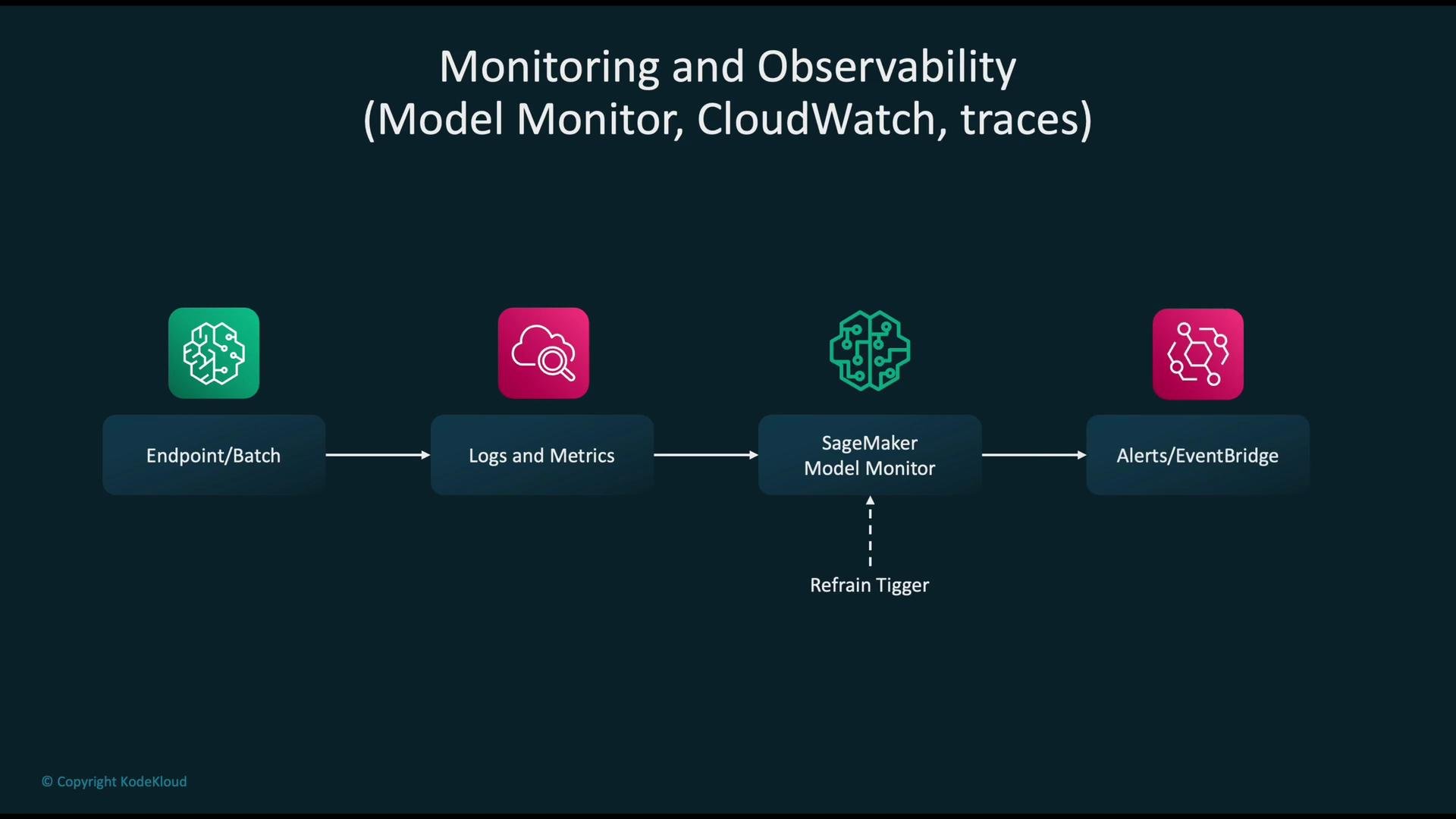 When drift or alerts occur, automated retraining pipelines can be started—but retrained models must pass the same verification and gating steps before promotion to production.
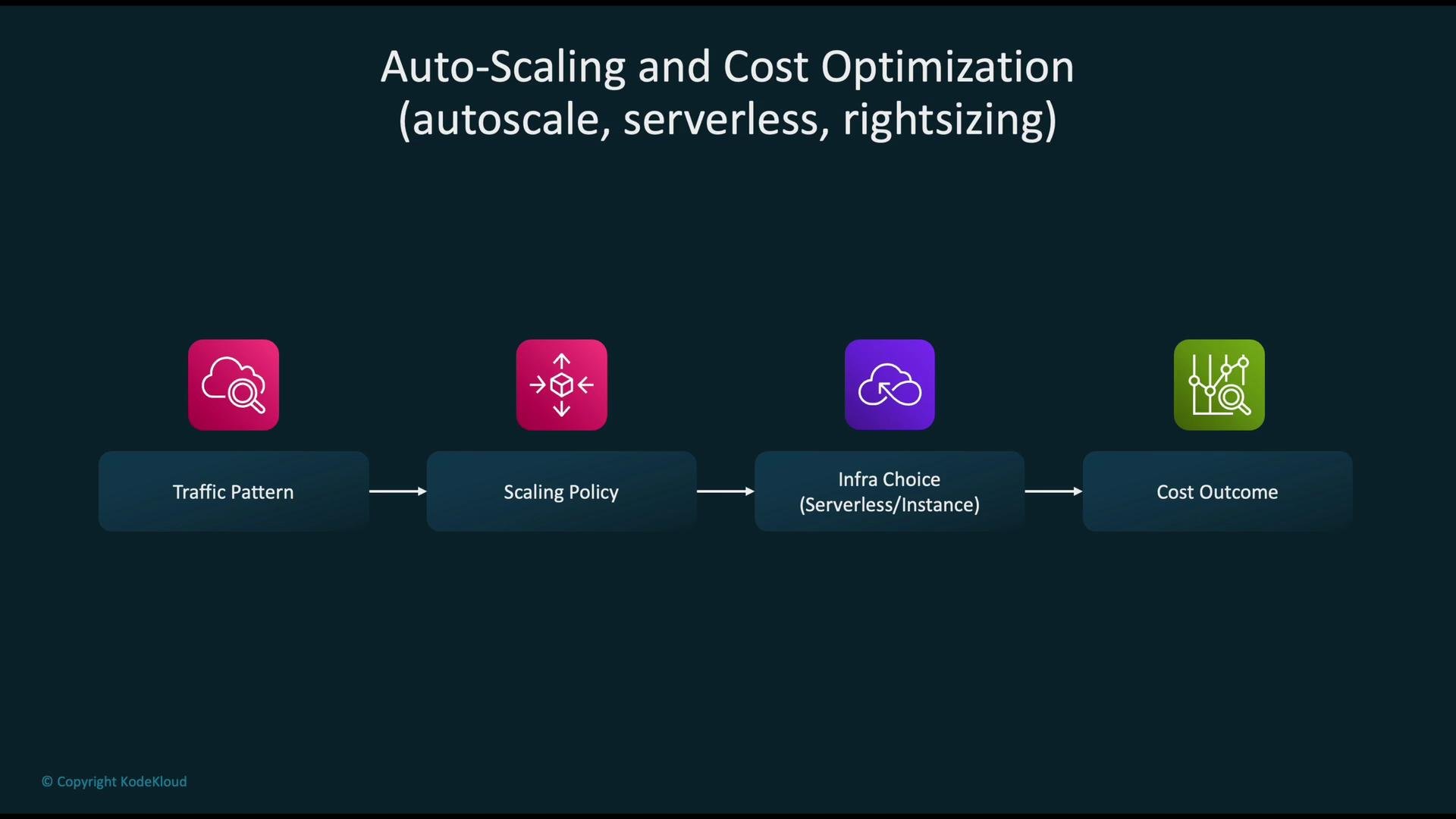
## Auto scaling and cost optimization
Match infrastructure to traffic patterns and SLOs to balance latency and cost:
* Define scaling policies based on realistic traffic forecasts and performance SLOs.
* Consider serverless or managed inference for spiky workloads (e.g., SageMaker Serverless Inference).
* Use dedicated instances for consistent, predictable workloads.
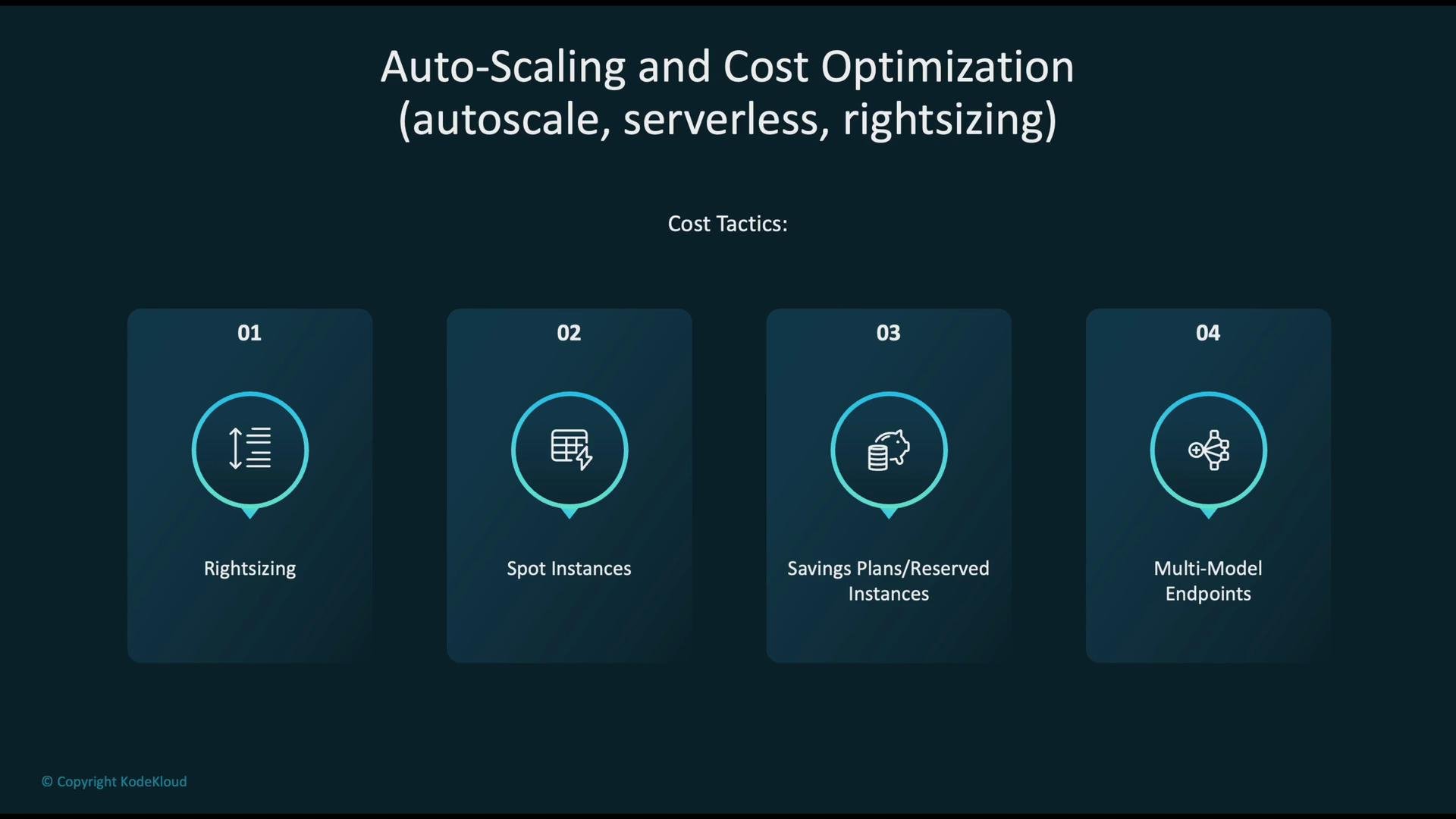
Common cost-optimization tactics:
| Tactic | When to use | Example / Link |
| ---------------------------------- | ------------------------------------------------- | -------------------------------------------------------------------------------------------------------------------------------------------------------------------------------- |
| Right-sizing | Workloads with stable performance characteristics | Choose instance types that meet CPU/GPU and memory needs |
| Spot Instances | Flexible, non-critical batch processing | Use EC2 Spot for large offline training jobs ([EC2 Spot Instances](https://docs.aws.amazon.com/AWSEC2/latest/UserGuide/spot-instances.html)) |
| Savings Plans / Reserved Instances | Predictable capacity | Commit to capacity for discounted pricing ([Savings Plans](https://docs.aws.amazon.com/savingsplans/latest/userguide/what-is-savings-plans.html)) |
| Multi-model endpoints | Many small models with low per-model traffic | Serve multiple models from a single endpoint to reduce footprint ([SageMaker Multi-Model Endpoints](https://docs.aws.amazon.com/sagemaker/latest/dg/multi-model-endpoints.html)) |
When drift or alerts occur, automated retraining pipelines can be started—but retrained models must pass the same verification and gating steps before promotion to production.
## Auto scaling and cost optimization
Match infrastructure to traffic patterns and SLOs to balance latency and cost:
* Define scaling policies based on realistic traffic forecasts and performance SLOs.
* Consider serverless or managed inference for spiky workloads (e.g., SageMaker Serverless Inference).
* Use dedicated instances for consistent, predictable workloads.
Common cost-optimization tactics:
| Tactic | When to use | Example / Link |
| ---------------------------------- | ------------------------------------------------- | -------------------------------------------------------------------------------------------------------------------------------------------------------------------------------- |
| Right-sizing | Workloads with stable performance characteristics | Choose instance types that meet CPU/GPU and memory needs |
| Spot Instances | Flexible, non-critical batch processing | Use EC2 Spot for large offline training jobs ([EC2 Spot Instances](https://docs.aws.amazon.com/AWSEC2/latest/UserGuide/spot-instances.html)) |
| Savings Plans / Reserved Instances | Predictable capacity | Commit to capacity for discounted pricing ([Savings Plans](https://docs.aws.amazon.com/savingsplans/latest/userguide/what-is-savings-plans.html)) |
| Multi-model endpoints | Many small models with low per-model traffic | Serve multiple models from a single endpoint to reduce footprint ([SageMaker Multi-Model Endpoints](https://docs.aws.amazon.com/sagemaker/latest/dg/multi-model-endpoints.html)) |
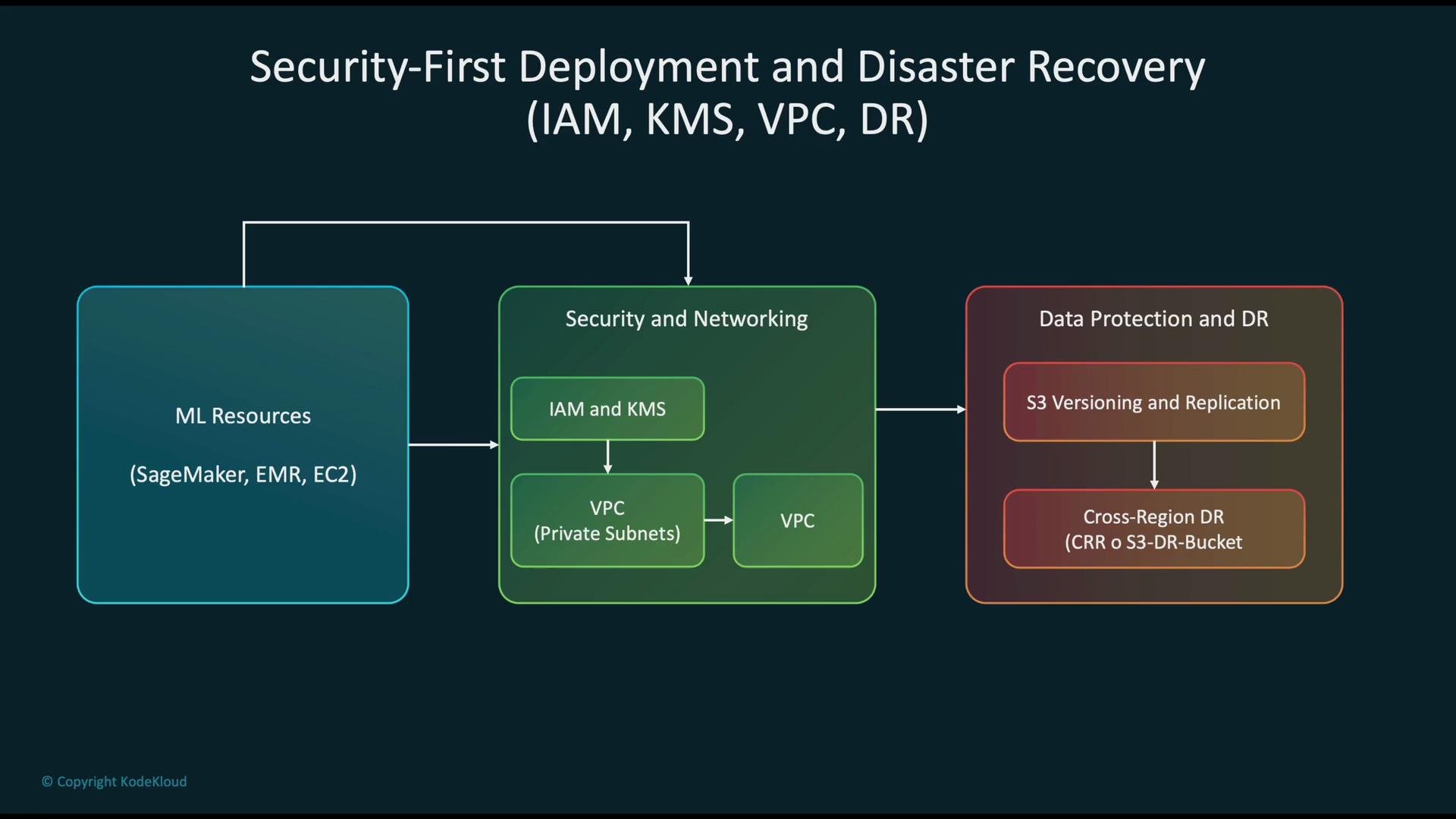
 ## Security-first architectures
Protect compute, data, and access using defense-in-depth:
* Enforce IAM least-privilege for users and services ([IAM best practices](https://docs.aws.amazon.com/IAM/latest/UserGuide/best-practices.html#grant-least-privilege)).
* Encrypt artifacts and secrets with KMS ([KMS](https://docs.aws.amazon.com/kms/)).
* Use VPC private subnets for endpoint and compute isolation.
* Implement data protection with S3 versioning, cross-region replication, backups, and a tested disaster recovery plan.
These controls help ensure secure, isolated, and resilient ML systems.
## Security-first architectures
Protect compute, data, and access using defense-in-depth:
* Enforce IAM least-privilege for users and services ([IAM best practices](https://docs.aws.amazon.com/IAM/latest/UserGuide/best-practices.html#grant-least-privilege)).
* Encrypt artifacts and secrets with KMS ([KMS](https://docs.aws.amazon.com/kms/)).
* Use VPC private subnets for endpoint and compute isolation.
* Implement data protection with S3 versioning, cross-region replication, backups, and a tested disaster recovery plan.
These controls help ensure secure, isolated, and resilient ML systems.
 ## Continuous delivery and automated ML workflows
Automating the ML lifecycle reduces manual error and accelerates safe releases:
* Source control: store code, configuration, and infrastructure-as-code in repositories (e.g., CodeCommit or GitHub).
* Build & test: run automated test suites to create reproducible artifacts.
* Orchestration: coordinate build-to-deploy flow with CI/CD (e.g., CodePipeline).
* ML pipelines: use SageMaker Pipelines or alternative workflow engines to manage training, validation, and evaluation.
* Model registry: archive approved model versions for auditing and reproducibility (e.g., SageMaker Model Registry).
* Deploy: push validated artifacts to production using automated deployment steps.
* Monitor & retrain: continuously monitor and trigger retraining when performance degrades.
## Continuous delivery and automated ML workflows
Automating the ML lifecycle reduces manual error and accelerates safe releases:
* Source control: store code, configuration, and infrastructure-as-code in repositories (e.g., CodeCommit or GitHub).
* Build & test: run automated test suites to create reproducible artifacts.
* Orchestration: coordinate build-to-deploy flow with CI/CD (e.g., CodePipeline).
* ML pipelines: use SageMaker Pipelines or alternative workflow engines to manage training, validation, and evaluation.
* Model registry: archive approved model versions for auditing and reproducibility (e.g., SageMaker Model Registry).
* Deploy: push validated artifacts to production using automated deployment steps.
* Monitor & retrain: continuously monitor and trigger retraining when performance degrades.
 ## Anti-patterns to avoid
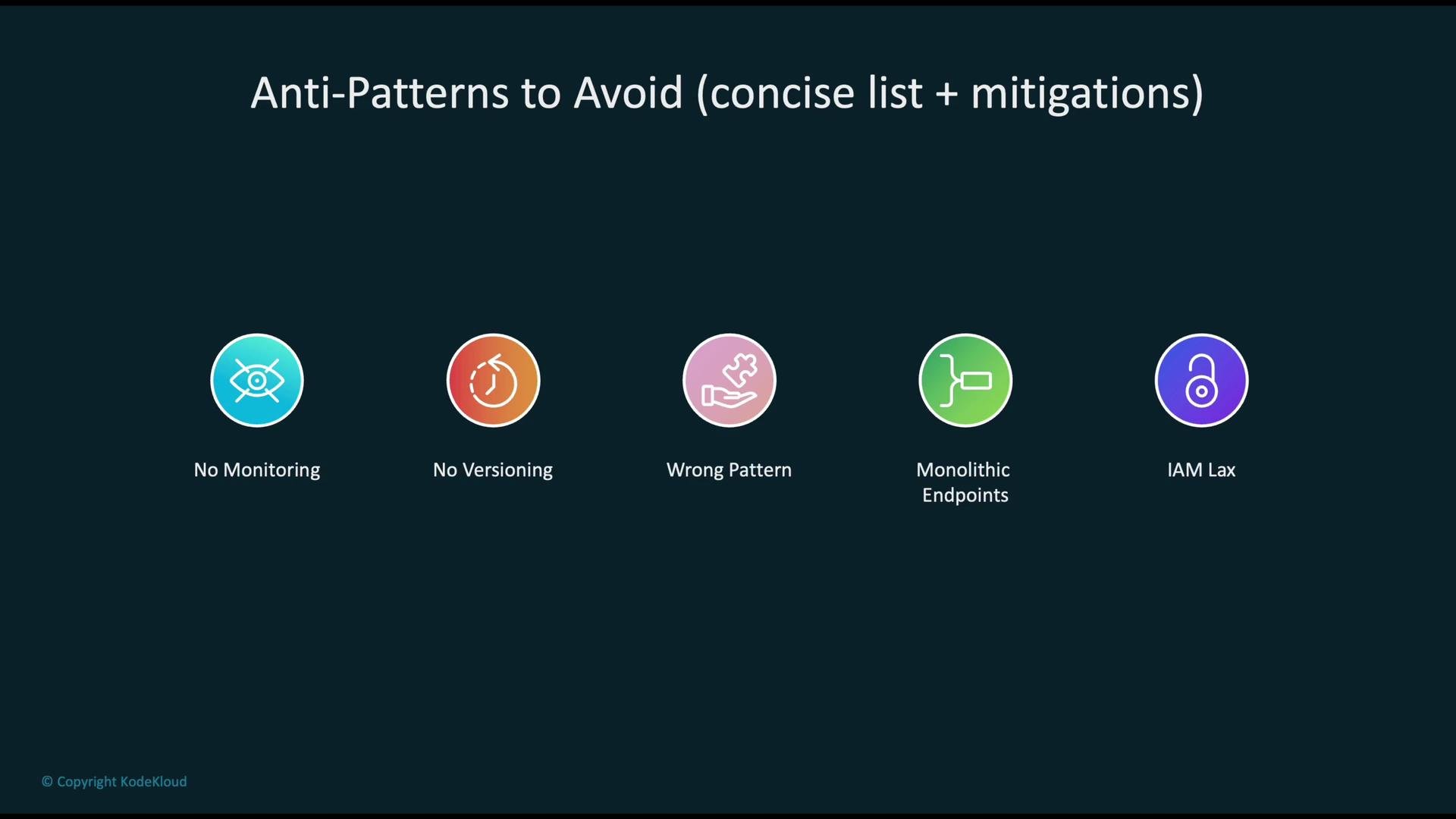
Avoid these common mistakes:
* No monitoring or observability for models in production.
* No versioning for code, data, or models.
* Wrong deployment pattern (e.g., monolithic endpoints without isolation).
* Lax IAM policies that grant excessive privileges.
* Architectures that prevent safe rollback or testing.
These anti-patterns are frequent contributors to reliability, security, and cost incidents.
Adopt a checklist-driven approach: automate repeatable tasks, version everything (code, data, models), and enforce tests and monitoring gates before promoting models to production.
## Best-practices checklist
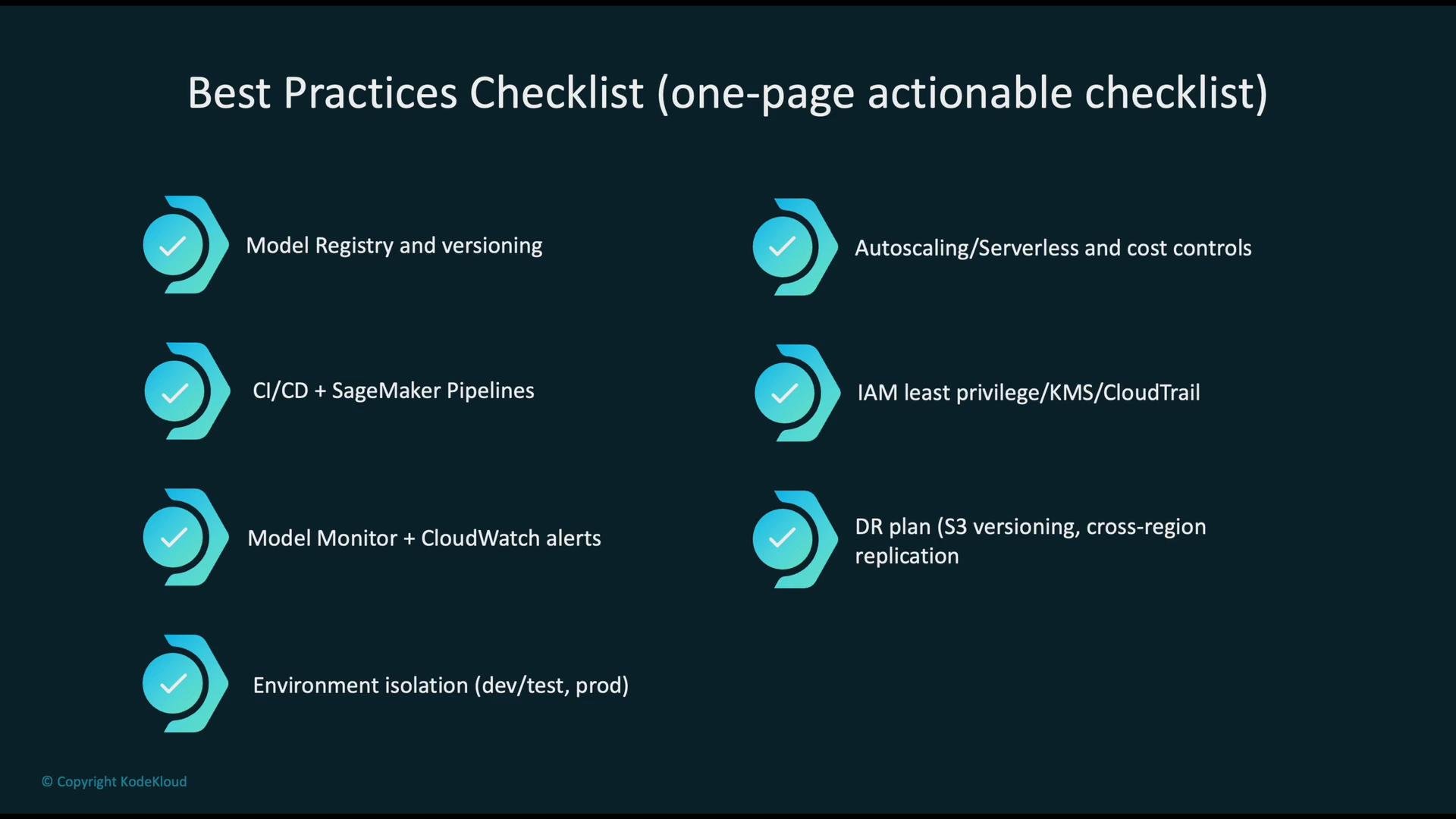
Use the following checklist to operationalize the practices above:
* Model Registry & Versioning: track models, datasets, and metadata for reproducibility and safe rollouts.
* CI/CD & Pipelines: automate build, training, validation, and deployment with tools like SageMaker Pipelines and CodePipeline.
* Continuous Monitoring: use Model Monitor and CloudWatch for data and prediction drift alerts.
* Environment Isolation: maintain dev, test, staging, and production separations to validate changes safely.
* Auto-scaling & Serverless: choose cost-effective execution patterns based on traffic characteristics.
* Cost Controls: right-size resources, use Spot where appropriate, and leverage Savings Plans/Reserved Instances.
* Security Controls: enforce IAM least-privilege, encrypt with KMS, and enable auditing via CloudTrail.
* Disaster Recovery: implement S3 versioning, cross-region replication, backups, and runbooks for recovery.
## Anti-patterns to avoid
Avoid these common mistakes:
* No monitoring or observability for models in production.
* No versioning for code, data, or models.
* Wrong deployment pattern (e.g., monolithic endpoints without isolation).
* Lax IAM policies that grant excessive privileges.
* Architectures that prevent safe rollback or testing.
These anti-patterns are frequent contributors to reliability, security, and cost incidents.
Adopt a checklist-driven approach: automate repeatable tasks, version everything (code, data, models), and enforce tests and monitoring gates before promoting models to production.
## Best-practices checklist
Use the following checklist to operationalize the practices above:
* Model Registry & Versioning: track models, datasets, and metadata for reproducibility and safe rollouts.
* CI/CD & Pipelines: automate build, training, validation, and deployment with tools like SageMaker Pipelines and CodePipeline.
* Continuous Monitoring: use Model Monitor and CloudWatch for data and prediction drift alerts.
* Environment Isolation: maintain dev, test, staging, and production separations to validate changes safely.
* Auto-scaling & Serverless: choose cost-effective execution patterns based on traffic characteristics.
* Cost Controls: right-size resources, use Spot where appropriate, and leverage Savings Plans/Reserved Instances.
* Security Controls: enforce IAM least-privilege, encrypt with KMS, and enable auditing via CloudTrail.
* Disaster Recovery: implement S3 versioning, cross-region replication, backups, and runbooks for recovery.
 ## Links and references
* SageMaker Model Monitor: [https://docs.aws.amazon.com/sagemaker/latest/dg/model-monitor.html](https://docs.aws.amazon.com/sagemaker/latest/dg/model-monitor.html)
* Amazon CloudWatch: [https://docs.aws.amazon.com/cloudwatch/index.html](https://docs.aws.amazon.com/cloudwatch/index.html)
* Amazon EventBridge: [https://docs.aws.amazon.com/eventbridge/latest/userguide/what-is-amazon-eventbridge.html](https://docs.aws.amazon.com/eventbridge/latest/userguide/what-is-amazon-eventbridge.html)
* EC2 Spot Instances: [https://docs.aws.amazon.com/AWSEC2/latest/UserGuide/spot-instances.html](https://docs.aws.amazon.com/AWSEC2/latest/UserGuide/spot-instances.html)
* SageMaker real-time & Serverless Inference: [https://docs.aws.amazon.com/sagemaker/latest/dg/real-time-inference.html](https://docs.aws.amazon.com/sagemaker/latest/dg/real-time-inference.html) / [https://docs.aws.amazon.com/sagemaker/latest/dg/serverless-inference.html](https://docs.aws.amazon.com/sagemaker/latest/dg/serverless-inference.html)
* Savings Plans and Reserved Instances: [https://docs.aws.amazon.com/savingsplans/latest/userguide/what-is-savings-plans.html](https://docs.aws.amazon.com/savingsplans/latest/userguide/what-is-savings-plans.html) / [https://docs.aws.amazon.com/AWSEC2/latest/UserGuide/ec2-reserved-instances.html](https://docs.aws.amazon.com/AWSEC2/latest/UserGuide/ec2-reserved-instances.html)
Apply these patterns iteratively: prioritize monitoring and gating first, add automated pipelines next, and progressively invest in cost optimization and security to reach higher ML deployment maturity.
## Links and references
* SageMaker Model Monitor: [https://docs.aws.amazon.com/sagemaker/latest/dg/model-monitor.html](https://docs.aws.amazon.com/sagemaker/latest/dg/model-monitor.html)
* Amazon CloudWatch: [https://docs.aws.amazon.com/cloudwatch/index.html](https://docs.aws.amazon.com/cloudwatch/index.html)
* Amazon EventBridge: [https://docs.aws.amazon.com/eventbridge/latest/userguide/what-is-amazon-eventbridge.html](https://docs.aws.amazon.com/eventbridge/latest/userguide/what-is-amazon-eventbridge.html)
* EC2 Spot Instances: [https://docs.aws.amazon.com/AWSEC2/latest/UserGuide/spot-instances.html](https://docs.aws.amazon.com/AWSEC2/latest/UserGuide/spot-instances.html)
* SageMaker real-time & Serverless Inference: [https://docs.aws.amazon.com/sagemaker/latest/dg/real-time-inference.html](https://docs.aws.amazon.com/sagemaker/latest/dg/real-time-inference.html) / [https://docs.aws.amazon.com/sagemaker/latest/dg/serverless-inference.html](https://docs.aws.amazon.com/sagemaker/latest/dg/serverless-inference.html)
* Savings Plans and Reserved Instances: [https://docs.aws.amazon.com/savingsplans/latest/userguide/what-is-savings-plans.html](https://docs.aws.amazon.com/savingsplans/latest/userguide/what-is-savings-plans.html) / [https://docs.aws.amazon.com/AWSEC2/latest/UserGuide/ec2-reserved-instances.html](https://docs.aws.amazon.com/AWSEC2/latest/UserGuide/ec2-reserved-instances.html)
Apply these patterns iteratively: prioritize monitoring and gating first, add automated pipelines next, and progressively invest in cost optimization and security to reach higher ML deployment maturity.