> ## Documentation Index
> Fetch the complete documentation index at: https://notes.kodekloud.com/llms.txt
> Use this file to discover all available pages before exploring further.
# On Demand vs Provisioned Resources for ML
> Guide comparing on-demand versus provisioned cloud resources for ML, explaining trade-offs and hybrid strategies to balance cost, reliability, and scalability
When running machine learning workloads, you must decide how to allocate compute capacity. This guide compares on-demand (pay-as-you-go) resources with provisioned capacity, explains trade-offs, and gives practical guidance to choose the best option for your ML projects.
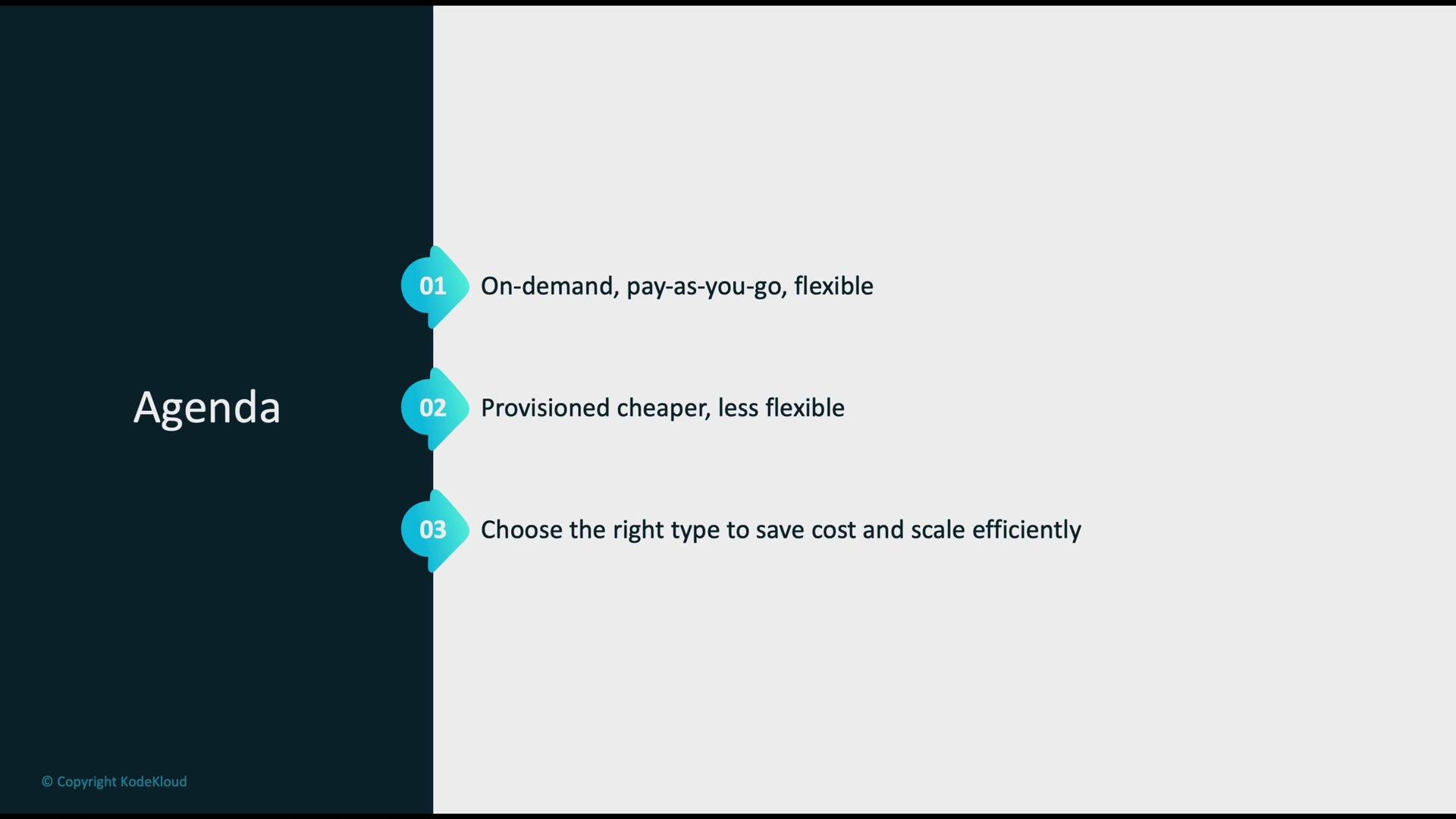
Agenda:
* Explore the on-demand, pay-as-you-go model and its flexibility.
* Compare provisioned models that reduce cost but add commitment.
* Show how to pick a strategy that balances cost, reliability, and scalability.
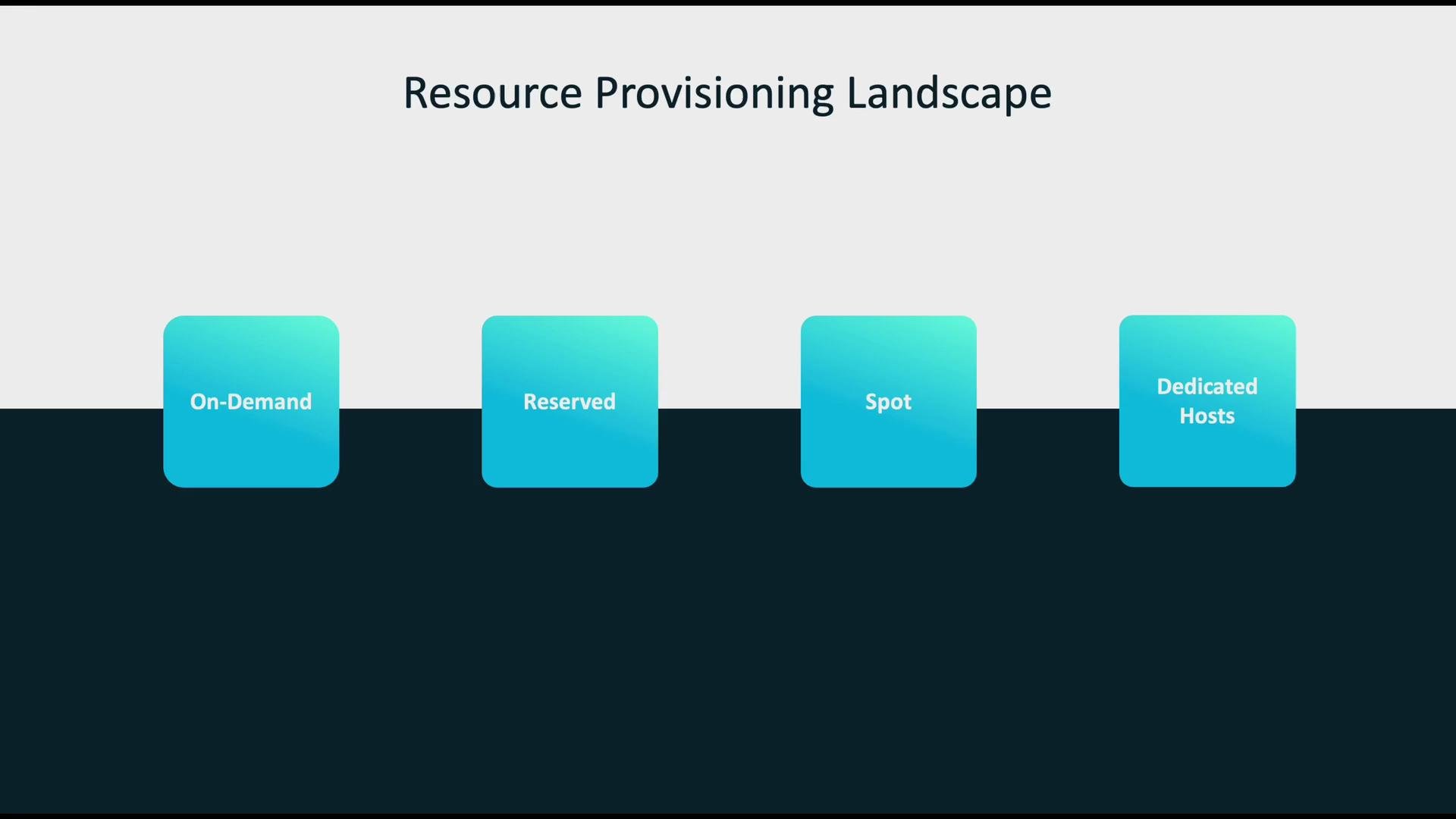
 ## Provisioning models to consider
Choose provisioning based on predictability, cost tolerance, and compliance needs.
| Model | Description | Typical savings / trade-off | Best fit |
| ------------------ | -------------------------------------------------------------------- | ------------------------------------------------------------------ | ------------------------------------------------------------------- |
| On-Demand | Pay for compute by the hour/second with no long-term contract. | No upfront costs; higher per-unit price but maximum flexibility. | Experiments, development, unpredictable or spiky workloads. |
| Reserved Instances | Commit to 1–3 years for specific instance class/region. | Up to \~72% savings vs on-demand; requires commitment. | Predictable, long-running services (steady inference). |
| Savings Plans | Commit to an hourly spend to get discounts across instance families. | Flexible across instance types; lower cost than on-demand. | Teams needing flexibility across instances with predictable spend. |
| Spot Instances | Use spare capacity at steep discounts (interruptible). | Up to \~90% savings; instances can be reclaimed with short notice. | Fault-tolerant large-scale training, batch jobs with checkpointing. |
| Dedicated Hosts | An entire physical server for single-tenant use. | Higher cost but required for certain licenses or compliance. | Workloads with licensing or regulatory isolation needs. |
## Provisioning models to consider
Choose provisioning based on predictability, cost tolerance, and compliance needs.
| Model | Description | Typical savings / trade-off | Best fit |
| ------------------ | -------------------------------------------------------------------- | ------------------------------------------------------------------ | ------------------------------------------------------------------- |
| On-Demand | Pay for compute by the hour/second with no long-term contract. | No upfront costs; higher per-unit price but maximum flexibility. | Experiments, development, unpredictable or spiky workloads. |
| Reserved Instances | Commit to 1–3 years for specific instance class/region. | Up to \~72% savings vs on-demand; requires commitment. | Predictable, long-running services (steady inference). |
| Savings Plans | Commit to an hourly spend to get discounts across instance families. | Flexible across instance types; lower cost than on-demand. | Teams needing flexibility across instances with predictable spend. |
| Spot Instances | Use spare capacity at steep discounts (interruptible). | Up to \~90% savings; instances can be reclaimed with short notice. | Fault-tolerant large-scale training, batch jobs with checkpointing. |
| Dedicated Hosts | An entire physical server for single-tenant use. | Higher cost but required for certain licenses or compliance. | Workloads with licensing or regulatory isolation needs. |
 ## Match instance choice to workload patterns
Workloads typically follow two demand patterns:
* Spiky / variable — e.g., many training jobs, unpredictable experiments.
* Steady / predictable — e.g., production inference endpoints with consistent traffic.
Selecting the wrong model either wastes budget (overprovisioning) or causes capacity shortages (underprovisioning). Align choice to the workload’s predictability and fault-tolerance.
## On-demand resources: when flexibility matters
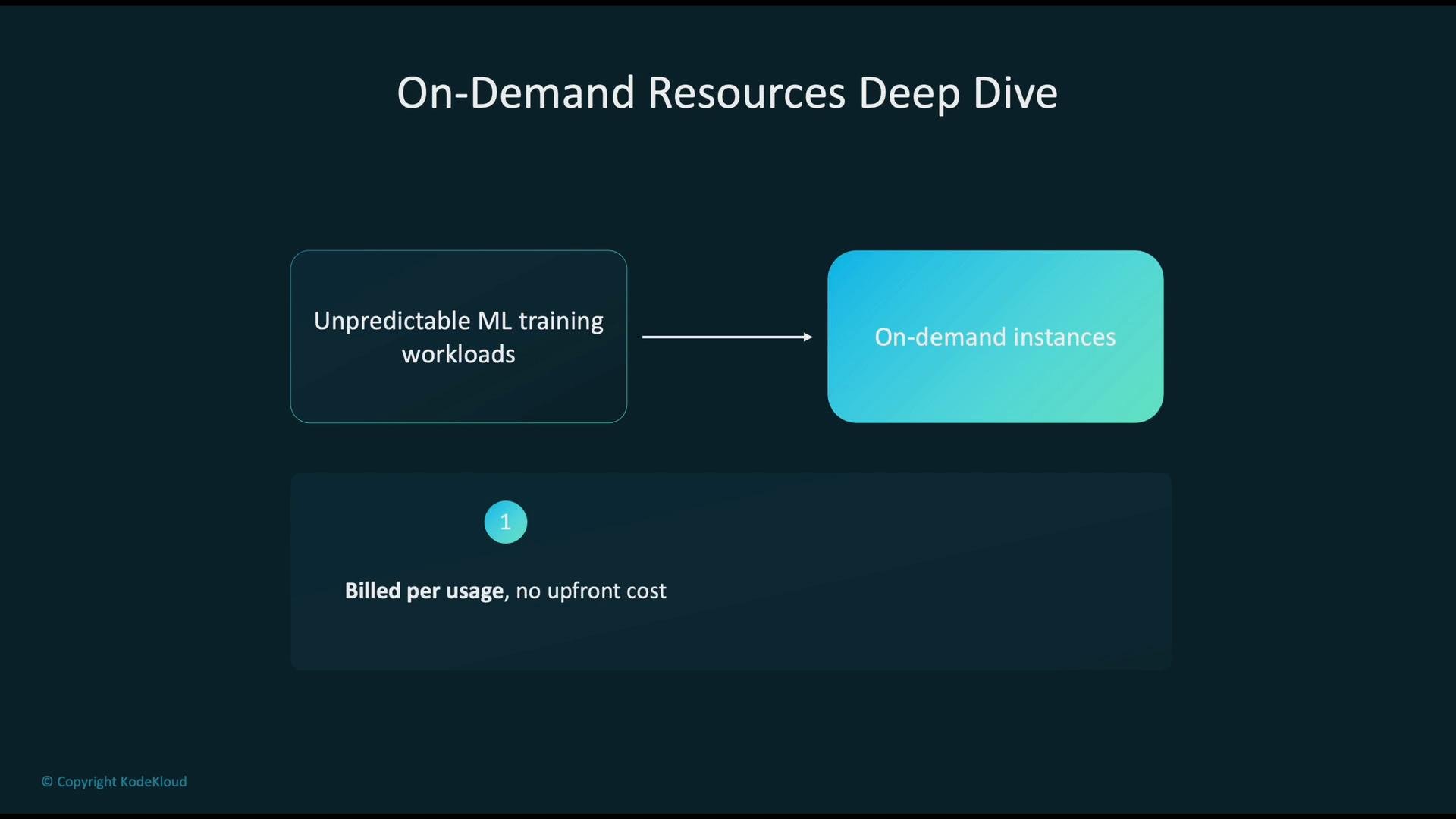
On-demand instances are ideal when you cannot predict timing or scale. They require no long-term commitment and are billed only for usage, making them excellent for iterative development and bursty workloads.
## Match instance choice to workload patterns
Workloads typically follow two demand patterns:
* Spiky / variable — e.g., many training jobs, unpredictable experiments.
* Steady / predictable — e.g., production inference endpoints with consistent traffic.
Selecting the wrong model either wastes budget (overprovisioning) or causes capacity shortages (underprovisioning). Align choice to the workload’s predictability and fault-tolerance.
## On-demand resources: when flexibility matters
On-demand instances are ideal when you cannot predict timing or scale. They require no long-term commitment and are billed only for usage, making them excellent for iterative development and bursty workloads.
 When to prefer on-demand:
* Short or uncertain training runs where long-term commitment isn’t justified.
* Development, experimentation, and rapid iteration cycles.
* Handling sudden traffic spikes or unplanned compute needs.
## Provisioned options: optimize for cost
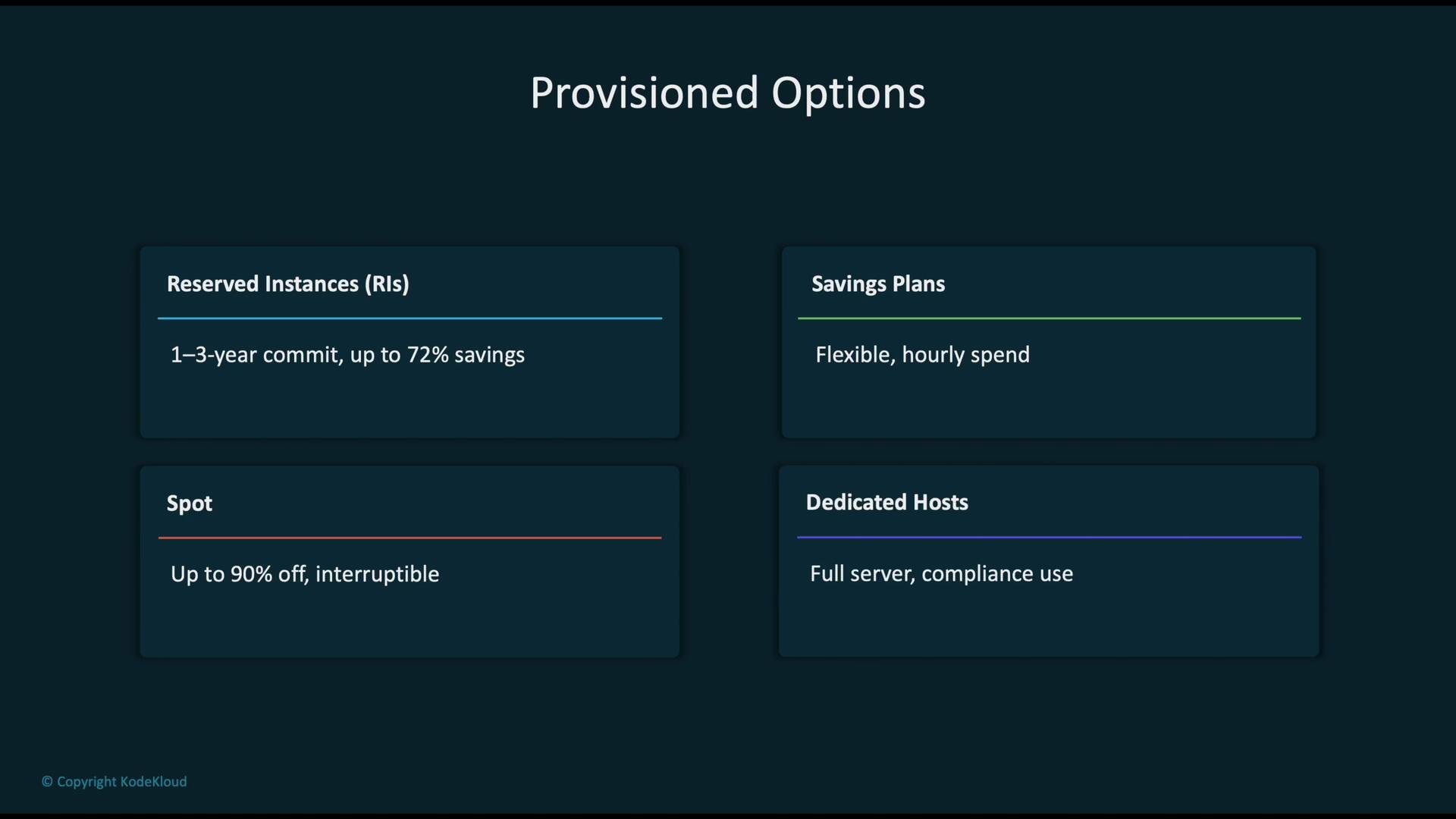
When usage is predictable, provisioned models significantly lower costs. Use reserved commitments when you can forecast steady usage, and use spot for fault-tolerant workloads to maximize savings.
When to prefer on-demand:
* Short or uncertain training runs where long-term commitment isn’t justified.
* Development, experimentation, and rapid iteration cycles.
* Handling sudden traffic spikes or unplanned compute needs.
## Provisioned options: optimize for cost
When usage is predictable, provisioned models significantly lower costs. Use reserved commitments when you can forecast steady usage, and use spot for fault-tolerant workloads to maximize savings.
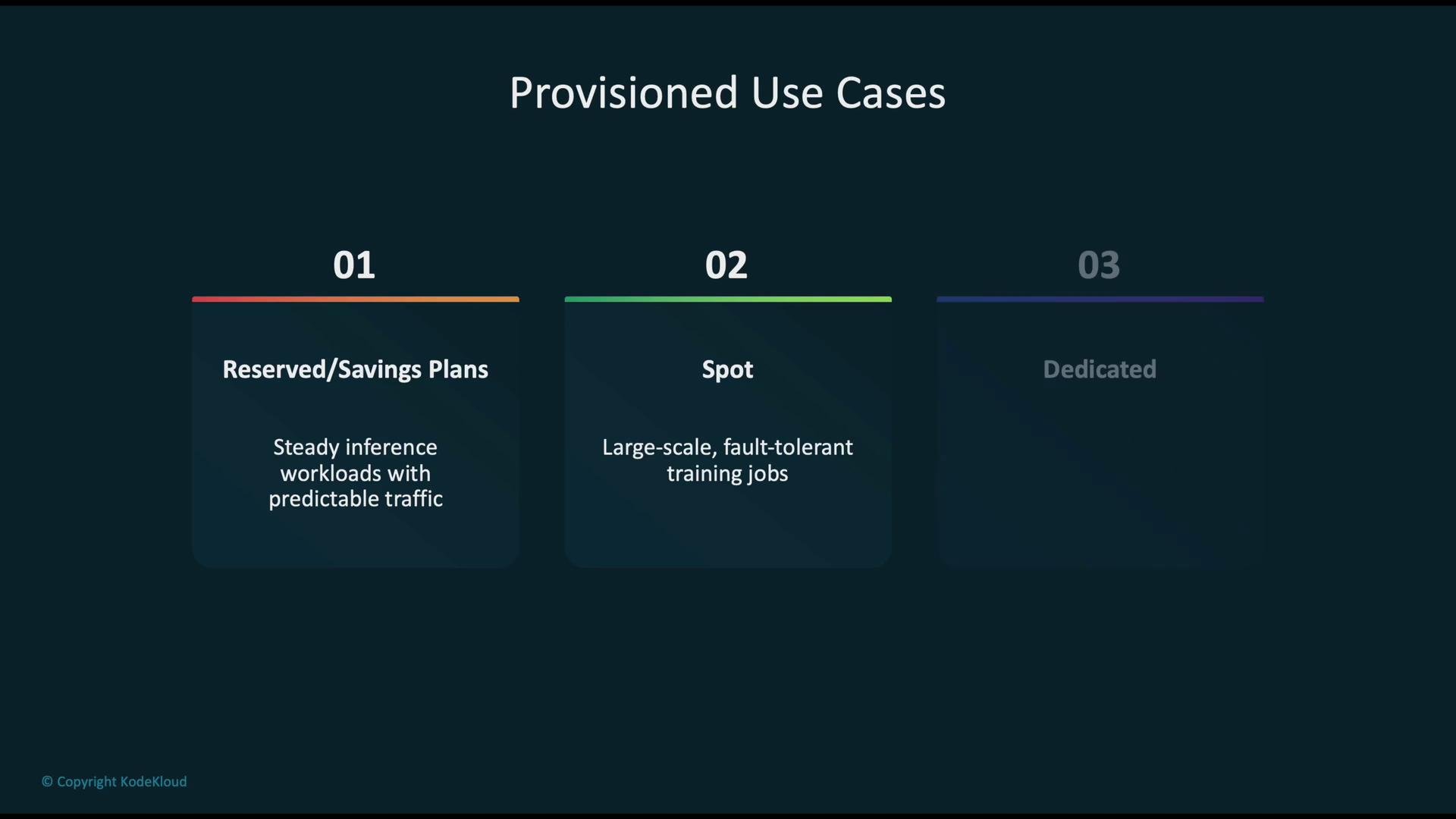
 Provisioned use cases:
* Steady inference workloads: use Reserved Instances or Savings Plans to reduce long-term costs.
* Large-scale training: use Spot Instances plus checkpointing to keep costs low while tolerating interruptions.
* Compliance-sensitive workloads: use Dedicated Hosts when isolation or specific licensing is required.
Provisioned use cases:
* Steady inference workloads: use Reserved Instances or Savings Plans to reduce long-term costs.
* Large-scale training: use Spot Instances plus checkpointing to keep costs low while tolerating interruptions.
* Compliance-sensitive workloads: use Dedicated Hosts when isolation or specific licensing is required.
 ## Hybrid strategy: balance cost and reliability
A hybrid approach often yields the best balance:
* Run the majority (for example, 70–90%) of non-critical distributed training on Spot Instances to maximize cost savings.
* Keep a minority (for example, 10–30%) as On-Demand capacity to ensure critical tasks complete when spot nodes are reclaimed.
* Use Reserved Instances or Savings Plans for long-running inference services to lock in discounts.
This mix captures most cost benefits of spot capacity while preserving enough stable capacity for reliability.
## Cost optimization best practices
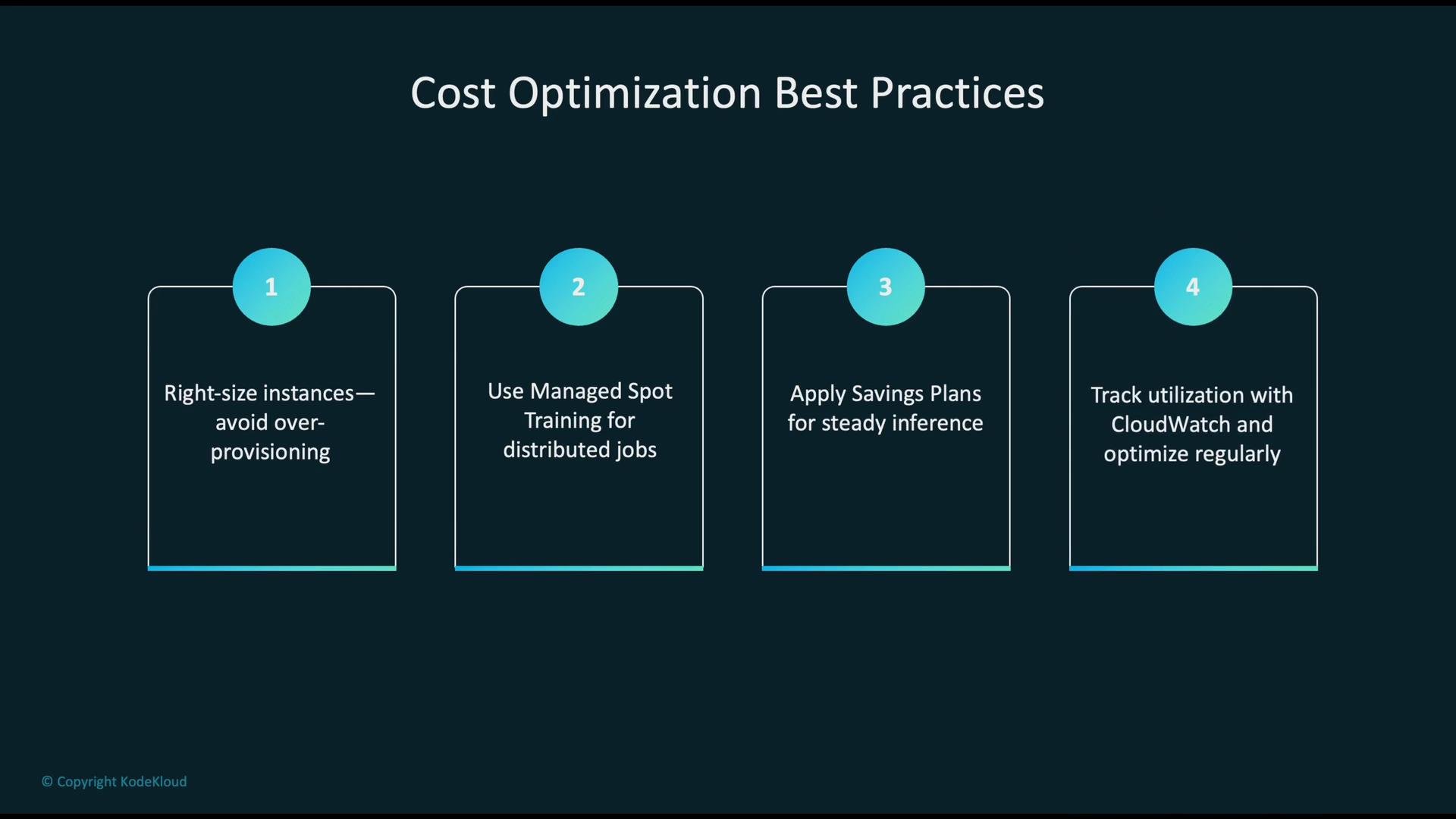
* Right-size instances: choose instance families and sizes that match CPU, memory, GPU, and I/O needs.
* Build fault-tolerance: use managed spot training, frequent checkpoints, and job retries for distributed jobs.
* Apply Savings Plans or Reserved Instances where usage is consistent.
* Monitor utilization and adjust commitments regularly (e.g., [AWS CloudWatch](https://learn.kodekloud.com/user/courses/aws-cloudwatch) or your provider’s monitoring tools).
* Automate lifecycle: use autoscaling and orchestration to spin instances up and down based on demand.
## Hybrid strategy: balance cost and reliability
A hybrid approach often yields the best balance:
* Run the majority (for example, 70–90%) of non-critical distributed training on Spot Instances to maximize cost savings.
* Keep a minority (for example, 10–30%) as On-Demand capacity to ensure critical tasks complete when spot nodes are reclaimed.
* Use Reserved Instances or Savings Plans for long-running inference services to lock in discounts.
This mix captures most cost benefits of spot capacity while preserving enough stable capacity for reliability.
## Cost optimization best practices
* Right-size instances: choose instance families and sizes that match CPU, memory, GPU, and I/O needs.
* Build fault-tolerance: use managed spot training, frequent checkpoints, and job retries for distributed jobs.
* Apply Savings Plans or Reserved Instances where usage is consistent.
* Monitor utilization and adjust commitments regularly (e.g., [AWS CloudWatch](https://learn.kodekloud.com/user/courses/aws-cloudwatch) or your provider’s monitoring tools).
* Automate lifecycle: use autoscaling and orchestration to spin instances up and down based on demand.
 Design distributed training to tolerate spot interruptions: use frequent checkpoints, incremental saves of model state, and reliable job retry logic so progress persists when capacity is reclaimed.
## Common pitfalls and how to avoid them
* Expect spot interruptions: implement checkpointing, graceful shutdown handling, and orchestration that supports retries.
* Over-commitment risk: avoid locking too much capacity in Reserved Instances if usage patterns can change.
* Oversizing: measure actual utilization and right-size to prevent unnecessary spend.
* Mismatched choices: always align instance type to workload pattern — flexibility for variable workloads, provisioned capacity for predictable workloads.
## Real-world example — Acme AI Corp.
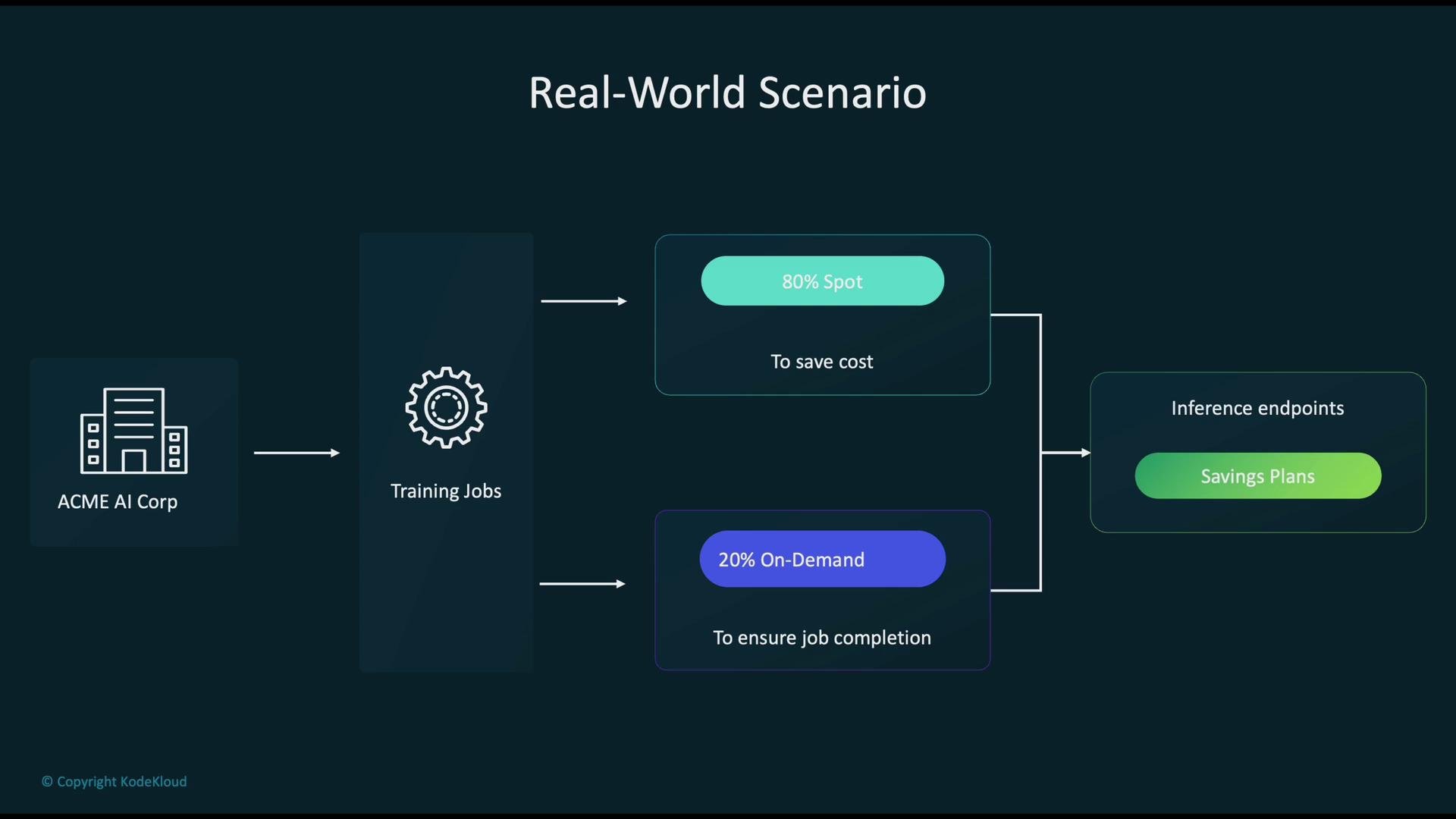
Acme AI operates large model training pipelines and production inference:
* Training: 80% of training capacity runs on Spot Instances to minimize cost. 20% runs on On-Demand to guarantee completion for critical jobs.
* Inference: steady, long-running endpoints are covered by Savings Plans to capture predictable discounts and reduce per-hour costs.
Design distributed training to tolerate spot interruptions: use frequent checkpoints, incremental saves of model state, and reliable job retry logic so progress persists when capacity is reclaimed.
## Common pitfalls and how to avoid them
* Expect spot interruptions: implement checkpointing, graceful shutdown handling, and orchestration that supports retries.
* Over-commitment risk: avoid locking too much capacity in Reserved Instances if usage patterns can change.
* Oversizing: measure actual utilization and right-size to prevent unnecessary spend.
* Mismatched choices: always align instance type to workload pattern — flexibility for variable workloads, provisioned capacity for predictable workloads.
## Real-world example — Acme AI Corp.
Acme AI operates large model training pipelines and production inference:
* Training: 80% of training capacity runs on Spot Instances to minimize cost. 20% runs on On-Demand to guarantee completion for critical jobs.
* Inference: steady, long-running endpoints are covered by Savings Plans to capture predictable discounts and reduce per-hour costs.
 ## Recap — key takeaways
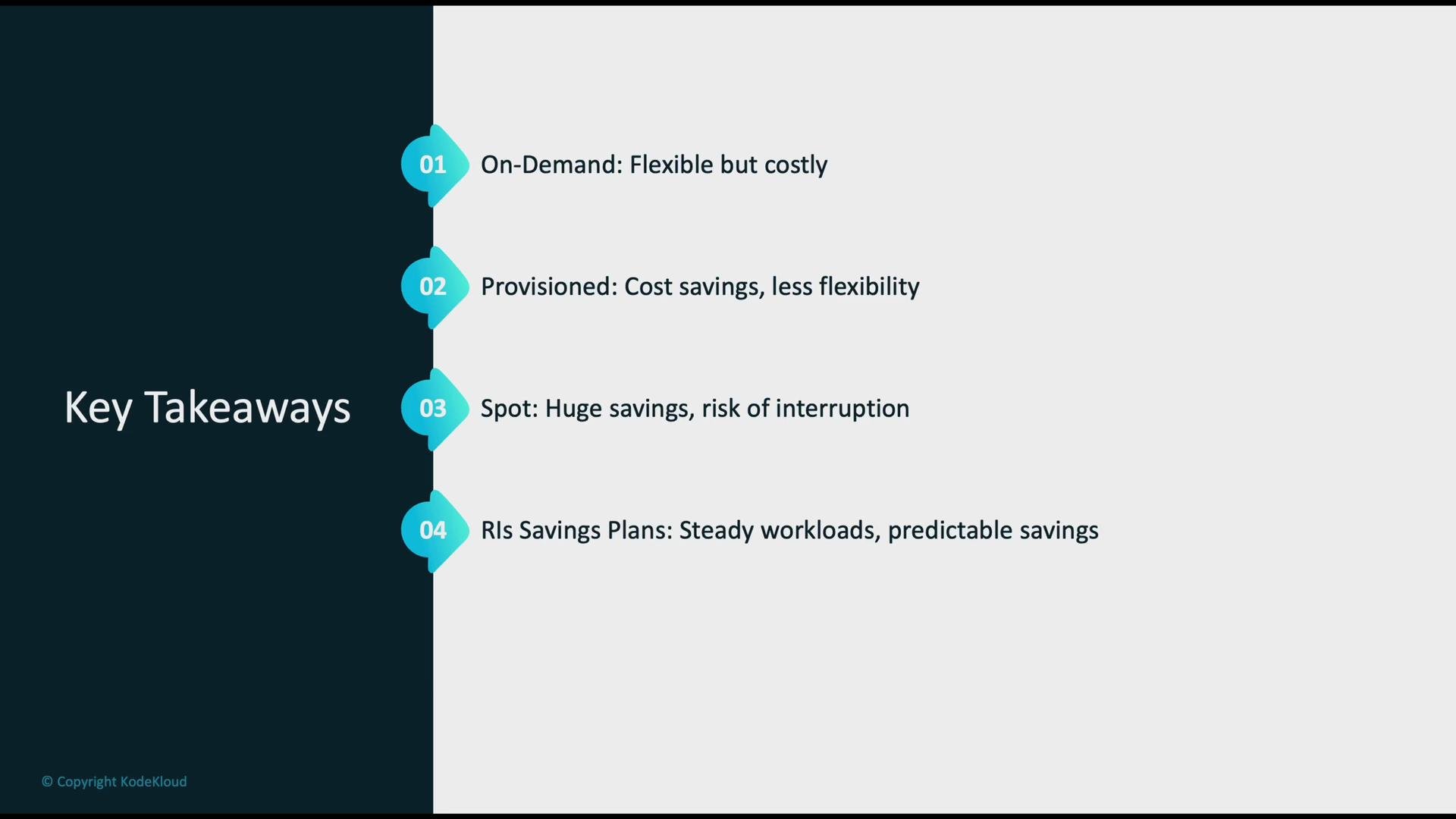
* On-demand: maximum flexibility, higher cost; ideal for experimentation and unpredictable workloads.
* Provisioned (Reserved / Savings Plans): lower cost for predictable workloads; trade flexibility for savings.
* Spot: biggest cost savings, but interruptible; perfect for fault-tolerant, large-scale batch or training jobs.
* Hybrid strategies (mix of Spot + On-Demand + Savings Plans) typically balance cost and reliability best.
## Recap — key takeaways
* On-demand: maximum flexibility, higher cost; ideal for experimentation and unpredictable workloads.
* Provisioned (Reserved / Savings Plans): lower cost for predictable workloads; trade flexibility for savings.
* Spot: biggest cost savings, but interruptible; perfect for fault-tolerant, large-scale batch or training jobs.
* Hybrid strategies (mix of Spot + On-Demand + Savings Plans) typically balance cost and reliability best.
 ## Links and references
* [AWS EC2 Pricing & Instance Types](https://aws.amazon.com/ec2/pricing/)
* [Amazon EC2 Spot Instances](https://aws.amazon.com/ec2/spot/)
* [AWS Savings Plans](https://aws.amazon.com/savingsplans/)
* [AWS Reserved Instances](https://aws.amazon.com/ec2/pricing/reserved-instances/)
* [AWS CloudWatch monitoring](https://learn.kodekloud.com/user/courses/aws-cloudwatch)
Use these resources to validate cost assumptions and automate optimizations for production ML workflows.
## Links and references
* [AWS EC2 Pricing & Instance Types](https://aws.amazon.com/ec2/pricing/)
* [Amazon EC2 Spot Instances](https://aws.amazon.com/ec2/spot/)
* [AWS Savings Plans](https://aws.amazon.com/savingsplans/)
* [AWS Reserved Instances](https://aws.amazon.com/ec2/pricing/reserved-instances/)
* [AWS CloudWatch monitoring](https://learn.kodekloud.com/user/courses/aws-cloudwatch)
Use these resources to validate cost assumptions and automate optimizations for production ML workflows.