> ## Documentation Index
> Fetch the complete documentation index at: https://notes.kodekloud.com/llms.txt
> Use this file to discover all available pages before exploring further.
# Creating Performance Baselines
> Guide on creating and using baseline models to evaluate machine learning performance, from naive and heuristic to model-based and SOTA baselines, with examples and a practical checklist.
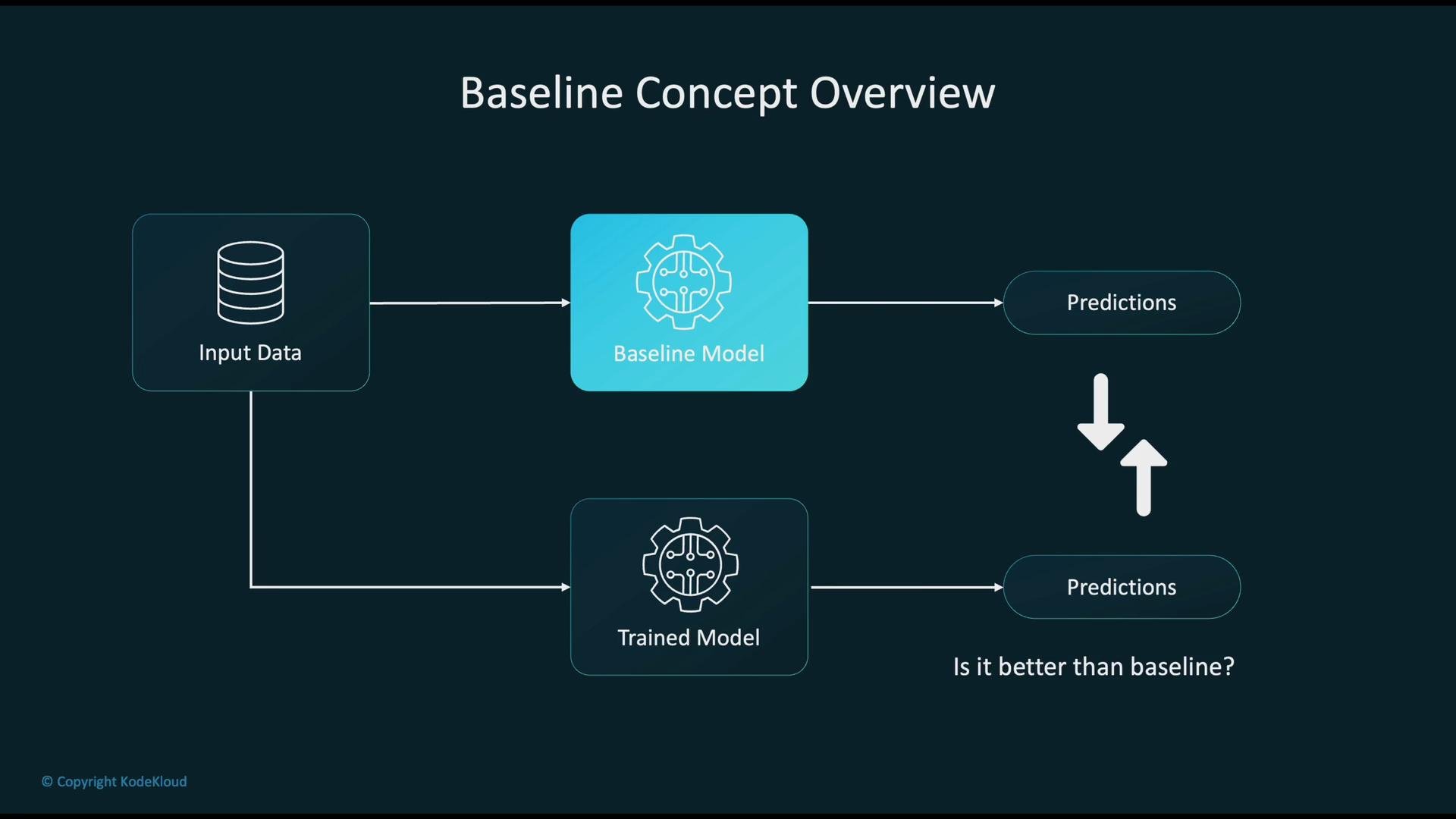
A baseline model is a simple, well-defined reference used to evaluate whether a new model provides meaningful improvement. In practice, you feed the same input to both a BaselineModel and your TrainModel and compare their predictions and metrics. The purpose of a baseline is to establish a minimum acceptable performance and to justify added model complexity when the trained model exceeds that baseline.
 ## Common baseline types
Use increasingly stronger baselines as you progress: start simple and advance toward more competitive references. Below is a concise description of common baseline classes.
| Baseline Type | Purpose / When to Use | Typical Example |
| ----------------- | --------------------------------------------------: | -------------------------------------------------- |
| Naive | Quick sanity check to set a very low bar | Always predict the majority class (classification) |
| Random | Establish a minimum floor for performance | Random class labels or random regression values |
| Heuristic | Capture simple domain rules; interpretable | Rule-based formula like `y = 2x` |
| SimpleModel | Lightweight ML models providing data-driven fit | Linear/logistic regression, decision stump, k-NN |
| HumanLevel | Compare model to human expert performance | Expert label accuracy in medical imaging |
| SOTA | Benchmark against best published or industry models | Top-performing research model or leaderboard entry |
| Business-as-usual | Compare to the system currently in production | Existing model or rule set serving customers |
Choose baselines appropriate to your problem and dataset. Start with the simplest (naive) and progress to heuristics, simple models, and SOTA baselines until you establish a realistic target for development and deployment.
## Why baselines matter (example)
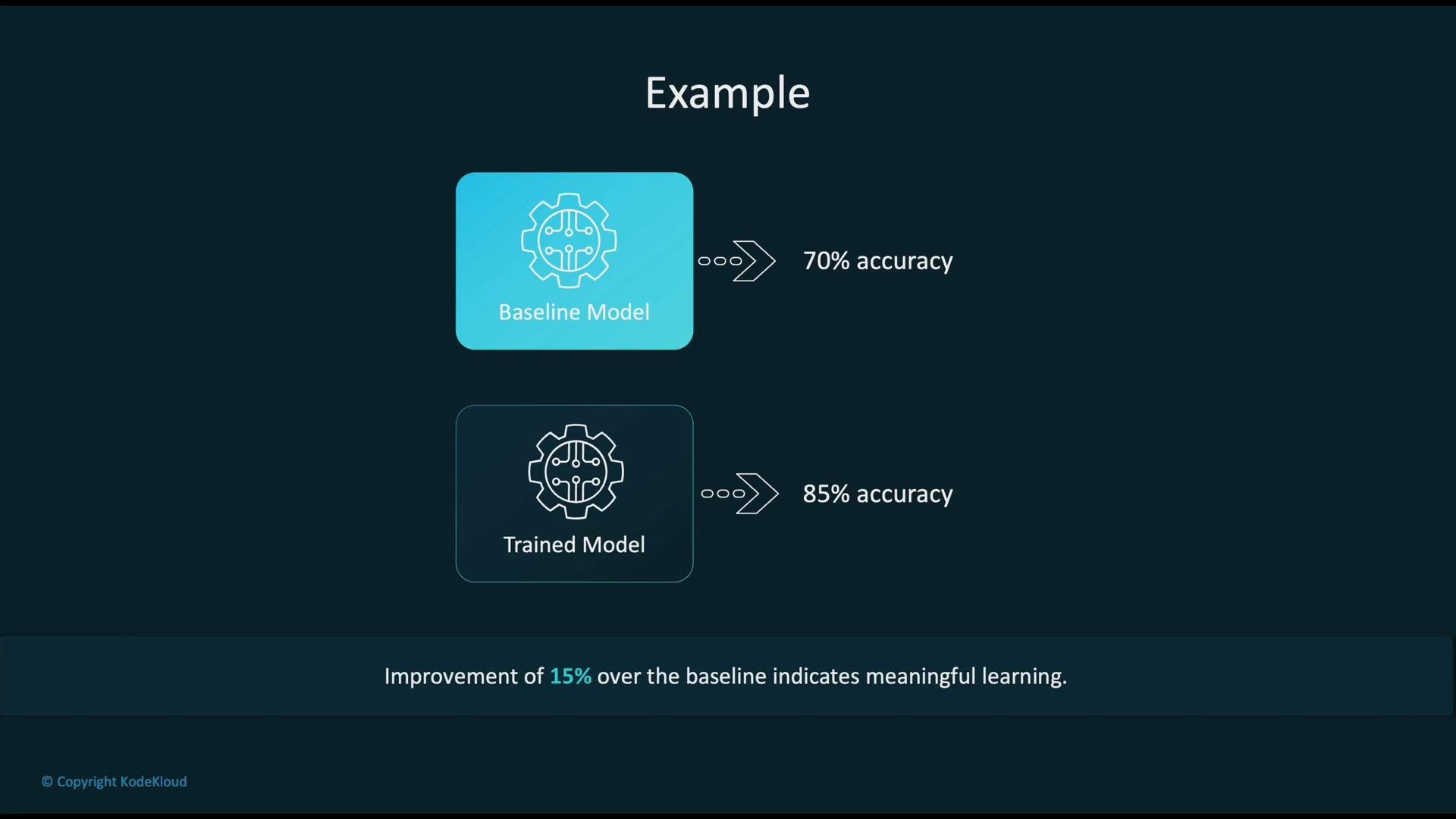
Suppose a baseline reaches 70% accuracy and your trained model reaches 85% accuracy — a 15 percentage-point improvement. That gap quantifies the model’s added value and helps decide whether extra complexity is justified.
## Common baseline types
Use increasingly stronger baselines as you progress: start simple and advance toward more competitive references. Below is a concise description of common baseline classes.
| Baseline Type | Purpose / When to Use | Typical Example |
| ----------------- | --------------------------------------------------: | -------------------------------------------------- |
| Naive | Quick sanity check to set a very low bar | Always predict the majority class (classification) |
| Random | Establish a minimum floor for performance | Random class labels or random regression values |
| Heuristic | Capture simple domain rules; interpretable | Rule-based formula like `y = 2x` |
| SimpleModel | Lightweight ML models providing data-driven fit | Linear/logistic regression, decision stump, k-NN |
| HumanLevel | Compare model to human expert performance | Expert label accuracy in medical imaging |
| SOTA | Benchmark against best published or industry models | Top-performing research model or leaderboard entry |
| Business-as-usual | Compare to the system currently in production | Existing model or rule set serving customers |
Choose baselines appropriate to your problem and dataset. Start with the simplest (naive) and progress to heuristics, simple models, and SOTA baselines until you establish a realistic target for development and deployment.
## Why baselines matter (example)
Suppose a baseline reaches 70% accuracy and your trained model reaches 85% accuracy — a 15 percentage-point improvement. That gap quantifies the model’s added value and helps decide whether extra complexity is justified.
 ## Naive baselines by problem type
Naive baselines are fast to compute and useful as the first checkpoint. They intentionally ignore patterns in the features and act as a simple reference.
| Problem Type | Naive Strategy |
| ------------------------ | --------------------------------------------------- |
| Classification | Predict the majority class |
| Regression | Predict the global mean or median of the target |
| Time series | Predict the last observed value (persistence model) |
| Ranking / Recommendation | Rank items by global popularity |
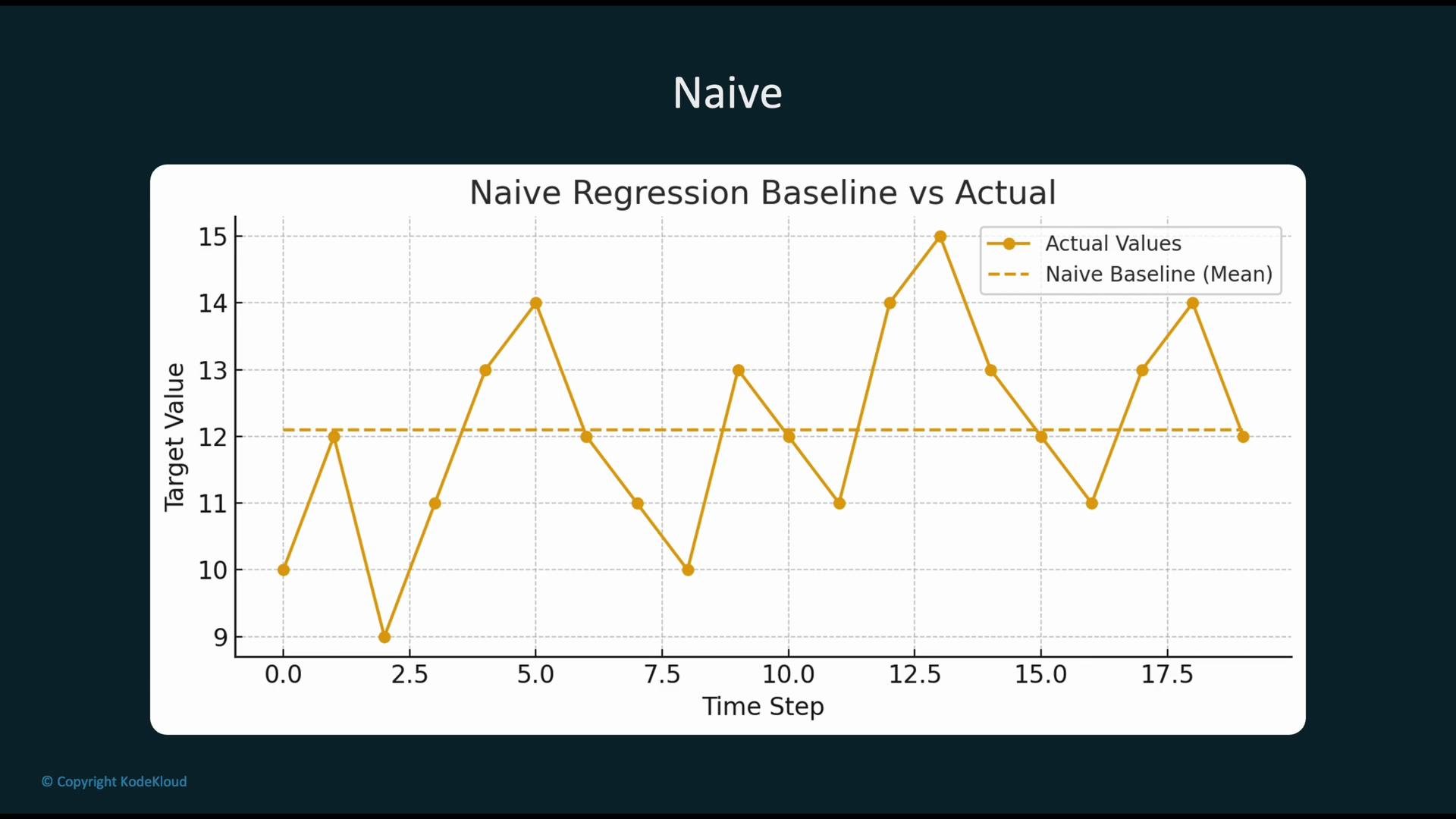
The plot below illustrates a naive regression baseline predicting the global mean as a constant (dashed line) while the actual target values vary over time. This highlights how naive approaches provide a minimal benchmark that more sophisticated models should surpass.
## Naive baselines by problem type
Naive baselines are fast to compute and useful as the first checkpoint. They intentionally ignore patterns in the features and act as a simple reference.
| Problem Type | Naive Strategy |
| ------------------------ | --------------------------------------------------- |
| Classification | Predict the majority class |
| Regression | Predict the global mean or median of the target |
| Time series | Predict the last observed value (persistence model) |
| Ranking / Recommendation | Rank items by global popularity |
The plot below illustrates a naive regression baseline predicting the global mean as a constant (dashed line) while the actual target values vary over time. This highlights how naive approaches provide a minimal benchmark that more sophisticated models should surpass.
 ## Heuristic baselines
Heuristic baselines apply simple, interpretable rules derived from domain knowledge (for example, `y = 2x`). They often outperform naive baselines because they encode known relationships and provide a stronger, explainable benchmark. Use these to confirm whether model complexity is adding value beyond simple rules.
## Model-based baselines
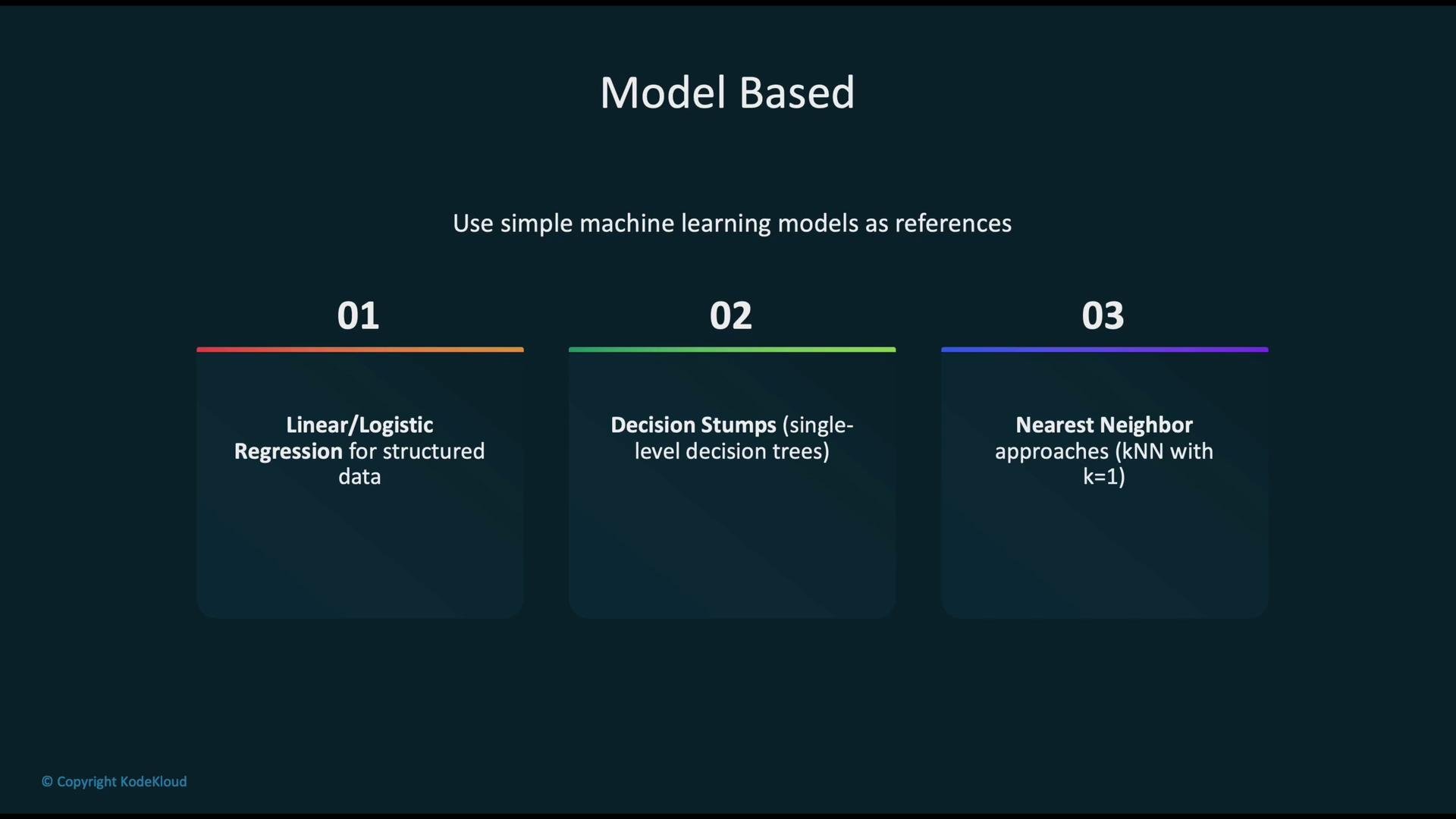
Model-based baselines use basic machine learning algorithms to create a data-adaptive reference. These typically outperform naive and heuristic baselines and are essential for structured data problems.
Common simple-model baselines:
* Linear regression / logistic regression for tabular data
* Decision stumps (single-level decision trees)
* k-Nearest Neighbors (kNN), often with k=1 or small k
These model families are lightweight, fast to train, and help set realistic expectations before moving to more complex architectures.
## Heuristic baselines
Heuristic baselines apply simple, interpretable rules derived from domain knowledge (for example, `y = 2x`). They often outperform naive baselines because they encode known relationships and provide a stronger, explainable benchmark. Use these to confirm whether model complexity is adding value beyond simple rules.
## Model-based baselines
Model-based baselines use basic machine learning algorithms to create a data-adaptive reference. These typically outperform naive and heuristic baselines and are essential for structured data problems.
Common simple-model baselines:
* Linear regression / logistic regression for tabular data
* Decision stumps (single-level decision trees)
* k-Nearest Neighbors (kNN), often with k=1 or small k
These model families are lightweight, fast to train, and help set realistic expectations before moving to more complex architectures.
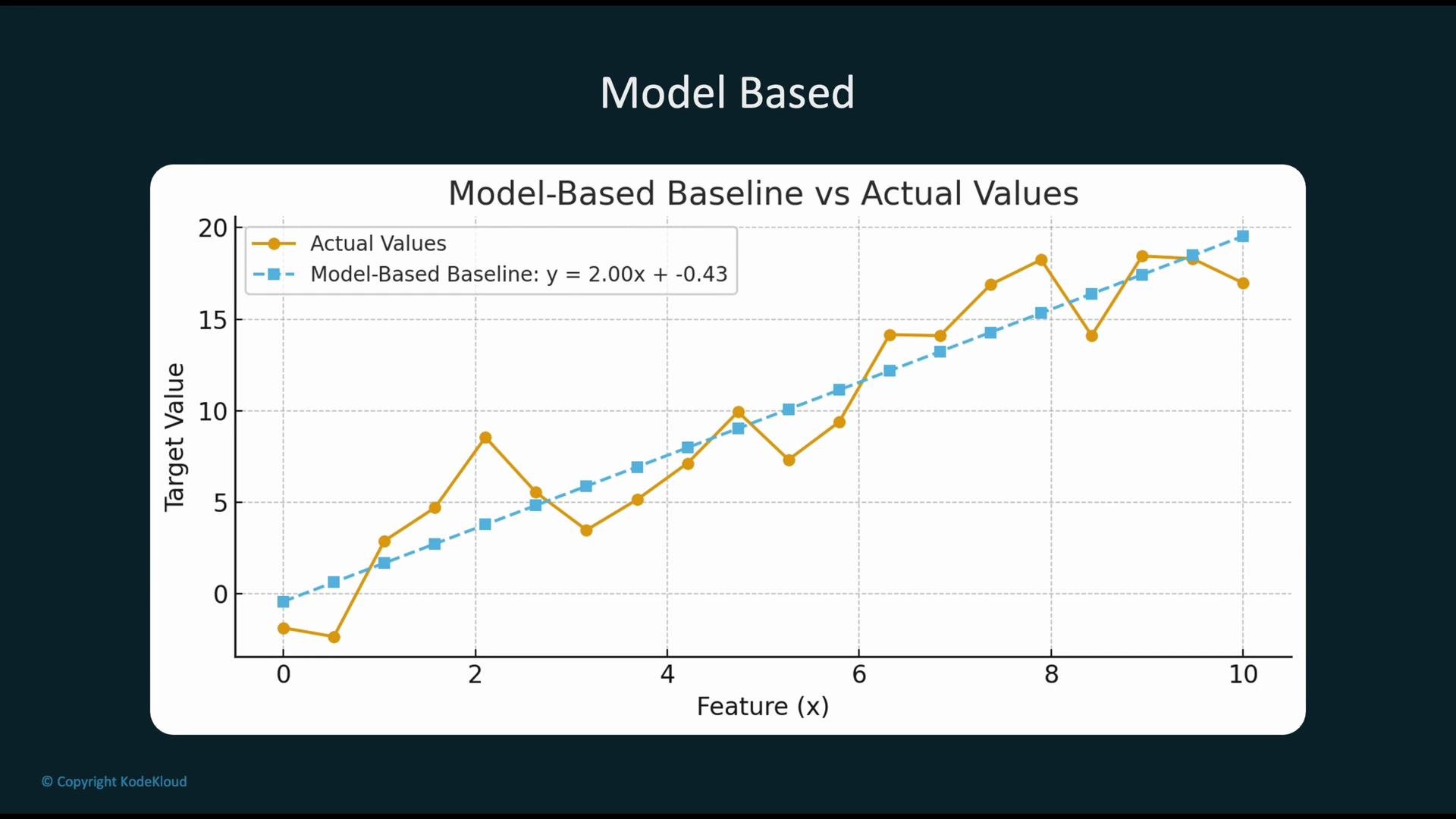
 A model-based baseline such as linear regression adapts to the data and typically produces a better fit than a heuristic rule. The example below shows a linear baseline described by `y = 2.00x + 0.43` (dashed line) compared to actual values — a clear, data-driven reference.
 ## State-of-the-art (SOTA) baselines
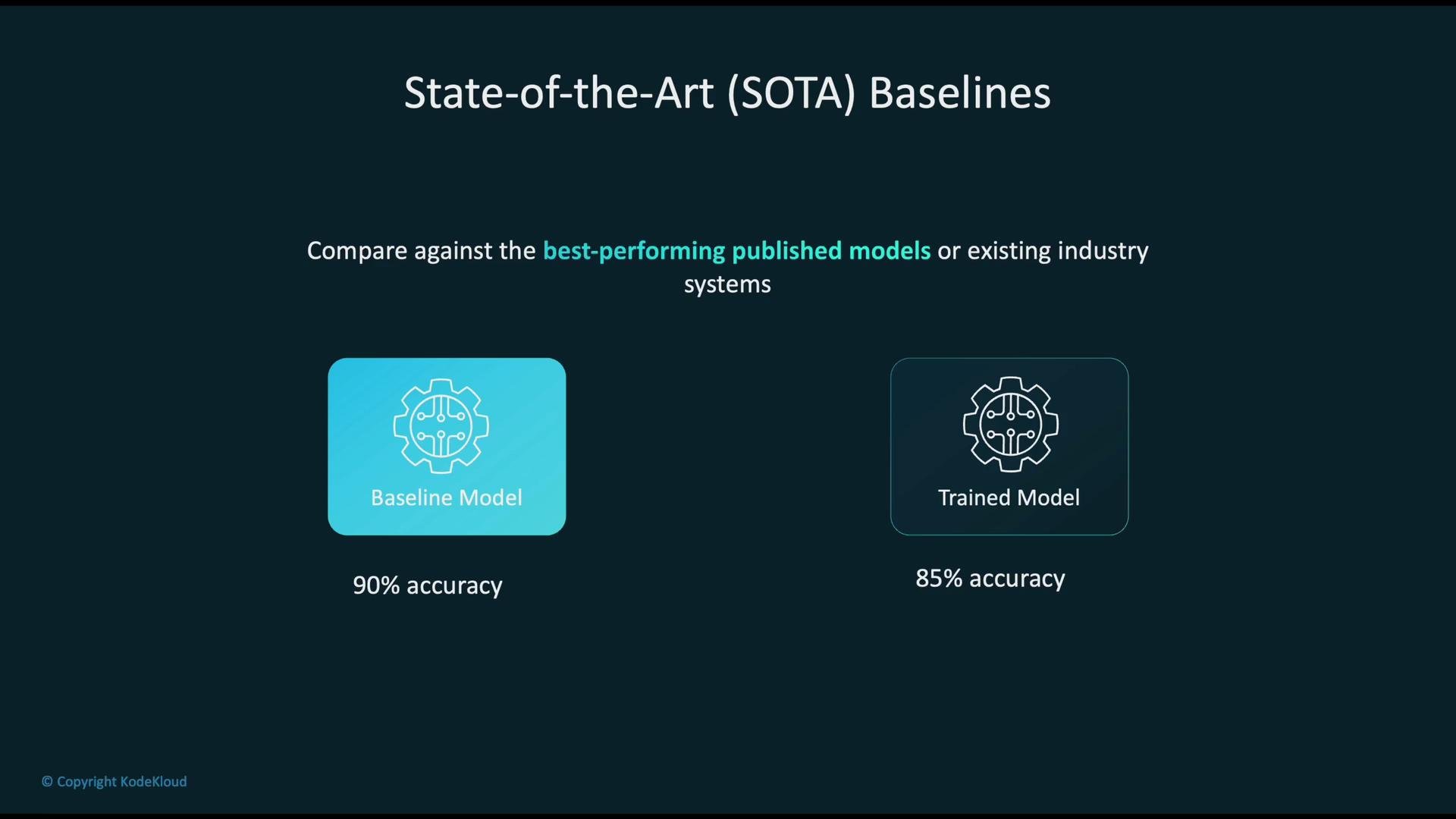
SOTA baselines benchmark your approach against the best published or industry-standard models. These are useful to determine whether your model is competitive:
* If SOTA = 90% and your model = 85% → further improvements needed.
* If your model approaches SOTA, you may focus on deployment, inference optimization, or cost/performance trade-offs.
## State-of-the-art (SOTA) baselines
SOTA baselines benchmark your approach against the best published or industry-standard models. These are useful to determine whether your model is competitive:
* If SOTA = 90% and your model = 85% → further improvements needed.
* If your model approaches SOTA, you may focus on deployment, inference optimization, or cost/performance trade-offs.
 ## Practical checklist for baselines
* Establish at least one simple baseline (naive or random) before model tuning.
* Iterate: naive → heuristic → simple model → SOTA as needed.
* Use the baseline gap (performance delta) to quantify business value and justify complexity.
* Report baselines alongside model metrics in documentation and model cards for transparency.
* Re-evaluate baselines when data, labels, or business objectives change.
Resources and further reading:
* [Model evaluation best practices](https://en.wikipedia.org/wiki/Cross-validation_\(statistics\))
* [When to compare with SOTA models](https://www.semanticscholar.org/)
By defining clear baselines early, you save development time, avoid unnecessary complexity, and focus on changes that deliver measurable value.
## Practical checklist for baselines
* Establish at least one simple baseline (naive or random) before model tuning.
* Iterate: naive → heuristic → simple model → SOTA as needed.
* Use the baseline gap (performance delta) to quantify business value and justify complexity.
* Report baselines alongside model metrics in documentation and model cards for transparency.
* Re-evaluate baselines when data, labels, or business objectives change.
Resources and further reading:
* [Model evaluation best practices](https://en.wikipedia.org/wiki/Cross-validation_\(statistics\))
* [When to compare with SOTA models](https://www.semanticscholar.org/)
By defining clear baselines early, you save development time, avoid unnecessary complexity, and focus on changes that deliver measurable value.