> ## Documentation Index
> Fetch the complete documentation index at: https://notes.kodekloud.com/llms.txt
> Use this file to discover all available pages before exploring further.
# Hyperparameter Tuning Techniques
> Overview of hyperparameter tuning methods, pros and cons, and managed tools like SageMaker for optimizing machine learning model performance and resource use.
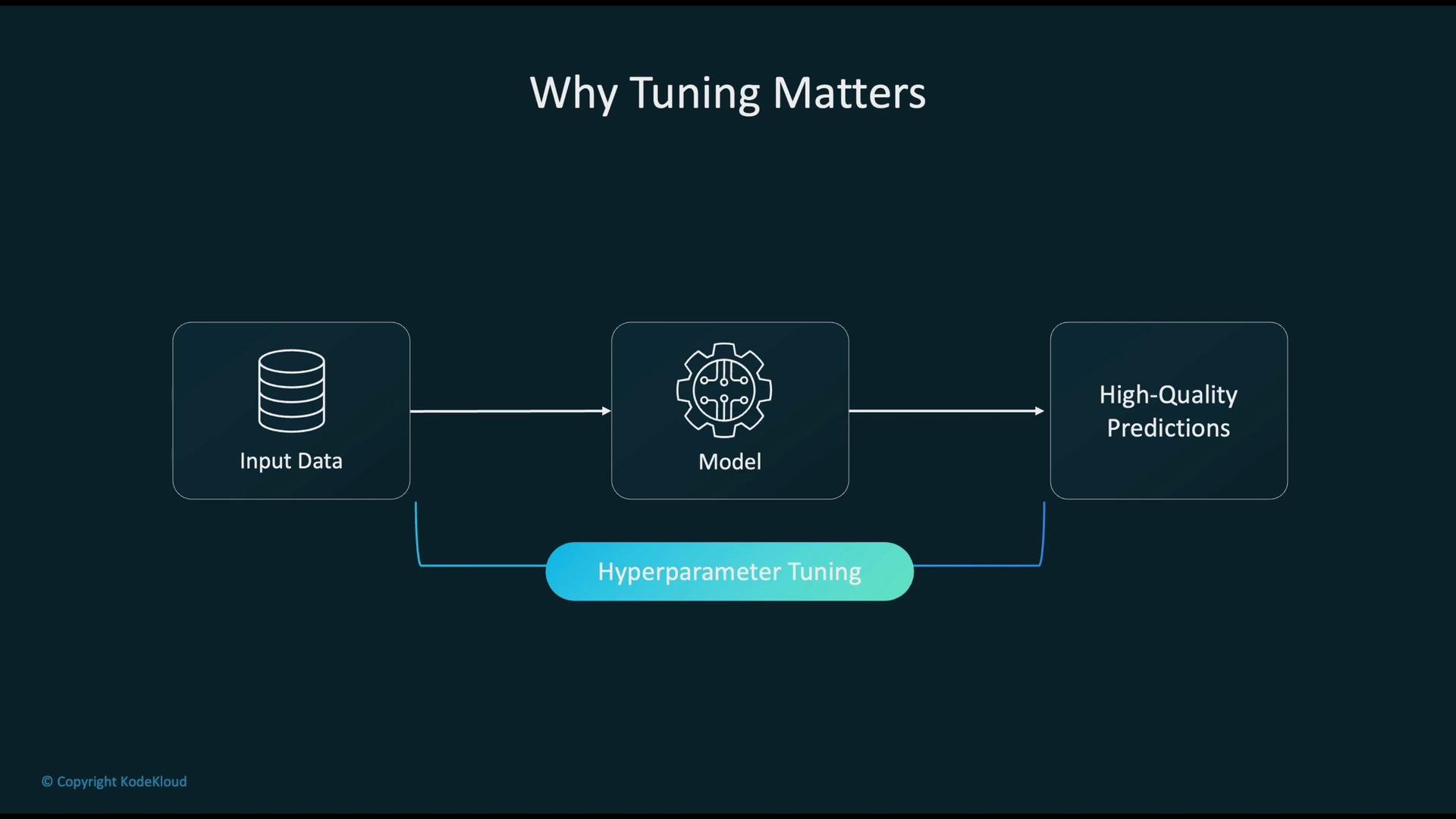
Hyperparameter tuning (also called hyperparameter optimization, HPO) is the process of selecting the best set of hyperparameters for a machine learning model. Hyperparameters are set before training — unlike model parameters (weights, biases) that are learned — and they control data preprocessing, training dynamics, model capacity, and evaluation. Choosing the right hyperparameters is essential for building models that generalize well and are stable in production.
Why tuning matters
* Correct hyperparameters control the trade-off between underfitting and overfitting.
* They influence convergence speed, final accuracy, and resource usage (compute and time).
* Effective tuning can reduce cost by lowering the number of expensive training runs needed to reach target performance.
 Types of hyperparameters
Hyperparameters fall into several categories depending on what aspect of the training or model they affect:
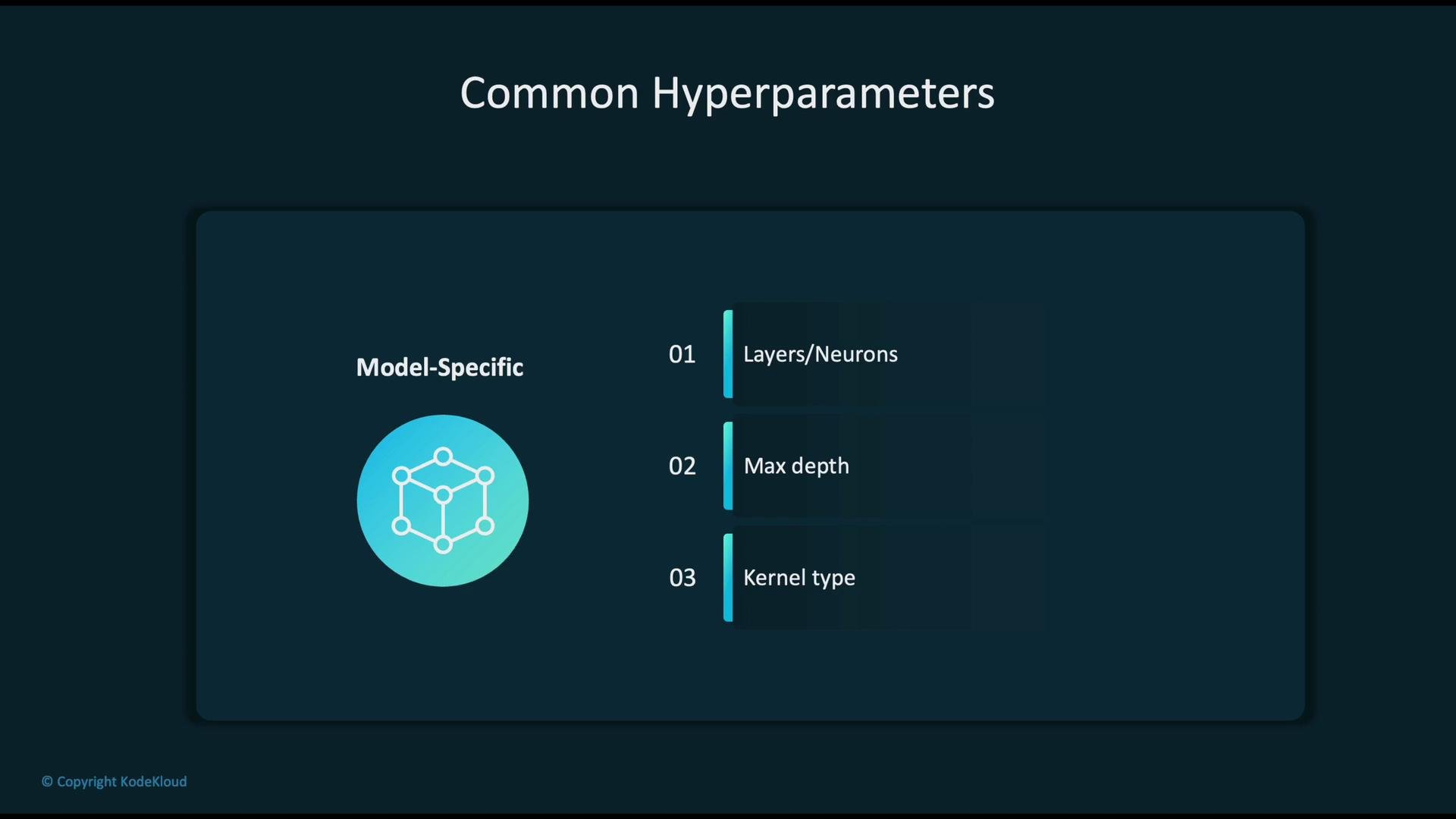
* Model-specific: number of layers, number of neurons, max depth (decision trees), kernel type (SVM).
* Regularization: L1/L2 penalties, dropout rate, weight decay.
* Training process: learning rate, batch size, optimizer, number of epochs.
* Evaluation / early stopping: validation split, early-stopping patience, checkpoint frequency.
Table: common hyperparameter categories and examples
| Category | Purpose | Examples |
| ----------------------- | ------------------------------------------------ | -------------------------------------------------------------------- |
| Model-specific | Controls model capacity/architecture | `num_layers`, `hidden_units`, `max_depth`, `kernel` |
| Regularization | Prevents overfitting and improves generalization | `dropout_rate`, `l1_lambda`, `l2_lambda`, `weight_decay` |
| Training process | Affects optimization dynamics and resource use | `learning_rate`, `batch_size`, `optimizer`, `num_epochs` |
| Evaluation / scheduling | Controls evaluation cadence and early exit | `validation_split`, `early_stopping_patience`, `checkpoint_interval` |
Types of hyperparameters
Hyperparameters fall into several categories depending on what aspect of the training or model they affect:
* Model-specific: number of layers, number of neurons, max depth (decision trees), kernel type (SVM).
* Regularization: L1/L2 penalties, dropout rate, weight decay.
* Training process: learning rate, batch size, optimizer, number of epochs.
* Evaluation / early stopping: validation split, early-stopping patience, checkpoint frequency.
Table: common hyperparameter categories and examples
| Category | Purpose | Examples |
| ----------------------- | ------------------------------------------------ | -------------------------------------------------------------------- |
| Model-specific | Controls model capacity/architecture | `num_layers`, `hidden_units`, `max_depth`, `kernel` |
| Regularization | Prevents overfitting and improves generalization | `dropout_rate`, `l1_lambda`, `l2_lambda`, `weight_decay` |
| Training process | Affects optimization dynamics and resource use | `learning_rate`, `batch_size`, `optimizer`, `num_epochs` |
| Evaluation / scheduling | Controls evaluation cadence and early exit | `validation_split`, `early_stopping_patience`, `checkpoint_interval` |
 Overview of tuning strategies
Common tuning strategies include manual tuning, grid search, random search, and Bayesian optimization. Each technique balances exploration, exploitation, cost, and the number of training trials differently. Choose the method that fits your compute budget, search space size, and required repeatability.
Overview of tuning strategies
Common tuning strategies include manual tuning, grid search, random search, and Bayesian optimization. Each technique balances exploration, exploitation, cost, and the number of training trials differently. Choose the method that fits your compute budget, search space size, and required repeatability.
 Comparative summary of tuning techniques
| Technique | Pros | Cons | Best for |
| --------------------- | --------------------------------------------------: | ------------------------------------------------------- | ----------------------------------------------- |
| Manual tuning | Fast for small experiments; builds intuition | Not scalable, subjective | Quick prototypes, educational experiments |
| Grid search | Deterministic, parallelizable, exhaustive on grid | Explodes combinatorially for many params | Small, bounded discrete search spaces |
| Random search | Efficient in high-dimensional spaces, simple | Still brute-force, may miss narrow optima | Medium-to-large spaces with limited budget |
| Bayesian optimization | Sample-efficient; balances exploration/exploitation | More complex to implement; overhead for surrogate model | Expensive training runs; when trials are costly |
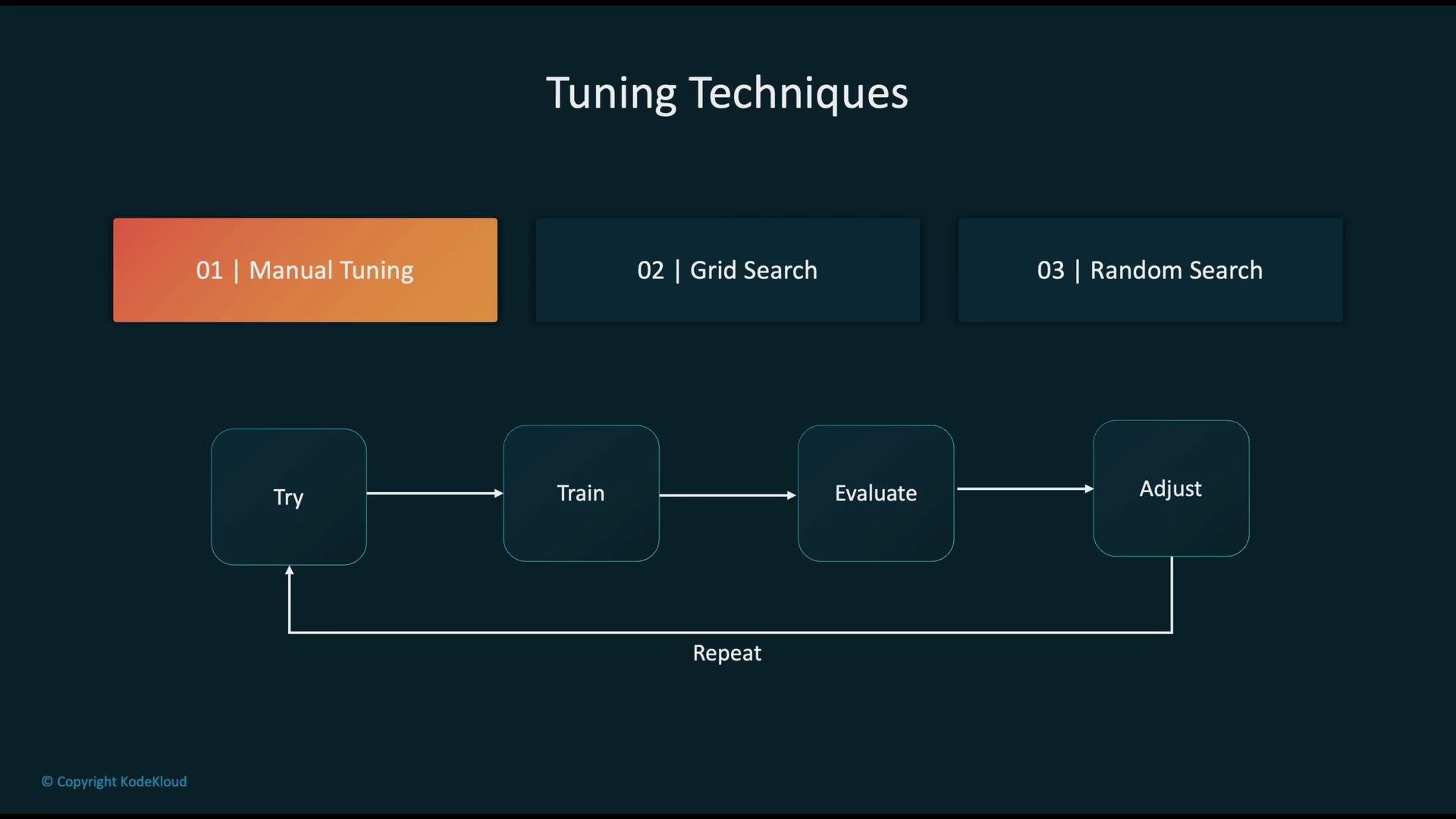
Manual tuning
* Pros: Simple, increases practitioner intuition about which hyperparameters matter.
* Cons: Time-consuming, not scalable, often yields suboptimal configurations.
* When to use: Exploratory experiments, small models, or educational settings.
Grid search
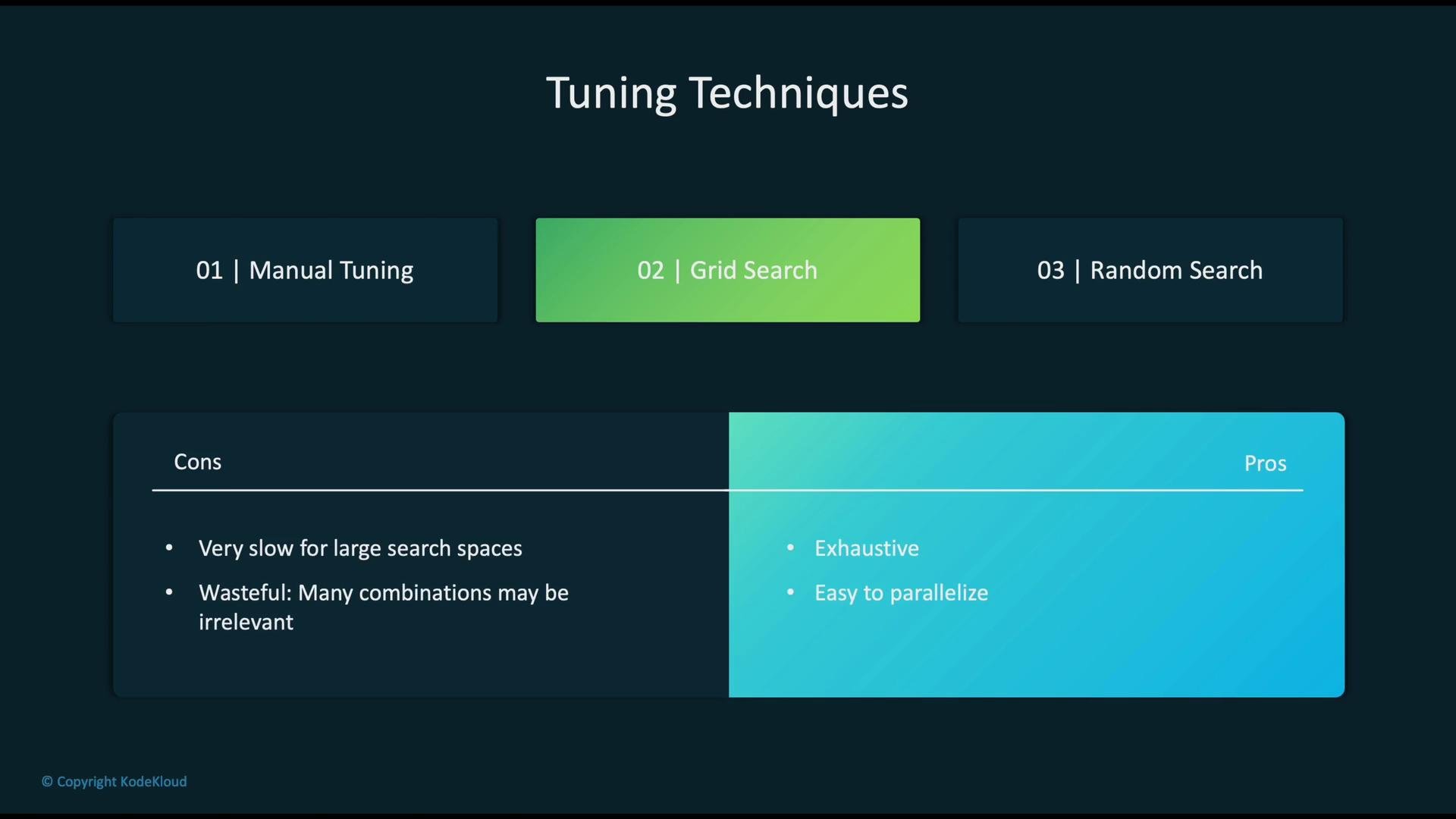
Grid search evaluates all combinations from a pre-specified grid of values.
* Pros: Exhaustive within the grid and easy to parallelize.
* Cons: Infeasible for large or continuous search spaces; wastes trials on unimportant parameters.
* When to use: Low-dimensional, discrete search spaces where guaranteed grid coverage is desired.
Comparative summary of tuning techniques
| Technique | Pros | Cons | Best for |
| --------------------- | --------------------------------------------------: | ------------------------------------------------------- | ----------------------------------------------- |
| Manual tuning | Fast for small experiments; builds intuition | Not scalable, subjective | Quick prototypes, educational experiments |
| Grid search | Deterministic, parallelizable, exhaustive on grid | Explodes combinatorially for many params | Small, bounded discrete search spaces |
| Random search | Efficient in high-dimensional spaces, simple | Still brute-force, may miss narrow optima | Medium-to-large spaces with limited budget |
| Bayesian optimization | Sample-efficient; balances exploration/exploitation | More complex to implement; overhead for surrogate model | Expensive training runs; when trials are costly |
Manual tuning
* Pros: Simple, increases practitioner intuition about which hyperparameters matter.
* Cons: Time-consuming, not scalable, often yields suboptimal configurations.
* When to use: Exploratory experiments, small models, or educational settings.
Grid search
Grid search evaluates all combinations from a pre-specified grid of values.
* Pros: Exhaustive within the grid and easy to parallelize.
* Cons: Infeasible for large or continuous search spaces; wastes trials on unimportant parameters.
* When to use: Low-dimensional, discrete search spaces where guaranteed grid coverage is desired.
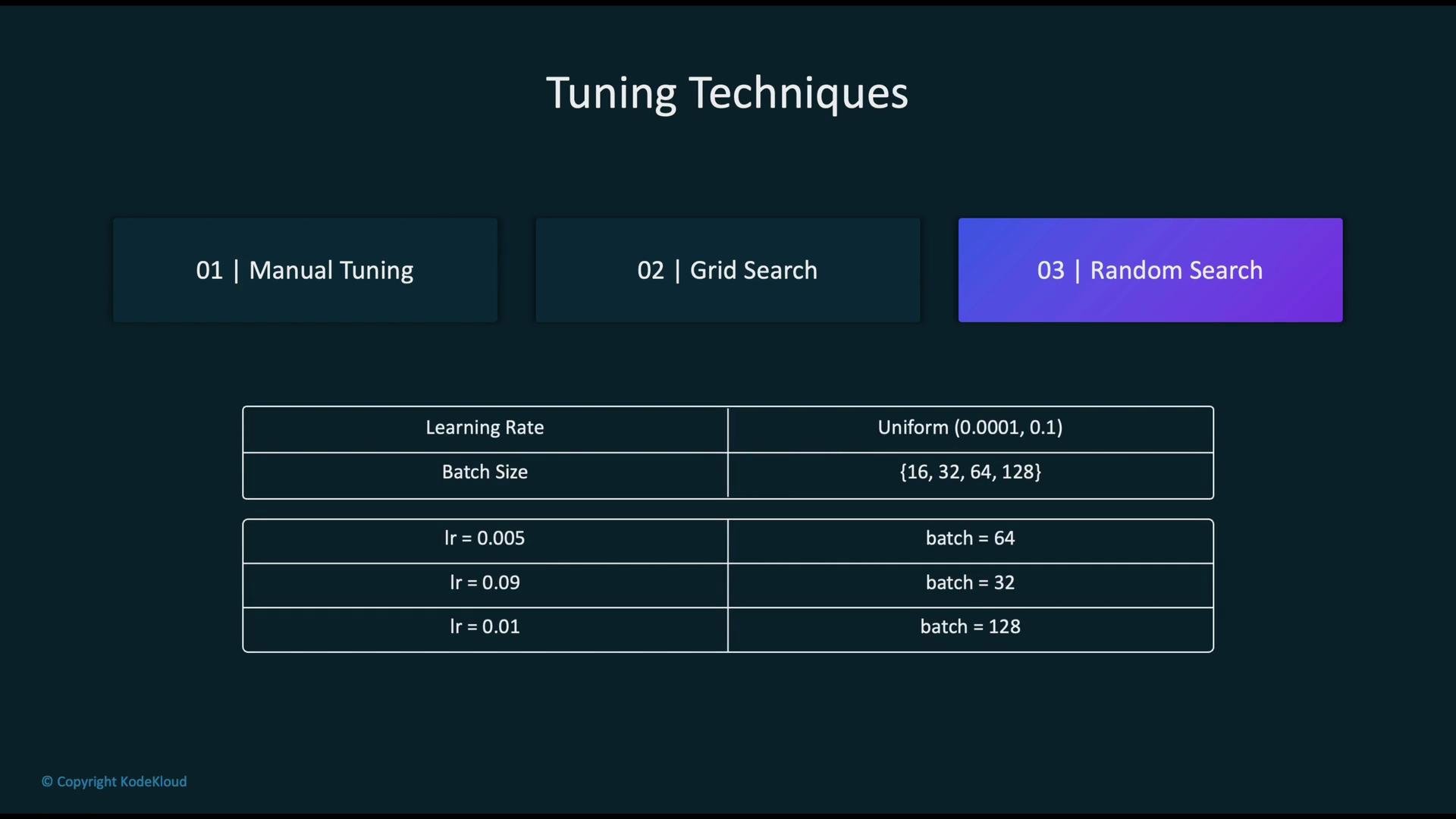
 Random search
 samples configurations from specified distributions or discrete sets.
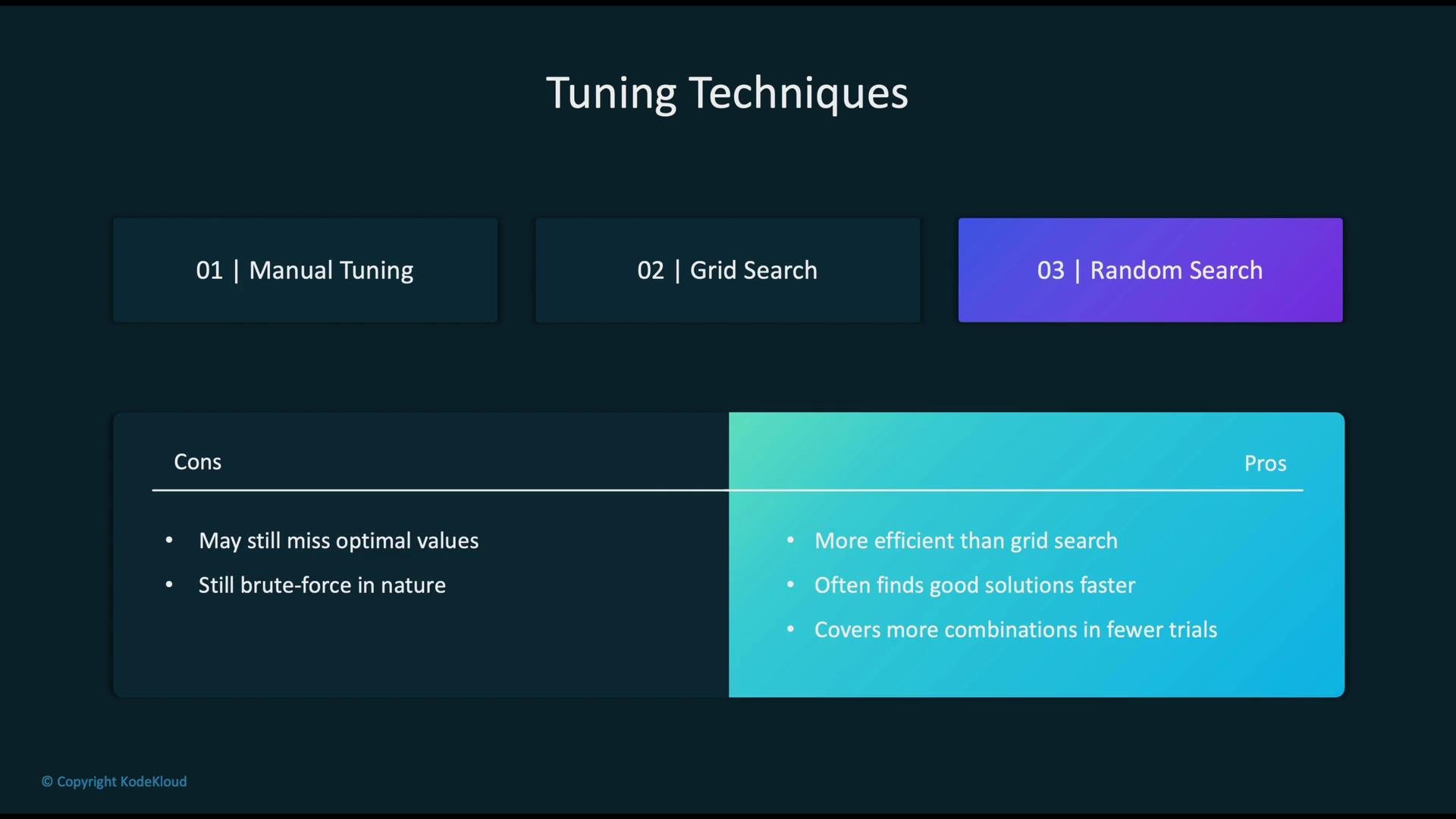
* Pros: More efficient than grid search in many practical high-dimensional problems; tends to find good configurations with fewer trials.
* Cons: Still random and can miss narrow optimal regions.
* When to use: Medium-to-large search spaces where budget is limited and you want broader coverage than a grid.
Random search
Random search samples configurations from specified distributions or discrete sets.
* Pros: More efficient than grid search in many practical high-dimensional problems; tends to find good configurations with fewer trials.
* Cons: Still random and can miss narrow optimal regions.
* When to use: Medium-to-large search spaces where budget is limited and you want broader coverage than a grid.
 Bayesian optimization
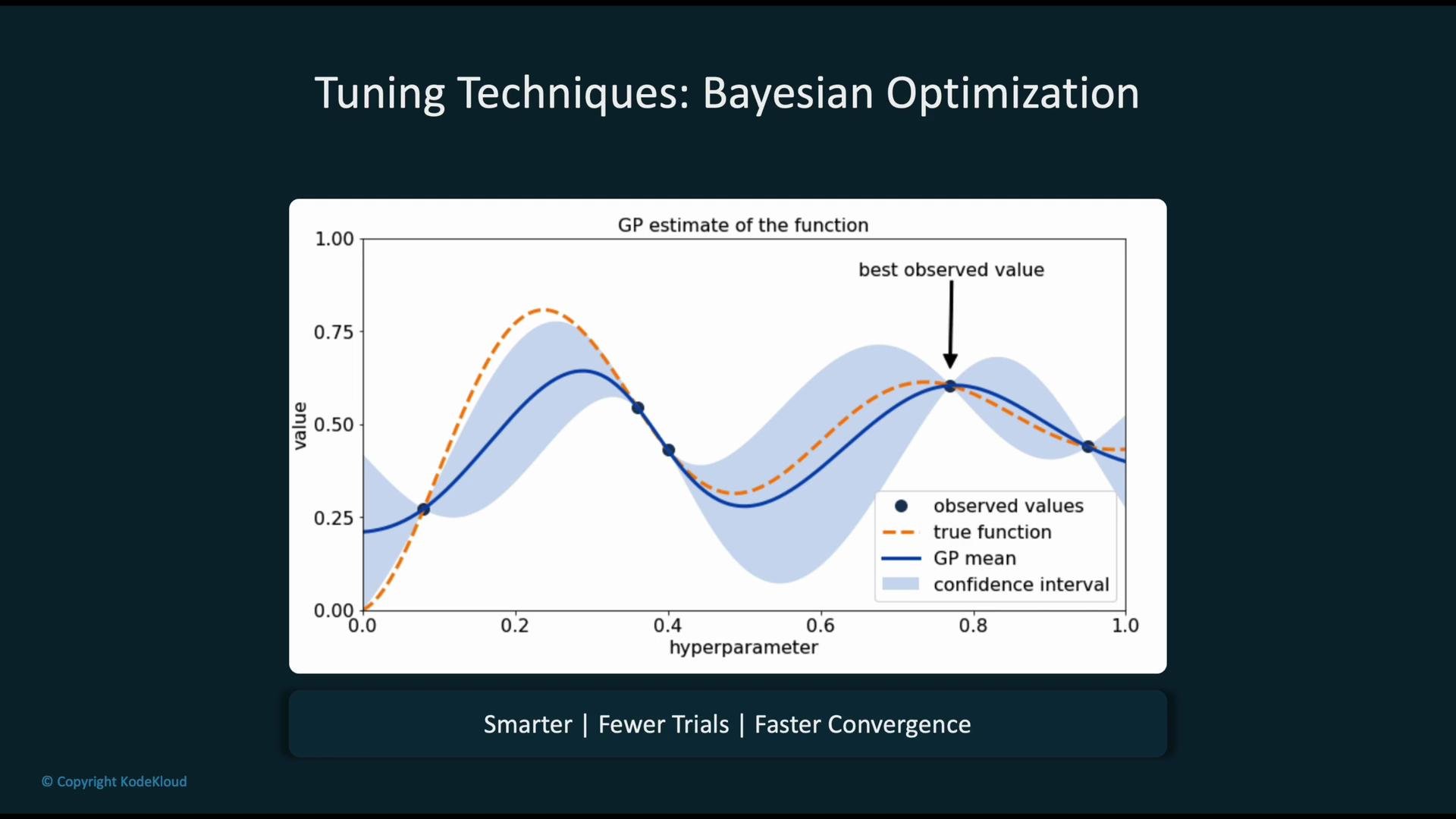
 constructs a probabilistic surrogate (often a Gaussian Process) to model the relationship between hyperparameters and the objective metric. An acquisition function (e.g., Expected Improvement, Upper Confidence Bound) selects the most promising hyperparameters to evaluate next, yielding sample-efficient search that typically converges faster than grid or random search.
* Pros: Great for expensive-to-evaluate objectives; reduces number of required trials.
* Cons: Additional implementation complexity; surrogate model overhead for many parallel experiments.
* When to use: Long training runs, costly compute (GPU/TPU), or when each trial is expensive in time or money.
Bayesian optimization
Bayesian optimization constructs a probabilistic surrogate (often a Gaussian Process) to model the relationship between hyperparameters and the objective metric. An acquisition function (e.g., Expected Improvement, Upper Confidence Bound) selects the most promising hyperparameters to evaluate next, yielding sample-efficient search that typically converges faster than grid or random search.
* Pros: Great for expensive-to-evaluate objectives; reduces number of required trials.
* Cons: Additional implementation complexity; surrogate model overhead for many parallel experiments.
* When to use: Long training runs, costly compute (GPU/TPU), or when each trial is expensive in time or money.
 Amazon SageMaker hyperparameter tuning
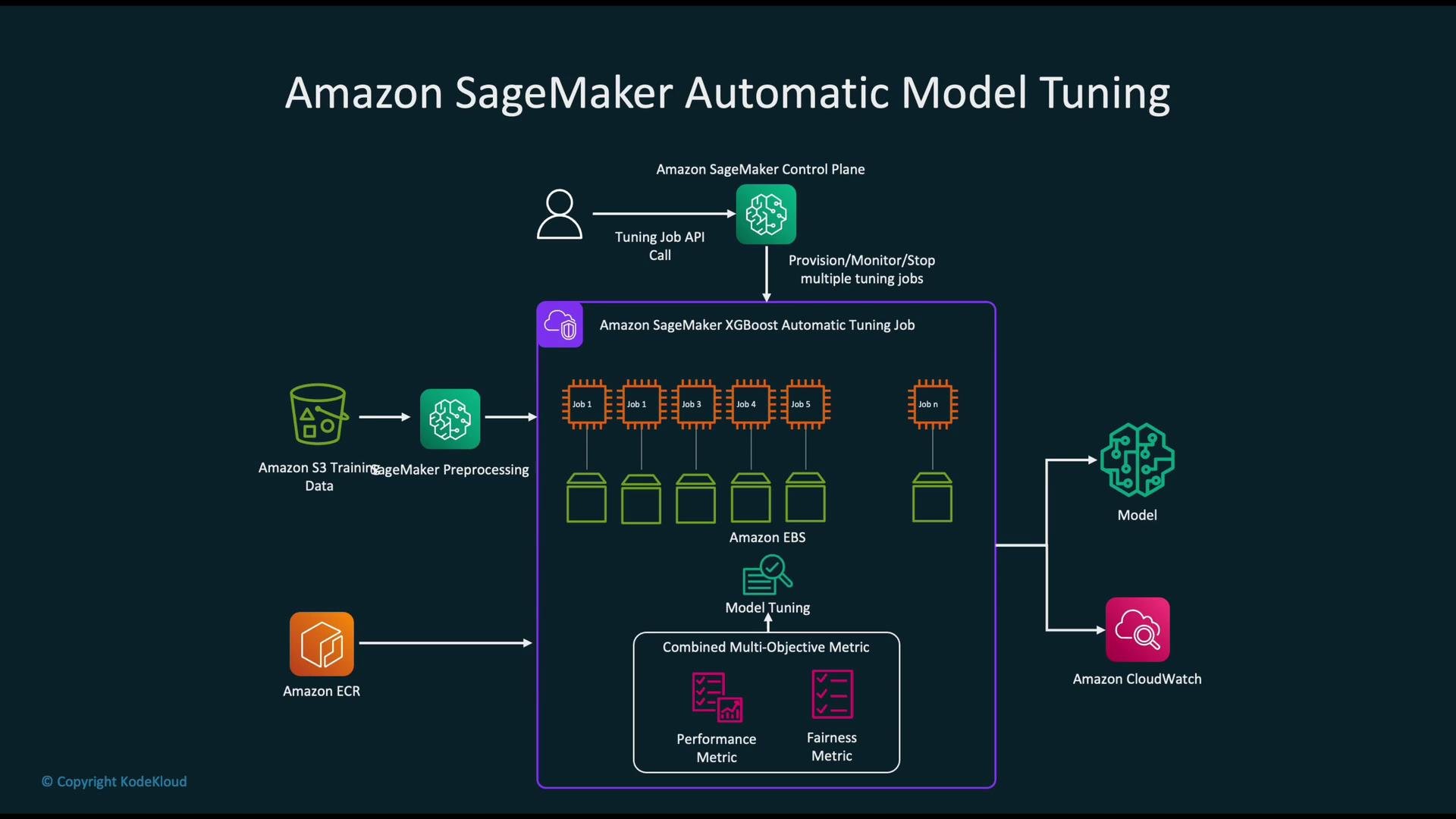
Amazon SageMaker exposes managed hyperparameter tuning jobs (HPO) to orchestrate many training jobs with different hyperparameter combinations. SageMaker handles parallelization, resource provisioning, logging, and supports both random and Bayesian (SMBO) optimization strategies, making it practical for production pipelines where scale, cost control, and observability are important.
* Key features:
* Define hyperparameter ranges and distributions.
* Choose optimization strategies (random or Bayesian/SMBO).
* Run many training jobs in parallel with resource management.
* Aggregate results, log metrics, and automatically select the best model.
Amazon SageMaker hyperparameter tuning
Amazon SageMaker exposes managed hyperparameter tuning jobs (HPO) to orchestrate many training jobs with different hyperparameter combinations. SageMaker handles parallelization, resource provisioning, logging, and supports both random and Bayesian (SMBO) optimization strategies, making it practical for production pipelines where scale, cost control, and observability are important.
* Key features:
* Define hyperparameter ranges and distributions.
* Choose optimization strategies (random or Bayesian/SMBO).
* Run many training jobs in parallel with resource management.
* Aggregate results, log metrics, and automatically select the best model.
 When to prefer managed or Bayesian HPO
* Use Bayesian optimization or a managed HPO service (like SageMaker HPO) when training is expensive or each trial takes hours/days.
* Use random search for a balance of simplicity and efficiency on larger search spaces.
* Reserve grid search for small, discrete, and well-bounded parameter grids.
When training is expensive (long training times or high compute cost), prefer Bayesian optimization or managed tuning services that reduce the number of trials needed to find a good configuration.
Further reading and references
* [Kubernetes Documentation](https://kubernetes.io/docs/) (deployment patterns for training clusters)
* [Amazon SageMaker](https://learn.kodekloud.com/user/courses/aws-sagemaker) (managed model training and HPO)
* Research on Bayesian optimization and SMBO for hyperparameter tuning
Use these techniques and tools to match your problem constraints — computation budget, time-to-result, and repeatability — and to move from intuition-driven experiments to production-ready, well-tuned models.
When to prefer managed or Bayesian HPO
* Use Bayesian optimization or a managed HPO service (like SageMaker HPO) when training is expensive or each trial takes hours/days.
* Use random search for a balance of simplicity and efficiency on larger search spaces.
* Reserve grid search for small, discrete, and well-bounded parameter grids.
When training is expensive (long training times or high compute cost), prefer Bayesian optimization or managed tuning services that reduce the number of trials needed to find a good configuration.
Further reading and references
* [Kubernetes Documentation](https://kubernetes.io/docs/) (deployment patterns for training clusters)
* [Amazon SageMaker](https://learn.kodekloud.com/user/courses/aws-sagemaker) (managed model training and HPO)
* Research on Bayesian optimization and SMBO for hyperparameter tuning
Use these techniques and tools to match your problem constraints — computation budget, time-to-result, and repeatability — and to move from intuition-driven experiments to production-ready, well-tuned models.