> ## Documentation Index
> Fetch the complete documentation index at: https://notes.kodekloud.com/llms.txt
> Use this file to discover all available pages before exploring further.
# Monitoring strategy and Categories of insights
> This guide shows how to design a monitoring strategy and leverage the FCAPS model for actionable insights in AWS CloudWatch and IT environments.
Building on proactive problem reduction, this guide shows how to design a monitoring strategy and leverage the FCAPS model to gain actionable insights in AWS CloudWatch and other IT environments.
## Monitoring Strategies
Imagine your IT ecosystem as a dynamic organism—complex, interconnected, and requiring constant vigilance.
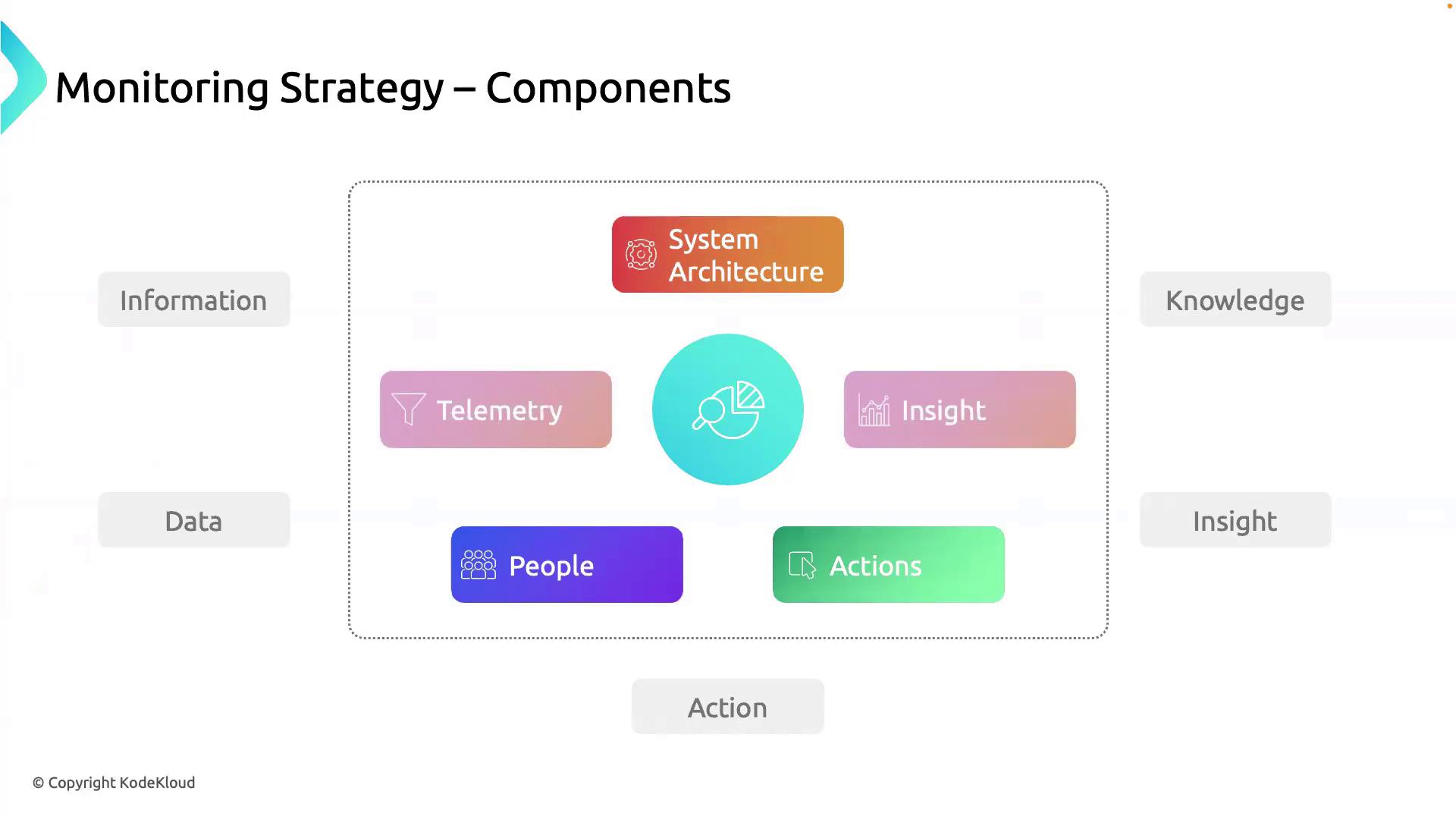
A **comprehensive monitoring strategy** converts raw data into operations-ready guidance:
* **Telemetry**: Your system’s sensory network—collects logs, metrics, traces, and events in real time.
* **System Architecture**: The topology map—defines data sources, dependencies, and expected behaviors.
* **Insights**: Actionable intelligence—derived by correlating telemetry with architectural baselines.
* **People**: DevOps engineers and operators—interpret insights to make informed decisions.
* **Actions**: Automated or manual responses—alerts, auto-scaling, remediation, and optimizations.
Together, these elements form a feedback loop that moves you from **Information → Knowledge → Insight → Action**.
A successful strategy integrates with tools like [AWS CloudWatch](https://docs.aws.amazon.com/cloudwatch/) for unified observability across logs, metrics, and alarms.
## Categories of Insights: The FCAPS Framework
The **FCAPS model** (Fault, Configuration, Accounting, Performance, Security) organizes monitoring into five key areas. Each category provides a unique lens on system health, helping you stay ahead of issues and drive continuous improvement.
FCAPS originated in network management standards and remains invaluable for holistic IT operations.
| Category | Purpose | Example Use Case |
| ------------------------ | ----------------------------------------------------- | ---------------------------------------- |
| Fault Management | Detect, isolate, and remedy errors | Server crash alerts & root-cause logs |
| Configuration Management | Track and enforce system settings | AMI version control & change audits |
| Accounting Management | Monitor resource usage and cost allocation | EC2 instance billing & usage charts |
| Performance Management | Analyze and optimize system efficiency | CPU/memory forecasting & auto-scaling |
| Security Management | Protect data integrity, confidentiality, availability | IAM policy compliance & threat detection |
### 1. Fault Management
Fault management acts like an on-demand diagnostic system:
* Continuously scans for errors—network outages, service failures, or unexpected restarts.
* Triggers alerts and runs automated remediation playbooks.
* Reduces mean time to repair (MTTR) by pinpointing root causes.
### 2. Configuration Management
Configuration management ensures settings and changes are versioned, documented, and enforceable.
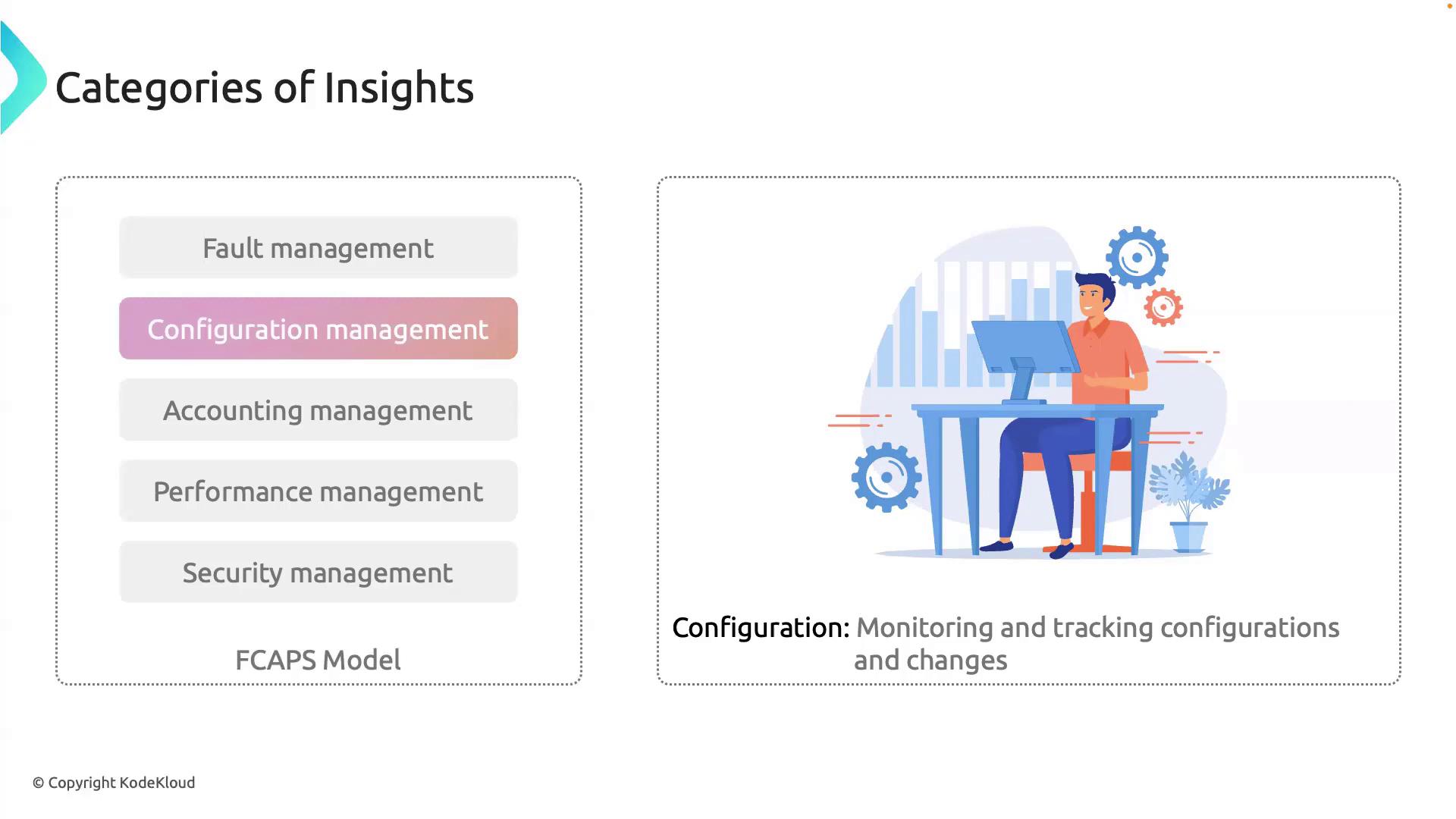
Use IaC tools (Terraform, CloudFormation) and drift detection to maintain a single source of truth and meet compliance requirements.
### 3. Accounting Management
Accounting management functions like a utility meter—tracking compute, storage, and network consumption.
* Enables precise cost allocation and chargeback models.
* Drives budget forecasting and capacity planning.
* Integrates with billing dashboards in AWS Cost Explorer or third-party platforms.
### 4. Performance Management
Performance management focuses on resource utilization and end-user experience:
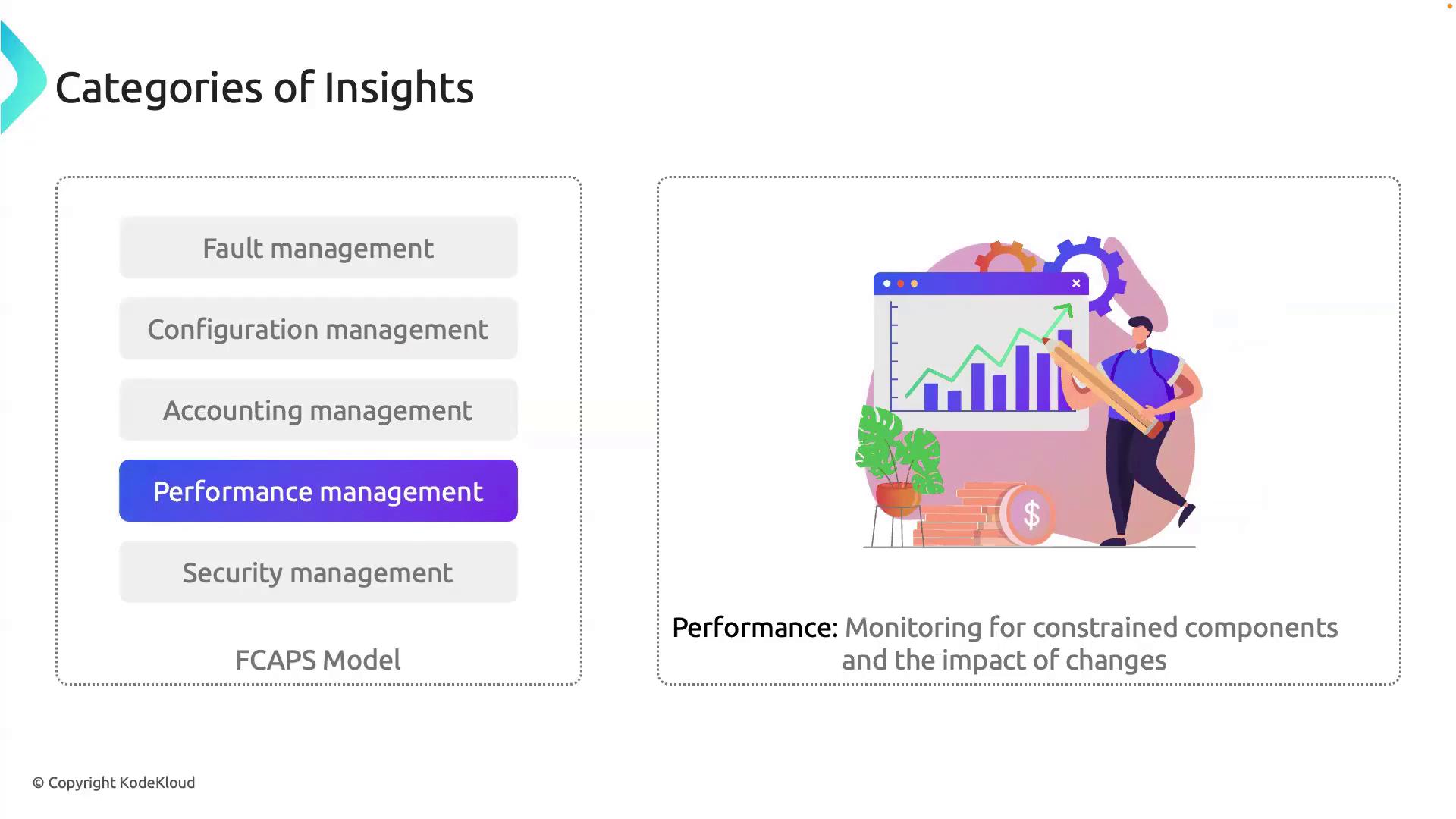
* Leverages historical metrics and trend analysis.
* Implements SLO/SLI tracking to uphold service levels.
* Automates scaling policies based on thresholds or predictive models.
Ignoring performance baselines can lead to cost overruns and degraded user experience. Always define realistic thresholds.
### 5. Security Management
Security management underpins trust and resilience:
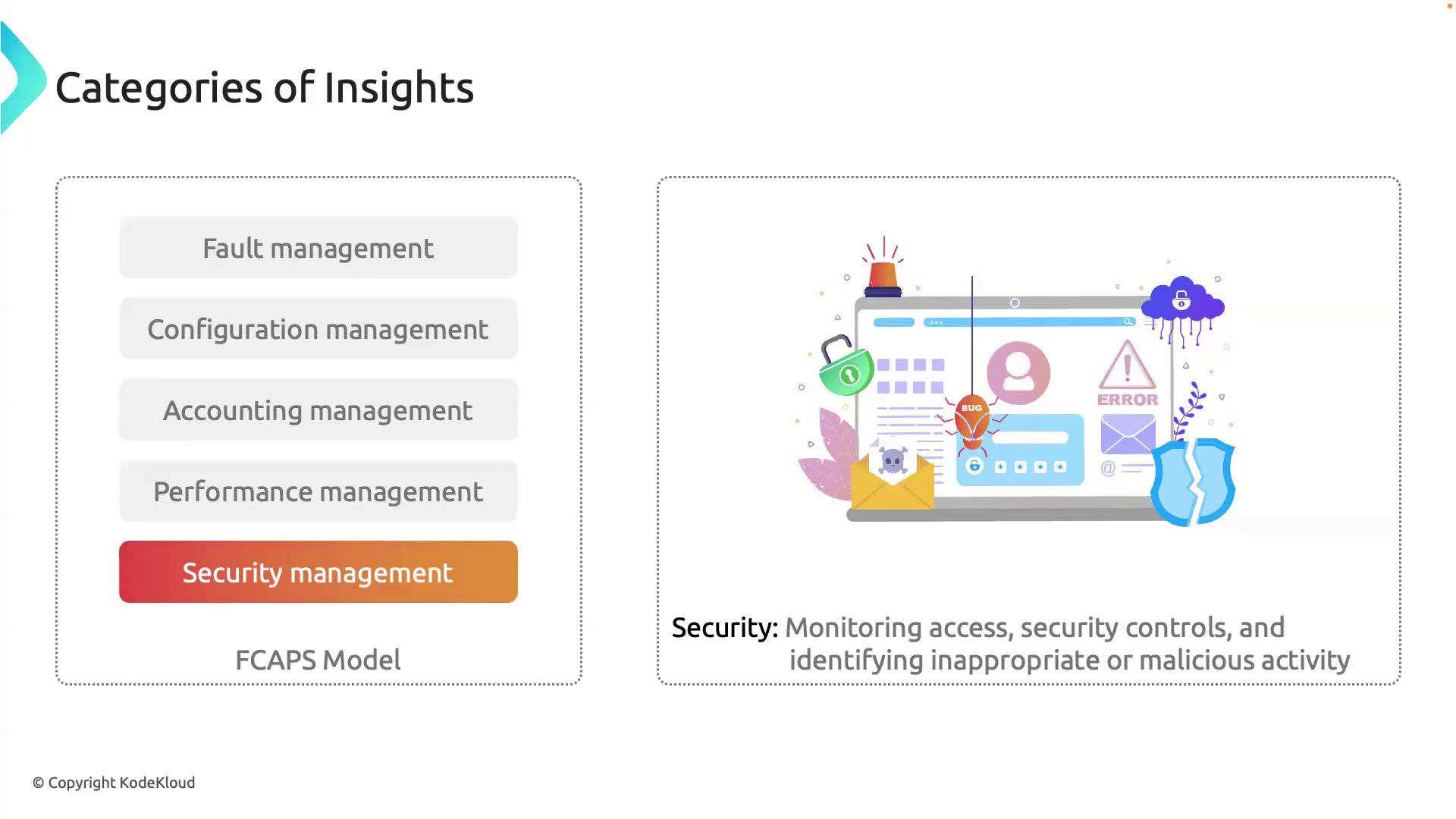
* Monitors IAM policy changes, suspicious API calls, and vulnerability scans.
* Enforces encryption, MFA, and network segmentation.
* Integrates with SIEM tools for real-time threat detection.
***
By mapping your observability tools and processes to the **FCAPS framework**, you can move from reactive firefighting to proactive optimization. This structured approach aligns DevOps, SecOps, and FinOps teams, driving efficiency, security, and cost control across the IT lifecycle.
## References
* [AWS CloudWatch Documentation](https://docs.aws.amazon.com/cloudwatch/)
* [ISTQB Glossary: FCAPS Model](https://glossary.istqb.org/en/search/fcaps)
* [Terraform Best Practices](https://developer.hashicorp.com/terraform/best-practices)