> ## Documentation Index
> Fetch the complete documentation index at: https://notes.kodekloud.com/llms.txt
> Use this file to discover all available pages before exploring further.
# Proactive problem detection
> This article discusses proactive problem detection in DevOps, focusing on predicting and preventing issues to enhance application performance and user experience.
Welcome back! In this lesson, we’ll dive into **Proactive Problem Detection**—the DevOps practice of predicting and preventing issues before they impact your users. By combining monitoring, alerting, and automation, you can catch anomalies early and keep your applications running smoothly.
## What Is Proactive Problem Detection?
Proactive Problem Detection consists of three key pillars:
1. Continuous Monitoring
2. Automated Alerting
3. Automatic Mitigation
By implementing these components, you can:
* Identify performance degradations in real time
* Trigger alerts when thresholds are breached
* Execute self-healing scripts or scale resources automatically
Choose monitoring tools that support anomaly detection and customizable dashboards. For example, [AWS CloudWatch Anomaly Detection](https://docs.aws.amazon.com/AmazonCloudWatch/latest/monitoring/CloudWatch-Anomaly-Detection.html) can help you identify unusual patterns without manual threshold tuning.
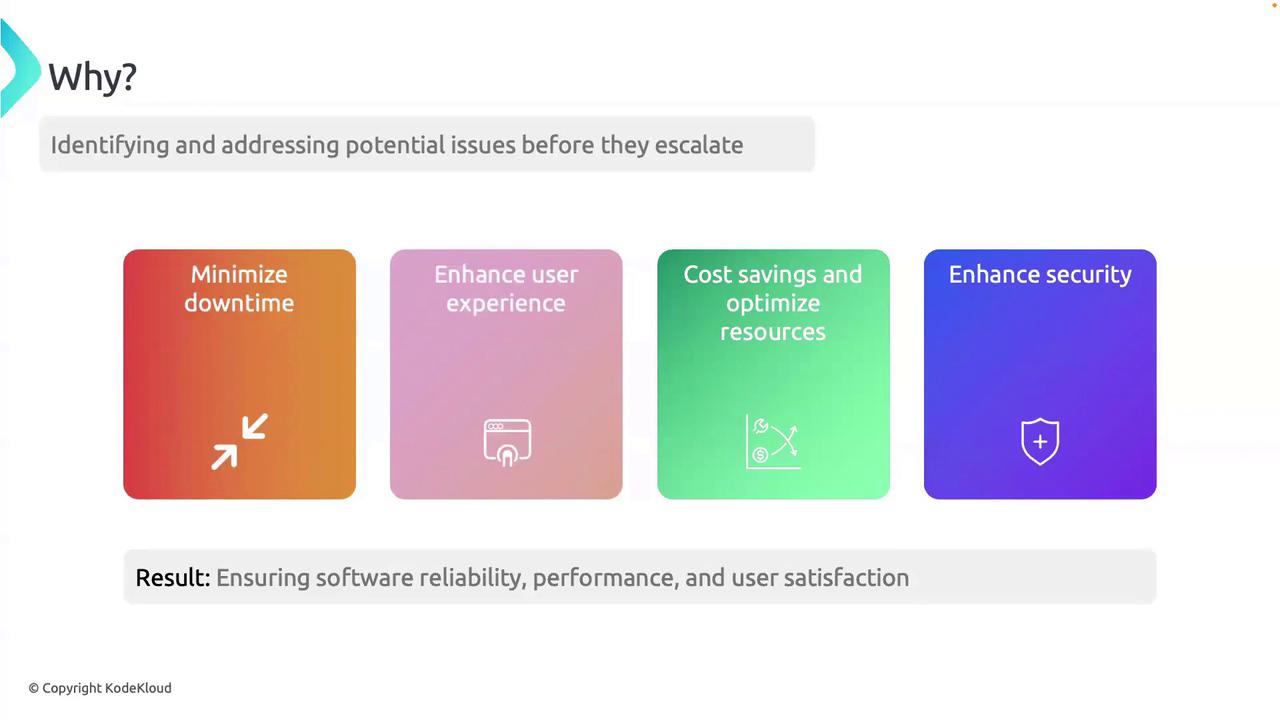
## Why Proactive Problem Detection Matters
Detecting and resolving issues early offers multiple advantages:
| Benefit | Description |
| ------------------------------------ | ---------------------------------------------------------------------------------------- |
| Minimized Downtime | Reduce financial losses and protect your reputation by restoring service before outages. |
| Enhanced User Experience | Keep interactions seamless, ensuring users remain satisfied and engaged. |
| Cost Savings & Resource Optimization | Identify underutilized resources or over-provisioning to lower cloud expenses. |
| Strengthened Security | Spot suspicious activity or vulnerabilities early, preventing potential breaches. |
### Key Outcomes
* **Software Reliability**: Keep your services available and resilient.
* **Peak Performance**: Maintain optimal response times under varying loads.
* **User Satisfaction**: Deliver a consistently high-quality experience.
***
## Next Steps
Implement a monitoring strategy that covers infrastructure, application metrics, and security events. Automate responses with tools like AWS Lambda, PagerDuty, or custom scripts, and continuously refine your dashboards and alerts.
## References
* [AWS CloudWatch Documentation](https://docs.aws.amazon.com/cloudwatch/)
* [DevOps Monitoring Best Practices](https://dzone.com/articles/devops-monitoring-best-practices)
* [Terraform Registry](https://registry.terraform.io/)