> ## Documentation Index
> Fetch the complete documentation index at: https://notes.kodekloud.com/llms.txt
> Use this file to discover all available pages before exploring further.
# An Introduction to Feature Engineering Part 2
> Explains how targeted feature engineering improves model accuracy, generalization, interpretability, and training efficiency, plus strategies for handling data issues and tools for scalable transformations.
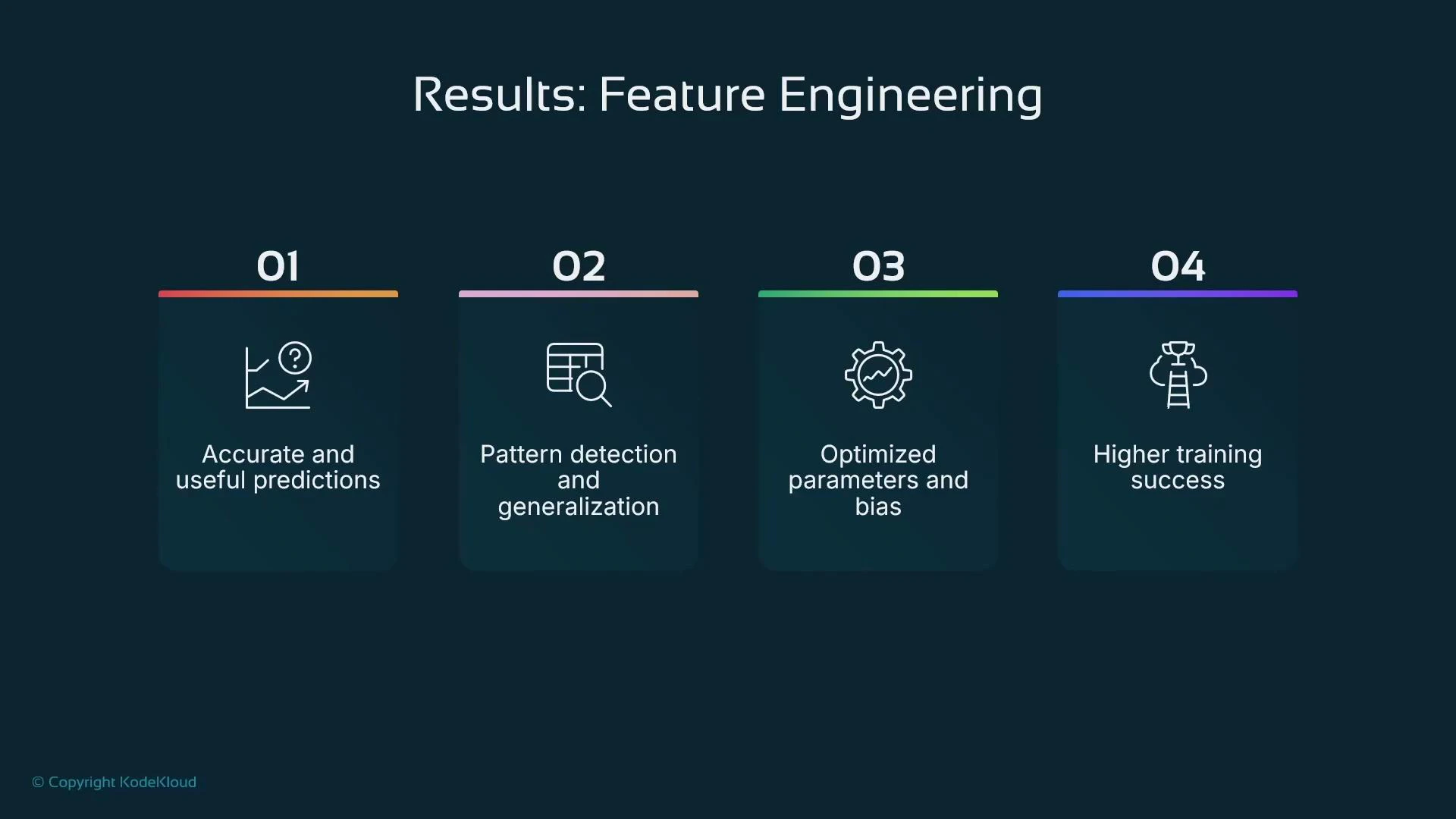
What can you expect from a targeted feature engineering process? In short: more accurate, more reliable models whose predictions are easier to act on. Thoughtful feature engineering strengthens signal, reduces noise, and helps training discover true, generalizable patterns instead of memorizing idiosyncrasies in the training set. The result is faster convergence, fewer experiments to reach acceptable performance, and improved downstream business utility.
 Impact on model performance and training
* Stronger features produce clearer correlations between inputs and targets, yielding more accurate predictions and lower error metrics (e.g., reduced mean squared error for regression).
* Feature engineering can reduce bias by exposing relevant signals, which leads to better-optimized model parameters and improved generalization.
* Well-crafted features often allow simpler models to achieve competitive performance and reduce the need for deeper architectures.
* Training usually converges faster on feature-engineered data, meaning fewer epochs and less hyperparameter tuning.
No feature engineering vs. feature engineering
| Without feature engineering | With feature engineering |
| ---------------------------------------------- | -------------------------------------------------------- |
| Weak signals; unclear feature importance | Stronger predictive signals and interpretable importance |
| Higher risk of overfitting or underfitting | Better generalization to new data |
| Slower convergence; may require complex models | Faster convergence; simpler models often suffice |
| Higher evaluation error (e.g., MSE) | Lower evaluation error and better-explained variance |
Why improved features help generalization
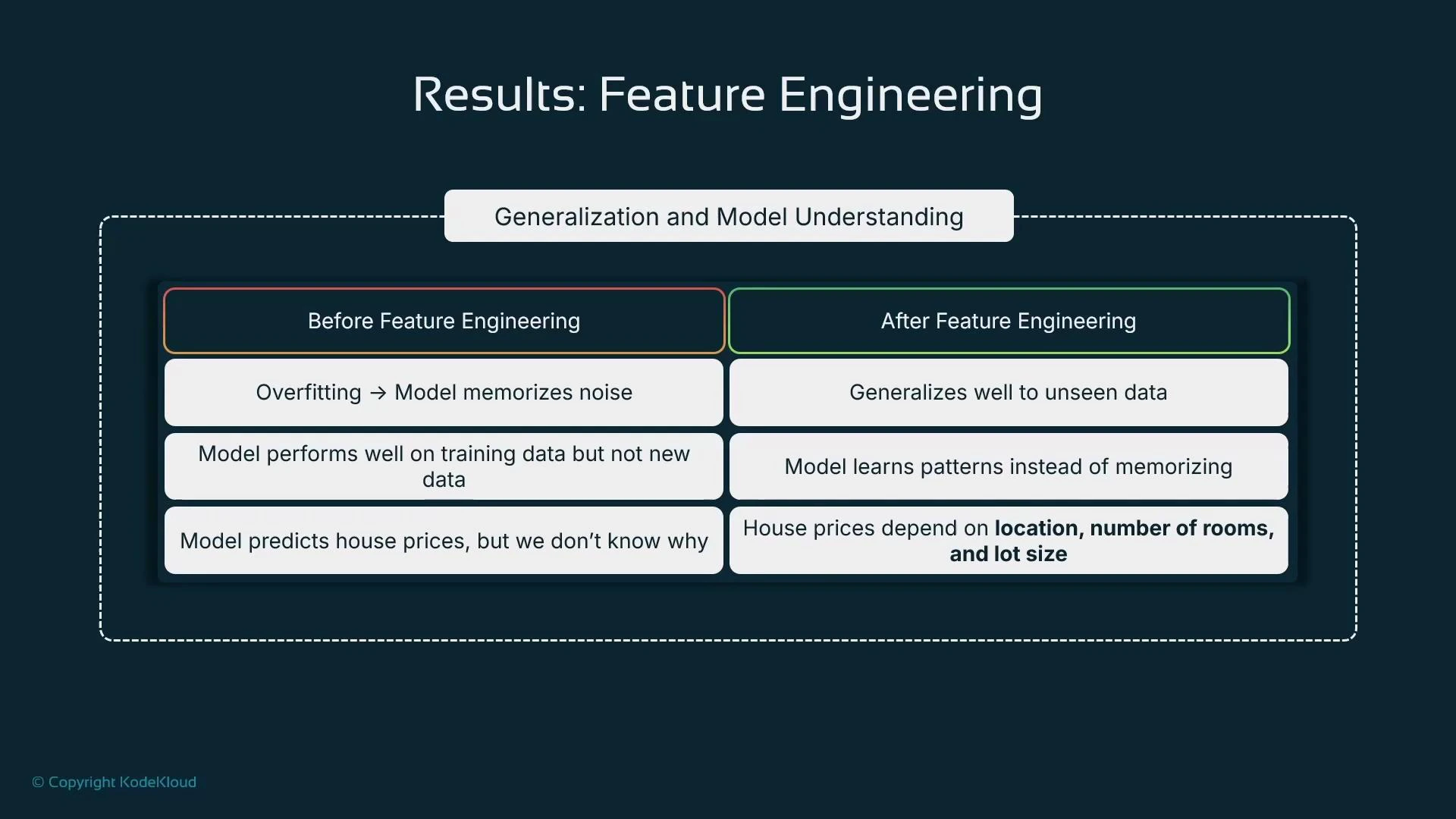
Overfitting happens when a model learns noise or peculiarities in training data rather than underlying patterns. Effective feature engineering reduces this risk by surfacing meaningful relationships and removing spurious signals—helping the model perform well on unseen data.
Overfitting is when a model memorizes training examples and performs poorly on new data. Thoughtful feature engineering mitigates overfitting by exposing true predictive signals and reducing noisy or irrelevant inputs.
Interpretable examples: house price prediction
When predicting house prices, unprocessed datasets can make model behavior opaque. With targeted features—such as neighborhood indices, room counts, lot area, and engineered temporal features—you gain clearer visibility into why the model outputs a price and which factors drive it. Often, a small number of well-designed features explain most of the predictive power in housing datasets.
Impact on model performance and training
* Stronger features produce clearer correlations between inputs and targets, yielding more accurate predictions and lower error metrics (e.g., reduced mean squared error for regression).
* Feature engineering can reduce bias by exposing relevant signals, which leads to better-optimized model parameters and improved generalization.
* Well-crafted features often allow simpler models to achieve competitive performance and reduce the need for deeper architectures.
* Training usually converges faster on feature-engineered data, meaning fewer epochs and less hyperparameter tuning.
No feature engineering vs. feature engineering
| Without feature engineering | With feature engineering |
| ---------------------------------------------- | -------------------------------------------------------- |
| Weak signals; unclear feature importance | Stronger predictive signals and interpretable importance |
| Higher risk of overfitting or underfitting | Better generalization to new data |
| Slower convergence; may require complex models | Faster convergence; simpler models often suffice |
| Higher evaluation error (e.g., MSE) | Lower evaluation error and better-explained variance |
Why improved features help generalization
Overfitting happens when a model learns noise or peculiarities in training data rather than underlying patterns. Effective feature engineering reduces this risk by surfacing meaningful relationships and removing spurious signals—helping the model perform well on unseen data.
Overfitting is when a model memorizes training examples and performs poorly on new data. Thoughtful feature engineering mitigates overfitting by exposing true predictive signals and reducing noisy or irrelevant inputs.
Interpretable examples: house price prediction
When predicting house prices, unprocessed datasets can make model behavior opaque. With targeted features—such as neighborhood indices, room counts, lot area, and engineered temporal features—you gain clearer visibility into why the model outputs a price and which factors drive it. Often, a small number of well-designed features explain most of the predictive power in housing datasets.
 Handling common data issues during feature engineering
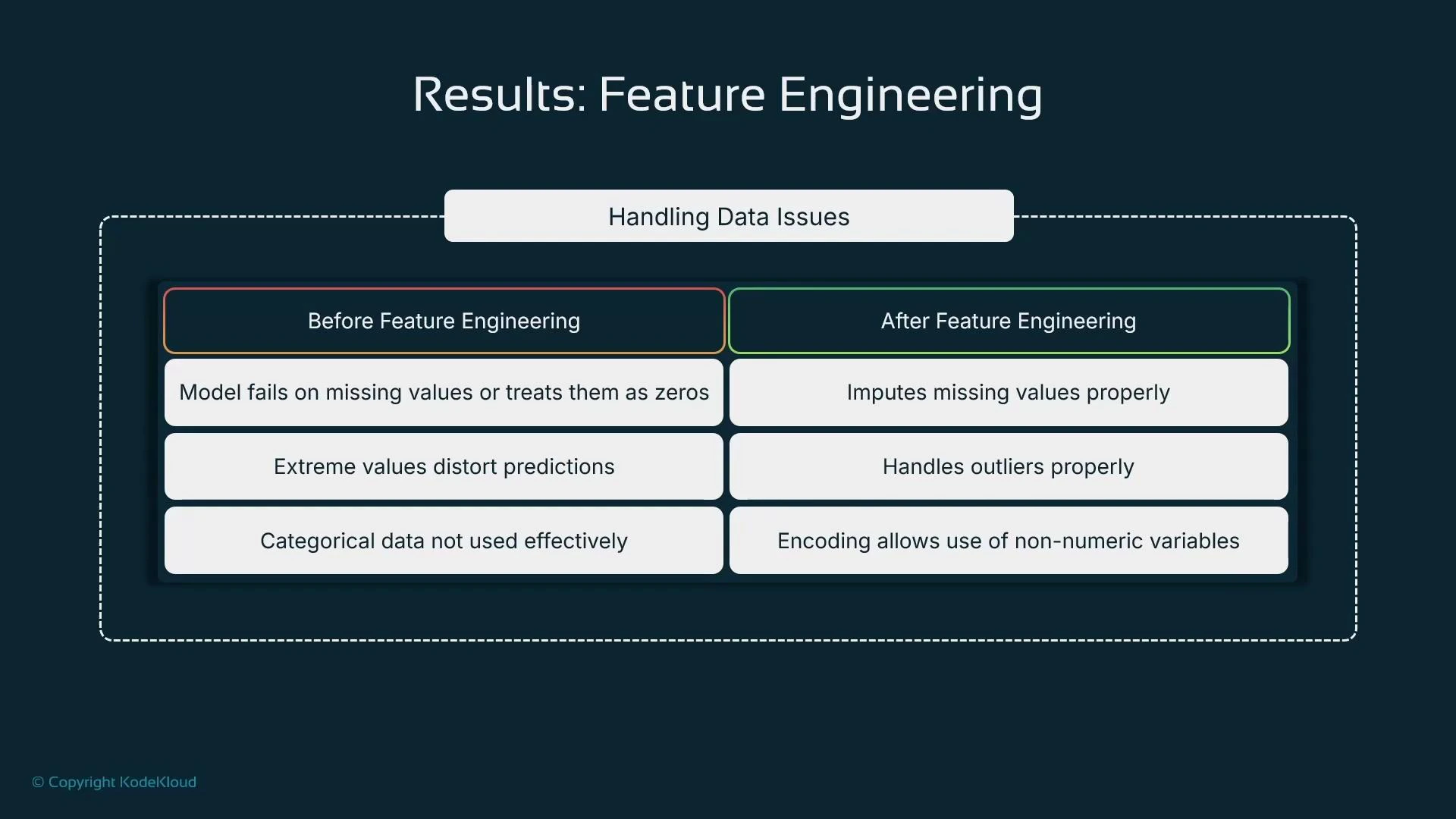
Feature engineering extends basic cleaning to address domain-specific problems. Typical concerns and approaches:
* Missing values: apply per-feature strategies such as mean/median imputation, KNN imputation, or model-based methods; consider adding a missing-value indicator.
* Outliers/extreme values: use clipping, winsorizing, trimming, or model-based handling depending on whether extremes are valid signals.
* Categorical variables: choose one-hot, ordinal, target/mean encoding, or learned embeddings based on cardinality and model type.
| Data issue | Typical fixes |
| ------------------------------ | ----------------------------------------------------------------------- |
| Missing values | Mean/median imputation, KNN, model-based imputation, missing indicators |
| Outliers/extremes | Clipping, winsorizing, trimming, or model-aware handling |
| High-cardinality categorical | Target encoding, hashing, or embeddings |
| Skewed numerical distributions | Log transforms, power transforms, or quantile transforms |
These decisions influence both predictive performance and interpretability—so combine domain knowledge with algorithmic considerations when choosing strategies.
Handling common data issues during feature engineering
Feature engineering extends basic cleaning to address domain-specific problems. Typical concerns and approaches:
* Missing values: apply per-feature strategies such as mean/median imputation, KNN imputation, or model-based methods; consider adding a missing-value indicator.
* Outliers/extreme values: use clipping, winsorizing, trimming, or model-based handling depending on whether extremes are valid signals.
* Categorical variables: choose one-hot, ordinal, target/mean encoding, or learned embeddings based on cardinality and model type.
| Data issue | Typical fixes |
| ------------------------------ | ----------------------------------------------------------------------- |
| Missing values | Mean/median imputation, KNN, model-based imputation, missing indicators |
| Outliers/extremes | Clipping, winsorizing, trimming, or model-aware handling |
| High-cardinality categorical | Target encoding, hashing, or embeddings |
| Skewed numerical distributions | Log transforms, power transforms, or quantile transforms |
These decisions influence both predictive performance and interpretability—so combine domain knowledge with algorithmic considerations when choosing strategies.
 Domain-driven feature engineering examples
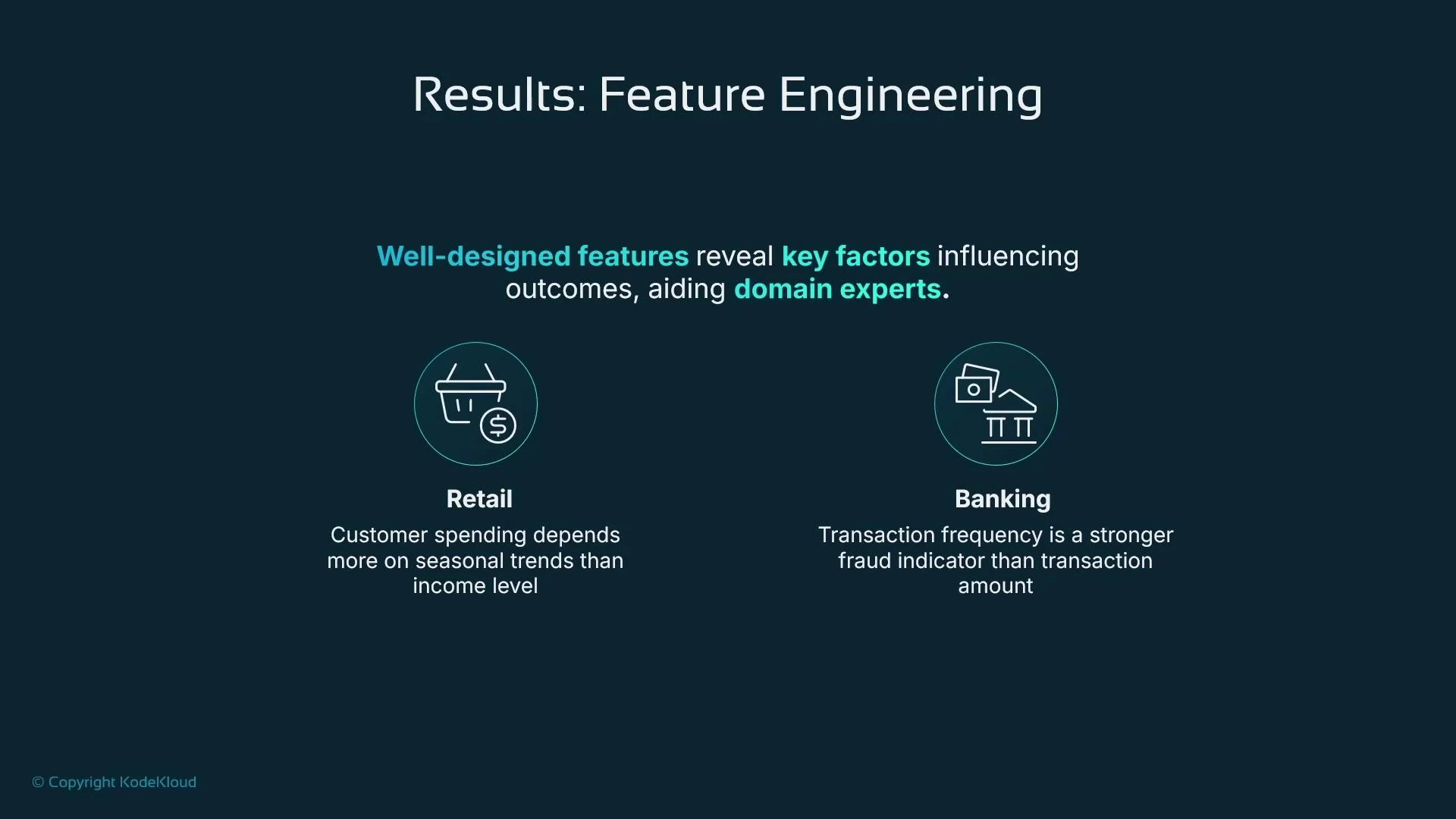
* Retail: Customer spend is often driven by seasonality or promotions rather than static income. Time-based features—month, week-of-year, holiday flags, rolling aggregates—can dramatically outperform raw income variables.
* Banking and fraud detection: Velocity and patterns (transactions per day, time since last transaction, anomalous sequence patterns) often indicate fraud more reliably than single-transaction amounts. Aggregate and ratio features are especially valuable.
Think in terms of business behavior and craft features that capture actions and trends rather than only static attributes.
Domain-driven feature engineering examples
* Retail: Customer spend is often driven by seasonality or promotions rather than static income. Time-based features—month, week-of-year, holiday flags, rolling aggregates—can dramatically outperform raw income variables.
* Banking and fraud detection: Velocity and patterns (transactions per day, time since last transaction, anomalous sequence patterns) often indicate fraud more reliably than single-transaction amounts. Aggregate and ratio features are especially valuable.
Think in terms of business behavior and craft features that capture actions and trends rather than only static attributes.
 Summary: practical takeaways and tools
Key takeaways
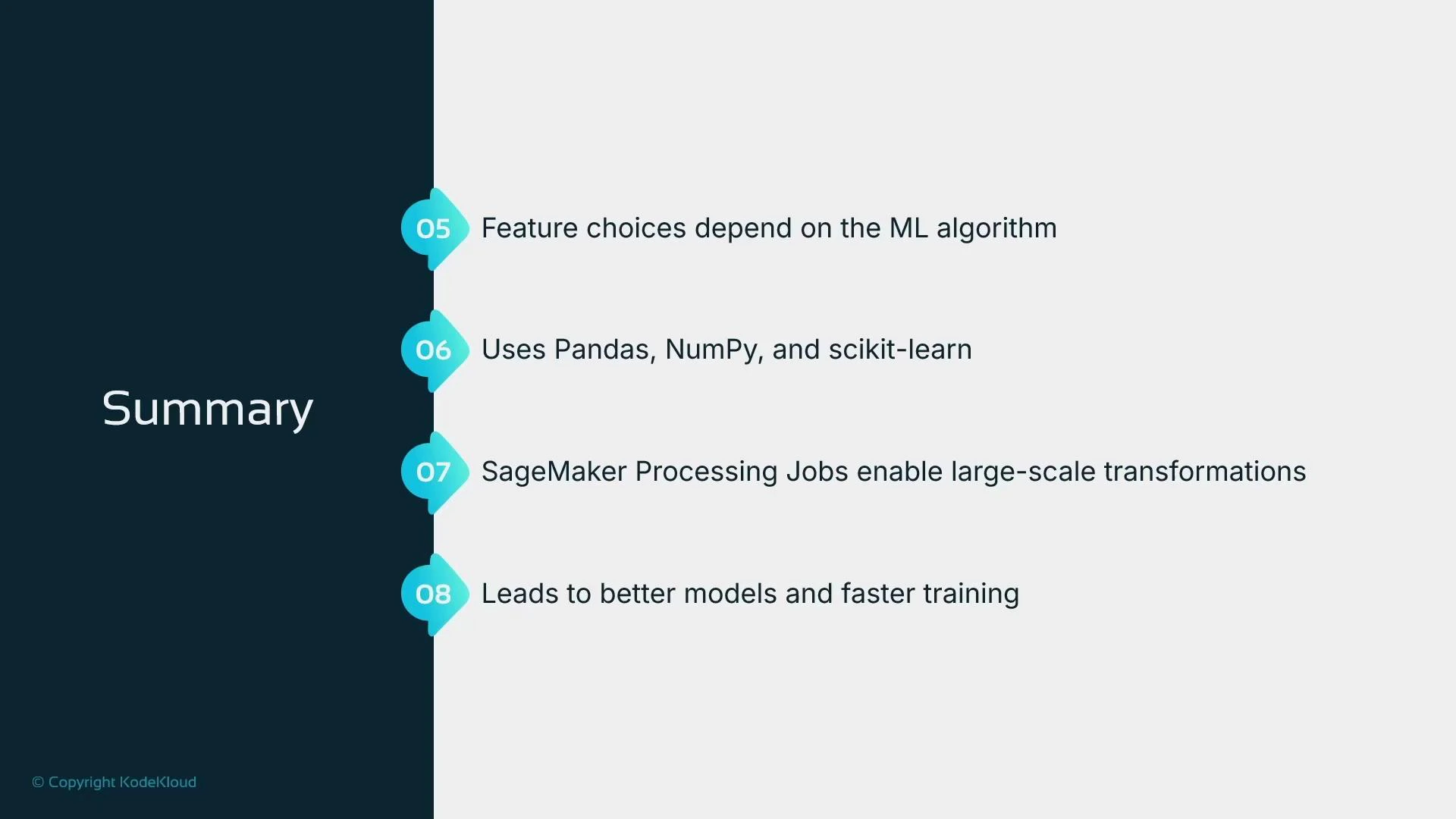
* Cleaned data is a necessary starting point but not sufficient—feature engineering extracts predictive signals that raw cleaning does not.
* Typical feature engineering steps: drop irrelevant variables, transform skewed features (log, power), synthesize new features (ratios, differences, timestamps to ages), and choose appropriate encodings.
* Consider the model family: tree-based models, linear models, and neural networks expect different feature representations (e.g., scaling matters more for linear and neural models than for many tree models).
Recommended libraries and compute patterns
| Resource | Use case |
| ------------------------- | ---------------------------------------------------- |
| pandas | Tabular data manipulation and feature construction |
| NumPy | Numerical operations and vectorized transforms |
| scikit-learn | Preprocessing pipelines, encoders, and transformers |
| SageMaker Processing Jobs | Scalable, managed data transforms for large datasets |
For large-scale transformations (e.g., applying min-max scaling or computing rollups on millions of rows), use managed batch processing (for example, a SageMaker Processing Job) instead of running heavy operations in an interactive notebook—this avoids resource contention and speeds up reproducible pipelines.
Links and further reading
* [pandas](https://pandas.pydata.org/)
* [NumPy](https://numpy.org/)
* [scikit-learn](https://scikit-learn.org/)
* [SageMaker Processing Jobs](https://docs.aws.amazon.com/sagemaker/latest/dg/processing-job.html)
* [Kubernetes Documentation](https://kubernetes.io/docs/) (for orchestration and deployment patterns)
Summary: practical takeaways and tools
Key takeaways
* Cleaned data is a necessary starting point but not sufficient—feature engineering extracts predictive signals that raw cleaning does not.
* Typical feature engineering steps: drop irrelevant variables, transform skewed features (log, power), synthesize new features (ratios, differences, timestamps to ages), and choose appropriate encodings.
* Consider the model family: tree-based models, linear models, and neural networks expect different feature representations (e.g., scaling matters more for linear and neural models than for many tree models).
Recommended libraries and compute patterns
| Resource | Use case |
| ------------------------- | ---------------------------------------------------- |
| pandas | Tabular data manipulation and feature construction |
| NumPy | Numerical operations and vectorized transforms |
| scikit-learn | Preprocessing pipelines, encoders, and transformers |
| SageMaker Processing Jobs | Scalable, managed data transforms for large datasets |
For large-scale transformations (e.g., applying min-max scaling or computing rollups on millions of rows), use managed batch processing (for example, a SageMaker Processing Job) instead of running heavy operations in an interactive notebook—this avoids resource contention and speeds up reproducible pipelines.
Links and further reading
* [pandas](https://pandas.pydata.org/)
* [NumPy](https://numpy.org/)
* [scikit-learn](https://scikit-learn.org/)
* [SageMaker Processing Jobs](https://docs.aws.amazon.com/sagemaker/latest/dg/processing-job.html)
* [Kubernetes Documentation](https://kubernetes.io/docs/) (for orchestration and deployment patterns)
 Next steps
This lesson closes the conceptual overview of feature engineering benefits and practical choices. In a follow-up article we'll demonstrate concrete feature transformations, show code examples and reproducible pipelines, and explain how to operationalize features for both training and inference.
Next steps
This lesson closes the conceptual overview of feature engineering benefits and practical choices. In a follow-up article we'll demonstrate concrete feature transformations, show code examples and reproducible pipelines, and explain how to operationalize features for both training and inference.