> ## Documentation Index
> Fetch the complete documentation index at: https://notes.kodekloud.com/llms.txt
> Use this file to discover all available pages before exploring further.
# Delving into Azure Policy
> Azure Policy helps enforce standards, assess compliance, and remediate drift in cloud environments for governance and security.
Azure Policy is a core pillar of Azure governance that helps you enforce standards, assess compliance, and remediate drift across your cloud environment. Whether you’re preparing for the [AZ-400 exam](https://learn.microsoft.com/en-us/certifications/exams/az-400/) or architecting a production workload, mastering Azure Policy ensures consistent, automated enforcement of your organizational requirements.
## Key Features of Azure Policy
| Feature | Description | Example |
| --------------------- | ----------------------------------------------------------------------------- | ----------------------------------------------------- |
| Policy Enforcement | Apply rules at scale to enforce resource configuration and naming conventions | Deny public IPs on virtual machines |
| Compliance Assessment | Continuously scan resources and generate compliance reports | Audit VMs without Azure Security Center extensions |
| Policy Library | Browse built-in definitions and initiative templates | ISO 27001:2013 initiative template |
| DevOps Integration | Embed policies in CI/CD pipelines using Azure DevOps or GitHub Actions | Enforce tagging policy during ARM template deployment |
Use the Policy Library to accelerate adoption—start with Microsoft-managed definitions and customize parameters as needed.
***
## Policy Definitions
A **policy definition** declares the conditions to evaluate (`if` block) and the action to take (`then` block). Definitions are expressed in JSON, making them easy to version and review.
### Basic Policy Definition
```json theme={null}
{
"policyRule": {
"$schema": "http://schema.management.azure.com/schemas/2019-09-01/policyDefinition.json#",
"if": {
"allOf": [
{
"field": "type",
"in": "[parameters('listOfResourceTypesNotAllowed')]"
}
]
},
"then": {
"effect": "[parameters('effect')]"
}
},
"parameters": {
"listOfResourceTypesNotAllowed": {
"type": "Array",
"metadata": {
"description": "Resource types to block",
"displayName": "Not allowed resource types"
}
},
"effect": {
"type": "String",
"allowedValues": [ "Deny", "Audit", "Disabled" ],
"defaultValue": "Deny",
"metadata": {
"description": "Policy enforcement action",
"displayName": "Effect"
}
}
},
"version": "1.0.0"
}
```
* **`if` block**\
Defines the condition to evaluate on resource properties.
* **`then` block**\
Specifies the enforcement action (e.g., *Deny*, *Audit*, *Disabled*).
* **`parameters`**\
Allow you to customize values at assignment time without editing the definition.
Always reference the latest schema URL to leverage new capabilities and metadata fields.
***
## Compliance Remediation
Azure Policy can automatically remediate non-compliant resources. The following rule adds an existence check before enforcing the effect:
```json theme={null}
{
"policyRule": {
"$schema": "http://schema.management.azure.com/schemas/2019-09-01/policyDefinition.json#",
"if": {
"allOf": [
{
"field": "type",
"in": "[parameters('listOfResourceTypesNotAllowed')]"
},
{
"field": "type",
"exists": true
}
]
},
"then": {
"effect": "[parameters('effect')]"
}
},
"parameters": {
"listOfResourceTypesNotAllowed": {
"type": "Array"
},
"effect": {
"type": "String"
}
},
"version": "2.0.0"
}
```
This enhanced rule ensures that drifted resources are detected and remediated only when they indeed exist.
***
## Policy Assignment
You can scope policy assignments at the management group, subscription, or resource group level. Use the Azure Portal, Azure CLI, or Azure PowerShell:
| Scope | Azure CLI | PowerShell |
| ---------------- | ------------------------------------------------------------------------------------------ | ------------------------------------------------------------------------------------------------------------------------ |
| Management Group | `az policy assignment create --name TAG_RG --mg mtg1 --policy ...` | `New-AzPolicyAssignment -Name TAG_RG -Scope /providers/Microsoft.Management/managementGroups/mtg1 -PolicyDefinition ...` |
| Subscription | `az policy assignment create --name SEC_AUDIT --scope /subscriptions/{subId} --policy ...` | `New-AzPolicyAssignment -Name SEC_AUDIT -Scope /subscriptions/{subId} -PolicyDefinition ...` |
| Resource Group | `az policy assignment create --name TAG_VM --resource-group rg1 --policy ...` | `New-AzPolicyAssignment -Name TAG_VM -Scope /subscriptions/{subId}/resourceGroups/rg1 -PolicyDefinition ...` |
Be careful when assigning **Deny** policies at high-level scopes to avoid unintended disruptions in your production environment.
***
## Azure Policy Initiatives
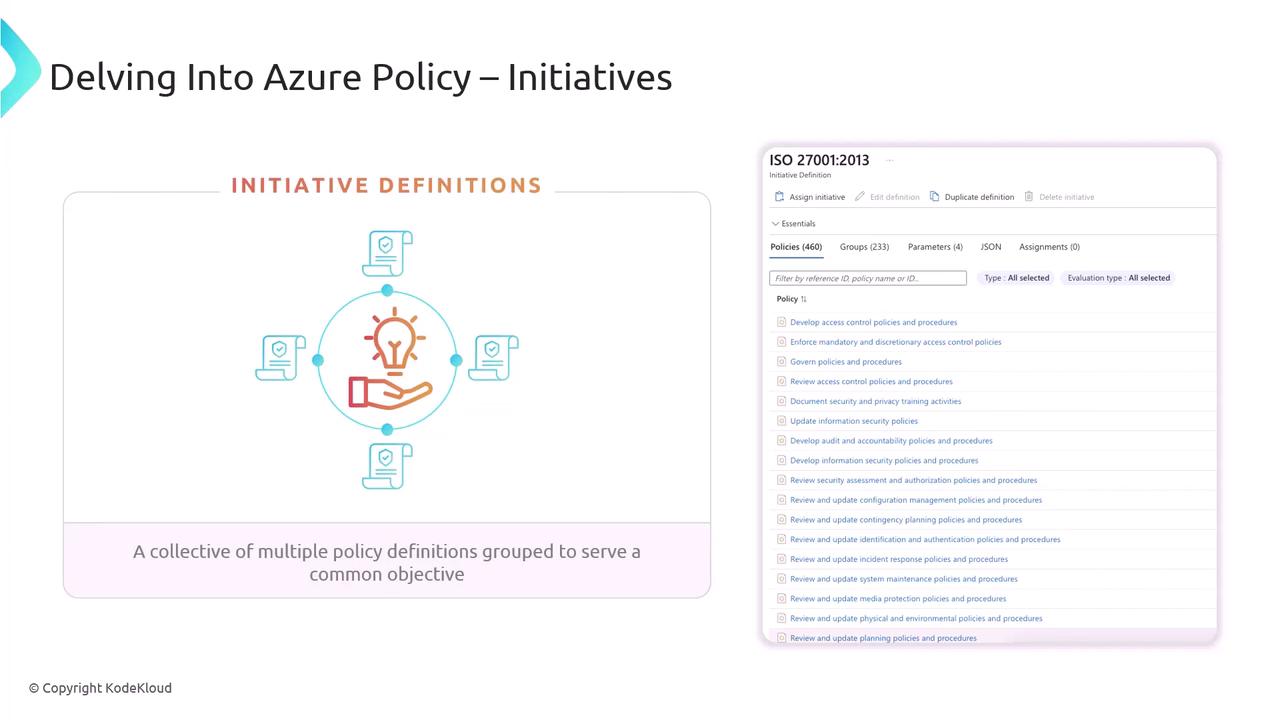
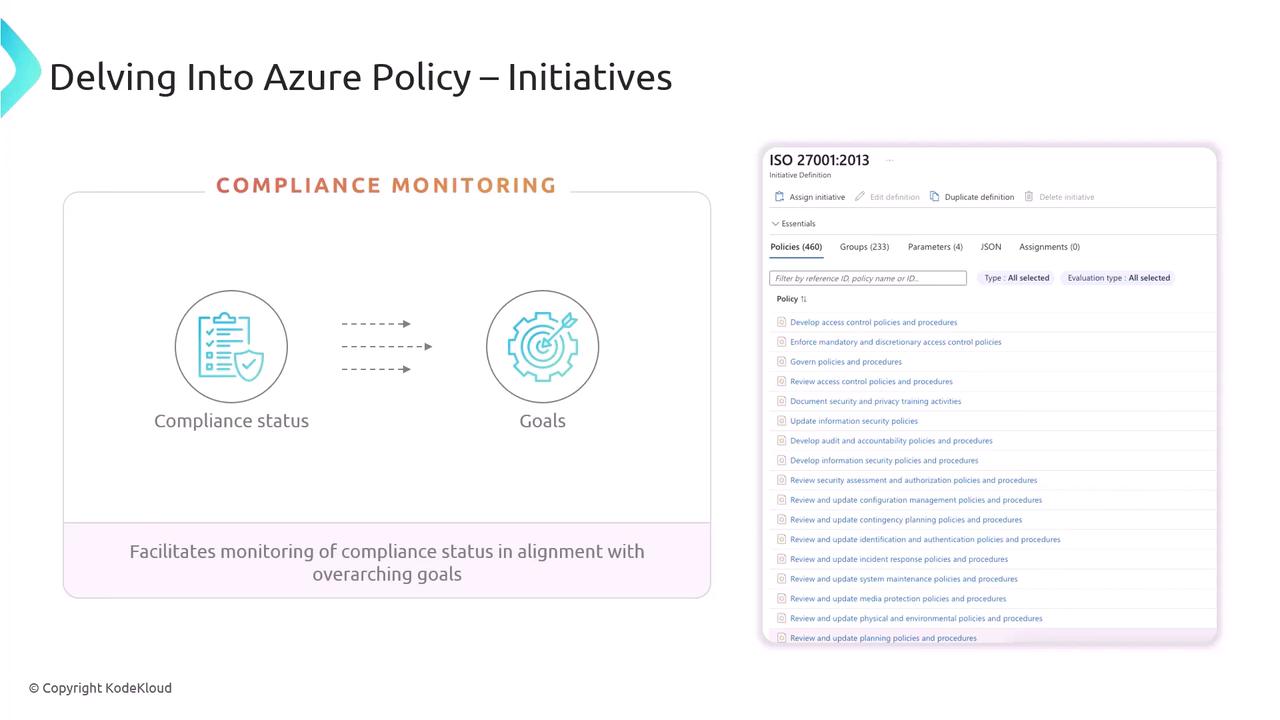
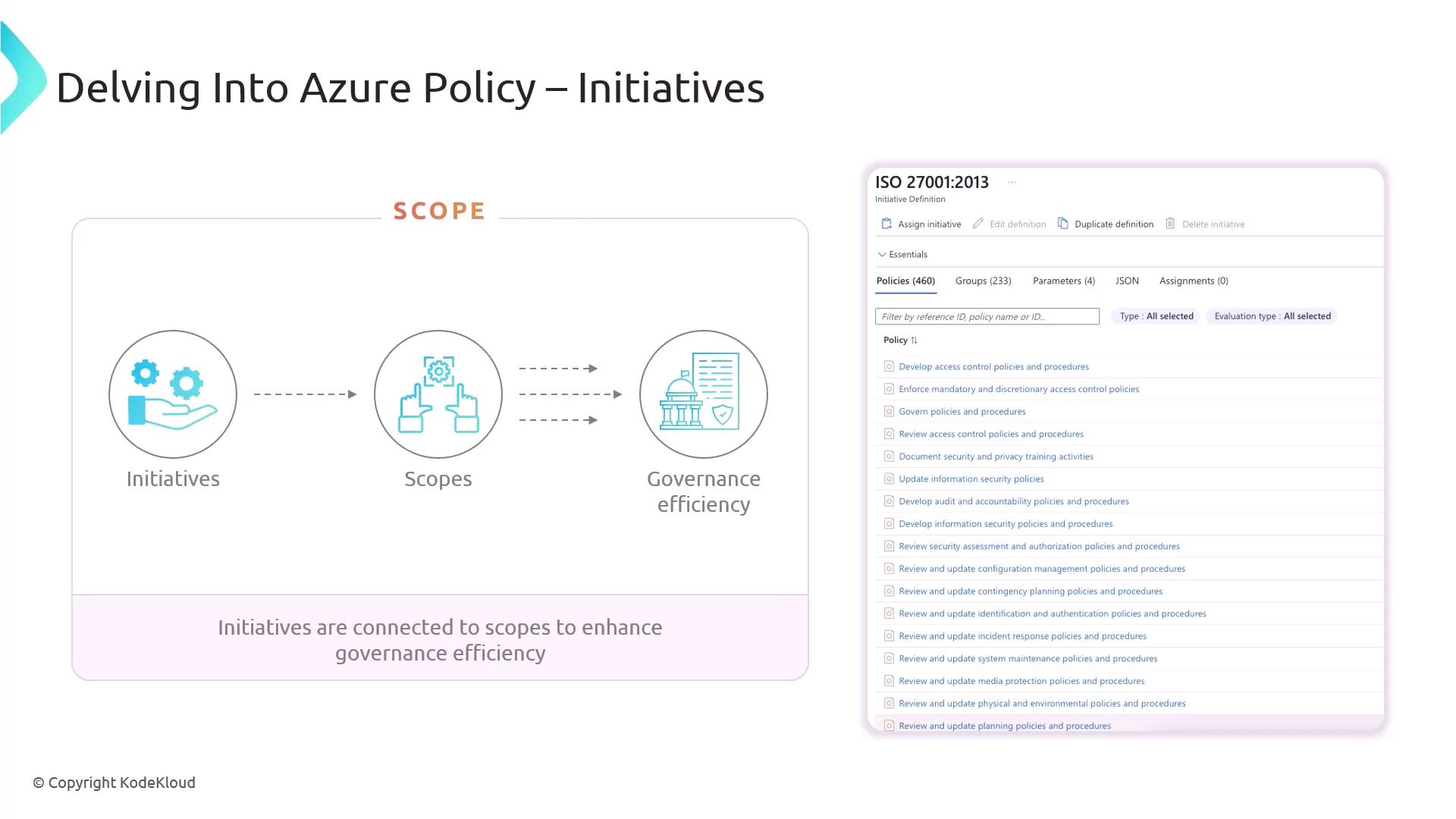
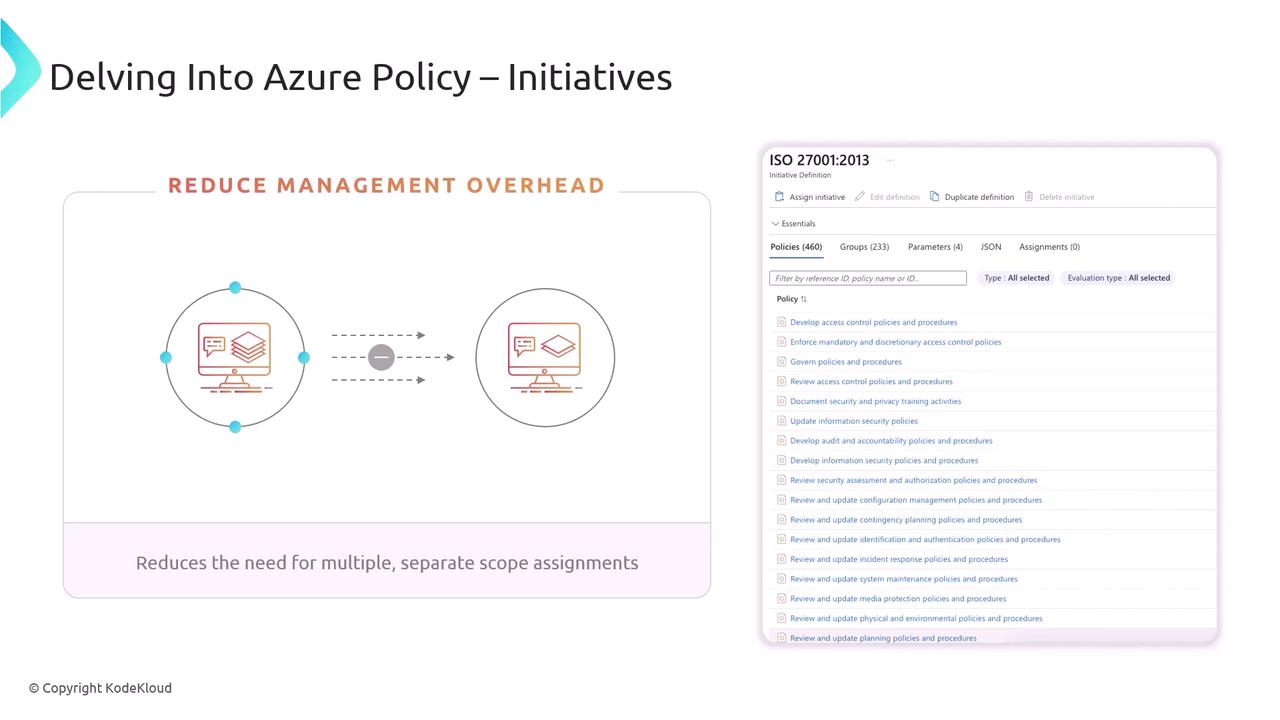
An **initiative** (also called a policy set) bundles multiple policy definitions to achieve a broader compliance objective—such as ISO 27001:2013 or PCI DSS. Initiatives simplify management by grouping related policies and tracking their combined compliance status.
***
## Next Steps and References
Mastering Azure Policy definitions, assignments, remediation, and initiatives is key to enforcing governance at scale and maintaining compliance. Dive deeper with these resources:
* [Azure Policy Documentation](https://learn.microsoft.com/azure/governance/policy/)
* [Azure Governance Overview](https://learn.microsoft.com/azure/governance/)
* [AZ-400 Exam Details](https://learn.microsoft.com/en-us/certifications/exams/az-400/)
By embedding Azure Policy into your DevOps pipelines and resource lifecycles, you’ll ensure a secure, compliant, and well-managed Azure environment.