> ## Documentation Index
> Fetch the complete documentation index at: https://notes.kodekloud.com/llms.txt
> Use this file to discover all available pages before exploring further.
# Introduction
> Guide to Azure NAT Gateway explaining outbound-only internet access, when to use it versus public IPs or load balancers, and how to configure and associate it with subnets.
Welcome to the module on configuring internet access with Azure Virtual NAT Gateway.
This lesson explains how Azure NAT Gateway provides secure, scalable outbound-only internet access for resources in your Azure Virtual Network (VNet). By centralizing egress through a NAT Gateway, you avoid assigning public IPs to individual virtual machines, reduce management overhead, and achieve predictable outbound (egress) behavior that improves your security posture and simplifies auditing.
By the end of this module you will be able to:
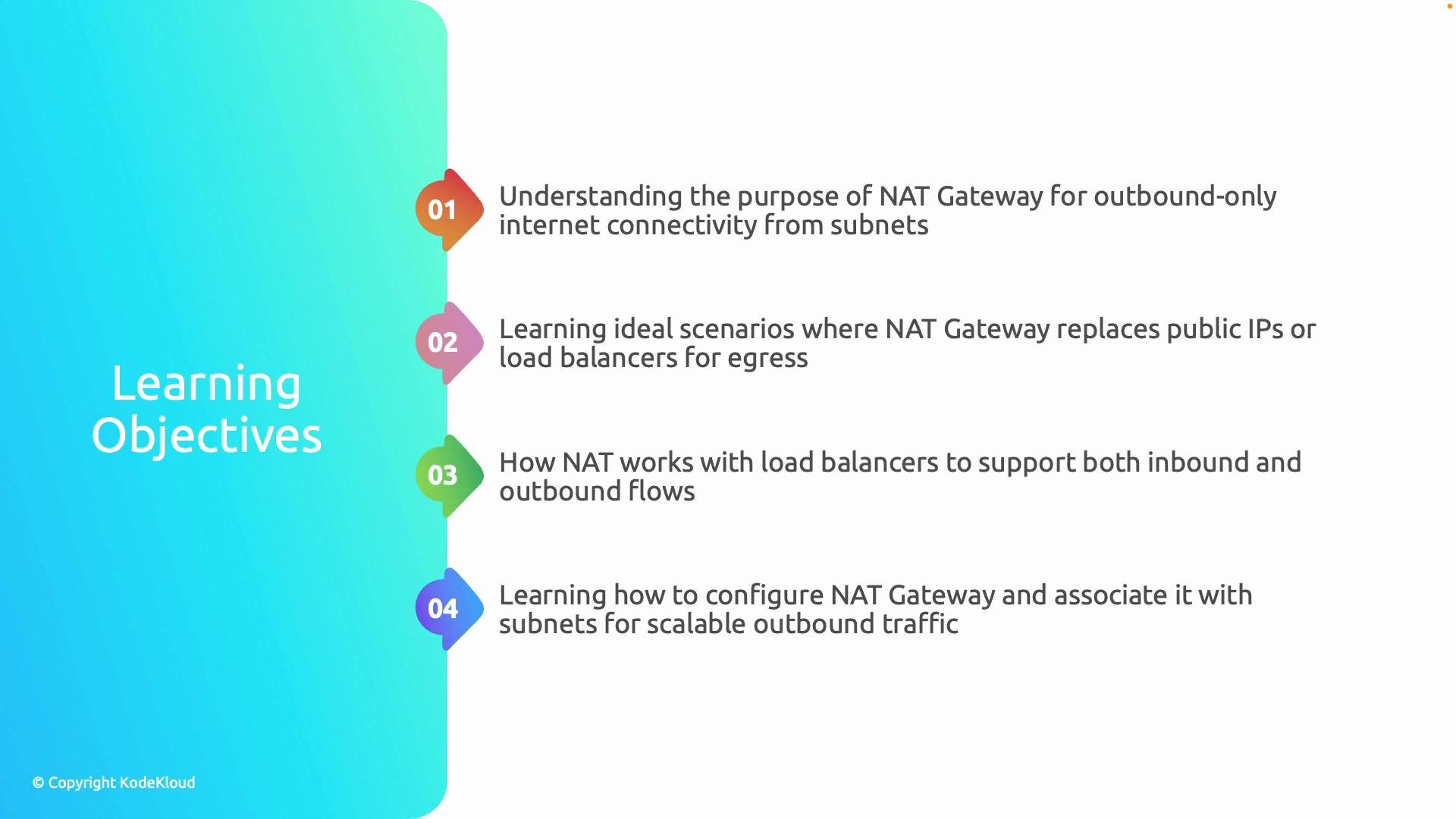
* Describe the purpose of Azure NAT Gateway and how it enables outbound-only internet connectivity for selected subnets.
* Explain when to prefer NAT Gateway over assigning public IP addresses directly to VMs or using load balancers for egress.
* Understand how NAT Gateway and Azure Load Balancer can work together to support both inbound and outbound connectivity for applications.
* Configure and associate a NAT Gateway with one or more subnets to provide scalable, efficient outbound traffic for your workloads.
 Before you proceed, ensure you have a basic understanding of Azure Virtual Networks, subnets, Network Security Groups (NSGs), and public IP addressing. For a quick primer, see the [Azure networking fundamentals](https://learn.microsoft.com/azure/virtual-network/virtual-networks-overview) documentation.
Learning objectives (mapped to outcomes and why they matter):
| Learning objective | What you'll be able to do | Why it matters |
| ------------------------------------- | --------------------------------------------------------------------------------------: | -------------------------------------------------------------------------------------------------------------------- |
| Describe NAT Gateway purpose | Explain how NAT Gateway provides outbound-only internet access for specified subnets | Centralizes egress, removes need for per-VM public IPs, and supports predictable source IPs for outbound connections |
| Choose the right egress pattern | Decide when to use NAT Gateway vs. VM public IPs or Load Balancer for outbound traffic | Helps meet security, cost, and scalability requirements for different application architectures |
| Combine NAT Gateway and Load Balancer | Architect solutions that handle both inbound (load-balanced) and outbound (NAT) traffic | Enables hybrid traffic patterns—public entry points plus secure, controlled egress |
| Configure and associate NAT Gateway | Create and attach a NAT Gateway to subnets to enable scalable outbound connectivity | Provides a repeatable, supported deployment pattern for production workloads |
References and further reading:
* [Azure NAT Gateway documentation](https://learn.microsoft.com/azure/virtual-network/nat-gateway)
* [Azure Load Balancer overview](https://learn.microsoft.com/azure/load-balancer/load-balancer-overview)
* [Azure Virtual Network overview](https://learn.microsoft.com/azure/virtual-network/virtual-networks-overview)
Before you proceed, ensure you have a basic understanding of Azure Virtual Networks, subnets, Network Security Groups (NSGs), and public IP addressing. For a quick primer, see the [Azure networking fundamentals](https://learn.microsoft.com/azure/virtual-network/virtual-networks-overview) documentation.
Learning objectives (mapped to outcomes and why they matter):
| Learning objective | What you'll be able to do | Why it matters |
| ------------------------------------- | --------------------------------------------------------------------------------------: | -------------------------------------------------------------------------------------------------------------------- |
| Describe NAT Gateway purpose | Explain how NAT Gateway provides outbound-only internet access for specified subnets | Centralizes egress, removes need for per-VM public IPs, and supports predictable source IPs for outbound connections |
| Choose the right egress pattern | Decide when to use NAT Gateway vs. VM public IPs or Load Balancer for outbound traffic | Helps meet security, cost, and scalability requirements for different application architectures |
| Combine NAT Gateway and Load Balancer | Architect solutions that handle both inbound (load-balanced) and outbound (NAT) traffic | Enables hybrid traffic patterns—public entry points plus secure, controlled egress |
| Configure and associate NAT Gateway | Create and attach a NAT Gateway to subnets to enable scalable outbound connectivity | Provides a repeatable, supported deployment pattern for production workloads |
References and further reading:
* [Azure NAT Gateway documentation](https://learn.microsoft.com/azure/virtual-network/nat-gateway)
* [Azure Load Balancer overview](https://learn.microsoft.com/azure/load-balancer/load-balancer-overview)
* [Azure Virtual Network overview](https://learn.microsoft.com/azure/virtual-network/virtual-networks-overview)