> ## Documentation Index
> Fetch the complete documentation index at: https://notes.kodekloud.com/llms.txt
> Use this file to discover all available pages before exploring further.
# Choose a Peering Location
> Guidance for selecting Azure ExpressRoute peering locations by evaluating latency, redundancy, SKU support, carrier presence, and data egress costs with a practical checklist for deployment
When designing an Azure ExpressRoute deployment, choosing the correct peering location is a pivotal decision. A peering location is the physical point where your network connects to Microsoft's global backbone. These locations are typically hosted in major colocation facilities where carriers, service providers, and enterprise networks interconnect.
You can see from the map that Microsoft provides a wide range of edge locations, especially across North America, Europe, and Asia Pacific, giving
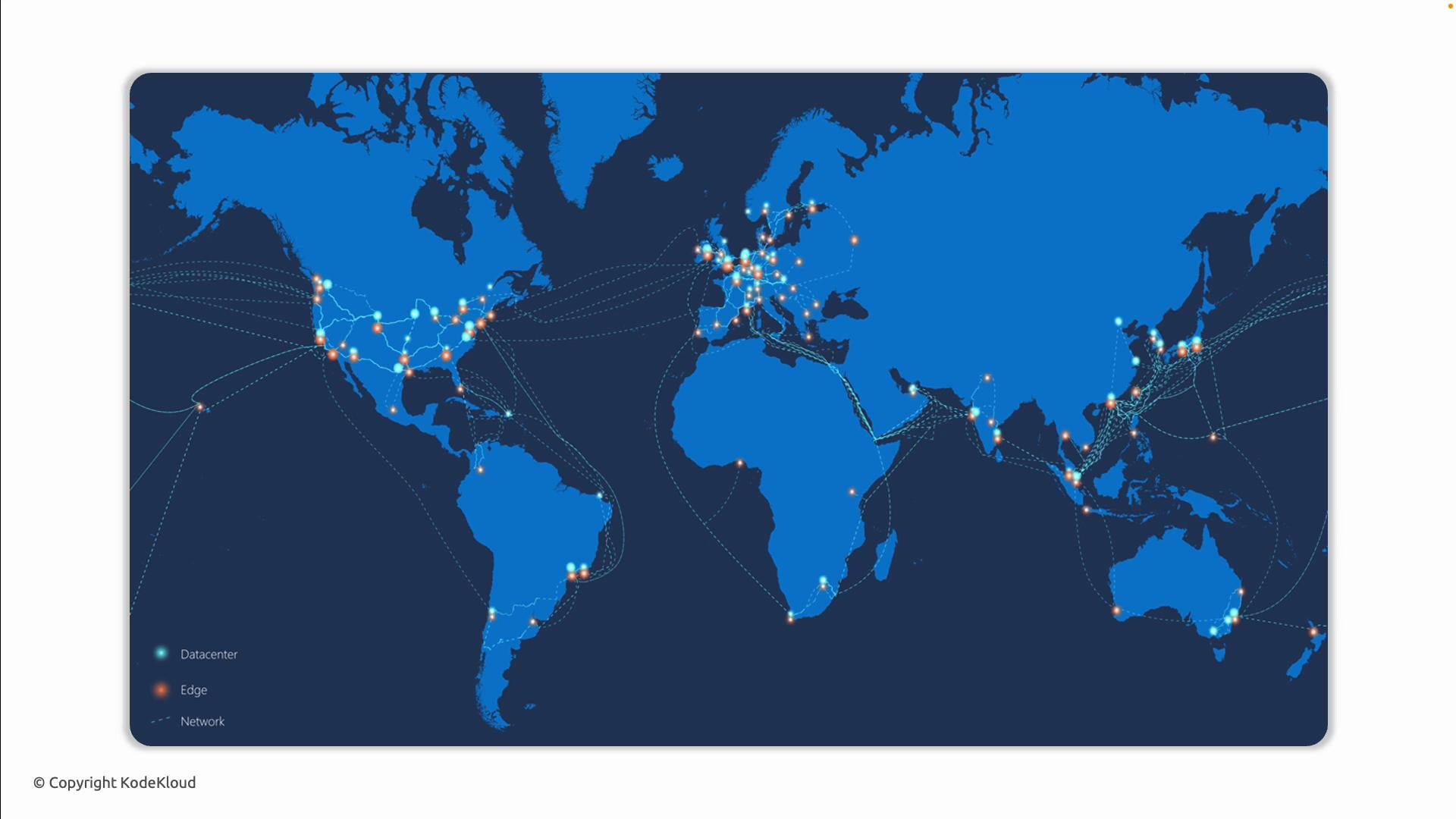 you the flexibility to choose the location that best balances latency, redundancy, and cost for your needs.
Key factors to evaluate when selecting a peering location:
| Factor | Why it matters | Action / Questions to ask |
| ------------------------------------ | --------------------------------------------------------------------------- | --------------------------------------------------------------------------------------------------------- |
| Proximity to on-premises | Reduces latency and improves performance for latency-sensitive applications | Is the peering location geographically close to your datacenter or branch offices? |
| Redundancy and availability | Avoids single points of failure and supports higher SLAs | Can you deploy across multiple peering locations or metros for failover? |
| Service and SKU support | Not all locations support every ExpressRoute SKU or feature | Does this location support the ExpressRoute SKU/features (e.g., FastPath, Microsoft peering) you require? |
| Connectivity provider presence | Determines partner options, SLAs, and operational support | Do your preferred carriers or partners have presence at this location? What SLAs do they offer? |
| Data egress, billing, and compliance | Affects data transfer costs and regulatory boundaries | Which egress region will be used for billable data and does that meet compliance requirements? |
Practical checklist to guide selection:
* Map application dependencies and latency sensitivity to candidate peering locations.
* Confirm the supported ExpressRoute SKUs and features at each candidate location.
* Verify carrier and partner presence, pricing, and SLAs for each site.
* Consider a multi-location deployment for resilience and geographic diversity.
* Account for data egress charges and compliance (data residency, cross-border rules).
Before finalizing a peering location, review the [Azure ExpressRoute documentation](https://learn.microsoft.com/en-us/azure/expressroute/) and confirm partner/peering provider coverage and SLAs to ensure the location supports the required SKUs and features.
By evaluating these factors—performance, redundancy, service support, carrier presence, and compliance—you can pick a peering location that optimizes connectivity, cost, and operational resilience for your ExpressRoute deployment.
Links and references:
* [Azure ExpressRoute documentation](https://learn.microsoft.com/en-us/azure/expressroute/)
* [ExpressRoute locations and partners](https://learn.microsoft.com/en-us/azure/expressroute/expressroute-locations)
you the flexibility to choose the location that best balances latency, redundancy, and cost for your needs.
Key factors to evaluate when selecting a peering location:
| Factor | Why it matters | Action / Questions to ask |
| ------------------------------------ | --------------------------------------------------------------------------- | --------------------------------------------------------------------------------------------------------- |
| Proximity to on-premises | Reduces latency and improves performance for latency-sensitive applications | Is the peering location geographically close to your datacenter or branch offices? |
| Redundancy and availability | Avoids single points of failure and supports higher SLAs | Can you deploy across multiple peering locations or metros for failover? |
| Service and SKU support | Not all locations support every ExpressRoute SKU or feature | Does this location support the ExpressRoute SKU/features (e.g., FastPath, Microsoft peering) you require? |
| Connectivity provider presence | Determines partner options, SLAs, and operational support | Do your preferred carriers or partners have presence at this location? What SLAs do they offer? |
| Data egress, billing, and compliance | Affects data transfer costs and regulatory boundaries | Which egress region will be used for billable data and does that meet compliance requirements? |
Practical checklist to guide selection:
* Map application dependencies and latency sensitivity to candidate peering locations.
* Confirm the supported ExpressRoute SKUs and features at each candidate location.
* Verify carrier and partner presence, pricing, and SLAs for each site.
* Consider a multi-location deployment for resilience and geographic diversity.
* Account for data egress charges and compliance (data residency, cross-border rules).
Before finalizing a peering location, review the [Azure ExpressRoute documentation](https://learn.microsoft.com/en-us/azure/expressroute/) and confirm partner/peering provider coverage and SLAs to ensure the location supports the required SKUs and features.
By evaluating these factors—performance, redundancy, service support, carrier presence, and compliance—you can pick a peering location that optimizes connectivity, cost, and operational resilience for your ExpressRoute deployment.
Links and references:
* [Azure ExpressRoute documentation](https://learn.microsoft.com/en-us/azure/expressroute/)
* [ExpressRoute locations and partners](https://learn.microsoft.com/en-us/azure/expressroute/expressroute-locations)