> ## Documentation Index
> Fetch the complete documentation index at: https://notes.kodekloud.com/llms.txt
> Use this file to discover all available pages before exploring further.
# Naming packages
> This article explores best practices for naming Go packages to enhance code readability and maintainability.
In this lesson, we will explore best practices for naming your Go packages. Choosing descriptive package names is crucial because the package name becomes part of the code you reference throughout your application. Clear and meaningful package names improve code readability and maintainability.
## Why Descriptive Package Names Matter
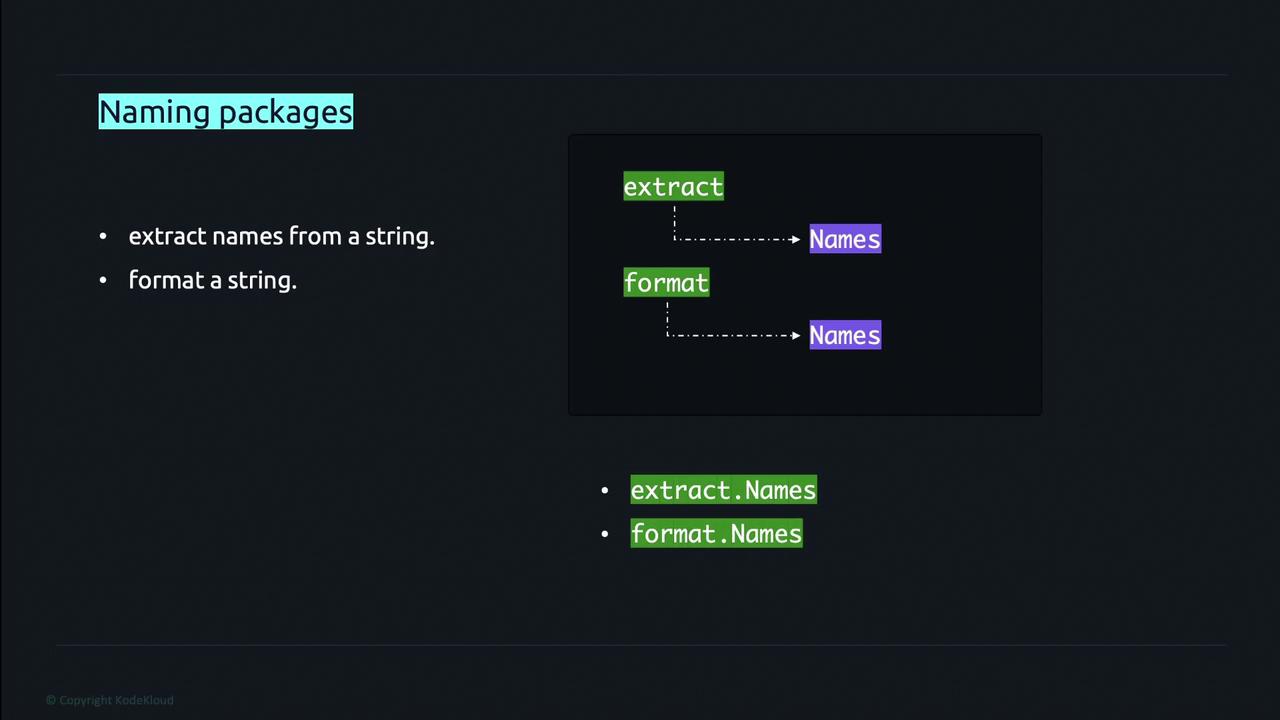
Consider a scenario where you have two helper functions: one for extracting names from a string and another for formatting names. Instead of grouping both functions in a generic "util" package (e.g., util.ExtractNames and util.FormatNames), it's more informative to organize them into distinct packages that convey their purpose. This approach leads to cleaner and more intuitive code.
For example, you can create:
* An **extract** package that includes a function named `names`.
* A **format** package that also includes a function named `names`.
Even though both functions share the same name, their package prefixes disambiguate them. When imported, you would reference them as:
```text theme={null}
extract.names
format.names
```
This naming convention makes it clear which functionality is being used and helps avoid ambiguity in your code.
Avoid reusing the package name in the function names. For example, if your package is named `extract`, do not name your function `extractNames` since the package context already implies the functionality.
## Organizing Files and Directories
Every Go file within a directory must begin with the same package clause. As a best practice, the package name should match the directory name containing the files. This convention ensures that the package's purpose and origin are instantly recognizable.
In some cases, this guideline is relaxed. A common exception is the use of the special package name `main`. The `main` package serves as the entry point for a Go application and cannot be imported. Therefore, it is acceptable for the directory name to differ from the package name without causing confusion in import statements.
Be cautious not to overcomplicate your package structure. While organizing by functionality is beneficial, ensure that each package remains focused and doesn't become a catch-all for unrelated functions.
That concludes this lesson on naming packages in Go. We look forward to exploring more topics with you in the next lesson.
## Quick Reference
| Aspect | Best Practice | Example |
| --------------------------- | ------------------------------------------------------------------------------ | ----------------------------------------------- |
| Package Naming | Use descriptive names that reflect functionality | `extract`, `format` |
| Function Naming | Avoid redundancy; do not include the package name in the function name | `names` in both `extract` and `format` packages |
| File Organization | Ensure all files in a directory start with the same package clause | Package name = directory name |
| Special Case - Main Package | Use the `main` package as the entry point and understand its unique properties | `package main` |
Happy coding and continue building robust and maintainable Go applications!