> ## Documentation Index
> Fetch the complete documentation index at: https://notes.kodekloud.com/llms.txt
> Use this file to discover all available pages before exploring further.
# Introduction
> This article compares imperative and declarative deployment methods in Kubernetes, highlighting their pros, cons, and use cases for effective resource management.
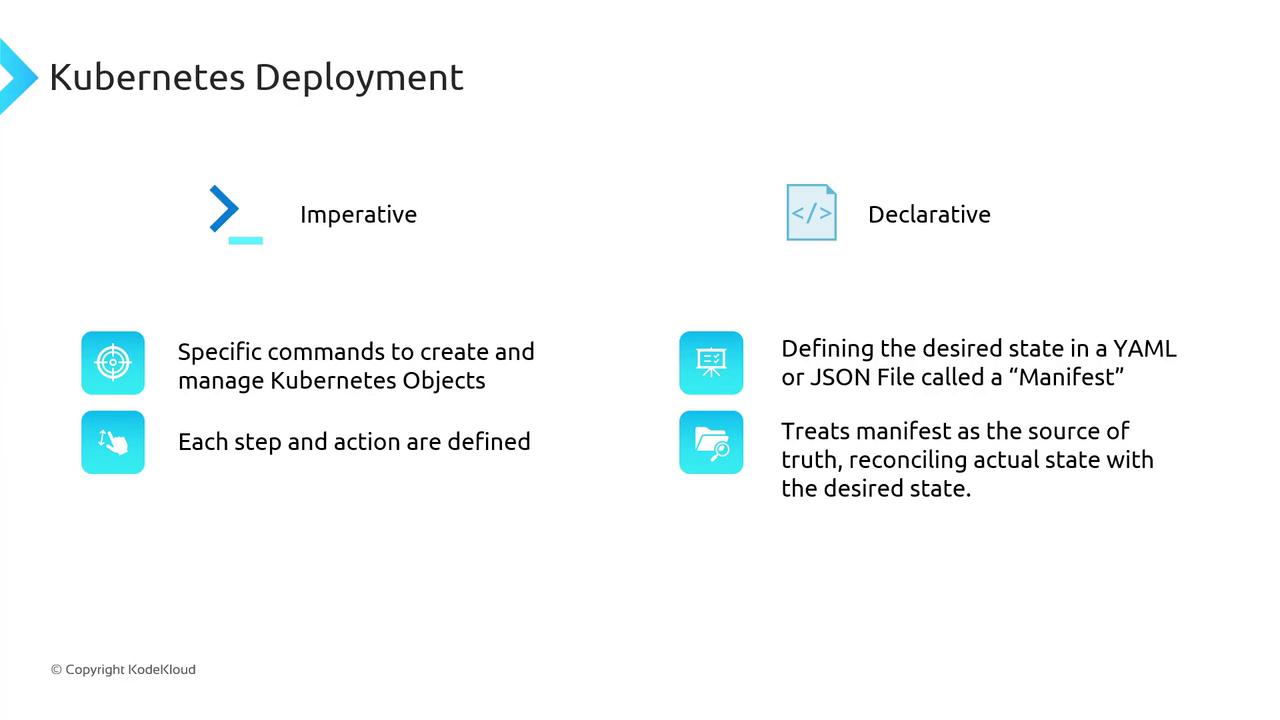
Kubernetes supports two primary deployment methods: Imperative and Declarative. The Imperative approach relies on explicit `kubectl` commands to create and manage resources step by step. The Declarative approach uses YAML or JSON manifests to define the desired state of your cluster, which Kubernetes continuously reconciles. Choosing the right method helps teams optimize for speed, reproducibility, and maintainability in environments like [Azure Kubernetes Service (AKS)](https://azure.microsoft.com/en-us/services/kubernetes-service/).
## Imperative vs Declarative at a Glance
| Aspect | Imperative Deployment | Declarative Deployment |
| ---------------- | ----------------------------------- | ------------------------------------------ |
| Definition | Step-by-step `kubectl` commands | Desired-state manifests (YAML/JSON) |
| Execution | Immediate and manual | Automated reconciliation via control plane |
| Idempotency | Not guaranteed on reruns | Always converges to desired state |
| Common Use Cases | Prototyping, troubleshooting, demos | Production, CI/CD pipelines, GitOps |
## Imperative Deployment
Imperative deployment gives you direct control through explicit commands. Here’s a typical workflow:
```bash theme={null}
kubectl create deployment nginx --image=nginx
kubectl expose deployment nginx --port=80
kubectl scale deployment nginx --replicas=3
kubectl delete service nginx
```
### Pros
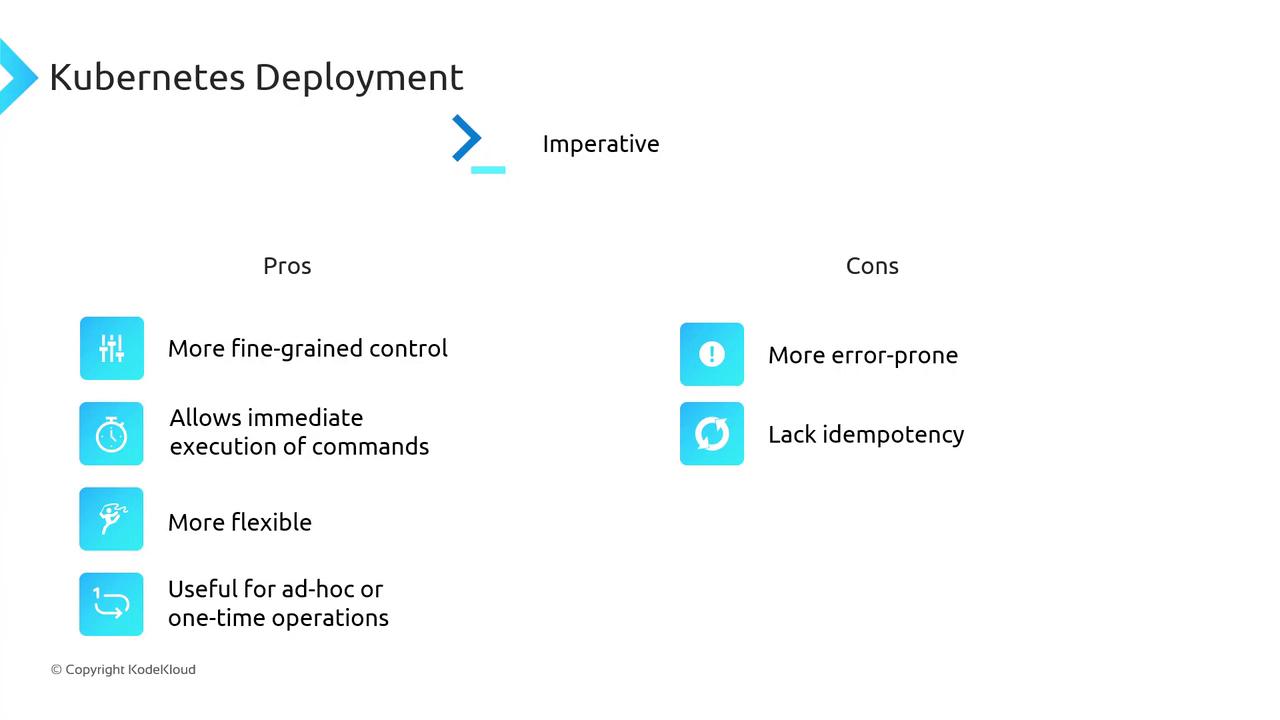
* Granular, step-by-step control
* Instant feedback after each command
* Perfect for ad hoc tasks: debugging, prototyping, one-off operations
### Cons
* Difficult to reproduce complex setups consistently
* Lacks idempotency—rerunning commands can yield different results
* Hard to track changes in version control
Imperative commands can introduce configuration drift if reused without validation. Always verify resource status with `kubectl get` or integrate into CI pipelines.
## Declarative Deployment
In the declarative model, you define the desired state in a manifest file, and Kubernetes ensures the live cluster matches it. For example:
```yaml theme={null}
# nginx-deployment.yaml
apiVersion: apps/v1
kind: Deployment
metadata:
name: nginx-deployment
spec:
replicas: 3
selector:
matchLabels:
app: nginx
template:
metadata:
labels:
app: nginx
spec:
containers:
- name: nginx
image: nginx:latest
ports:
- containerPort: 80
```
Apply this manifest with:
```bash theme={null}
kubectl apply -f nginx-deployment.yaml
```
### Pros
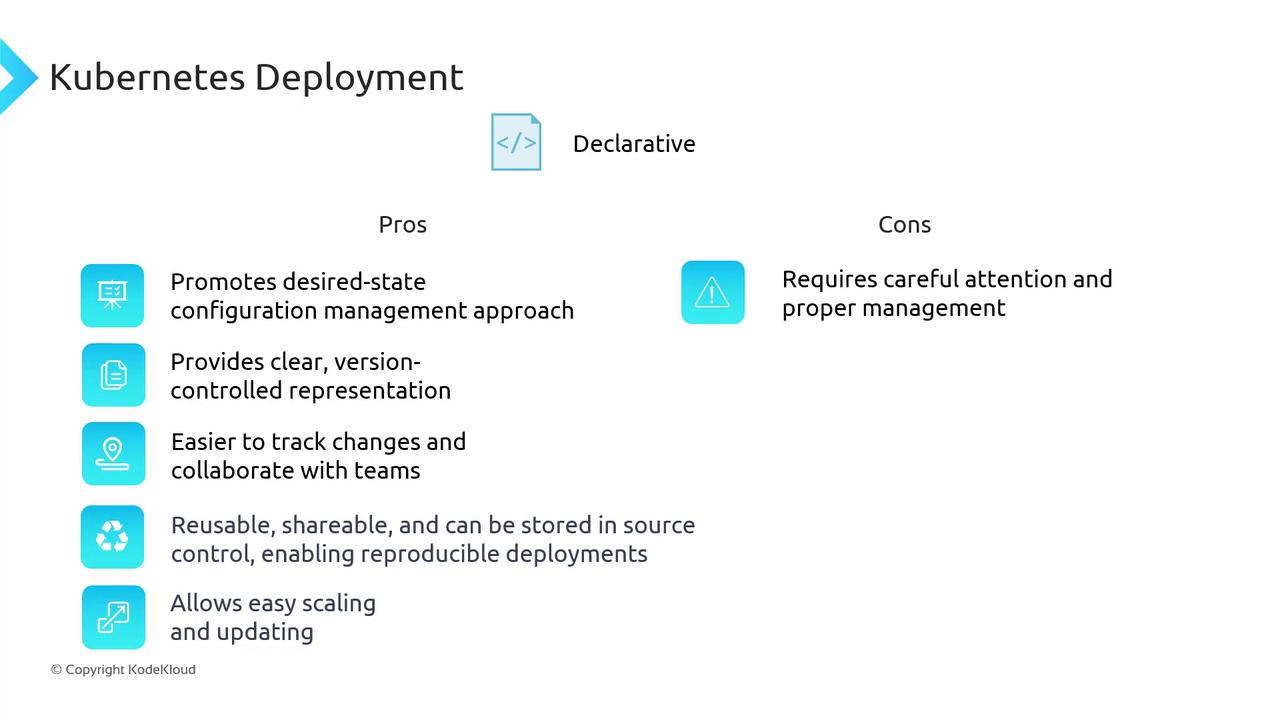
* Desired-state management ensures consistency
* Easy change tracking via Git and pull requests
* Reusable manifests support automation and GitOps workflows
* Simplifies scaling, rolling updates, and rollbacks
### Cons
* Requires governance on manifest changes to avoid unintended effects
* Misconfigurations can lead to unexpected resource updates
Store all YAML/JSON manifests in a Git repository and enforce reviews to prevent accidental outages.
## Summary
* Imperative deployment offers fast, hands-on commands ideal for quick experiments and troubleshooting.
* Declarative deployment provides consistency, versioning, and automation by treating manifests as the single source of truth.
In practice, combine both approaches: use imperative commands for on-the-fly tasks and declarative manifests for robust, production-grade workflows.
## Links and References
* [Kubernetes Basics](https://kubernetes.io/docs/concepts/overview/what-is-kubernetes/)
* [Azure Kubernetes Service (AKS)](https://azure.microsoft.com/en-us/services/kubernetes-service/)
* [kubectl CLI Reference](https://kubernetes.io/docs/reference/kubectl/)