> ## Documentation Index
> Fetch the complete documentation index at: https://notes.kodekloud.com/llms.txt
> Use this file to discover all available pages before exploring further.
# Azure Landing Zone
> Azure Landing Zone provides a scalable framework for building compliant cloud infrastructure tailored to organizational standards before deploying workloads.
Azure Scaffolding—formally known as the Azure Landing Zone—delivers a repeatable, compliant, and scalable framework for building your cloud infrastructure to meet organizational standards. While each enterprise customizes its landing zone, the core goal remains the same: establish foundational services before deploying workloads.
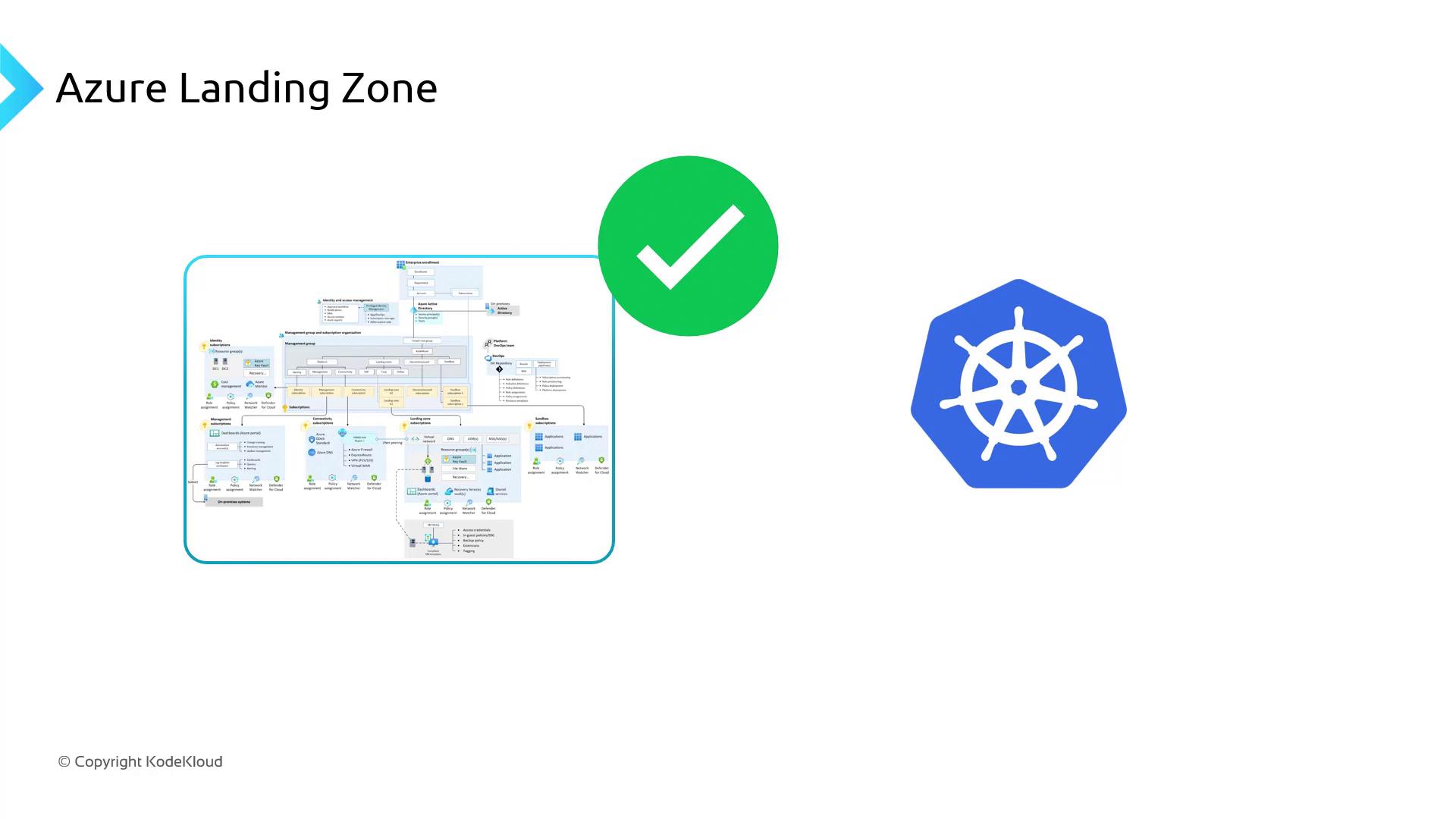
An Azure Landing Zone isn’t one-size-fits-all. Tailor networking, identity, and security controls to align with your company’s policies and compliance requirements.
## Key Infrastructure Domains
Think of a landing zone as the infrastructure “blueprint” for your cloud environment—much like a city plan that must exist before any buildings go up. Core areas include:
* **Networking**: Virtual networks and subnets create the “roads” that connect your resources.
* **Identity & Access**: Azure Active Directory, role-based access controls, and managed identities provision secure access.
* **Security & Governance**: Azure Policy, Blueprints, and resource locks enforce organizational standards, similar to building codes.
* **Monitoring & Operations**: Azure Monitor, Log Analytics, and automation scripts collect telemetry and handle incident response.
* **Cost Management**: Budgets, chargeback rules, and tagging strategies help track and optimize spend.
### Landing Zone Domains at a Glance
| Domain | Purpose | Azure Service Examples |
| -------------------------------------- | -------------------------------------------- | ------------------------------------------------------ |
| Identity & Access Management | Secure authentication and authorization | Azure AD, Privileged Identity Management (PIM) |
| Network Topology & Connectivity | Private and hybrid connectivity | Azure Virtual Network, VPN Gateway, ExpressRoute |
| Resource Organization & Tagging | Logical grouping and billing | Resource Groups, Management Groups, Tag Policies |
| Security Controls & Policy Enforcement | Compliance enforcement and threat protection | Azure Policy, Azure Security Center |
| Governance & Compliance Auditing | Continuous compliance monitoring | Azure Blueprints, Compliance Manager |
| Monitoring, Logging & Diagnostics | Health checks, alerts, and telemetry | Azure Monitor, Log Analytics, Application Insights |
| Cost Management & Chargeback | Budgeting and cost allocation | Azure Cost Management, Budgets, Tags |
| Automation & DevOps Integration | CI/CD pipelines and infrastructure as code | Azure DevOps, GitHub Actions, ARM Templates, Terraform |
Skipping proper scaffolding can lead to inconsistent deployments and security gaps. Always validate your landing zone against Azure’s Well-Architected Framework.
## AKS-Specific Landing Zone
When deploying Azure Kubernetes Service (AKS), you’ll extend the general landing zone with AKS-specific scaffolding. This ensures that:
* Virtual networks and subnets are preconfigured for pod-to-pod and pod-to-service traffic.
* Route tables, network security groups (NSGs), and Azure Firewall rules enforce network segmentation.
* Managed identities and Azure Key Vault integrate for secure secret management.
* Log and metric pipelines feed into Azure Monitor and a centralized SIEM for observability.
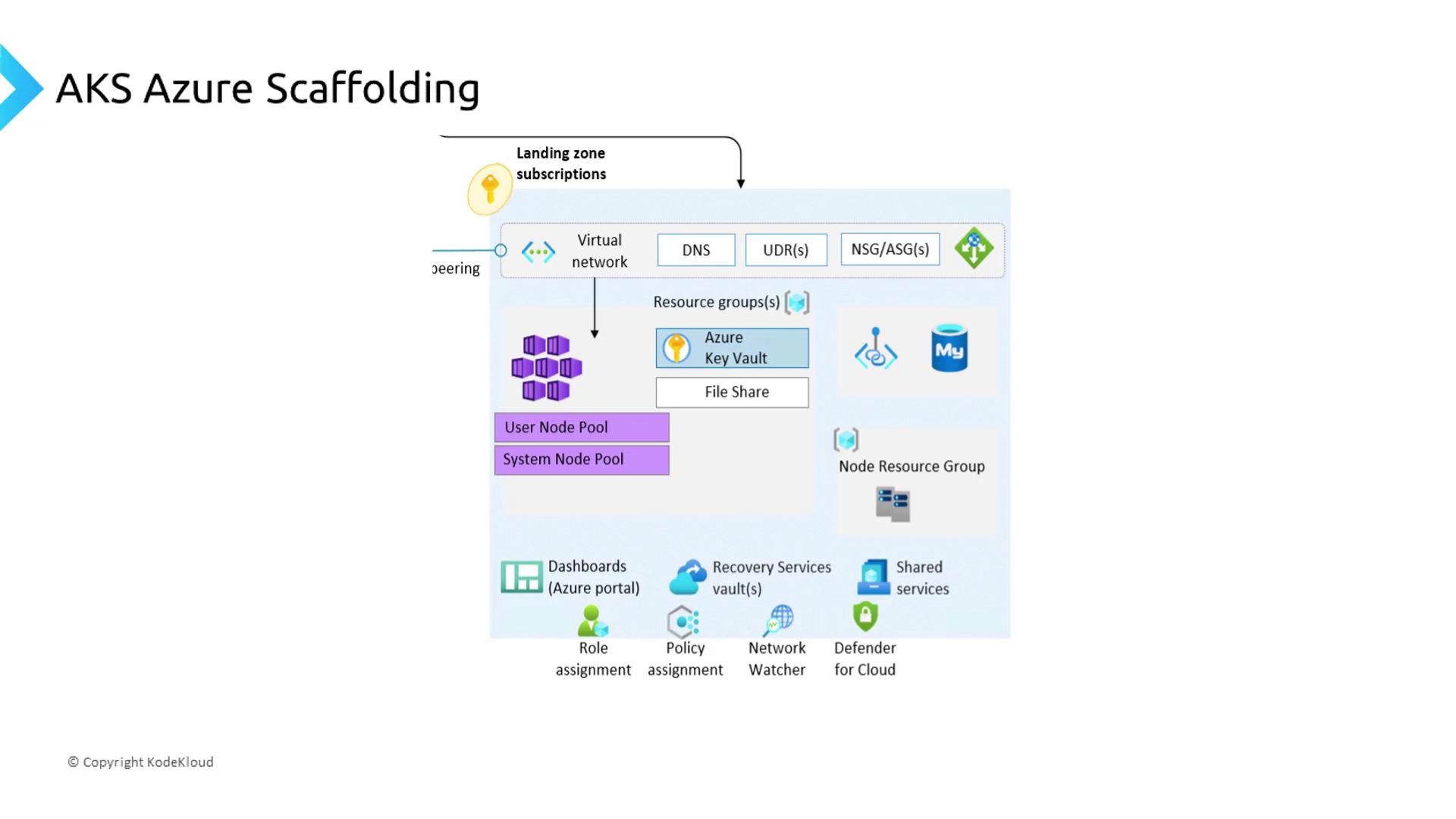
By leveraging an AKS landing zone, your clusters gain predictable connectivity, robust security controls, and seamless integration with other Azure services—accelerating your path to production.
***
## Links and References
* [Azure Landing Zones Overview](https://learn.microsoft.com/azure/cloud-adoption-framework/landing-zones/overview)
* [Azure Kubernetes Service (AKS) Documentation](https://learn.microsoft.com/azure/aks/)
* [Azure Well-Architected Framework](https://learn.microsoft.com/azure/architecture/framework/)