> ## Documentation Index
> Fetch the complete documentation index at: https://notes.kodekloud.com/llms.txt
> Use this file to discover all available pages before exploring further.
# Azure Kubernetes Fleet
> This guide explores multicluster management for Azure Kubernetes Service, detailing implementation strategies and solutions for scalability and compliance.
Managing hundreds or thousands of Azure Kubernetes Service (AKS) clusters can quickly become complex. This guide explores why you should adopt a multicluster pattern—and how to implement it on Azure using both community and enterprise solutions.
## Why Use a Multicluster Architecture?
Single Kubernetes clusters can handle multiple workloads via namespaces and pods. However, large-scale or regulated deployments often require more:
| Requirement | Description |
| --------------------- | ----------------------------------------------------------- |
| Multi-tenancy | Isolate resources across teams or customers |
| High availability | Distribute workloads for regional failover and resilience |
| Regulatory compliance | Ensure data sovereignty and meet industry-specific rules |
| Scalability limits | Scale beyond single-cluster node and pod count restrictions |
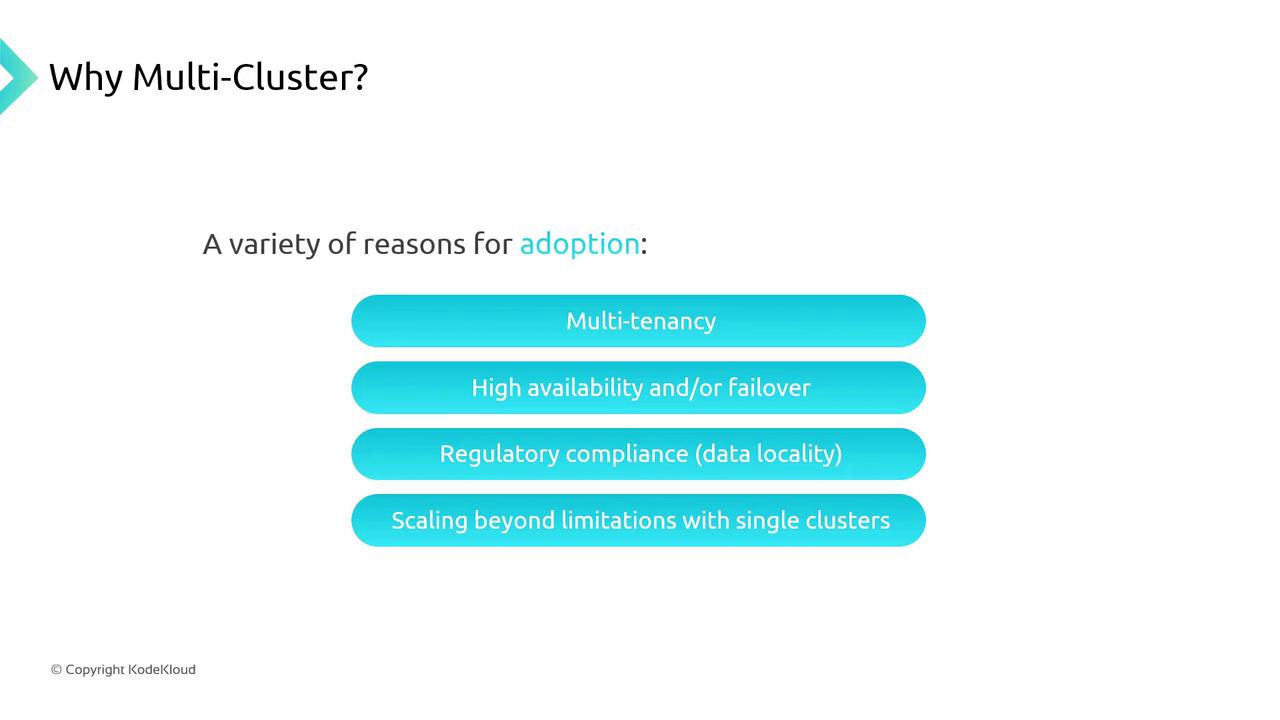
Multicluster setups introduce operational overhead. Evaluate your tenancy, compliance, and scale requirements before proceeding.
Compliance alone can justify the additional complexity—for example, U.S. state-level regulations might require separate AKS clusters per jurisdiction. When application demands exceed single-cluster limits, a fleet of clusters becomes essential.
***
## Open-Source Multicluster Solutions
Several community-driven projects enable cross-cluster orchestration:
### Kubernetes Cluster Federation (KubeFed)
KubeFed provides federated APIs to coordinate resources across multiple Kubernetes clusters.
```bash theme={null}
kubectl apply -f federated_resource.yml
```
Version history:
* v1: Deprecated
* v2: Archived
KubeFed v2 is no longer actively developed. Consider alternative projects for production use.
### Open Cluster Management (OCM)
OCM by Red Hat implements a hub-and-spoke control plane:
* **Hub cluster**: Central management plane
* **Spoke clusters**: Agents (`clusterlet`) register and enforce policies

Key OCM features:
* Cluster registration and discovery
* Placement, scheduling, and policy enforcement
### Karmada
Karmada introduces a separate control plane with its own API server and scheduler.
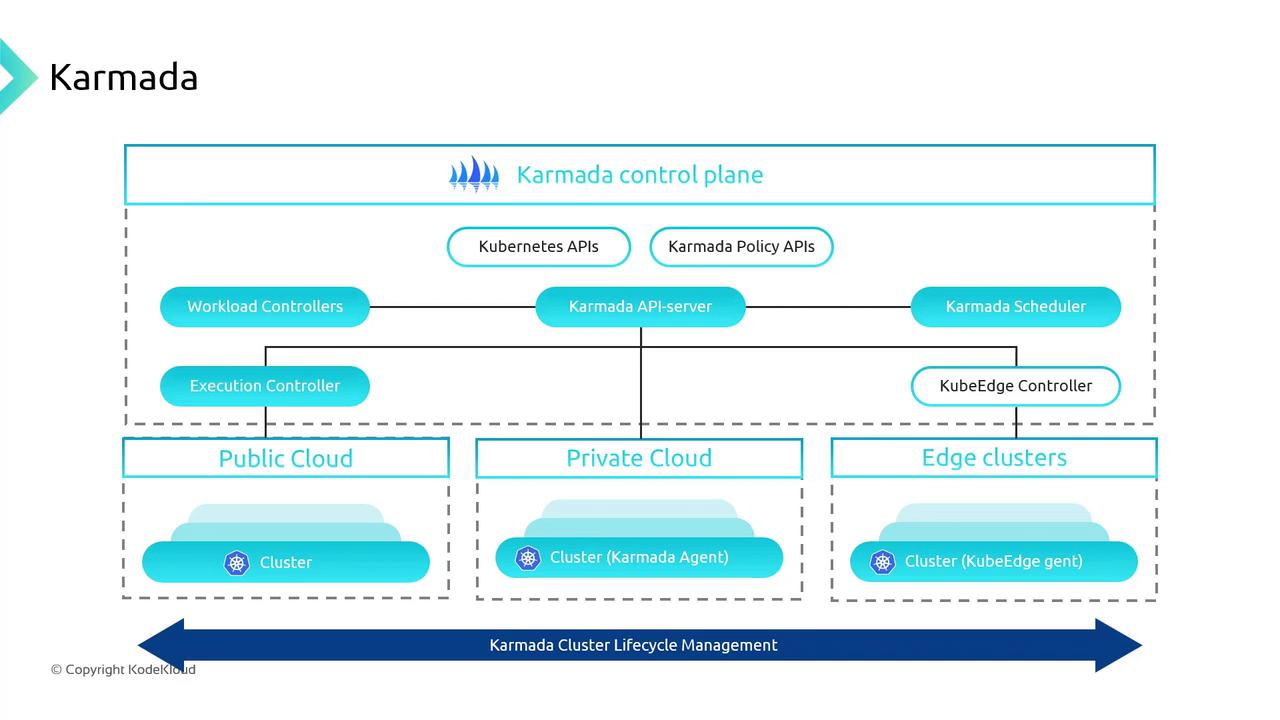
Highlights:
* Dedicated Karmada API server
* Workload controllers sync across clusters
* Requires agent deployment in each member cluster
***
## Enterprise Multicluster Management with Azure Kubernetes Fleet Manager
Azure Kubernetes Fleet Manager offers a managed service for AKS fleet operations at scale:
* Centralized cluster inventory and bulk operations
* Automated provisioning, upgrades, and configuration
* Policy-driven workload placement and governance
* Integrated north-south load balancing across regions
You need an Azure subscription with required permissions to create and manage fleet resources.
### Example: Placing a Namespace Across Clusters
Define a `ClusterResourcePlacement` CRD to deploy a namespace to clusters in `eastus`:
```yaml theme={null}
apiVersion: fleet.azure.com/v1alpha1
kind: ClusterResourcePlacement
metadata:
name: demo
spec:
resourceSelectors:
- group:
version: v1
kind: Namespace
name: demo
policy:
affinity:
clusterAffinity:
clusterSelectorTerms:
- labelSelector:
matchLabels:
fleet.azure.com/location: eastus
```
### Example: Creating a MultiClusterService
Import a service across your fleet using the `MultiClusterService` CRD:
```yaml theme={null}
apiVersion: networking.fleet.azure.com/v1alpha1
kind: MultiClusterService
metadata:
name: demo
namespace: demo
spec:
serviceImport:
name: demo
```
### Fleet Manager Features
| Feature | Description |
| -------------------- | ------------------------------------------------------------------ |
| Bulk operations | Apply changes across dozens or hundreds of clusters simultaneously |
| Automated lifecycle | Self-service cluster provisioning and version upgrades |
| Policy enforcement | Define and enforce policies (e.g., Kubernetes version, pod limits) |
| Update orchestration | Stage rollouts (test → prod) with update waves |
You can orchestrate rollouts in phases (e.g., test, staging, prod) by grouping clusters into waves:
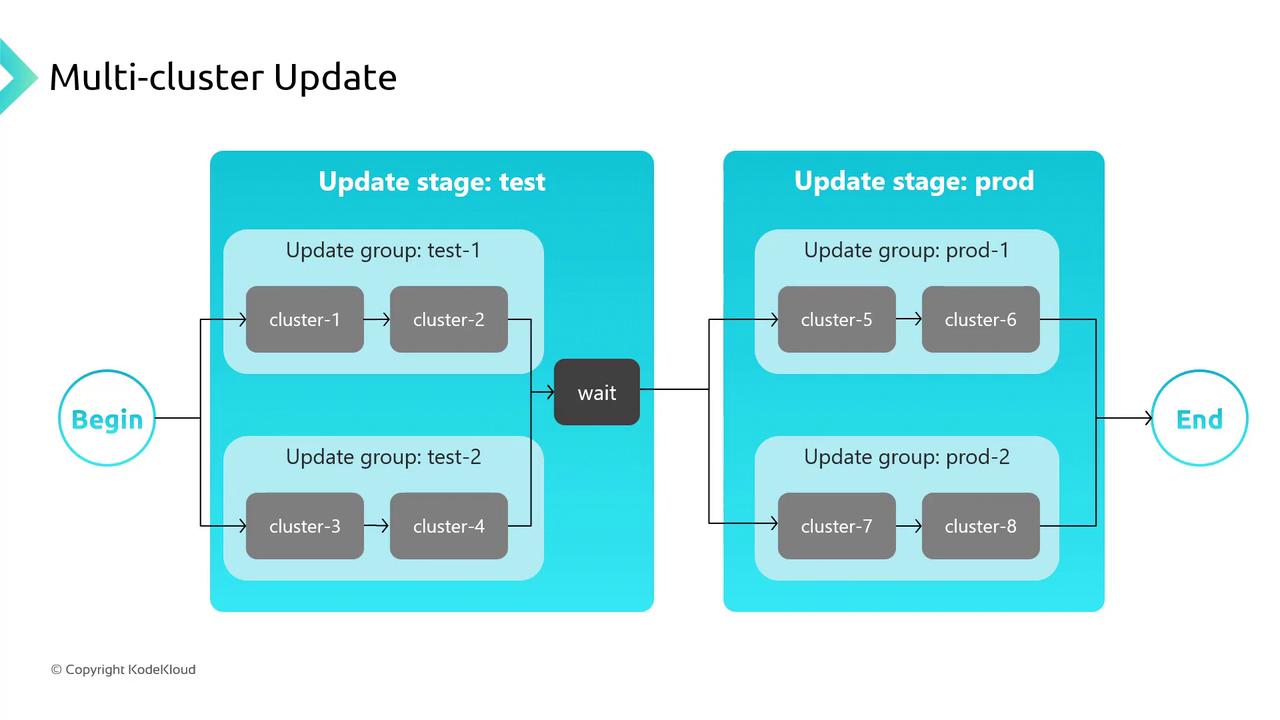
This approach ensures consistent, safe updates across your entire AKS fleet.
***
## Links and References
* [Kubernetes Federation (KubeFed) Documentation](https://github.com/kubernetes-sigs/kubefed)
* [Open Cluster Management (OCM) Project](https://open-cluster-management.io/)
* [Karmada Official Site](https://karmada.io/)
* [Azure Kubernetes Fleet Manager](https://learn.microsoft.com/azure/aks/fleet-manager)
* [Azure Kubernetes Service (AKS) Overview](https://azure.microsoft.com/products/kubernetes-service/)