> ## Documentation Index
> Fetch the complete documentation index at: https://notes.kodekloud.com/llms.txt
> Use this file to discover all available pages before exploring further.
# Software Testing
> This article discusses effective software testing practices within the CI/CD pipeline to enhance code quality and maintain system integrity.
Effective software testing is essential in the CI/CD pipeline to catch defects early, improve code quality, and enable safe refactoring. By integrating a robust test suite into your development workflow, you can ensure that every change maintains system integrity and performance.

## Common Types of Software Testing
* **Unit Testing**\
Verifies individual functions or methods in isolation.
* **Integration Testing**\
Ensures that modules or services communicate correctly.
* **Smoke Testing**\
A quick, surface-level check of critical features.
* **Functional Testing**\
Validates the software against functional requirements.
* **Non-Regression Testing**\
Confirms that new changes haven’t broken existing functionality.
* **Acceptance Testing**\
Tests the system from an end-user perspective.
* **Code Quality & Static Analysis**\
Identifies code smells, style violations, and potential bugs using tools like ESLint or SonarQube.
* **Performance Testing**\
Measures responsiveness and stability under load.
* **Security Testing**\
Scans for vulnerabilities such as SQL injection or cross-site scripting.
* **Manual Testing**\
Exploratory or UX-focused tests performed by QA engineers.
## Test Categories by Execution Speed
| Category | Test Types | Purpose |
| ---------------- | -------------------------------------------------- | --------------------------------------- |
| Fast Automated | Unit Tests, Integration Tests, Smoke Tests | Immediate feedback on code changes |
| Slower Automated | Functional Tests, Non-Regression Tests, Acceptance | Comprehensive validation before release |
| Manual | Exploratory Testing, User-Experience Validation | Human-driven scenarios and edge cases |
Manual testing is best reserved for exploratory scenarios and usability validation after your automated suites pass.
## Balanced Testing Strategy
A layered testing approach optimizes feedback loops and resource usage:
1. **Run Unit Tests First**\
Trigger these on every commit for fast error detection.
2. **Schedule Higher-Level Tests**\
Execute functional, non-regression, and acceptance tests on a build server or nightly job.
3. **Investigate Failures from Bottom Up**\
Always start with unit or integration test errors to pinpoint the root cause.
Skipping unit tests can lead to cascading failures in higher-level tests. Always fix the smallest failing test before moving up the testing pyramid.
## Key Testing Principles
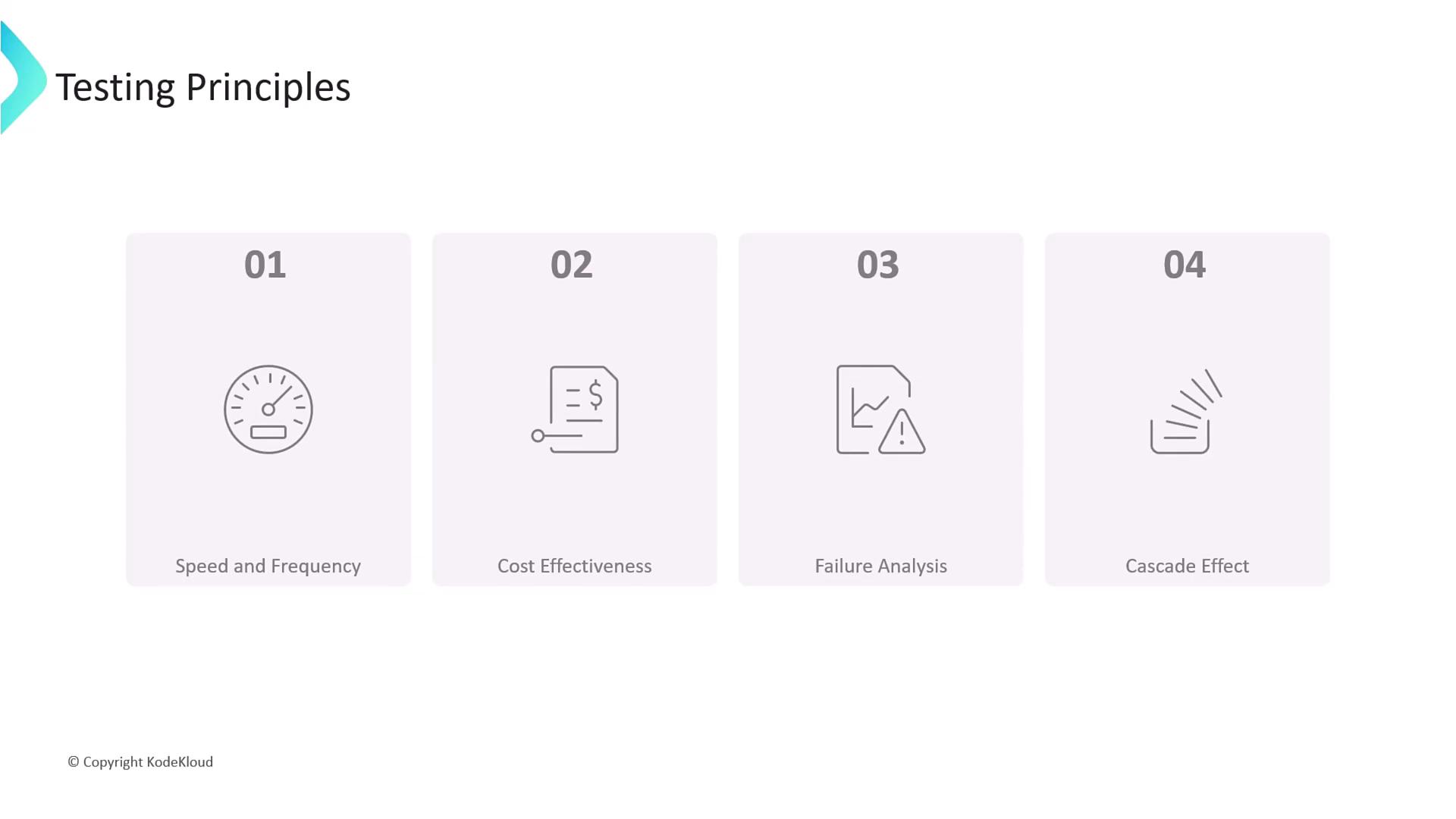
| Principle | Description |
| ------------------- | ----------------------------------------------------------------------------------------- |
| Speed and Frequency | Run low-level tests (unit/integration) on every change; reserve resource-intensive tests. |
| Cost Effectiveness | Maximize automated coverage where maintenance effort yields high ROI. |
| Failure Analysis | Address unit/integration failures before reviewing higher-level test results. |
| Cascade Effect | Trace broad test failures back to the smallest component to locate defects efficiently. |
## Links and References
* [Jenkins Documentation](https://www.jenkins.io/doc/)
* [CI/CD Best Practices](https://www.redhat.com/en/topics/devops/what-is-ci-cd)
* [Software Testing Fundamentals](https://www.guru99.com/software-testing.html)
* [SonarQube Static Analysis](https://www.sonarqube.org/)