> ## Documentation Index
> Fetch the complete documentation index at: https://notes.kodekloud.com/llms.txt
> Use this file to discover all available pages before exploring further.
# Multi Container Pods Design Patterns
> Overview of Kubernetes multi-container Pod design patterns — co-located containers, initContainers, and sidecars — with guidance on when to use each and how to handle startup, readiness, and shutdown.
In this lesson you'll learn the three common multi-container Pod design patterns in Kubernetes, when to use each, and practical guidance for startup ordering, readiness, and shutdown coordination. These patterns are essential for designing reliable applications that require multiple cooperating processes inside the same Pod.
Common patterns covered:
* Co-located containers (multiple regular containers)
* initContainers (ordered initialization)
* Sidecar containers (support and augmentation)
Below we explain each pattern, show example Pod manifests, and highlight key behaviors and best practices.
***
## 1) Co-located containers
Co-located containers are simply multiple regular containers declared under `spec.containers`. They all share the same Pod lifecycle and resources (network namespace, volumes), but Kubernetes does not guarantee the startup order for these containers. Use co-located containers when multiple processes must run together but do not require strict ordering.
When to use:
* Multiple cooperating services that can start and run independently.
* Lightweight helper processes that do not require a guaranteed ordering with the main app.
Example Pod manifest (two co-located containers):
```yaml theme={null}
apiVersion: v1
kind: Pod
metadata:
name: simple-webapp
labels:
name: simple-webapp
spec:
containers:
- name: web-app
image: web-app
ports:
- containerPort: 8080
- name: main-app
image: main-app
```
Key points:
* Regular containers start independently; readiness of each may vary.
* Use `readinessProbe`/`livenessProbe` on each container to manage traffic and restarts.
* For lifecycle coordination, consider using initContainers, readiness checks, or in-app wait logic.
***
## 2) initContainers
`initContainers` are special containers that run sequentially and to completion before any regular containers in `spec.containers` are started. Each `initContainer` must exit successfully before the next `initContainer` or the main container(s) start. This provides a simple and robust way to enforce startup ordering and perform one-time setup tasks.
Common uses:
* Waiting for an external dependency (database, API).
* Performing schema migrations or seeding data.
* Creating files, config, or permissions that main containers depend on.
Example with two `initContainers` that run sequentially, then the main app starts:
```yaml theme={null}
apiVersion: v1
kind: Pod
metadata:
name: simple-webapp
labels:
name: simple-webapp
spec:
initContainers:
- name: db-checker
image: busybox
command: ["sh", "-c", "/wait-for-db-to-start.sh"]
- name: api-checker
image: busybox
command: ["sh", "-c", "/wait-for-another-api.sh"]
containers:
- name: web-app
image: web-app
ports:
- containerPort: 8080
```
Notes:
* `initContainers` run in order and must succeed for the Pod to progress.
* If an `initContainer` fails, kubelet will retry it according to the Pod's `restartPolicy` (Pod-level).
* Use shared volumes to pass initialization output (files/config) to the main containers.
***
## 3) Sidecar containers
Sidecar containers are regular containers that run alongside your main application in the same Pod and provide auxiliary functionality such as log shipping, reverse-proxying, metrics scraping, or configuration refreshing. Because sidecars are just regular containers, Kubernetes does not natively enforce that a sidecar is ready before the main container — you must design coordination if ordering matters.
Typical use cases:
* Log shippers (Filebeat, Fluentd)
* Proxies or network agents (Envoy)
* Configuration or cert refreshers
* Local caches or data prefetchers
Example Pod manifest with a Filebeat sidecar (log shipper):
```yaml theme={null}
apiVersion: v1
kind: Pod
metadata:
name: simple-webapp
labels:
name: simple-webapp
spec:
containers:
- name: web-app
image: web-app
ports:
- containerPort: 8080
- name: filebeat
image: filebeat
# filebeat runs alongside the app to collect logs; ensure coordination if you need it
```
Important considerations for sidecars:
* If the sidecar must be available before the main app, enforce this via:
* Application-level wait logic (main app polls sidecar readiness endpoint),
* `readinessProbe` checks and readiness gates (note: readiness gates require an external controller/mechanism),
* Or use an `initContainer` to perform setup required by both.
* You cannot set `restartPolicy` per container; `restartPolicy` is a Pod-level field. Design expectations for individual containers accordingly.
* To avoid losing termination logs, design a shutdown coordination mechanism so the sidecar can flush buffered logs after the main app exits. Use `preStop` hooks, shared volumes, signal handling, and `terminationGracePeriodSeconds`.
`restartPolicy` applies to the entire Pod, not individual containers. Containers are restarted by the kubelet according to the Pod `restartPolicy`. Do not assume per-container restart behavior can be configured via each container spec.
Kubernetes guarantees sequential execution only for `initContainers`. For regular containers (including sidecars), implement explicit coordination (readiness probes, initContainers, shared signals) when startup or shutdown ordering matters.
***
### Realistic example: logging pipeline with a Filebeat sidecar
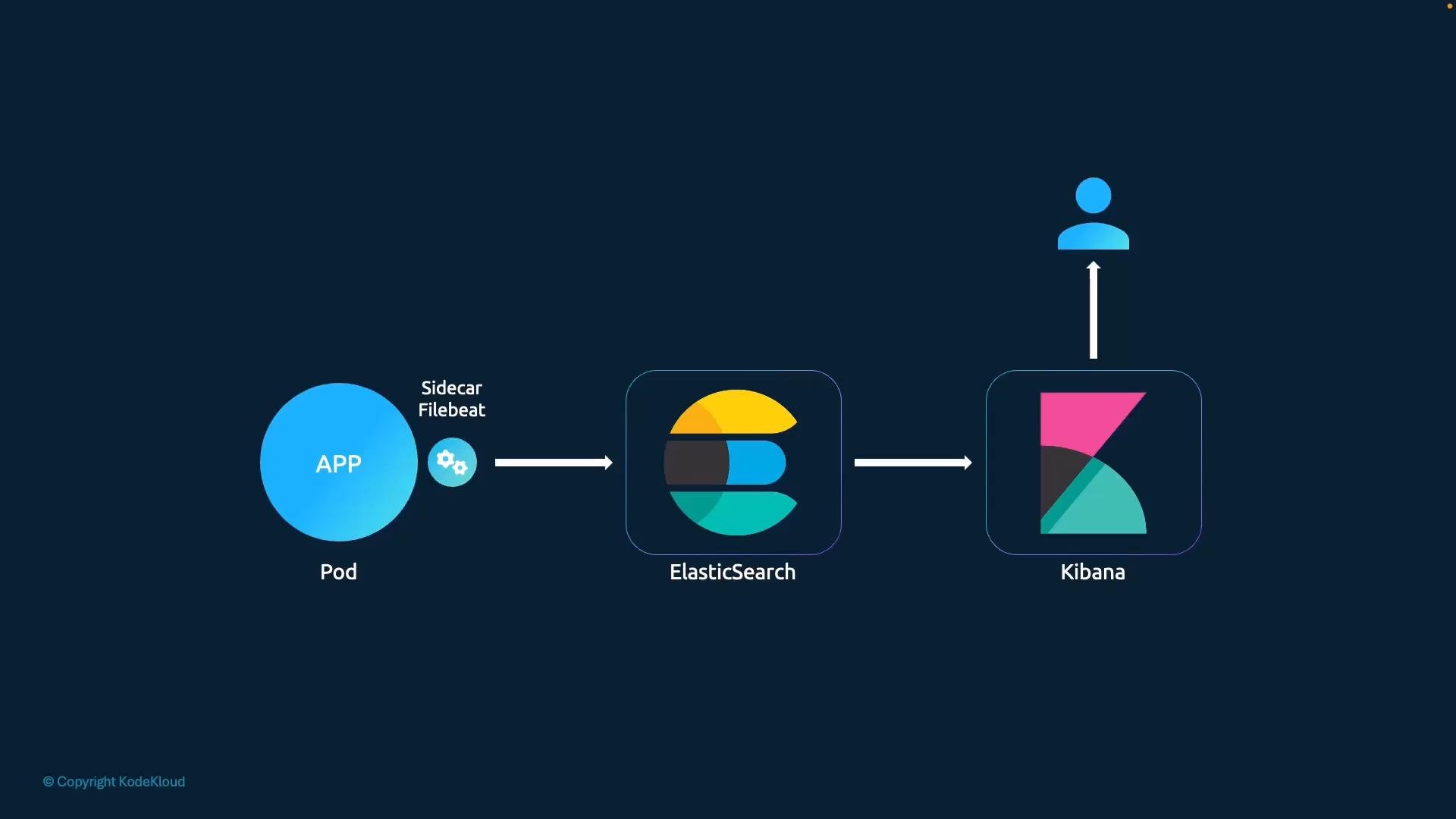
A common sidecar use case is log shipping. In this pattern, the application writes logs to a shared volume or the container filesystem; a Filebeat sidecar reads those logs and ships them to Elasticsearch, which can be visualized via Kibana.
 Best practices for sidecar log shipping:
* Use a shared volume (emptyDir or hostPath as appropriate) for log exchange between app and sidecar.
* Ensure the sidecar continues long enough to ship termination logs and flush buffers.
* Implement graceful shutdown: main app can trigger a flush signal or write a marker the sidecar watches for.
* Tune `terminationGracePeriodSeconds` and `preStop` hooks so the sidecar has time to complete log shipping.
***
## Comparison: Patterns at a glance
| Pattern | Purpose | Startup Ordering | Use Cases | Coordination Mechanisms |
| -: | - | -: | - | - |
| Co-located containers | Run multiple processes together | No guaranteed order | Multiple independent helpers | Readiness probes, in-app waits |
| initContainers | Ordered initialization before main app | Sequential—guaranteed | DB checks, migrations, setup | Shared volumes, exit codes, Pod-level retries |
| Sidecars | Auxiliary services running alongside main app | No guaranteed order | Logging, proxying, metrics | Readiness endpoints, initContainers, signals |
***
## Summary and recommendations
* Choose `initContainers` when you need guaranteed sequential initialization before your main containers run.
* Use co-located containers when ordering is not required and processes can start independently.
* Use the sidecar pattern for companion processes (logging, proxying, metrics), but design explicit coordination if the main app depends on the sidecar’s readiness or if you must guarantee capture of startup/termination logs.
* Plan for Pod-level lifecycle semantics (e.g., `restartPolicy`, `terminationGracePeriodSeconds`) and use shared volumes, probes, `preStop` hooks, and signals to synchronize containers inside a Pod.
Links and references:
* [Kubernetes Pods](https://kubernetes.io/docs/concepts/workloads/pods/)
* [Init Containers](https://kubernetes.io/docs/concepts/workloads/pods/init-containers/)
* [Best Practices for Logging in Kubernetes](https://kubernetes.io/docs/concepts/cluster-administration/logging/)
This documentation is built and hosted on [Mintlify](https://mintlify.com), a developer documentation platform.
Best practices for sidecar log shipping:
* Use a shared volume (emptyDir or hostPath as appropriate) for log exchange between app and sidecar.
* Ensure the sidecar continues long enough to ship termination logs and flush buffers.
* Implement graceful shutdown: main app can trigger a flush signal or write a marker the sidecar watches for.
* Tune `terminationGracePeriodSeconds` and `preStop` hooks so the sidecar has time to complete log shipping.
***
## Comparison: Patterns at a glance
| Pattern | Purpose | Startup Ordering | Use Cases | Coordination Mechanisms |
| -: | - | -: | - | - |
| Co-located containers | Run multiple processes together | No guaranteed order | Multiple independent helpers | Readiness probes, in-app waits |
| initContainers | Ordered initialization before main app | Sequential—guaranteed | DB checks, migrations, setup | Shared volumes, exit codes, Pod-level retries |
| Sidecars | Auxiliary services running alongside main app | No guaranteed order | Logging, proxying, metrics | Readiness endpoints, initContainers, signals |
***
## Summary and recommendations
* Choose `initContainers` when you need guaranteed sequential initialization before your main containers run.
* Use co-located containers when ordering is not required and processes can start independently.
* Use the sidecar pattern for companion processes (logging, proxying, metrics), but design explicit coordination if the main app depends on the sidecar’s readiness or if you must guarantee capture of startup/termination logs.
* Plan for Pod-level lifecycle semantics (e.g., `restartPolicy`, `terminationGracePeriodSeconds`) and use shared volumes, probes, `preStop` hooks, and signals to synchronize containers inside a Pod.
Links and references:
* [Kubernetes Pods](https://kubernetes.io/docs/concepts/workloads/pods/)
* [Init Containers](https://kubernetes.io/docs/concepts/workloads/pods/init-containers/)
* [Best Practices for Logging in Kubernetes](https://kubernetes.io/docs/concepts/cluster-administration/logging/)
This documentation is built and hosted on [Mintlify](https://mintlify.com), a developer documentation platform.