> ## Documentation Index
> Fetch the complete documentation index at: https://notes.kodekloud.com/llms.txt
> Use this file to discover all available pages before exploring further.
# Conclusion
> This article covers Chaos Engineering with AWS Fault Injection Simulator, focusing on injecting failures, observing behavior, and enhancing resilience in distributed applications.
Congratulations on completing this lesson on Chaos Engineering with **AWS Fault Injection Simulator**. You’ve learned how to inject failures safely, observe system behavior, and build continuous resilience into your distributed applications.
## Modern Resilience Challenges
Organizations today must navigate:
* Customer expectations for **always-on** services
* Complex, distributed architectures managed by remote teams
* The need for **frequent, reliable releases**
By embedding resilience practices into every stage of your development lifecycle, you’ll proactively uncover weaknesses and prevent outages.
For detailed guidance on AWS Fault Injection Simulator, see the [AWS FIS User Guide](https://docs.aws.amazon.com/fis/latest/userguide/).
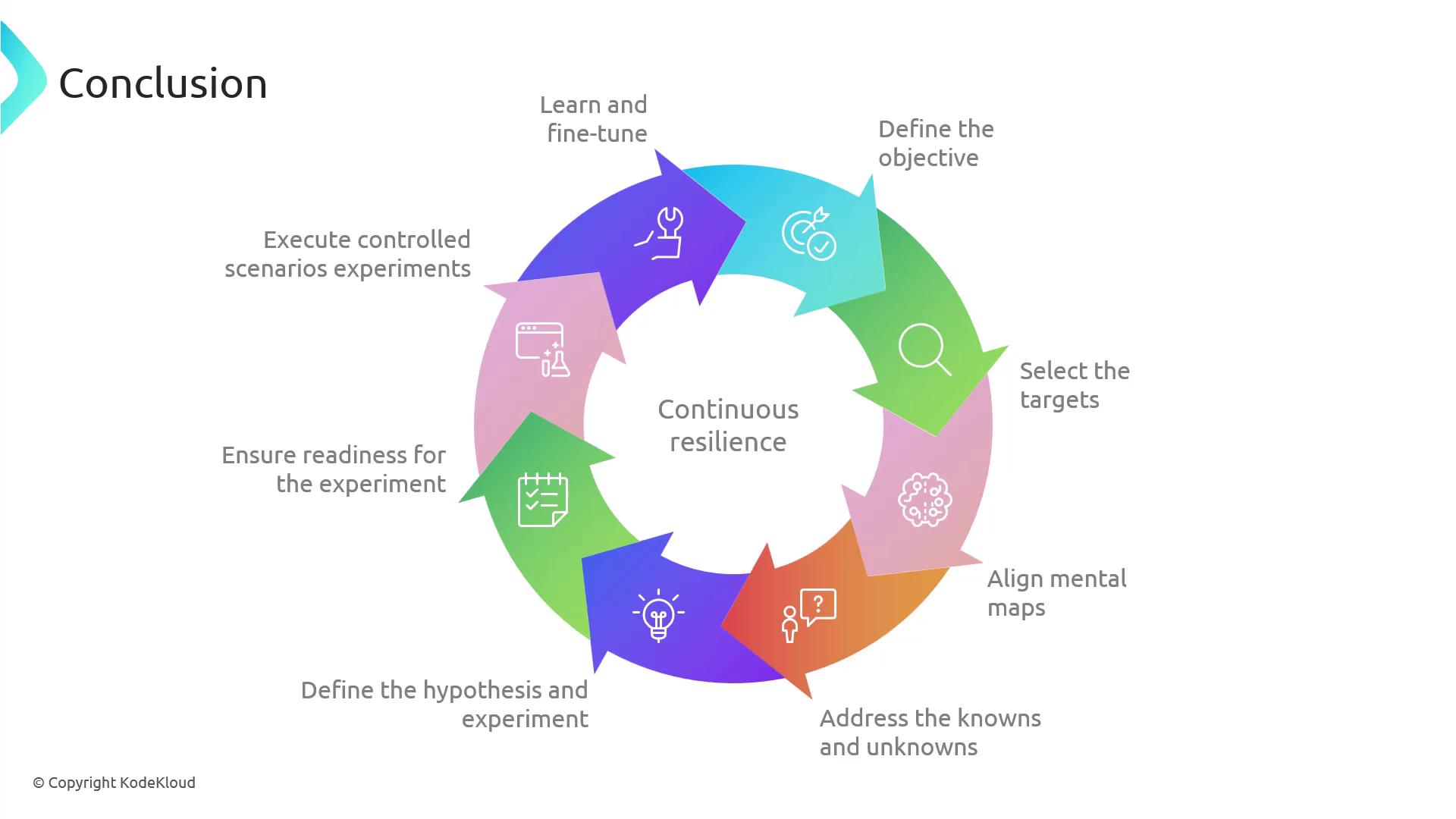
## Continuous Resilience Lifecycle
This circular flow represents the iterative process that keeps your systems robust:
## Step-by-Step Breakdown
| Step | Description |
| ----------------------------- | ----------------------------------------------------------------------- |
| 1. Define objectives | Establish clear resilience goals aligned with business requirements. |
| 2. Select targets | Identify services, resources, or components for fault injection. |
| 3. Align mental models | Ensure the team shares a common understanding of system behavior. |
| 4. Identify knowns & unknowns | List assumptions, dependencies, and potential blind spots. |
| 5. Formulate hypotheses | Predict how the system should respond under failure scenarios. |
| 6. Ensure readiness | Verify monitoring, logging, and rollback mechanisms. |
| 7. Execute experiments | Inject faults in a controlled environment and collect data. |
| 8. Learn & fine-tune | Analyze results, refine hypotheses, and iterate on resilience measures. |
Always perform chaos experiments in a **staging** or **non-production** environment first. Double-check IAM permissions, backups, and monitoring before injecting faults.
By weaving these steps into your sprint cycles, you’ll continuously validate your system’s ability to withstand disruptions. Thank you for joining this journey—I'm Nasia Ullas, and I look forward to seeing how you apply these practices to build more resilient, reliable applications. Good luck!