> ## Documentation Index
> Fetch the complete documentation index at: https://notes.kodekloud.com/llms.txt
> Use this file to discover all available pages before exploring further.
# Demo Error Handling Resilience Audit
> Audit of an Express/Node.js login demo identifying error-handling and resilience gaps, prioritizing findings, and providing minimal drop‑in remediation code and configuration suggestions
This audit inspects an Express/Node.js login demo to identify error-handling and resilience gaps, prioritize findings, and provide minimal, drop‑in remediation snippets. The goal is actionable fixes that integrate cleanly into the existing codebase (e.g., `server.js`, `routes/auth.js`, `database.js`), with minimal surface area change.
Example interactive prompt used to drive the audit:
```text theme={null}
* Welcome to [Claude Code For Beginners](https://learn.kodekloud.com/user/courses/claude-code-for-beginners)!
/help for help, /status for your current setup
cwd: /Users/jeremy/Repos/Claude Code Course/Express-login-demo
> Try "create a util `logging.py` that..."
? for shortcuts
```
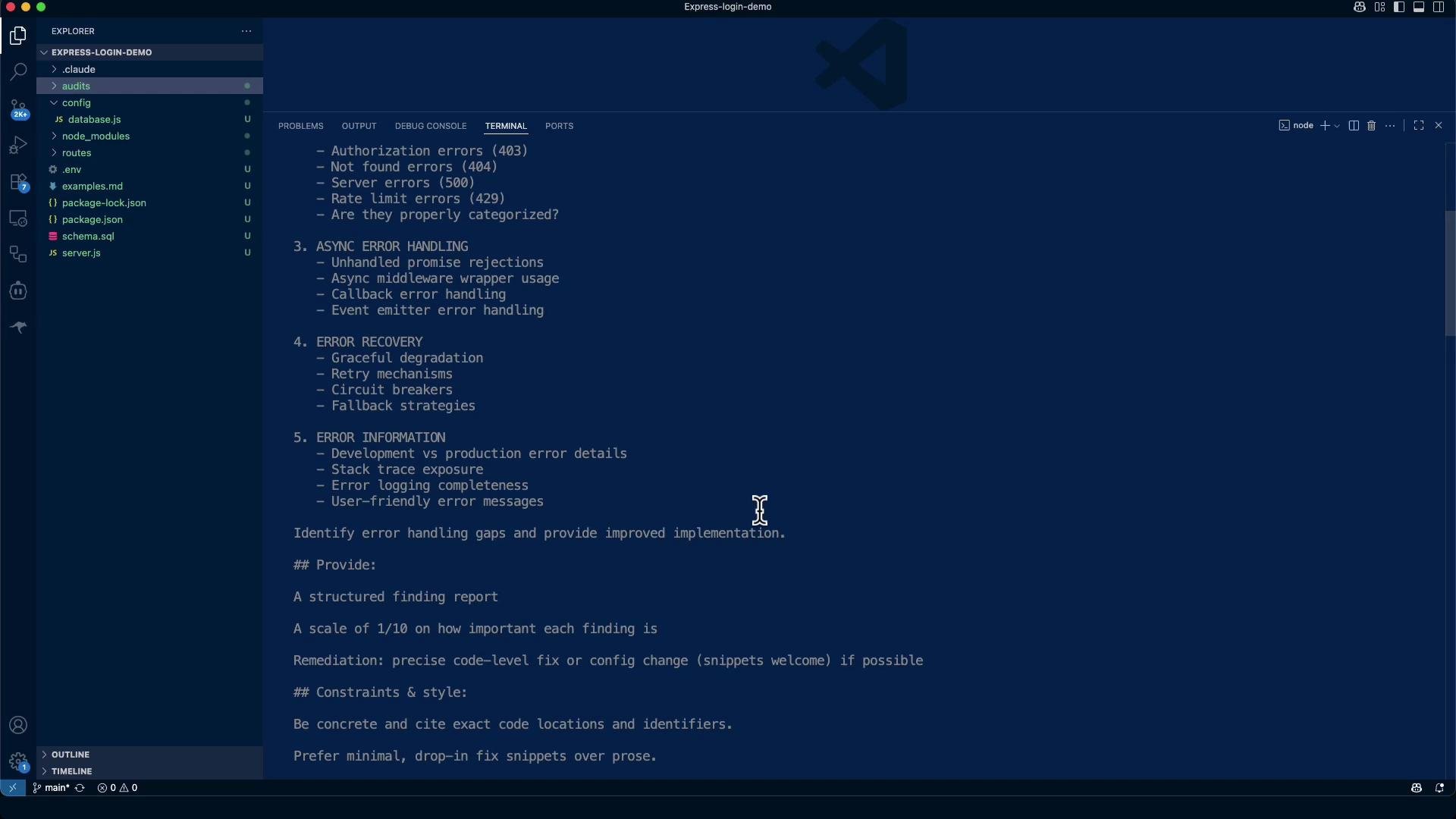
Audit focus (excerpt from the evaluation prompt)
```text theme={null}
4. ERROR RECOVERY
- Graceful degradation
- Retry mechanisms
- Circuit breakers
- Fallback strategies
5. ERROR INFORMATION
- Development vs production error details
- Stack trace exposure
- Error logging completeness
- User-friendly error messages
Identify error handling gaps and provide improved implementation.
## Provide:
A structured finding report
A scale of 1/10 on how important each finding is
Remediation: precise code-level fix or config change (snippets welcome)
## Constraints & style:
Be concrete and cite exact code locations and identifiers.
Prefer minimal, drop-in fix snippets over prose.
Do not invent files or functions that aren't present; if context is missing, mark as Unable to verify and say what code would prove it.
Write this into a markdown file and place it in the audits/ folder.
```
Evaluation checklist (used during the audit)
```text theme={null}
1. ERROR HANDLING CONSISTENCY
- Centralized error handler?
- Uniform error responses?
- Custom error classes vs generic Error?
2. ERROR CATEGORIES
- 400/401/403/404/409/429/500/503 mapping
3. ASYNC ERROR HANDLING
- Unhandled promise rejections
- Async middleware wrapper usage
4. ERROR RECOVERY
- Graceful degradation, retries, breakers, fallbacks
5. ERROR INFORMATION
- Dev vs prod details, stack trace exposure, logging completeness
```
Executive summary (condensed)
* Overall score: **3.5 / 10** — current demo not ready for production.
* Major problems: no centralized error handling, inconsistent response format, unhandled promise rejections, no retry/circuit-breaker patterns, and sensitive info written to logs.
* Immediate priorities: add a centralized error middleware, register process-level handlers for unhandled rejections/uncaught exceptions, and stop logging raw error objects.
Critical findings (short table)
| Category | Score | Status | Critical Issues |
| -------------------------- | ----: | ------- | ------------------------------------------------ |
| Error Handling Consistency | 2/10 | FAIL | No centralized error handling (server.js) |
| Error Categories | 4/10 | PARTIAL | Missing 403, 404, 429, 409 mappings |
| Async Error Handling | 3/10 | FAIL | No unhandledRejection/uncaughtException handlers |
| Error Recovery | 1/10 | FAIL | No retry/circuit-breaker/fallback patterns |
| Error Information | 4/10 | PARTIAL | Console-only logs; raw error objects leaked |
During development, verbose stack traces are helpful. In production, never expose stack traces or raw error objects to API responses or unprotected logs—use sanitized, structured logs and environment-based response behavior.
Logging full error objects (which may include DB URIs, SQL, tokens, or user credentials) is a high-risk data-exposure vector. Sanitize or redact sensitive fields before logging.
Image: project context (keeps original placement with explanation)
 ***
## Detailed findings and concrete remediation
Below are prioritized findings with precise remediation snippets suitable for drop-in changes. Where new helper files are recommended, place them under `utils/` or `middleware/` unless your repo already contains equivalents. If a file does not exist, add it; if you prefer not to add files, the contents can be placed inline in `server.js`, but separating increases maintainability.
1. ERROR HANDLING CONSISTENCY — CRITICAL
* Location: `server.js` (top-level Express setup)
* Evidence: No centralized error middleware or standardized response format.
Current minimal example (evidence of missing middleware):
```javascript theme={null}
// server.js - simplified
app.use(express.json());
app.use('/api/auth', require('./routes/auth'));
// ❌ Missing error middleware
app.listen(PORT, () => {
console.log('Server listening on', PORT);
});
```
Recommended remediation (drop-in): add a central error response shape and middleware.
a) ErrorResponse utility (create `utils/errorResponse.js`):
```javascript theme={null}
// utils/errorResponse.js
class ErrorResponse {
constructor(message, statusCode = 500, details = null) {
this.message = message;
this.statusCode = statusCode;
this.details = details;
}
toJSON() {
return {
error: {
message: this.message,
...(this.details ? { details: this.details } : {})
}
};
}
}
module.exports = ErrorResponse;
```
b) Centralized error middleware (create `middleware/errorHandler.js`):
```javascript theme={null}
// middleware/errorHandler.js
const ErrorResponse = require('../utils/errorResponse');
function errorHandler(err, req, res, next) {
// Respect pre-built ErrorResponse instances
if (err instanceof ErrorResponse) {
return res.status(err.statusCode).json(err.toJSON());
}
const statusCode = err.statusCode || err.status || 500;
const message = process.env.NODE_ENV === 'production'
? 'An unexpected error occurred.'
: (err.message || 'Internal Server Error');
const response = {
error: { message }
};
if (process.env.NODE_ENV !== 'production' && err.stack) {
response.error.stack = err.stack;
}
res.status(statusCode).json(response);
}
module.exports = errorHandler;
```
c) Mount middleware at the end of `server.js` after routes:
```javascript theme={null}
// server.js (after routes)
const errorHandler = require('./middleware/errorHandler');
// ... app.use routes above ...
app.use(errorHandler);
```
2. ERROR CATEGORIES — MEDIUM
* Current: routes only use a handful of statuses (400/401/500); missing common HTTP error mappings (403, 404, 409, 429).
* Impact: Clients and monitoring cannot reliably interpret failures.
Remediation: add a small HTTP error factory and use it in routes.
`utils/httpErrors.js`:
```javascript theme={null}
// utils/httpErrors.js
class HttpError extends Error {
constructor(message, statusCode = 500, details = null) {
super(message);
this.statusCode = statusCode;
this.details = details;
}
}
const BadRequest = (msg, details) => new HttpError(msg || 'Bad Request', 400, details);
const Unauthorized = (msg, details) => new HttpError(msg || 'Unauthorized', 401, details);
const Forbidden = (msg, details) => new HttpError(msg || 'Forbidden', 403, details);
const NotFound = (msg, details) => new HttpError(msg || 'Not Found', 404, details);
const Conflict = (msg, details) => new HttpError(msg || 'Conflict', 409, details);
const TooManyRequests = (msg, details) => new HttpError(msg || 'Too Many Requests', 429, details);
const ServiceUnavailable = (msg, details) => new HttpError(msg || 'Service Unavailable', 503, details);
module.exports = {
HttpError,
BadRequest,
Unauthorized,
Forbidden,
NotFound,
Conflict,
TooManyRequests,
ServiceUnavailable
};
```
Usage example in `routes/auth.js`:
```javascript theme={null}
const { BadRequest, Unauthorized } = require('../utils/httpErrors');
if (!email || !password) {
throw BadRequest('Email and password are required');
}
if (!user) {
throw Unauthorized('Invalid credentials');
}
```
3. ASYNC ERROR HANDLING — CRITICAL
* Issues: no `process.on('unhandledRejection')` or `process.on('uncaughtException')` handlers; routes use manual try/catch scattered throughout.
* Evidence: missing global handlers in `server.js`.
Remediation:
a) Add global process handlers in `server.js` (near top, before `app.listen`):
```javascript theme={null}
// server.js (top-level)
process.on('unhandledRejection', (reason, promise) => {
console.error('Unhandled Rejection at:', promise, 'reason:', reason);
if (global.__server) {
global.__server.close(() => process.exit(1));
} else {
process.exit(1);
}
});
process.on('uncaughtException', (err) => {
console.error('Uncaught Exception:', err);
if (global.__server) {
global.__server.close(() => process.exit(1));
} else {
process.exit(1);
}
});
```
b) Add an async wrapper to avoid repeating try/catch in every route (`middleware/asyncHandler.js`):
```javascript theme={null}
// middleware/asyncHandler.js
module.exports = fn => (req, res, next) => {
Promise.resolve(fn(req, res, next)).catch(next);
};
```
Usage:
```javascript theme={null}
const asyncHandler = require('../middleware/asyncHandler');
router.post('/login', asyncHandler(async (req, res) => {
// async code here; throw HttpError on validation failures
}));
```
4. ERROR RECOVERY — FAIL
* Issues: no retry logic for transient DB/network errors; no circuit-breaker or fallback strategies.
* Impact: transient errors lead to service outages and potential cascading failures.
Remediation (minimal, pragmatic examples):
a) Database connection retry (example `config/database.js`):
```javascript theme={null}
// config/database.js
const mongoose = require('mongoose');
async function connectWithRetry(uri, options = {}, attempts = 5, delayMs = 2000) {
for (let i = 1; i <= attempts; i += 1) {
try {
await mongoose.connect(uri, options);
console.log('Database connected');
return;
} catch (err) {
console.warn(`DB connect attempt ${i} failed: ${err.message}`);
if (i === attempts) throw err;
await new Promise(r => setTimeout(r, delayMs));
}
}
}
module.exports = { connectWithRetry };
```
b) Circuit breaker helper (example using opossum — `npm i opossum`):
```javascript theme={null}
// utils/circuit.js
const CircuitBreaker = require('opossum');
function createBreaker(action, options = {}) {
const breaker = new CircuitBreaker(action, {
timeout: options.timeout || 3000,
errorThresholdPercentage: options.errorThresholdPercentage || 50,
resetTimeout: options.resetTimeout || 30000
});
return breaker;
}
module.exports = { createBreaker };
```
Apply breakers around brittle downstream calls (email, payment, external APIs) — do not wrap internal DB calls unless those are remote and flaky.
5. ERROR INFORMATION & LOGGING — CRITICAL / MEDIUM
* Evidence: application uses `console.log`/`console.error` and logs full error objects (including DB details).
* Impact: sensitive data (connection strings, SQL, tokens) may leak to logs.
Remediation: adopt structured logging (Winston, Pino) and sanitize inputs before logging.
a) Winston example logger (`utils/logger.js`):
```javascript theme={null}
// utils/logger.js
const { createLogger, format, transports } = require('winston');
const logger = createLogger({
level: process.env.LOG_LEVEL || 'info',
format: format.combine(
format.timestamp(),
format.errors({ stack: true }),
format.splat(),
format.json()
),
transports: [
new transports.Console()
// Add file / remote transports in production.
]
});
module.exports = logger;
```
b) Replace `console.error('Login error:', error)` with:
```javascript theme={null}
const logger = require('./utils/logger');
logger.error('Login error: %s', error.message, { stack: error.stack });
```
c) Sanitize and redact before logging:
* Never log full request body for authentication endpoints.
* Remove DB URIs, tokens, and passwords from logged objects.
* Consider sampling or PII redaction policies for high-volume endpoints.
6. ENVIRONMENT-SPECIFIC BEHAVIOR — HIGH\
Ensure `NODE_ENV` controls verbosity:
* Development: include stack traces and verbose logs.
* Production: hide stack traces from API responses; log full details to secure destinations only.
The `errorHandler` above respects `NODE_ENV` and only includes stack traces when `NODE_ENV !== 'production'`.
***
## Priority remediation plan
| Priority | Action | Target files / location |
| -------------------: | ---------------------------------------------------------- | ------------------------------------------------ |
| Immediate (Week 1) | Centralized error handler + mount it | `middleware/errorHandler.js`, `server.js` |
| Immediate (Week 1) | Global unhandled rejection / uncaught exception handlers | `server.js` |
| Immediate (Week 1) | Replace `console.*` with structured logger + sanitize logs | `utils/logger.js`, replace calls across codebase |
| Short-term (Month 1) | Add `asyncHandler` and refactor routes | `middleware/asyncHandler.js`, `routes/` |
| Short-term (Month 1) | Standardize error types (httpErrors, ErrorResponse) | `utils/httpErrors.js`, `utils/errorResponse.js` |
| Medium (Month 2–3) | Connection retry logic & circuit breaker wrappers | `config/database.js`, `utils/circuit.js` |
| Medium (Month 2–3) | Implement graceful degradation & feature fallbacks | application code & feature flags |
Estimated effort:
* Core fixes: 2–3 days for a small team (error middleware, global handlers, logger replacement).
* Full resilience: 2–3 months to implement retries, breakers, and staged fallbacks.
Security impact & production readiness
* Current: NOT READY for production.
* After critical fixes: improved readiness; still require monitoring, alerting, secret management, and secure logging destinations.
Notes on verification
* Audit referenced `server.js`, `routes/auth.js`, and `config/database.js`. For an automated verification run, include exact lines where `console.error` is used and route handlers are defined so tests can assert replacement by logger and async handlers.
* If any suggested file does not exist, create `utils/` and `middleware/` files as described. Alternatively, embed minimal logic into `server.js` for fast verification, but modular placement is recommended.
Final summary / checklist
* Implement the central error middleware and mount it after routes.
* Register process-level handlers for unhandled rejections and uncaught exceptions.
* Replace ad-hoc `console.*` with a structured logger (Winston/Pino) and enforce sanitization rules.
* Add `asyncHandler` to wrap async route handlers and standardize error objects via `httpErrors`/`ErrorResponse`.
* Add retry logic for DB connections and circuit-breaker wrappers for fragile external services.
Links & references
* Express error handling recommendations: [https://expressjs.com/en/guide/error-handling.html](https://expressjs.com/en/guide/error-handling.html)
* Node process `unhandledRejection` / `uncaughtException`: [https://nodejs.org/api/process.html#process\_event\_unhandledrejection](https://nodejs.org/api/process.html#process_event_unhandledrejection)
* Winston structured logging: [https://github.com/winstonjs/winston](https://github.com/winstonjs/winston)
* Opossum circuit breaker: [https://nodeshift.dev/opossum/](https://nodeshift.dev/opossum/)
Thank you for reading.
***
## Detailed findings and concrete remediation
Below are prioritized findings with precise remediation snippets suitable for drop-in changes. Where new helper files are recommended, place them under `utils/` or `middleware/` unless your repo already contains equivalents. If a file does not exist, add it; if you prefer not to add files, the contents can be placed inline in `server.js`, but separating increases maintainability.
1. ERROR HANDLING CONSISTENCY — CRITICAL
* Location: `server.js` (top-level Express setup)
* Evidence: No centralized error middleware or standardized response format.
Current minimal example (evidence of missing middleware):
```javascript theme={null}
// server.js - simplified
app.use(express.json());
app.use('/api/auth', require('./routes/auth'));
// ❌ Missing error middleware
app.listen(PORT, () => {
console.log('Server listening on', PORT);
});
```
Recommended remediation (drop-in): add a central error response shape and middleware.
a) ErrorResponse utility (create `utils/errorResponse.js`):
```javascript theme={null}
// utils/errorResponse.js
class ErrorResponse {
constructor(message, statusCode = 500, details = null) {
this.message = message;
this.statusCode = statusCode;
this.details = details;
}
toJSON() {
return {
error: {
message: this.message,
...(this.details ? { details: this.details } : {})
}
};
}
}
module.exports = ErrorResponse;
```
b) Centralized error middleware (create `middleware/errorHandler.js`):
```javascript theme={null}
// middleware/errorHandler.js
const ErrorResponse = require('../utils/errorResponse');
function errorHandler(err, req, res, next) {
// Respect pre-built ErrorResponse instances
if (err instanceof ErrorResponse) {
return res.status(err.statusCode).json(err.toJSON());
}
const statusCode = err.statusCode || err.status || 500;
const message = process.env.NODE_ENV === 'production'
? 'An unexpected error occurred.'
: (err.message || 'Internal Server Error');
const response = {
error: { message }
};
if (process.env.NODE_ENV !== 'production' && err.stack) {
response.error.stack = err.stack;
}
res.status(statusCode).json(response);
}
module.exports = errorHandler;
```
c) Mount middleware at the end of `server.js` after routes:
```javascript theme={null}
// server.js (after routes)
const errorHandler = require('./middleware/errorHandler');
// ... app.use routes above ...
app.use(errorHandler);
```
2. ERROR CATEGORIES — MEDIUM
* Current: routes only use a handful of statuses (400/401/500); missing common HTTP error mappings (403, 404, 409, 429).
* Impact: Clients and monitoring cannot reliably interpret failures.
Remediation: add a small HTTP error factory and use it in routes.
`utils/httpErrors.js`:
```javascript theme={null}
// utils/httpErrors.js
class HttpError extends Error {
constructor(message, statusCode = 500, details = null) {
super(message);
this.statusCode = statusCode;
this.details = details;
}
}
const BadRequest = (msg, details) => new HttpError(msg || 'Bad Request', 400, details);
const Unauthorized = (msg, details) => new HttpError(msg || 'Unauthorized', 401, details);
const Forbidden = (msg, details) => new HttpError(msg || 'Forbidden', 403, details);
const NotFound = (msg, details) => new HttpError(msg || 'Not Found', 404, details);
const Conflict = (msg, details) => new HttpError(msg || 'Conflict', 409, details);
const TooManyRequests = (msg, details) => new HttpError(msg || 'Too Many Requests', 429, details);
const ServiceUnavailable = (msg, details) => new HttpError(msg || 'Service Unavailable', 503, details);
module.exports = {
HttpError,
BadRequest,
Unauthorized,
Forbidden,
NotFound,
Conflict,
TooManyRequests,
ServiceUnavailable
};
```
Usage example in `routes/auth.js`:
```javascript theme={null}
const { BadRequest, Unauthorized } = require('../utils/httpErrors');
if (!email || !password) {
throw BadRequest('Email and password are required');
}
if (!user) {
throw Unauthorized('Invalid credentials');
}
```
3. ASYNC ERROR HANDLING — CRITICAL
* Issues: no `process.on('unhandledRejection')` or `process.on('uncaughtException')` handlers; routes use manual try/catch scattered throughout.
* Evidence: missing global handlers in `server.js`.
Remediation:
a) Add global process handlers in `server.js` (near top, before `app.listen`):
```javascript theme={null}
// server.js (top-level)
process.on('unhandledRejection', (reason, promise) => {
console.error('Unhandled Rejection at:', promise, 'reason:', reason);
if (global.__server) {
global.__server.close(() => process.exit(1));
} else {
process.exit(1);
}
});
process.on('uncaughtException', (err) => {
console.error('Uncaught Exception:', err);
if (global.__server) {
global.__server.close(() => process.exit(1));
} else {
process.exit(1);
}
});
```
b) Add an async wrapper to avoid repeating try/catch in every route (`middleware/asyncHandler.js`):
```javascript theme={null}
// middleware/asyncHandler.js
module.exports = fn => (req, res, next) => {
Promise.resolve(fn(req, res, next)).catch(next);
};
```
Usage:
```javascript theme={null}
const asyncHandler = require('../middleware/asyncHandler');
router.post('/login', asyncHandler(async (req, res) => {
// async code here; throw HttpError on validation failures
}));
```
4. ERROR RECOVERY — FAIL
* Issues: no retry logic for transient DB/network errors; no circuit-breaker or fallback strategies.
* Impact: transient errors lead to service outages and potential cascading failures.
Remediation (minimal, pragmatic examples):
a) Database connection retry (example `config/database.js`):
```javascript theme={null}
// config/database.js
const mongoose = require('mongoose');
async function connectWithRetry(uri, options = {}, attempts = 5, delayMs = 2000) {
for (let i = 1; i <= attempts; i += 1) {
try {
await mongoose.connect(uri, options);
console.log('Database connected');
return;
} catch (err) {
console.warn(`DB connect attempt ${i} failed: ${err.message}`);
if (i === attempts) throw err;
await new Promise(r => setTimeout(r, delayMs));
}
}
}
module.exports = { connectWithRetry };
```
b) Circuit breaker helper (example using opossum — `npm i opossum`):
```javascript theme={null}
// utils/circuit.js
const CircuitBreaker = require('opossum');
function createBreaker(action, options = {}) {
const breaker = new CircuitBreaker(action, {
timeout: options.timeout || 3000,
errorThresholdPercentage: options.errorThresholdPercentage || 50,
resetTimeout: options.resetTimeout || 30000
});
return breaker;
}
module.exports = { createBreaker };
```
Apply breakers around brittle downstream calls (email, payment, external APIs) — do not wrap internal DB calls unless those are remote and flaky.
5. ERROR INFORMATION & LOGGING — CRITICAL / MEDIUM
* Evidence: application uses `console.log`/`console.error` and logs full error objects (including DB details).
* Impact: sensitive data (connection strings, SQL, tokens) may leak to logs.
Remediation: adopt structured logging (Winston, Pino) and sanitize inputs before logging.
a) Winston example logger (`utils/logger.js`):
```javascript theme={null}
// utils/logger.js
const { createLogger, format, transports } = require('winston');
const logger = createLogger({
level: process.env.LOG_LEVEL || 'info',
format: format.combine(
format.timestamp(),
format.errors({ stack: true }),
format.splat(),
format.json()
),
transports: [
new transports.Console()
// Add file / remote transports in production.
]
});
module.exports = logger;
```
b) Replace `console.error('Login error:', error)` with:
```javascript theme={null}
const logger = require('./utils/logger');
logger.error('Login error: %s', error.message, { stack: error.stack });
```
c) Sanitize and redact before logging:
* Never log full request body for authentication endpoints.
* Remove DB URIs, tokens, and passwords from logged objects.
* Consider sampling or PII redaction policies for high-volume endpoints.
6. ENVIRONMENT-SPECIFIC BEHAVIOR — HIGH\
Ensure `NODE_ENV` controls verbosity:
* Development: include stack traces and verbose logs.
* Production: hide stack traces from API responses; log full details to secure destinations only.
The `errorHandler` above respects `NODE_ENV` and only includes stack traces when `NODE_ENV !== 'production'`.
***
## Priority remediation plan
| Priority | Action | Target files / location |
| -------------------: | ---------------------------------------------------------- | ------------------------------------------------ |
| Immediate (Week 1) | Centralized error handler + mount it | `middleware/errorHandler.js`, `server.js` |
| Immediate (Week 1) | Global unhandled rejection / uncaught exception handlers | `server.js` |
| Immediate (Week 1) | Replace `console.*` with structured logger + sanitize logs | `utils/logger.js`, replace calls across codebase |
| Short-term (Month 1) | Add `asyncHandler` and refactor routes | `middleware/asyncHandler.js`, `routes/` |
| Short-term (Month 1) | Standardize error types (httpErrors, ErrorResponse) | `utils/httpErrors.js`, `utils/errorResponse.js` |
| Medium (Month 2–3) | Connection retry logic & circuit breaker wrappers | `config/database.js`, `utils/circuit.js` |
| Medium (Month 2–3) | Implement graceful degradation & feature fallbacks | application code & feature flags |
Estimated effort:
* Core fixes: 2–3 days for a small team (error middleware, global handlers, logger replacement).
* Full resilience: 2–3 months to implement retries, breakers, and staged fallbacks.
Security impact & production readiness
* Current: NOT READY for production.
* After critical fixes: improved readiness; still require monitoring, alerting, secret management, and secure logging destinations.
Notes on verification
* Audit referenced `server.js`, `routes/auth.js`, and `config/database.js`. For an automated verification run, include exact lines where `console.error` is used and route handlers are defined so tests can assert replacement by logger and async handlers.
* If any suggested file does not exist, create `utils/` and `middleware/` files as described. Alternatively, embed minimal logic into `server.js` for fast verification, but modular placement is recommended.
Final summary / checklist
* Implement the central error middleware and mount it after routes.
* Register process-level handlers for unhandled rejections and uncaught exceptions.
* Replace ad-hoc `console.*` with a structured logger (Winston/Pino) and enforce sanitization rules.
* Add `asyncHandler` to wrap async route handlers and standardize error objects via `httpErrors`/`ErrorResponse`.
* Add retry logic for DB connections and circuit-breaker wrappers for fragile external services.
Links & references
* Express error handling recommendations: [https://expressjs.com/en/guide/error-handling.html](https://expressjs.com/en/guide/error-handling.html)
* Node process `unhandledRejection` / `uncaughtException`: [https://nodejs.org/api/process.html#process\_event\_unhandledrejection](https://nodejs.org/api/process.html#process_event_unhandledrejection)
* Winston structured logging: [https://github.com/winstonjs/winston](https://github.com/winstonjs/winston)
* Opossum circuit breaker: [https://nodeshift.dev/opossum/](https://nodeshift.dev/opossum/)
Thank you for reading.