> ## Documentation Index
> Fetch the complete documentation index at: https://notes.kodekloud.com/llms.txt
> Use this file to discover all available pages before exploring further.
# Exception Flow Analysis
> Audit of an Express login demo's error handling, tracing exception flows, identifying anti patterns, and providing prioritized code fixes to improve resilience, observability, and consistency.
This audit documents how the Express login demo produces, propagates, transforms, logs, and surfaces exceptions. It traces error flows from origin points through transformation layers to final handlers, identifies anti-patterns, and provides prioritized, minimal remediation snippets to improve resilience, observability, and consistency.
Goals:
* Map where errors are caught and how they're transformed
* Determine what is logged versus what the user sees
* Verify system-state consistency after failures
* Provide a prioritized remediation plan with code-level fixes
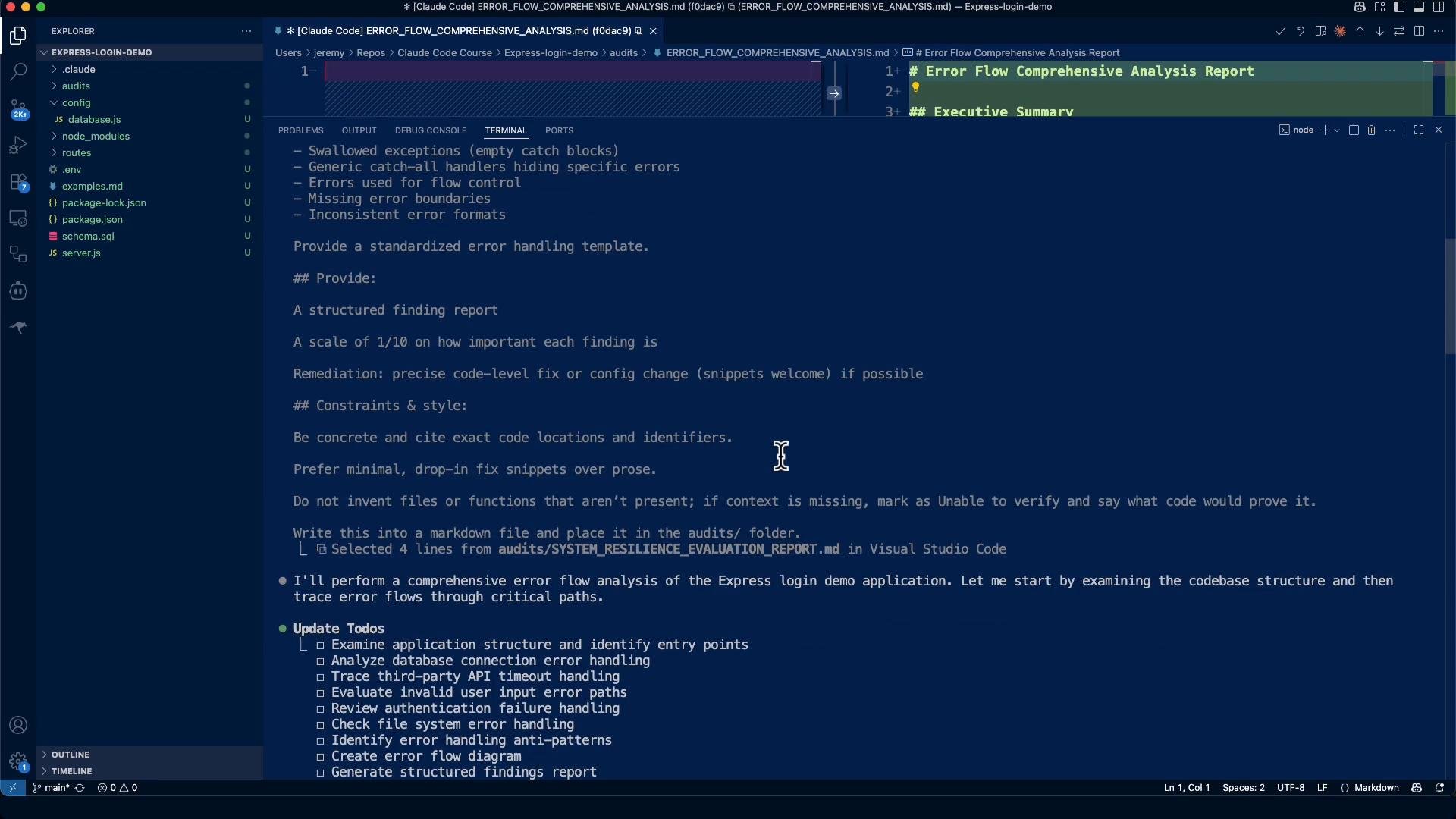
Below is the prompt used to drive the audit:
```text theme={null}
Evaluate this entire application.
Trace error flow through the application:
Critical paths to analyze:
1. Database connection failure
2. Third-party API timeout
3. Invalid user input
4. Authentication failure
5. File system errors
For each path, verify:
- Where is the error caught?
- How is it transformed?
- What gets logged?
- What does the user see?
- Is the system state consistent?
Create an error flow diagram showing:
- Error origin points
- Transformation layers
- Final handling points
- Recovery mechanisms
Anti-patterns to identify:
- Swallowed exceptions (empty catch blocks)
- Generic catch-all handlers hiding specific errors
- Errors used for flow control
- Missing error boundaries
- Inconsistent error formats
Provide a standardized error handling template.
Provide:
- A structured findings report
- A scale of 1/10 on how important each finding is
- Remediation: precise code-level fix or config change (snippets welcome) if possible
Constraints:
- Be concrete and cite exact code locations and identifiers (where present).
- Prefer minimal, drop-in fix snippets over prose.
- Do not invent files or functions that aren't present; if context is missing, mark as Unable to verify.
- Write this into a markdown file and place it in the audits/ folder.
```
 ***
## Executive summary
This audit inspects error handling in a small Express login demo. Key findings show several high-impact gaps that make the service susceptible to outages, information leakage, and inconsistent system state. The highest-priority fixes are adding a global error handler, validating critical runtime configuration, and protecting database interactions with timeouts and pool limits.
Top recommendations (high-level):
* Add a global Express error handler + process-level rejection handlers
* Harden database usage: connection pool limits, connection timeouts, and per-query timeouts
* Standardize error JSON responses and switch to structured logging (no console-only logs)
* Harden JWT usage (validate presence of secrets and specify algorithms)
* Add rate limiting to auth endpoints and consider circuit-breaker/retry for transient dependencies
Target keywords: Express error handling, Node.js error flow, PostgreSQL pool, JWT security, structured logging, rate limiting, circuit breaker.
***
## Application entry points and observed state
* Main server entry point: server is started but lacks a global error-handling middleware and request-level timeouts.
* Authentication route: single POST `/api/auth/login` endpoint implements validation, bcrypt compare, JWT signing.
* Database: PostgreSQL `pg` Pool exists but is missing explicit `max`, `connectionTimeoutMillis`, and per-query timeouts.
* Core dependencies observed: Express 4.x, `jsonwebtoken`, `bcrypt`, `express-validator`.
* Not found in the codebase: external HTTP clients and file system operations (`fs` not detected).
Where verification was not possible, the report calls that out (e.g., third-party API timeouts are "Not present / Unable to verify").
***
## Critical path analyses
For each critical path we show: origin points, observed flow, key gaps, and minimal remediation snippets.
### 1) Database connection / query failures — Severity: 9/10
Origin points
* Pool creation and configuration (missing connection timeouts / max clients)
* Route-level DB queries in auth flow (no per-query timeout)
Observed flow
* DB connection error or long-running query → `pool.query()` or client usage → route-level `catch` → generic error mapping to 503 or 500
* Potentially sensitive error messages are logged or returned depending on environment
Gaps
* No per-query timeouts → hung queries can block resources
* No pool max configuration → possible connection exhaustion under load
* No retry/circuit-breaker for transient failures
* Logging may include raw DB error objects (sensitive)
Minimal remediation (drop-in)
1. Set pool limits / timeouts (database config):
```javascript theme={null}
// database configuration — pool setup example
const { Pool } = require('pg');
const pool = new Pool({
connectionString: process.env.DATABASE_URL,
max: 20, // max clients in pool
idleTimeoutMillis: 30000, // close idle clients after 30s
connectionTimeoutMillis: 5000 // error if cannot connect in 5s
});
module.exports = pool;
```
2. Per-query timeout wrapper:
```javascript theme={null}
// Example per-query timeout wrapper
async function queryWithTimeout(text, params, timeoutMs = 5000) {
const client = await pool.connect();
try {
await client.query(`SET statement_timeout = ${timeoutMs}`);
return await client.query(text, params);
} finally {
client.release();
}
}
```
3. Circuit-breaker sketch (use to guard DB calls):
```javascript theme={null}
// circuit breaker utility — simplified example
class CircuitBreaker {
constructor({ failureThreshold = 5, timeout = 60_000 } = {}) {
this.failureThreshold = failureThreshold;
this.timeout = timeout;
this.failureCount = 0;
this.state = 'CLOSED';
this.lastFailureTime = 0;
}
async execute(fn) {
if (this.state === 'OPEN') {
if (Date.now() - this.lastFailureTime > this.timeout) this.state = 'HALF_OPEN';
else throw new Error('Circuit is OPEN');
}
try {
const result = await fn();
this.failureCount = 0;
this.state = 'CLOSED';
return result;
} catch (err) {
this.failureCount++;
this.lastFailureTime = Date.now();
if (this.failureCount >= this.failureThreshold) this.state = 'OPEN';
throw err;
}
}
}
```
Notes: For production use, prefer battle-tested libraries (e.g., `opossum`) and instrument metrics.
***
### 2) Third-party API timeout — Severity: N/A (Not present / Unable to verify)
Finding: No external HTTP clients detected in repository. Future integrations must:
* Set per-request timeouts (axios/fetch/timeouts)
* Implement retries with backoff and circuit breakers
* Surface standardized errors to the client
Unable to verify current code since no third-party calls were found.
***
### 3) Invalid user input — Severity: 6/10
Origin points
* Validation middleware applied on `/api/auth/login` (express-validator chains and `validationResult`)
Observed
* Email normalization and format checks present
* Password minimum length check exists
* Missing: explicit max lengths, sanitization to prevent XSS vectors, and strict error messaging to avoid information leakage
Gaps
* No size limits on input fields (risk of DoS with large payloads)
* Validation error responses can disclose too much detail
Minimal remediation (validation hardening):
```javascript theme={null}
// validation chains for the login endpoint
router.post('/login', [
body('email')
.isEmail().withMessage('Please provide a valid email address')
.normalizeEmail()
.isLength({ max: 254 }).withMessage('Email too long'),
body('password')
.isLength({ min: 8, max: 128 }).withMessage('Password must be 8-128 characters long')
], async (req, res, next) => {
const errors = validationResult(req);
if (!errors.isEmpty()) {
// Minimal, non-sensitive error response
return res.status(400).json({ error: 'Validation failed' });
}
// ... handler logic
});
```
Also consider input-size limits at the body parser / reverse proxy layer.
***
### 4) Authentication failures — Severity: 7/10
Origin points
* User-not-found branch
* Invalid password path using `bcrypt.compare`
* JWT signing usage
Observed good practices
* Consistent client-facing message for invalid credentials (prevents enumeration)
* Use of `bcrypt.compare` for password verification
Gaps
* No startup validation that `JWT_SECRET` exists; no explicit signing algorithm specified in `jwt.sign`
* No rate limiting or account lockouts
* JWT expiry read from env without validation
Minimal remediation
1. Validate critical config at startup:
```javascript theme={null}
// early in startup (main server entry point)
if (!process.env.JWT_SECRET) {
console.error('JWT_SECRET is not set. Exiting.');
process.exit(1);
}
```
2. Enforce JWT algorithm when signing:
```javascript theme={null}
const jwtOptions = { algorithm: 'HS256', expiresIn: process.env.JWT_EXPIRY || '1h' };
const token = jwt.sign({ sub: user.id }, process.env.JWT_SECRET, jwtOptions);
```
3. Apply rate limiting to login endpoint:
```javascript theme={null}
const rateLimit = require('express-rate-limit');
const loginLimiter = rateLimit({
windowMs: 15 * 60 * 1000, // 15 minutes
max: 5, // limit each IP to 5 login attempts per window
skipSuccessfulRequests: true,
message: { error: 'Too many login attempts, please try again later' }
});
app.use('/api/auth/login', loginLimiter);
```
Consider account lockout or progressive delays for repeated failed attempts.
***
### 5) File system errors — Severity: N/A (Not present / Unable to verify)
Finding: No file system usage found. If future code adds `fs` operations:
* Wrap I/O in try/catch and map errors to safe client responses
* Log errors with context but avoid exposing file paths or internals to users
***
## Error handling anti-patterns observed
* Generic catch-all handlers that swallow specific errors (e.g., returning 500 without context or remediation)
* Console-only logging (insufficient structured logs for production)
* Missing global error middleware and process-level handlers
* Inconsistent error response formats across code paths (validation vs auth vs DB errors)
Severity ranking (summary)
* Missing global handler: 9/10
* Generic swallowed errors: 8/10
* No circuit-breaker/retry: 8/10
* Console-only logging: 7/10
* Inconsistent response formats: 5/10
***
## Error flow diagram (simplified)
\[ HTTP Request ] → \[ Express App ] → \[ Auth Route ]
↓ ↓ ↓
ERROR ORIGIN POINTS: Input Validation | Authentication | Database | JWT
↓
TRANSFORMATION LAYER: Validation formatting | Auth normalization | DB error code switch
↓
FINAL HANDLING: HTTP status + standardized error JSON + structured log (avoid console-only)
↓
RECOVERY: Retry / Circuit Breaker / Rate limit / Graceful degradation (NONE present in current app)
***
## Structured findings (selected)
| # | Finding | Location | Severity | Impact | Remediation Complexity |
| -: | - | - | -: | - | - |
| 1 | Missing global error handler | main server entry point | 9/10 | Service crash on unhandled errors | Low |
| 2 | DB without timeouts/pool limits | database config; auth route queries | 9/10 | Resource exhaustion / hangs | Medium |
| 3 | Generic catch-all & swallowed errors | auth route catch blocks | 8/10 | Hidden failures | Low |
| 4 | No circuit-breaker / retry for DB | auth route DB interactions | 8/10 | Cascading failures | Medium |
| 5 | Insecure/untested JWT config | auth route JWT handling | 7/10 | Token risk | Low |
| 6 | No login rate limiting | server startup / auth routes | 7/10 | Brute-force risk | Medium |
| 7 | Console-only logging | auth route logging | 7/10 | Poor observability | Low |
| 8 | Missing input length limits | auth route validation middleware | 6/10 | DoS via large payloads | Low |
| 9 | Validation detail exposure | auth route validation handling | 5/10 | Information disclosure | Low |
| 10 | Inconsistent error formats | multiple locations | 5/10 | Poor client experience | Medium |
***
## Concrete remediations (minimal, prioritized snippets)
Priority 1 (Immediate, low-effort)
1. Add global Express error middleware (place after all routes):
```javascript theme={null}
// add after all route middleware in the main server entry point
app.use((err, req, res, next) => {
// Replace console.error with structured logger in production
console.error('Unhandled error:', err);
const clientMessage = process.env.NODE_ENV === 'production'
? 'Internal server error'
: err.message || 'Internal server error';
res.status(err.status || 500).json({
error: {
type: err.type || 'internal_error',
message: clientMessage
}
});
});
```
2. Process-level rejection / exception handlers (startup):
```javascript theme={null}
process.on('unhandledRejection', (reason, promise) => {
console.error('Unhandled Rejection at:', promise, 'reason:', reason);
// Optionally: graceful shutdown
process.exit(1);
});
process.on('uncaughtException', (err) => {
console.error('Uncaught Exception:', err);
// Optionally: attempt graceful shutdown
process.exit(1);
});
```
3. Validate critical config at startup:
```javascript theme={null}
if (!process.env.JWT_SECRET) {
console.error('JWT_SECRET is not set. Exiting.');
process.exit(1);
}
```
Priority 2 (Short-term)
4. Database pool and per-query timeout (see Database section above).
5. Rate limiting for login (see Authentication section above).
6. Replace console logging with structured logger:
```javascript theme={null}
// logger utility — create a logger module
const winston = require('winston');
const logger = winston.createLogger({
level: 'info',
format: winston.format.combine(
winston.format.timestamp(),
winston.format.json()
),
transports: [
new winston.transports.File({ filename: 'error.log', level: 'error' }),
new winston.transports.File({ filename: 'combined.log' }),
new winston.transports.Console({ format: winston.format.simple() })
]
});
module.exports = logger;
```
Use `logger.error(...)` / `logger.info(...)` instead of `console.*`.
Priority 3 (Medium-term)
7. Standardize error responses:
```javascript theme={null}
// error response helper
const sendErrorResponse = (res, statusCode, errorType, message, details = null) => {
const payload = {
error: { type: errorType, message }
};
if (details && process.env.NODE_ENV !== 'production') payload.error.details = details;
return res.status(statusCode).json(payload);
};
```
8. Enforce JWT signing options (see Authentication section).
9. Implement resilient patterns: circuit-breaker and retries for transient dependencies.
***
## Testing suggestions (local/manual)
Run these to validate behavior changes:
```bash theme={null}
# Test DB timeout (simulate long query)
timeout 5s psql -h localhost -U user -d db -c "SELECT pg_sleep(10);"
# Simulate concurrent login attempts to reveal connection exhaustion
for i in {1..25}; do curl -s -X POST http://localhost:3000/api/auth/login -d '{"email":"a@b.com","password":"x"}' -H "Content-Type: application/json" & done
# Test malformed input
curl -s -X POST http://localhost:3000/api/auth/login -d '{"email":"invalid","password":""}' -H "Content-Type: application/json"
# Test rate limiting (after adding limiter)
for i in {1..10}; do curl -s -X POST http://localhost:3000/api/auth/login -d '{"email":"test@test.com","password":"wrongpass"}' -H "Content-Type: application/json"; done
```
Add automated integration tests that simulate DB failures, timeouts, and high concurrency for regression coverage.
***
## Summary & recommended next steps
Short-term (days)
* Add global error middleware and process-level handlers.
* Validate critical environment variables at startup (`JWT_SECRET`).
* Swap `console` calls for a structured logger (winston or similar).
Near-term (1–2 weeks)
* Enforce DB pool limits and per-query timeouts.
* Add rate limiting to auth endpoints.
* Explicitly set JWT signing algorithm and validate expiry config.
Mid-term (2–4 weeks)
* Implement circuit-breaker/retry patterns around DB/external calls.
* Standardize error payloads across routes.
* Harden input sanitization and size limits.
* Add account lockout and monitoring/alerts on error rates.
These changes prioritize minimal, testable, drop-in improvements to reduce crash risk, limit information exposure, and improve observability. Apply incrementally and add tests verifying behavior under simulated failures.
Start by adding the global error middleware and config validation — they are low-effort, high-impact fixes that prevent many common failure modes.
This documentation is built and hosted on [Mintlify](https://mintlify.com), a developer documentation platform.