> ## Documentation Index
> Fetch the complete documentation index at: https://notes.kodekloud.com/llms.txt
> Use this file to discover all available pages before exploring further.
# Initial Project Analysis
> A structured automated audit of an Express Node.js login demo focusing on architecture, modularity, security issues, and concrete code-level remediation
In this lesson we demonstrate how to audit a small Express (Node.js) project for software design, modularity, and architectural issues using Claude Code. The aim is a structured findings report with concrete, code-level remediation you can apply incrementally.
In this lesson we perform an automated software-quality audit using Claude Code. If you've participated in enterprise code reviews, you already know reviewers check architecture, design patterns, error handling, and operational practices. Claude Code automates that process at scale and produces actionable remediation tied to code locations.
Example interactive session that starts Claude Code in the project folder:
```bash theme={null}
jeremy@MACSTUDIO Express-login-demo % claude
* Welcome to Claude Code!
/help for help, /status for your current setup
cwd: /Users/jeremy/Repos/Claude Code Course/Express-login-demo
> Try "refactor "
? for shortcuts
In COMPREHENSIVE_SECURITY_REPORT.md
```
The lesson uses a curated set of review prompts (instead of typing one-off prompts). The prompt set used for this lesson is available in the repo:
* [https://github.com/JeremyMorgan/claude-code-reviewing-prompts](https://github.com/JeremyMorgan/claude-code-reviewing-prompts)
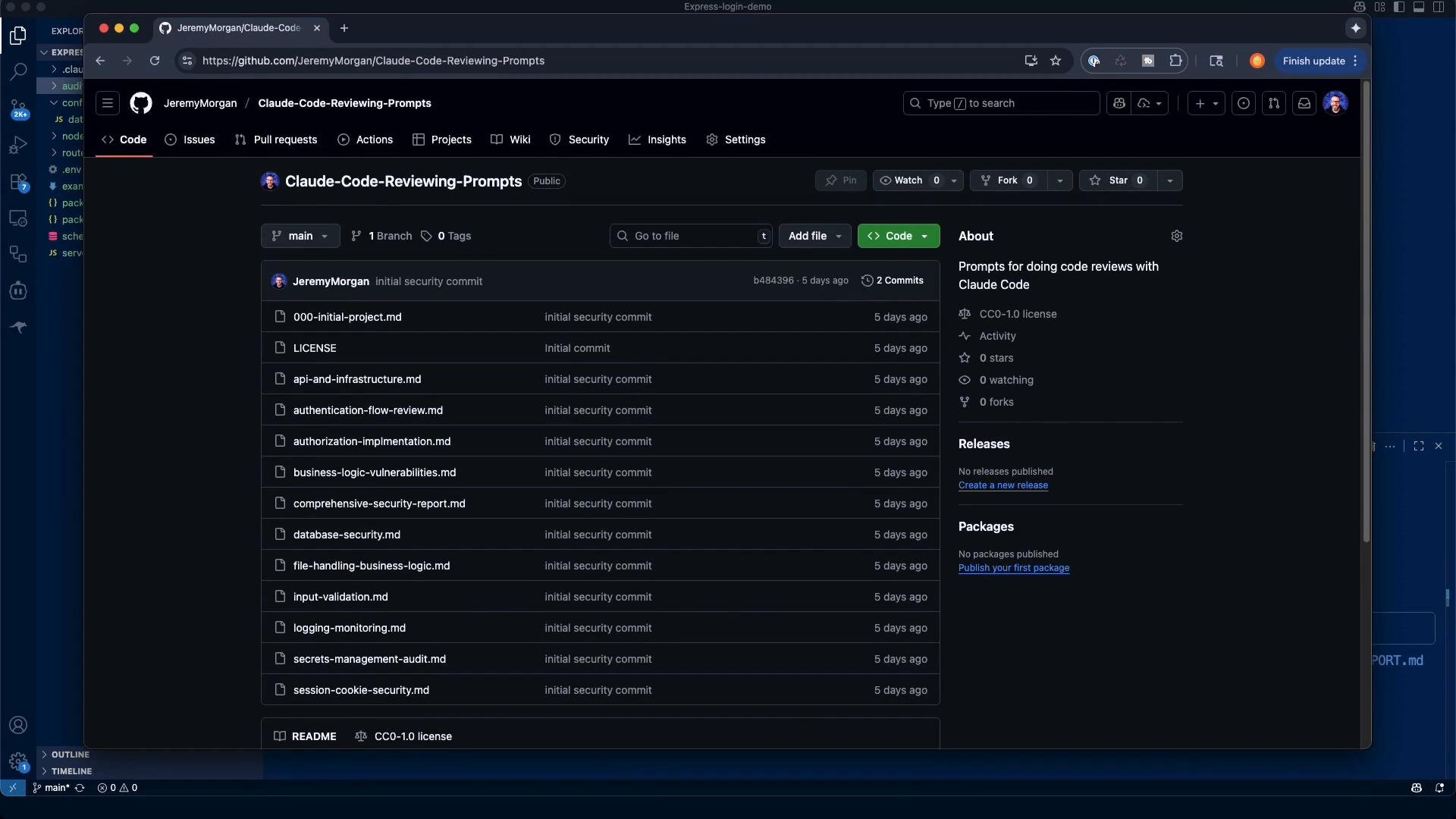 How the review is scoped (condensed prompt used for the audit):
```text theme={null}
Analyze the project architecture and identify:
Evaluate:
1. Is there clear separation of concerns?
2. Which architectural pattern is used (MVC, Layered, Microservices)?
3. Are there any God objects or modules doing too much?
4. Is the dependency flow clean (no circular dependencies)?
5. Rate the modularity (1-10) with justification
Provide a textual architecture description showing:
- Layer dependencies
- Data flow
- External service integrations
- Potential bottlenecks
Identify anti-patterns:
- Spaghetti code
- Copy-paste programming
- God classes/modules
- Tight coupling
- Missing abstractions
Provide:
- A structured findings report
- A scale of 1/10 on how important each finding is
- Remediation: precise code-level fix or config change (snippets welcome), plus defense-in-depth guidance
Constraints & style:
- Be concrete and cite exact code locations and identifiers.
- Prefer minimal, drop-in fix snippets over prose.
- Do not invent files or functions that aren’t present; if context is missing, mark as Unable to verify and say what code would prove it.
- Write this into a markdown file and place it in the audits/ folder.
```
While running, Claude Code inspects the repository: listing directories, reading key files, and searching for code patterns. Example actions (condensed):
```bash theme={null}
● List(~/Repos/Claude Code Course/Express-login-demo)
└ Listed 25 paths
● Read(server.js)
└ Read 19 lines
● Read(package.json)
└ Read 25 lines
● List(routes)
└ Listed 4 paths
● Read(routes/auth.js)
└ Read 98 lines
● Read(config/database.js)
└ Read 19 lines
● Read(schema.sql)
└ Read 22 lines
● Search(pattern: "class|function|async function", output_mode: "content")
└ Found 10827 lines
```
Claude then wrote a structured audit to `audits/SOFTWARE_DESIGN_ARCHITECTURE_ANALYSIS.md`. The cleaned and consolidated version of that report follows.
Project: Express Login Demo
***
## Executive summary
Overall Architecture Score: 4/10
This Express Login Demo exhibits a minimal MVC-inspired structure but contains significant design and operational shortcomings. Business logic is embedded in route handlers, there's limited abstraction, and the app lacks centralized error handling and input validation. These problems raise technical debt and make the code harder to test, secure, and scale.
***
## Architecture analysis
### 1. Architectural pattern assessment
Pattern identified: Minimal MVC-like structure
* Model: PostgreSQL integration via `config/database.js`
* View: JSON API responses
* Controller: Route handlers in `routes/auth.js`
Separation of concerns: 3/10
* Business logic and data access are mixed into route handlers.
* No service or repository layer is present.
* DB config is separated (positive).
### 2. Project structure
```text theme={null}
express-login-demo/
├─ server.js # Entry point + middleware setup
├─ routes/auth.js # Authentication routes (monolithic)
├─ config/database.js # Database connection
├─ schema.sql # Database schema
└─ package.json # Dependencies
```
Modularity: 3/10 — flat structure with most logic in `routes/auth.js`. No migrations, no distinct repositories or service abstractions.
### 3. Data flow (high-level)
* HTTP request → `routes/auth.js` (validation, DB queries, auth logic) → `config/database.js` → PostgreSQL
* Missing: service layer, caching, rate limiting, centralized logging, and centralized error handling
Potential bottlenecks:
1. Single DB pool without explicit connection limits
2. Blocking synchronous crypto (if used) can stall the Node event loop
3. No caching — every request hits the database
4. No rate limiting — auth endpoints exposed to brute-force attempts
***
## Anti-patterns identified
1. God object / God module (Severity: 8/10)
* Location: `routes/auth.js`
* Symptom: One file handles routing, validation, business logic, and DB access.
* Impact: Hard to test and maintain.
2. Primitive obsession (Severity: 6/10)
* Location: `routes/auth.js` — raw SQL and primitive payload handling.
* Example:
```javascript theme={null}
// Raw SQL and direct token creation
const userQuery = 'SELECT id, email, name, password FROM users WHERE email = $1';
const token = jwt.sign({ userId: user.id, email: user.email }, process.env.JWT_SECRET);
```
* Remediation: Introduce repositories/models and token services.
3. Copy-paste programming (Severity: 5/10)
* Location: `routes/auth.js`
* Symptom: Repeated error response patterns and duplicated logic.
* Remediation: Centralize error responses with middleware.
4. Tight coupling (Severity: 7/10)
* Location: Route handlers `require` DB, bcrypt, and jwt directly.
* Symptom: Hard to unit test and mock dependencies.
* Remediation: Use dependency injection via factories.
5. Missing input validation/sanitization (Severity: 6/10)
* Location: `routes/auth.js`
* Symptom: No robust validation (consider `express-validator`).
* Remediation: Add validation middleware.
***
## Detailed findings
### High priority issues
| Issue | Severity | Location | Impact | Remediation |
| - | - | - | - | - |
| Monolithic route handler | 8/10 | `routes/auth.js:17-96` | Maintenance, testing | Extract service & repository layers |
| No global error handling middleware | 7/10 | `server.js` | Inconsistent responses, leaking errors | Implement centralized error handler & AppError class |
| Tight coupling | 7/10 | Throughout | Hard to test/maintain | Use DI/factory functions |
| No input sanitization | 6/10 | `routes/auth.js` | Security risk | Add `express-validator` middleware |
| No structured logging | 6/10 | App-wide | Low observability | Implement `pino` or `winston` with correlation IDs |
### Medium priority issues
| Issue | Severity | Location | Impact | Remediation |
| - | - | - | - | - |
| Primitive obsession | 6/10 | `routes/auth.js` | Type safety, security | Create domain models and repository functions |
| Missing configuration management | 5/10 | `server.js` | Environment issues | Add a config module (12-factor approach) |
| No health checks | 4/10 | N/A | Deployment readiness | Add `/health` and readiness endpoints |
### Low priority issues
| Issue | Severity | Location | Impact | Remediation |
| - | - | - | - | - |
| No API versioning | 3/10 | Routes | Backwards compatibility | Add `/v1/` route prefixes |
| No request correlation IDs | 3/10 | N/A | Tracing/debugging | Add correlation middleware |
| No graceful shutdown | 2/10 | `server.js` | Deployment stability | Handle SIGTERM/SIGINT and drain DB connections |
***
## Recommended architecture improvements
### Layered architecture (conceptual)
```text theme={null}
+-----------------------------------------+
| Routes Layer |
+-----------------------------------------+
| Controllers Layer |
+-----------------------------------------+
| Services Layer |
+-----------------------------------------+
| Data Access Layer (Repositories) |
+-----------------------------------------+
| Models Layer |
+-----------------------------------------+
```
### Proposed directory structure
```text theme={null}
src/
├─ controllers/ # Request handling logic
├─ services/ # Business logic
├─ models/ # Domain models
├─ repositories/ # Data access layer
├─ middleware/ # Cross-cutting concerns
├─ utils/ # Utilities
├─ config/ # Configuration management
└─ constants/ # Application constants
```
### Dependency flow (text diagram)
```text theme={null}
Client → Routes → Controllers → Services → Repositories → Database
↓
Middleware (auth, validation, logging)
```
***
## Concrete remediations (drop-in examples)
Below are small, focused code patterns to reduce coupling, improve testability, and add defenses.
* Auth service (move business logic out of routes):
```javascript theme={null}
// src/services/AuthService.js
class AuthService {
constructor(userRepository, passwordService, tokenService) {
this.userRepository = userRepository;
this.passwordService = passwordService;
this.tokenService = tokenService;
}
async authenticate(email, password) {
const user = await this.userRepository.findByEmail(email);
if (!user || !(await this.passwordService.verify(password, user.password_hash))) {
const err = new Error('Invalid credentials');
err.statusCode = 401;
throw err;
}
const token = await this.tokenService.createToken({ userId: user.id, email: user.email });
return { user, token };
}
}
module.exports = AuthService;
```
* Repository abstraction for data access:
```javascript theme={null}
// src/repositories/userRepository.js
const pool = require('../../config/database');
async function findByEmail(email) {
const result = await pool.query(
'SELECT id, email, name, password_hash FROM users WHERE email = $1',
[email]
);
return result.rows[0] || null;
}
module.exports = { findByEmail };
```
* Use a factory to wire routes with injected services:
```javascript theme={null}
// src/routes/createAuthRouter.js
const express = require('express');
function createAuthRouter(authService, validatorMiddleware) {
const router = express.Router();
router.post('/login', validatorMiddleware, async (req, res, next) => {
try {
const { email, password } = req.body;
const { user, token } = await authService.authenticate(email, password);
res.json({ token, user: { id: user.id, email: user.email, name: user.name } });
} catch (err) {
next(err);
}
});
return router;
}
module.exports = createAuthRouter;
```
* Input validation middleware using express-validator:
```javascript theme={null}
// src/middleware/validators/authValidator.js
const { body, validationResult } = require('express-validator');
const loginValidation = [
body('email').isEmail().normalizeEmail(),
body('password').isLength({ min: 8 }).trim(),
(req, res, next) => {
const errors = validationResult(req);
if (!errors.isEmpty()) {
return res.status(422).json({ errors: errors.array() });
}
next();
}
];
module.exports = { loginValidation };
```
* Centralized error handler:
```javascript theme={null}
// src/middleware/errorHandler.js
function errorHandler(err, req, res, next) {
const status = err.statusCode || 500;
const message = status < 500 ? err.message : 'Internal server error';
// Example: logger.error(err);
res.status(status).json({ error: message });
}
module.exports = errorHandler;
```
* Token service:
```javascript theme={null}
// src/services/tokenService.js
const jwt = require('jsonwebtoken');
function createToken(payload) {
return jwt.sign(payload, process.env.JWT_SECRET, { expiresIn: '1h' });
}
module.exports = { createToken };
```
***
## Security & operational recommendations
* Sanitize and validate all inputs (e.g., express-validator).
* Always use parameterized queries (prepared statements) to prevent SQL injection.
* Run CPU-bound crypto (bcrypt) using async APIs; consider background workers for heavy tasks.
* Protect auth endpoints with rate limiting (express-rate-limit).
* Implement structured logging (pino or winston) and attach correlation IDs to requests.
* Add health and readiness endpoints for orchestration tooling.
* Implement graceful shutdown to drain DB/pool connections on SIGTERM/SIGINT.
***
## Final assessment and next steps
* Current state: Functional but with high architectural debt.
* Technical debt: High — refactoring required for scale and maintainability.
* Immediate actions:
1. Extract services and repositories from route handlers.
2. Add global error handling middleware and an AppError pattern.
3. Add input validation and sanitization.
4. Introduce DI/factory functions to decouple dependencies.
5. Implement structured logging and basic operational endpoints.
* Long-term:
1. Migrate to a layered architecture with clear responsibilities.
2. Add automated tests (unit + integration).
3. Add configuration management and environment-driven settings.
4. Integrate observability: metrics & tracing.
This analysis delivers a prioritized set of findings and concrete code examples that you can apply incrementally. Subsequent lessons will expand this with more detailed design principles and a targeted security audit.
***
## Links and references
* express-validator: [https://express-validator.github.io/docs/](https://express-validator.github.io/docs/)
* pino (structured logging): [https://getpino.io/](https://getpino.io/)
* winston: [https://github.com/winstonjs/winston](https://github.com/winstonjs/winston)
* express-rate-limit: [https://www.npmjs.com/package/express-rate-limit](https://www.npmjs.com/package/express-rate-limit)
* JSON Web Tokens (JWT): [https://jwt.io/](https://jwt.io/)
* Node.js best practices & architecture: [https://nodejs.org/en/docs/](https://nodejs.org/en/docs/) (general guidance)
This documentation is built and hosted on [Mintlify](https://mintlify.com), a developer documentation platform.