> ## Documentation Index
> Fetch the complete documentation index at: https://notes.kodekloud.com/llms.txt
> Use this file to discover all available pages before exploring further.
# Comprehensive Report
> Executive summary of security audit for an Express Login Demo app detailing vulnerabilities, prioritized remediation steps, and recommended tools and processes.
In this lesson we generate an executive-style, high-level security report for the Express Login Demo application. This executive summary consolidates findings from a repository audit and provides prioritized remediation steps for engineering teams and leadership.
**Application**: Express Login Demo\
**Date**: 2025-08-21\
**Auditor**: Claude Code Security Analysis\
**Version**: 1.0.0
This executive summary prioritizes remediation and recommends tools and processes. It is not a replacement for line-by-line code audits, automated/static scans, or penetration testing. Use this to guide immediate actions and to create detailed remediation tickets for engineering teams.
## Executive Summary
The Express Login Demo application contains multiple security issues across configuration, authentication, session, logging, and transport layers. The audit found 12 issues with a combined Overall Security Posture of: CRITICAL (9.2/10 Risk Score).
Key metrics at a glance:
| Category | Count |
| - | - |
| Critical vulnerabilities (Fix immediately) | 3 |
| High priority (Fix within 1 week) | 4 |
| Medium priority (Fix within 1 month) | 4 |
| Low priority (Fix in the next release) | 1 |
| Total issues found | 12 |
Immediate actions required:
* Replace weak or hard-coded JWT secret with a cryptographically strong secret and store it in a secrets manager.
* Implement rate limiting for authentication endpoints.
* Sanitize logs and reduce error-response detail to avoid leaking sensitive data.
* Enforce HTTPS and add appropriate security headers (Helmet).
Example of the interactive session used to begin the audit (for context):
```bash theme={null}
* Welcome to Claude Code!
/help for help, /status for your current setup
cwd: /Users/jeremy/Repos/Claude Code Course/Express-login-demo
> Try "refactor "
? for shortcuts
In LOGGING_AND_MONITORING_SECURITY_AUDIT.md
```
A brief snapshot of running an `npm audit` for dependency checks:
```bash theme={null}
$ npm audit --json
{
"auditReportVersion": 2,
"vulnerabilities": {}
// trimmed for brevity
}
```
***
Critical items below require immediate attention. Create high-priority tickets and coordinate credential rotations, deployment windows, and stakeholder communication before applying fixes that rotate secrets or revoke tokens.
## Critical Vulnerabilities (Fix Immediately)
### 1. Weak or Hard-coded JWT Secret Key
* Severity: Critical
* CVE: N/A (configuration issue)
* CWE: CWE-798 (Use of Hard-coded Credentials)
* Location: `.env` (example: `.env:2`)
Risk: A weak or committed JWT secret enables token forgery and offline brute-force attacks.
Remediation:
* Generate a cryptographically secure secret (256-bit / 32 bytes recommended).
* Do not commit secrets to source control. Use environment variables or a secrets manager (AWS Secrets Manager, Azure Key Vault, HashiCorp Vault).
* Rotate any exposed secrets immediately and update dependent deployments.
Example: generate a secure secret for Node.js:
```bash theme={null}
# generate a 256-bit secret (32 bytes) as hex
node -e "console.log(require('crypto').randomBytes(32).toString('hex'))"
```
Set in `.env` (never commit):
```text theme={null}
JWT_SECRET=replace_with_secure_hex_generated_above
```
### 2. Database Credentials or Secrets Exposed
* Severity: Critical
* CWE: CWE-200 (Information Exposure)
* Location: `.env` or other committed configuration files
Risk: Committed credentials allow unauthorized database access and can lead to data exfiltration.
Remediation:
* Rotate exposed credentials immediately.
* Move secrets to a dedicated secrets manager and restrict access via IAM roles or RBAC.
* Add `.env`, secrets, and config files to `.gitignore`. Consider scanning history for leaked credentials.
### 3. Sensitive Error Information Disclosure
* Severity: Critical
* CWE: CWE-209 (Information Exposure Through Error Messages)
* Location: `routes/auth.js` and global error handlers
Risk: Verbose stack traces and raw DB errors in HTTP responses reveal implementation details useful to attackers.
Remediation:
* Return generic client-facing error messages (e.g., "Invalid credentials" or "Internal server error").
* Log detailed errors securely on the server side with structured logging and appropriate retention controls.
* Sanitize logs to ensure no secrets or PII are stored in plaintext.
Example (Express) — safe error handler:
```javascript theme={null}
// Express error handler (example)
app.use((err, req, res, next) => {
// Log the detailed error securely (server side only)
logger.error('Unhandled error', { message: err.message, stack: err.stack });
// Send a generic response to the client
res.status(500).json({ error: 'Internal server error' });
});
```
***
## High Priority Issues (Fix within 1 week)
### 4. Missing Rate Limiting on Auth Endpoints
* Location: `routes/auth.js:9` (login route)
* Risk: Allows unlimited authentication attempts → credential stuffing / brute force.
Remediation:
* Add rate limiting middleware (e.g., `express-rate-limit`) and consider account lockouts or progressive delays after repeated failures.
Example (express-rate-limit):
```javascript theme={null}
const rateLimit = require('express-rate-limit');
const authLimiter = rateLimit({
windowMs: 15 * 60 * 1000, // 15 minutes
max: 10, // limit each IP to 10 requests per windowMs
standardHeaders: true,
legacyHeaders: false,
});
app.use('/login', authLimiter);
```
### 5. Insufficient Security Event Logging
* Severity: High
* CWE: CWE-778 (Insufficient Logging)
* Location: `routes/auth.js:32-46`
Risk: Missing authentication and suspicious-activity logs delay detection and incident response.
Remediation:
* Log authentication events (success/failure, source IP, user-agent) using structured logging (JSON).
* Avoid logging sensitive fields (passwords, tokens). Route logs to centralized aggregators (ELK, Splunk, Cloud Logging).
Example (winston):
```javascript theme={null}
const winston = require('winston');
const logger = winston.createLogger({
level: 'info',
transports: [new winston.transports.Console()],
});
// Logging a failed auth event
logger.warn('Login failed', { username: req.body.email, ip: req.ip });
```
### 6. Missing HTTPS Enforcement and Security Headers
* Severity: High
* CWE: CWE-319 (Cleartext Transmission of Sensitive Information)
* Location: `server.js`
Risk: Unencrypted traffic allows tokens and credentials to be intercepted.
Remediation:
* Enforce TLS with valid certificates and redirect HTTP to HTTPS.
* Use Helmet to set security headers: HSTS, X-Frame-Options, X-Content-Type-Options, and define CSP where applicable.
Example (Helmet + HTTPS redirect):
```javascript theme={null}
const helmet = require('helmet');
app.use(helmet());
// Redirect HTTP to HTTPS (behind a proxy/load balancer, ensure trust proxy as needed)
app.enable('trust proxy');
app.use((req, res, next) => {
if (!req.secure) return res.redirect(`https://${req.headers.host}${req.url}`);
next();
});
```
### 7. No Input Sanitization for Logging (Log Injection)
* Severity: High
* CWE: CWE-117 (Improper Output Neutralization for Logs)
Risk: Unsanitized inputs in logs can mislead analysts or poison parsers.
Remediation:
* Normalize and sanitize untrusted input before logging. Prefer structured logs rather than free-form text.
* Validate and escape user-supplied data that will be stored in logs or displayed in dashboards.
***
## Medium Priority Issues (Fix within 1 month)
### 8. Missing Security Headers (CSP, HSTS, X-Frame-Options)
* Severity: Medium
* CWE: CWE-693 (Protection Mechanism Failure)
* Location: `server.js`
Remediation:
* Configure Helmet and define a Content Security Policy to mitigate XSS and resource injection.
### 9. No Session Invalidation or Token Blacklisting
* Severity: Medium
* CWE: CWE-613 (Insufficient Session Expiration)
* Location: `routes/auth.js`
Risk: No mechanism to revoke JWTs allows continued access with stolen tokens.
Remediation:
* Implement short-lived access tokens and refresh tokens.
* Store refresh tokens securely (HttpOnly cookies) and maintain a server-side blacklist or token store (e.g., Redis) to revoke tokens on logout or compromise.
Example concept:
* Issue short-lived access token (15 min)
* Issue refresh token stored in a secure HttpOnly cookie
* On logout, mark refresh token as revoked in the server-side store
### 10. Inadequate Error Handling Exposing Implementation Details
* Severity: Medium
* CWE: CWE-209
* Location: `routes/auth.js:72-94`
Remediation:
* Standardize error handling middleware and ensure stack traces are not returned to clients. Log internal details only to secure logs.
### 11. Missing Input Length Validation
* Severity: Medium
* CWE: CWE-770
* Location: `routes/auth.js:10-16`
Risk: Extremely long inputs can cause DoS or unexpected resource consumption.
Remediation:
* Enforce reasonable maximum lengths for email, username, and other inputs. Use `express-validator` or similar libraries.
Example (express-validator):
```javascript theme={null}
const { body, validationResult } = require('express-validator');
app.post('/register', [
body('email').isEmail().isLength({ max: 254 }),
body('password').isLength({ min: 8, max: 128 }),
], (req, res) => {
const errors = validationResult(req);
if (!errors.isEmpty()) return res.status(400).json({ errors: errors.array() });
// proceed
});
```
***
## Low Priority Issues (Fix in next release)
### 12. No Monitoring and Health-check Endpoints
* Severity: Low
* CWE: CWE-778 (Insufficient Logging / Observability)
* Location: Application-wide
Remediation:
* Add health endpoints and metrics (Prometheus compatible), instrument performance metrics and errors, and integrate alerts to improve detection and response time.
***
## Security Recommendations and Implementation Roadmap
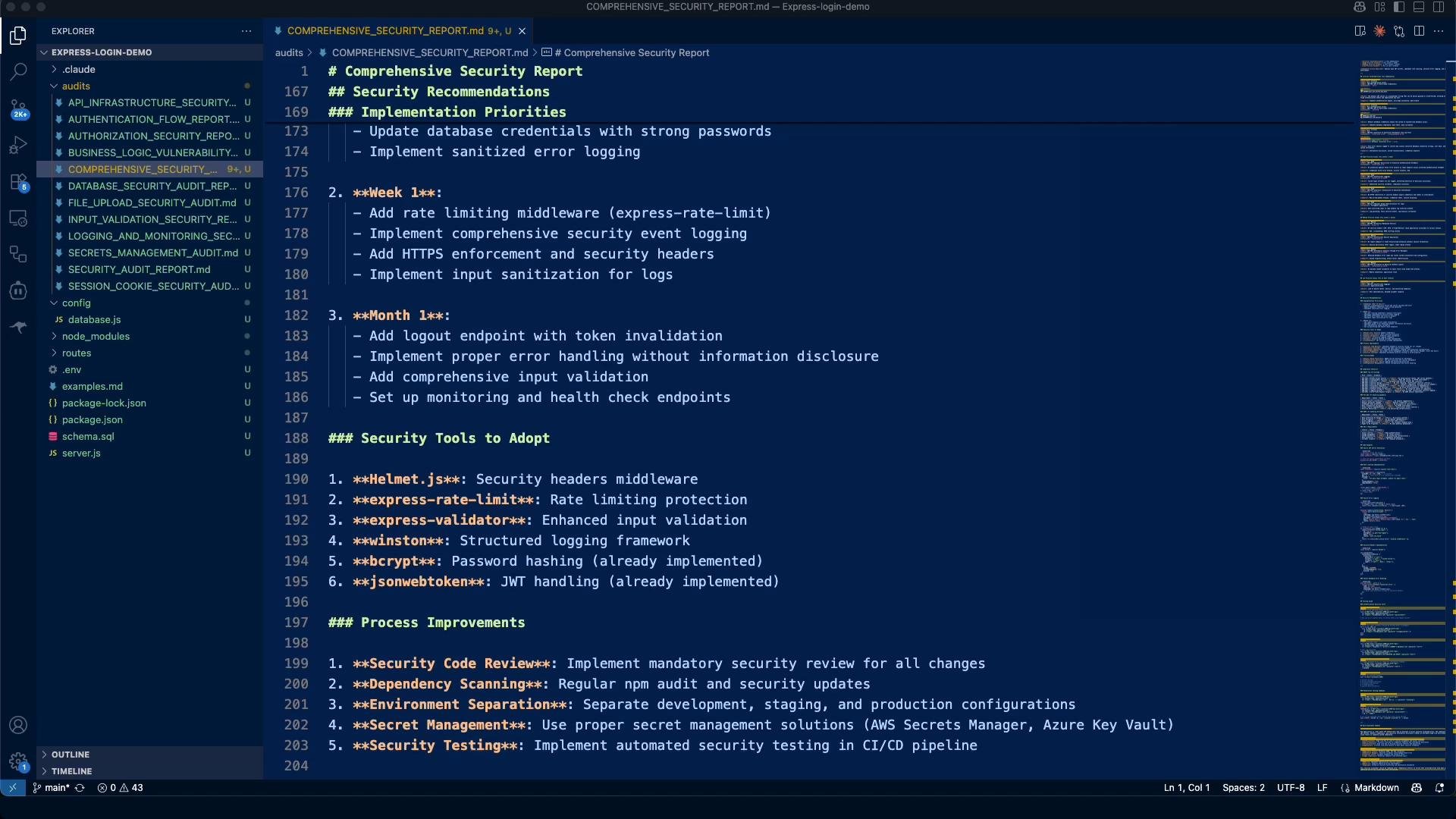
Prioritized implementation plan:
| Timeframe | Actions |
| - | - |
| Next 24 hours | Rotate any exposed credentials. Generate a secure JWT secret and store it in a secrets manager. Disable verbose error responses and implement secure server-side logging. |
| Week 1 | Add rate limiting for auth endpoints. Enforce HTTPS and add security headers via Helmet. Implement structured logging and sanitize logged inputs. |
| Month 1 | Implement token invalidation/refresh flows and short-lived tokens. Add comprehensive input validation and length checks. Deploy health checks, metrics, and monitoring integrations. Add automated dependency scanning in CI. |
Recommended tools:
* Helmet.js — security headers ([helmetjs.github.io](https://helmetjs.github.io/))
* express-rate-limit — rate limiting ([npmjs.com/package/express-rate-limit](https://www.npmjs.com/package/express-rate-limit))
* express-validator — input validation ([express-validator.github.io/docs/](https://express-validator.github.io/docs/))
* winston / pino — structured logging
* bcrypt — secure password hashing
* jsonwebtoken — JWT handling
* Secrets manager — AWS Secrets Manager, Azure Key Vault, or HashiCorp Vault
* SAST/DAST/Dependency scanning — integrate into CI pipelines
Process improvements:
* Require security-focused code reviews for auth and cryptography changes.
* Automate dependency and vulnerability scanning in CI.
* Separate environment configurations (dev/staging/prod) and enforce least privilege.
* Prohibit storing secrets in repositories and provide secure secrets onboarding.
* Provide secure-coding training focused on OWASP Top 10 for developers.
***
## Compliance Checklist
* OWASP Top 10: Authentication and injection protections addressed via rate limiting, input validation, CSP recommendations.
* PCI DSS: If handling payments, ensure encryption in transit, strict logging, and segmentation.
* GDPR: Minimize PII, apply retention policies, and secure storage/access controls.
* SOC 2: Ensure proper logging, monitoring, and access controls for SOC 2 readiness.
***
## Secure Code Examples (Selected)
1. Generate secure JWT secret (Node.js):
```bash theme={null}
node -e "console.log(require('crypto').randomBytes(32).toString('hex'))"
```
2. Express: Helmet + HTTPS redirect + rate limiting:
```javascript theme={null}
const express = require('express');
const helmet = require('helmet');
const rateLimit = require('express-rate-limit');
const app = express();
app.use(helmet());
app.enable('trust proxy'); // if behind reverse proxy
app.use((req, res, next) => {
if (!req.secure) return res.redirect(`https://${req.headers.host}${req.url}`);
next();
});
const authLimiter = rateLimit({
windowMs: 15 * 60 * 1000,
max: 10,
});
app.use('/login', authLimiter);
```
3. Safe error handling:
```javascript theme={null}
app.use((err, req, res, next) => {
logger.error('Unhandled error', { message: err.message, stack: err.stack });
res.status(500).json({ error: 'Internal server error' });
});
```
4. Logout / token revocation concept:
```javascript theme={null}
// On logout: mark refresh token as revoked in Redis or DB
// On token validation: check if token is revoked before accepting
```
***
## Testing Guide (Verification commands & checks)
* Rate limiting: use a script or `curl` to exceed allowed requests to `/login` and verify a `429` response.
* HTTPS redirect: `curl -I http://your-host` should return a `301/302` redirect to `https://`.
* Security headers: `curl -I https://your-host` should show `Strict-Transport-Security`, `X-Frame-Options`, `X-Content-Type-Options`, etc.
* Logging: attempt failed and successful logins and confirm events exist in centralized logs without sensitive data.
* Dependency scan: run `npm audit` and triage high/critical results in CI.
Example curl to check headers:
```bash theme={null}
curl -I https://localhost:3000
```
***
## Notes on Scope and Next Steps
This report is an executive-level summary intended to prioritize remediation work. It is not a replacement for detailed, line-by-line secure-code fixes, automated scans, or pentesting. For each identified issue produce an actionable ticket that includes:
* Code references and proposed changes
* Test cases to verify remediation
* Rollback plan and deployment windows if secrets or tokens must be rotated
This report was compiled from repository analysis and audit commands executed against the Express Login Demo codebase and environment. Use the remediation roadmap above to plan sprints and security tasks with engineering leadership.
 For reference, the prompts used to generate and iterate on these audits are collected at: [https://github.com/JeremyMorgan/Claude-Code-Reviewing-Prompts](https://github.com/JeremyMorgan/Claude-Code-Reviewing-Prompts)
Thank you for reading this lesson.
This documentation is built and hosted on [Mintlify](https://mintlify.com), a developer documentation platform.