> ## Documentation Index
> Fetch the complete documentation index at: https://notes.kodekloud.com/llms.txt
> Use this file to discover all available pages before exploring further.
# Storing Data
> This lesson explores the storing phase of the data pipeline in Azure, focusing on optimal storage solutions for analytics and batch processing.
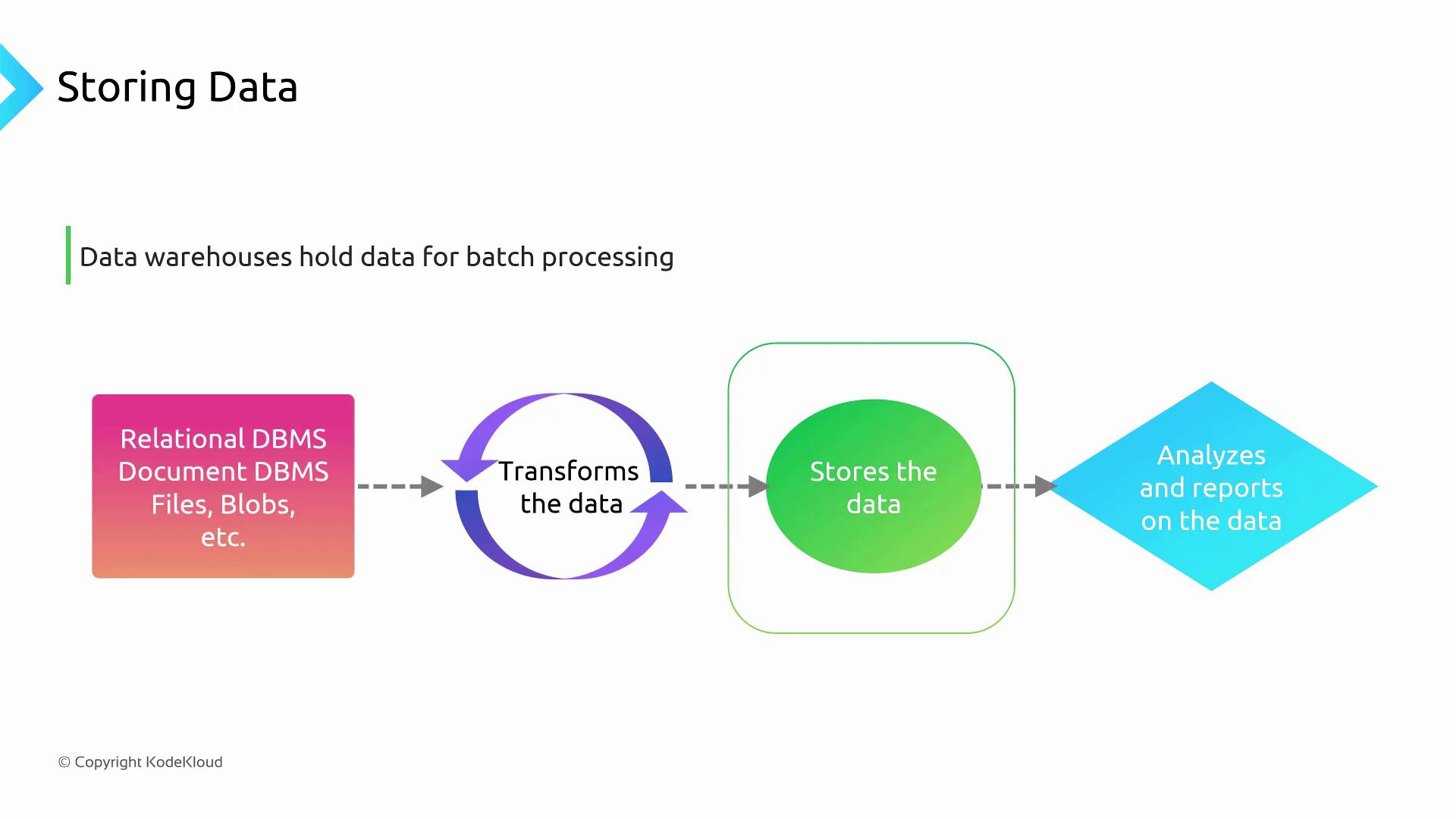
In this lesson from the **Azure Data Fundamentals (DP-900)** course, we explore the **Storing** phase of the data pipeline. After extracting and transforming data with **Azure Data Factory**, the next step is to load your cleansed data into the optimal storage solution for **batch processing**, reporting, and analytical workloads.
## Data Stores for Batch Processing
Whether you’re aggregating sales metrics or preparing large datasets for machine learning, choosing the right batch storage is crucial.
### Key Batch Storage Options
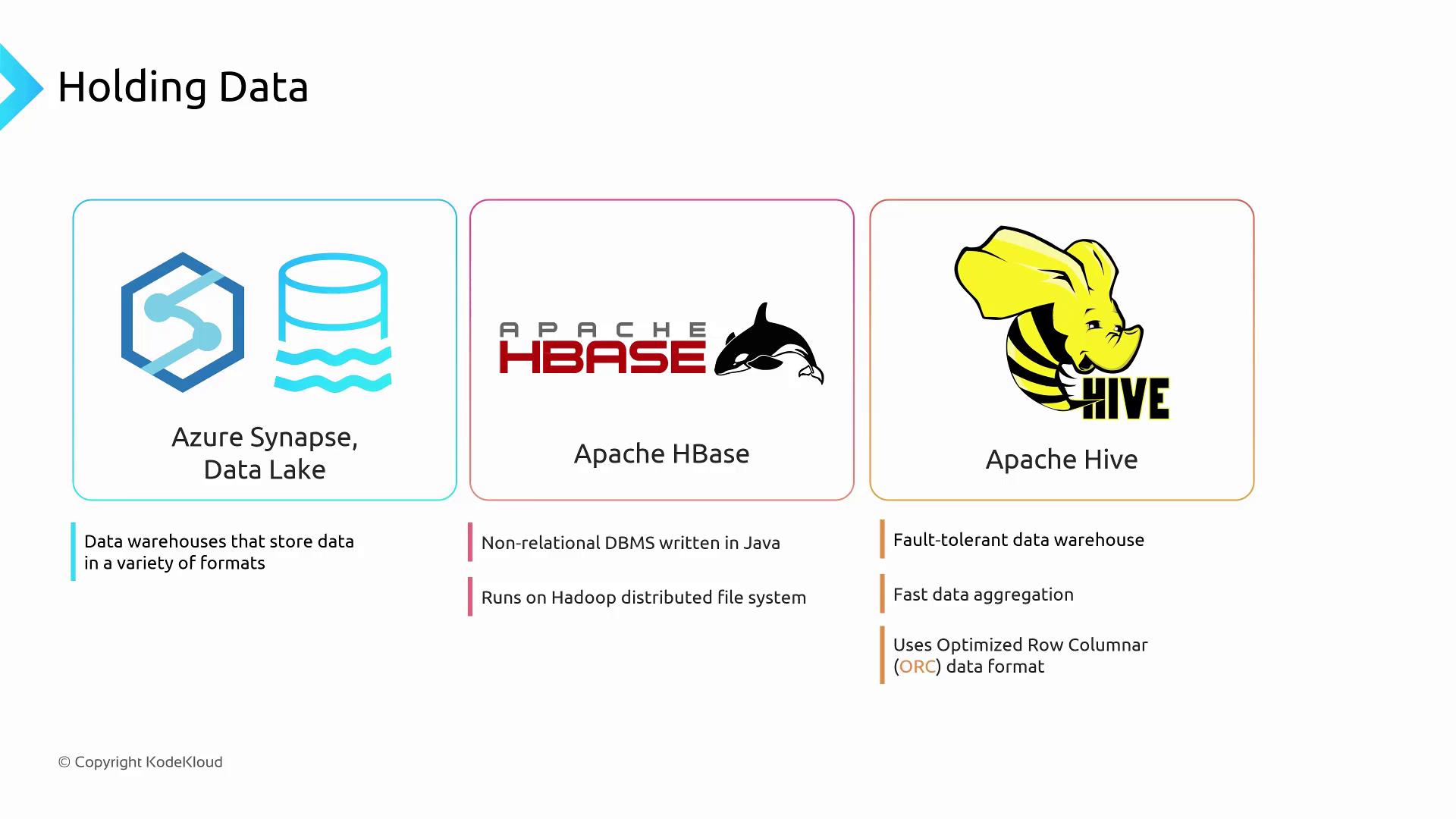
| Data Store | Type | Key Features | Common Use Case |
| -------------------- | --------------------- | -------------------------------------------------------------- | --------------------------------------- |
| Azure Synapse & ADLS | Cloud analytics lake | PolyBase for direct querying, supports Parquet/CSV/JSON | Large-scale data lake for SQL analytics |
| Apache HBase | NoSQL wide-column | Horizontally scalable, HDFS-native, low I/O bottlenecks | Real-time reads/writes on big tables |
| Apache Hive | Hadoop data warehouse | ORC columnar storage, fast `SUM`/`AVG`/`COUNT`, fault-tolerant | Ad-hoc aggregations on Hadoop clusters |
### Azure Synapse Analytics and Azure Data Lake Storage
Azure Synapse Analytics integrates seamlessly with Azure Data Lake Storage (ADLS). You can store data in multiple formats—**CSV, Parquet, JSON**, and more—and use **PolyBase** to run T-SQL queries directly against your files.
No ETL is required before querying. PolyBase pushes computation down to ADLS, boosting performance and reducing costs.
### Apache HBase
Apache HBase is a Java-based, NoSQL wide-column store built on Hadoop Distributed File System (HDFS). It offers:
* **Horizontal scalability**: Distributes data across many nodes for parallel reads and writes.
* **HDFS ecosystem**: Leverages existing Hadoop clusters, minimizing I/O bottlenecks.
* **Easy migration**: On-premises HBase schemas lift-and-shift to Azure effortlessly.
### Apache Hive
Apache Hive transforms Hadoop into a fault-tolerant data warehouse. Hive uses the **Optimized Row Columnar (ORC)** format to:
* Accelerate aggregations like `SUM`, `AVG`, and `COUNT`.
* Read only relevant columns, reducing I/O overhead.
* Maintain schema-on-read for flexible data ingestion.
## Data Warehouse Schemas for Analytics
When designing for analytics, your table schemas often deviate from OLTP patterns. Two popular modeling techniques are the **Star Schema** and the **Cube Schema**.
| Schema Type | Structure | Best For |
| ----------- | ----------------------------------------------- | ----------------------------------------- |
| Star Schema | Central fact table + surrounding dimensions | Multi-dimensional filters, ad-hoc queries |
| Cube Schema | Multiple “slices” of the same fact by dimension | High-speed aggregations across axes |
### Star Schema
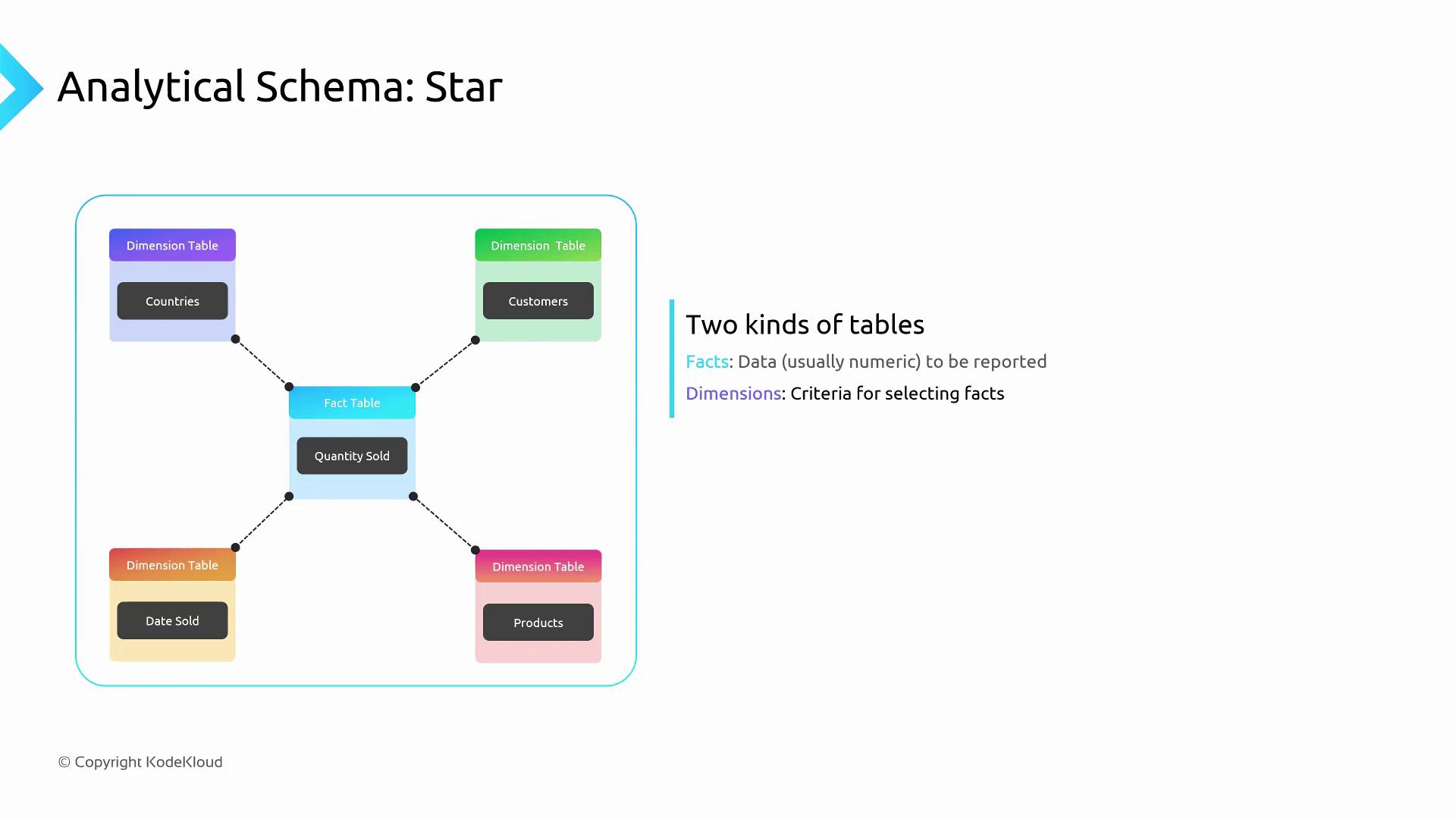
A **star schema** centers around a **fact table** containing numeric measures (e.g., sales amounts), linked to multiple **dimension tables** (e.g., Customer, Product, Date).
* **Fact table**: Holds transactional metrics over time.
* **Dimension tables**: Store descriptive attributes for filtering and grouping.
This model simplifies SQL joins and enhances query performance, especially in **Azure Synapse dedicated SQL pools**.
### Cube Schema
A **cube schema** extends beyond two dimensions by stacking multiple slices of data—each slice represents the fact table at a specific dimension value (e.g., year).
* Fast aggregations along time, geography, and product axes.
* Pre-aggregated views reduce query runtime.
* Scales to 4+ dimensions in many OLAP systems.
Cubes optimize dashboards and BI tools that require instant drill-downs and rollups.
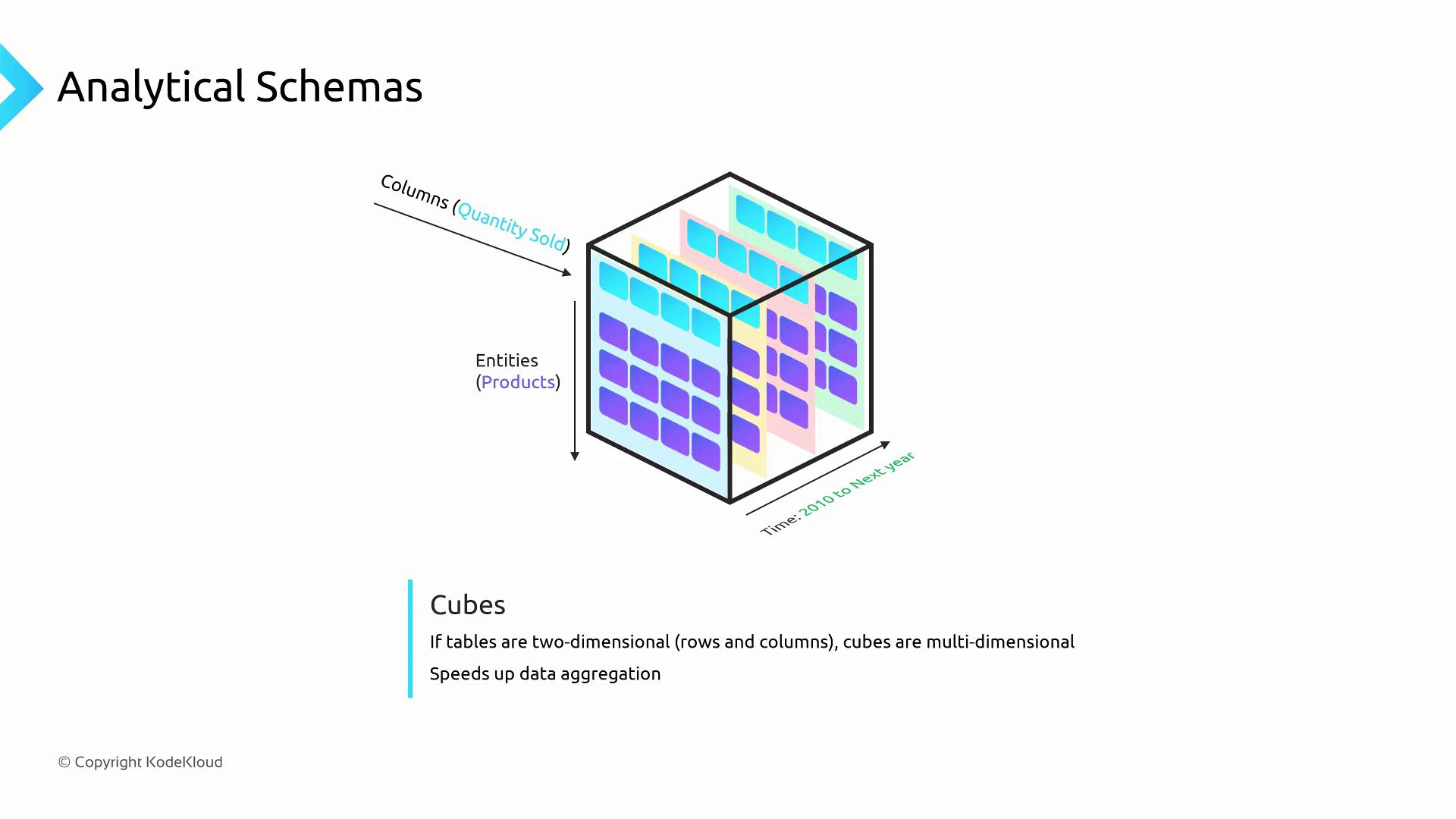
Some OLAP solutions support even more dimensions—each tailored for specialized analytical queries.
## Links and References
* [Azure Data Factory Overview](https://docs.microsoft.com/azure/data-factory/overview)
* [Azure Synapse Analytics Documentation](https://docs.microsoft.com/azure/synapse-analytics/)
* [Apache HBase Reference Guide](https://hbase.apache.org/book.html)
* [Apache Hive ORC Format](https://orc.apache.org/)
* [DP-900 Microsoft Certified: Azure Data Fundamentals](https://docs.microsoft.com/certifications/exams/dp-900/)