> ## Documentation Index
> Fetch the complete documentation index at: https://notes.kodekloud.com/llms.txt
> Use this file to discover all available pages before exploring further.
# Costs and Benefits
> This article evaluates the costs and benefits of relational databases compared to alternative storage solutions for structured data management.
By now, we’ve covered relational schemas, structured data modeling, core SQL operations, and transaction integrity. This section evaluates when to use relational databases—and when to consider alternative storage solutions.
## Advantages of the Relational Model
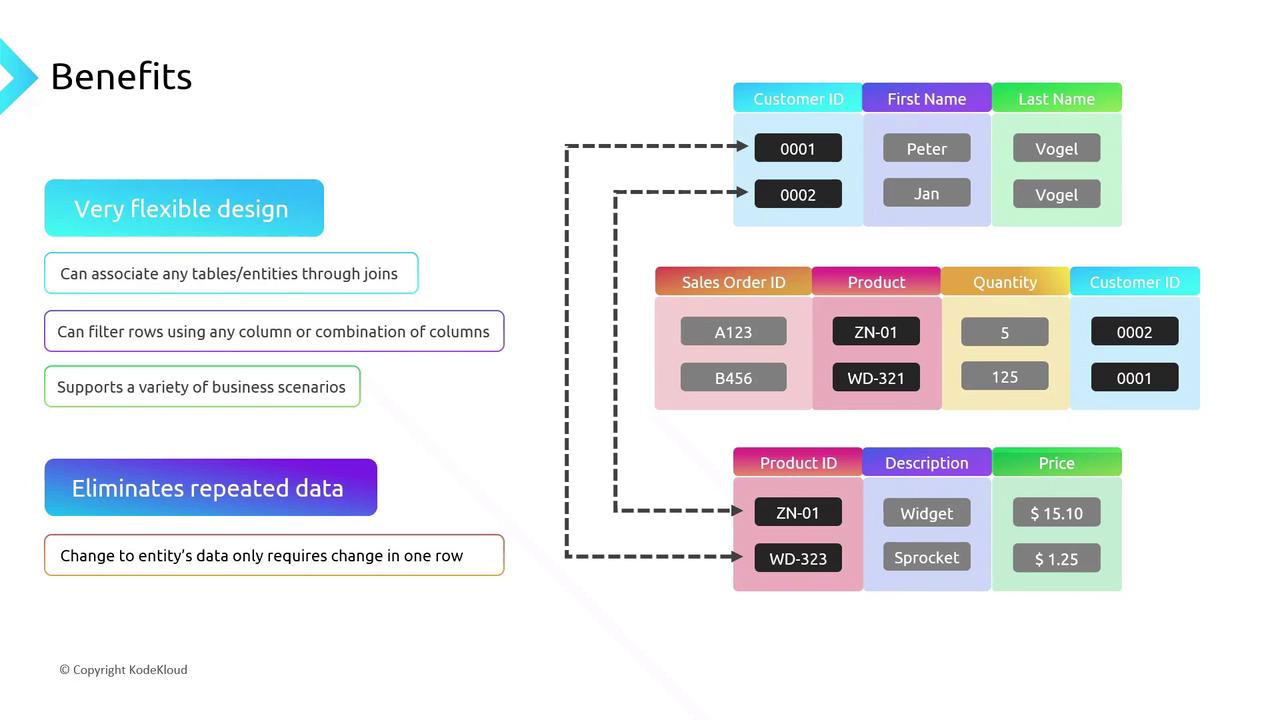
Relational databases excel at organizing structured data with clear relationships:
* **Flexible schema design:** Link tables like **Customer**, **SalesOrder**, and **Product** through foreign keys.
* **Data integrity:** Enforce constraints to eliminate duplicates.
* **Powerful queries:** Use joins to answer questions such as “Which products did each customer purchase?”
## Performance Overhead in OLTP Workloads
In an OLTP environment, minimizing latency and maximizing throughput are critical. Multi‐table updates—for example, transferring funds between savings and checking accounts—require:
1. Coordinated, transactional updates across multiple tables
2. Locking and logging for ACID compliance
These operations can become a bottleneck, limiting transactions per second.
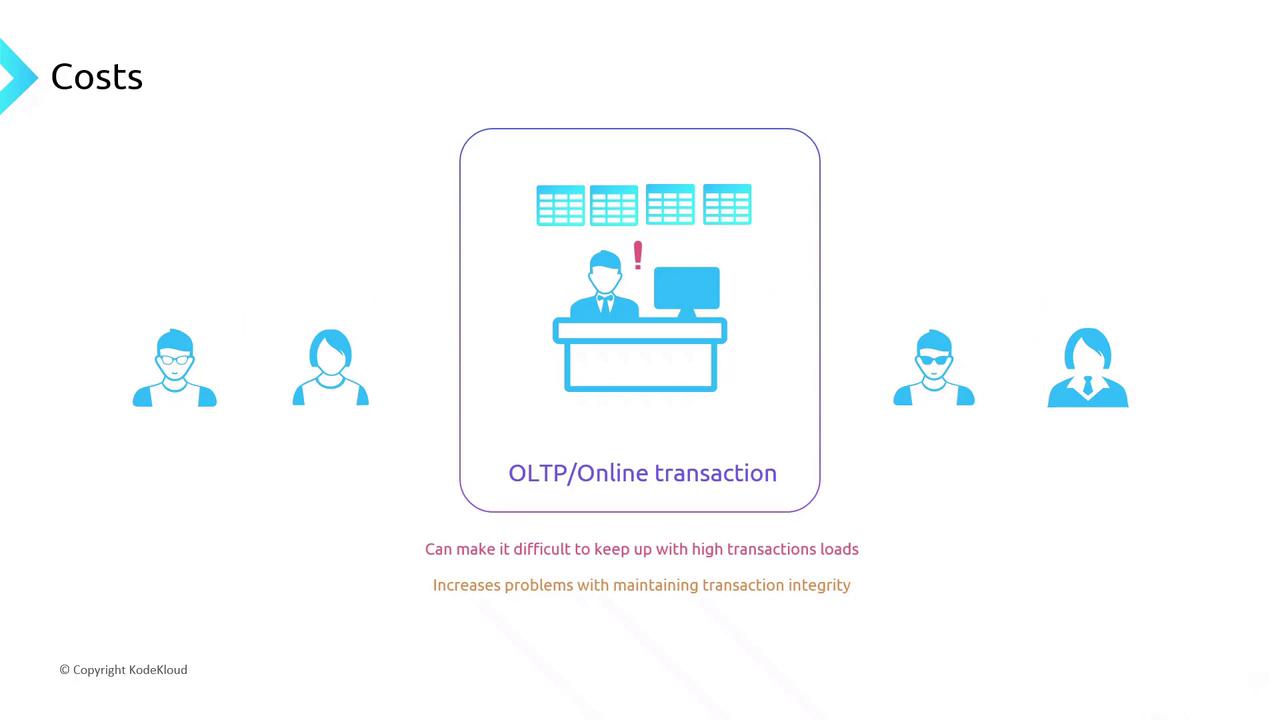
High transaction volumes with complex joins can degrade performance. For latency-sensitive workloads, consider specialized data stores or caching layers.
## Modeling Diverse Entities with a Fixed Schema
A rigid table structure forces all records to share the same columns. Selling books, gas stoves, and laptops in one table leads to:
* Many nullable columns
* Multiple specialized tables or EAV patterns
This complexity can be hard to maintain and query.
## Reporting Challenges on Normalized Schemas
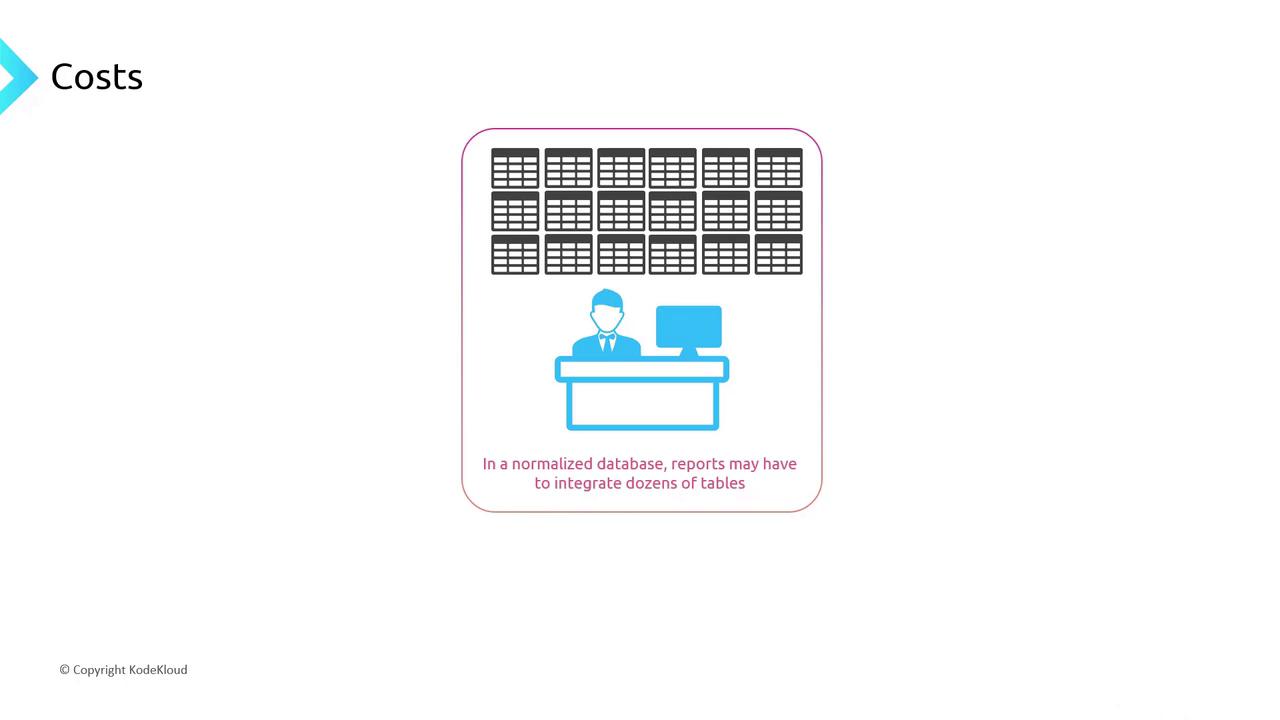
Normalized schemas are ideal for OLTP but often problematic for large‐scale analytics. Generating a report over hundreds of thousands of orders requires:
* Joining **Customer**, **SalesOrder**, and **Product** tables for each row
* Scanning large indexes repeatedly
## Alternative Data Storage Solutions
To overcome these limitations, teams often adopt:
| Storage Pattern | Use Case | Benefits |
| -------------------------- | ----------------------------------------- | ------------------------------------------------ |
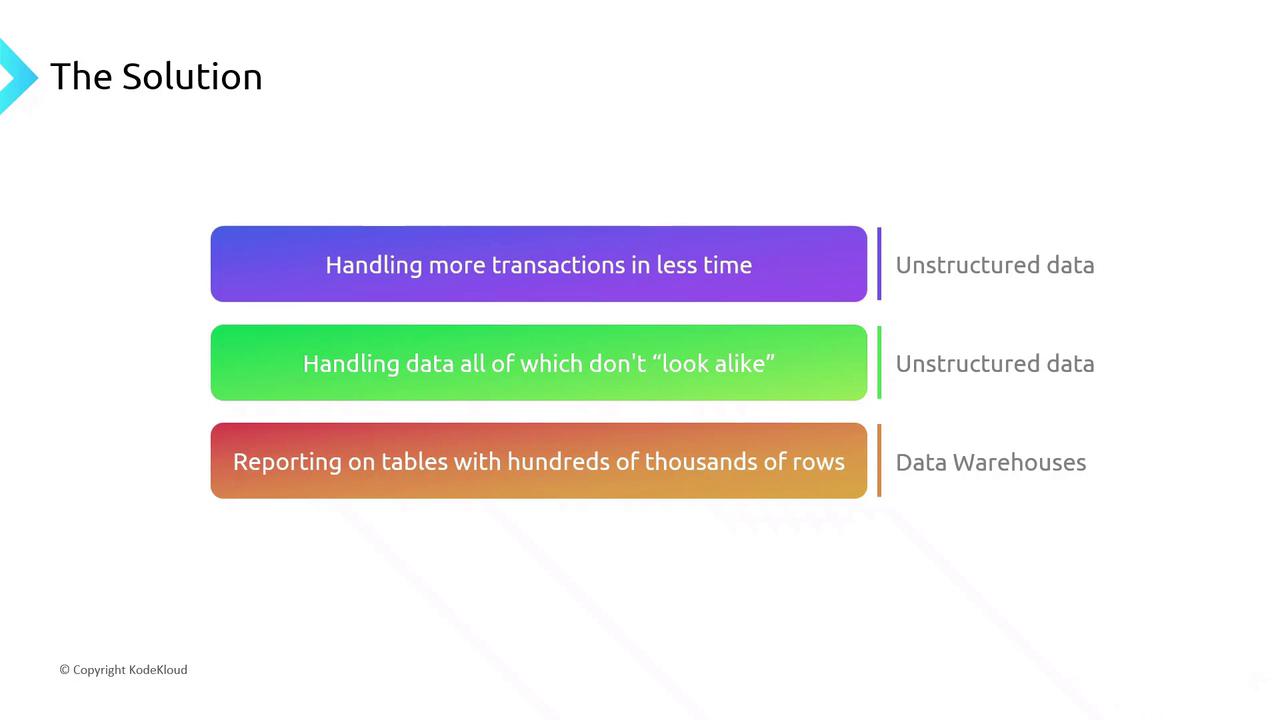
| NoSQL (Document/Key-Value) | High-volume, schema-flexible transactions | Eliminates multi-table updates; low latency |
| Columnar/Analytical Stores | Large-scale analytics and reporting | Optimized for scans and aggregations |
| Data Warehouse | Centralized analytics at scale | Denormalized/star schemas reduce expensive joins |
## Data Warehousing and ETL Strategies
In a data warehouse, you might merge **Customer**, **SalesOrder**, and **Product** into a single, denormalized table. This sacrifices update efficiency but speeds up reporting dramatically.
ETL pipelines, Change Data Capture (CDC), and other integration patterns ensure the warehouse stays up to date with your OLTP system. These will be covered in a later lesson.
***
## References
* [Azure SQL Database overview](https://docs.microsoft.com/azure/azure-sql/)
* [Introduction to NoSQL](https://docs.microsoft.com/azure/cosmos-db/introduction)
* [Data Warehouse concepts](https://docs.microsoft.com/azure/synapse-analytics/overview-what-is)