> ## Documentation Index
> Fetch the complete documentation index at: https://notes.kodekloud.com/llms.txt
> Use this file to discover all available pages before exploring further.
# Roles and Responsibilities
> This article outlines roles, responsibilities, and permission models in relational database management to ensure data security, integrity, and availability.
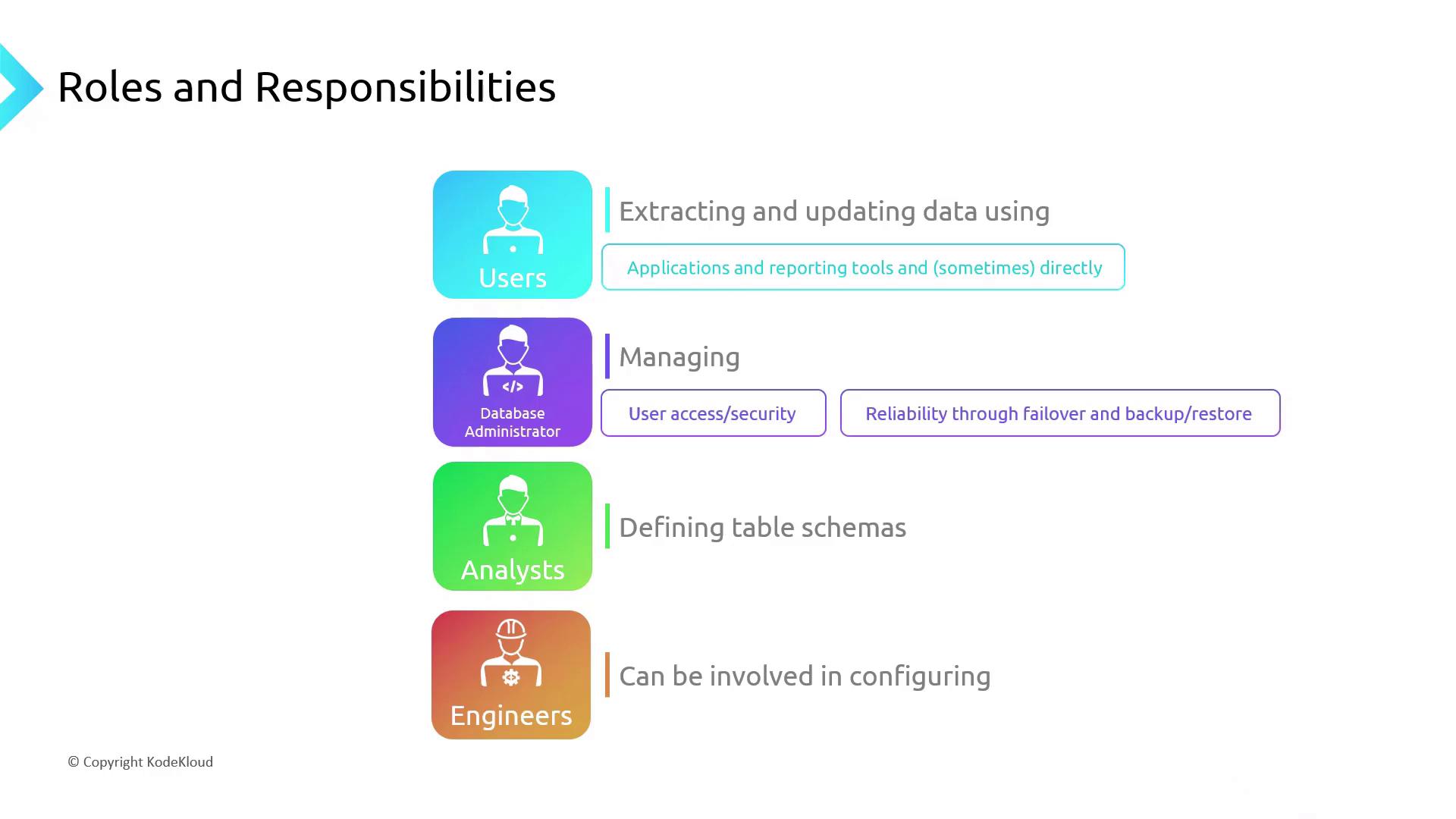
In a relational database environment, clear separation of duties ensures data security, integrity, and availability. Below, we outline each role’s scope, permission level, and core tasks.
## User Accounts and Permission Models
Regular users require finely tuned access to perform their daily tasks without overstepping boundaries.
| Permission Type | Description |
| --------------------- | ---------------------------------------------- |
| Read Only | View existing rows and schema definitions only |
| Insert Without Select | Add new rows without seeing existing data |
| Delete Rows | Remove rows under controlled conditions |
Grant the minimum necessary permissions following the principle of least privilege. Regularly audit roles to ensure they match current job functions.
## Applications and Reporting Tools
Applications and BI tools should inherit or explicitly receive the same permissions as individual users.
* Honor end-user credentials by default
* Require explicit grants when operating under a service account
* Prevent unauthorized data operations through role-based access
## Database Administrators
DBAs oversee the entire lifecycle of database operations:
* Assign and revoke user permissions
* Configure automated backups and restore procedures
* Monitor system health and performance metrics
* Plan and execute disaster recovery drills
## Data Analysts
Analysts focus on schema design and data model optimization:
* Use Data Definition Language (DDL) to create or modify tables
* Implement normalization rules to reduce redundancy
* Typically cannot SELECT sensitive production data directly
## Data Engineers
Engineers specialize in deployment and performance tuning:
* Configure database clusters and edge deployments (e.g., Azure IoT Edge)
* Optimize indexing, partitioning, and query plans
* Maintain schema integrity without viewing or exporting raw data
## Core Characteristics of Structured Data
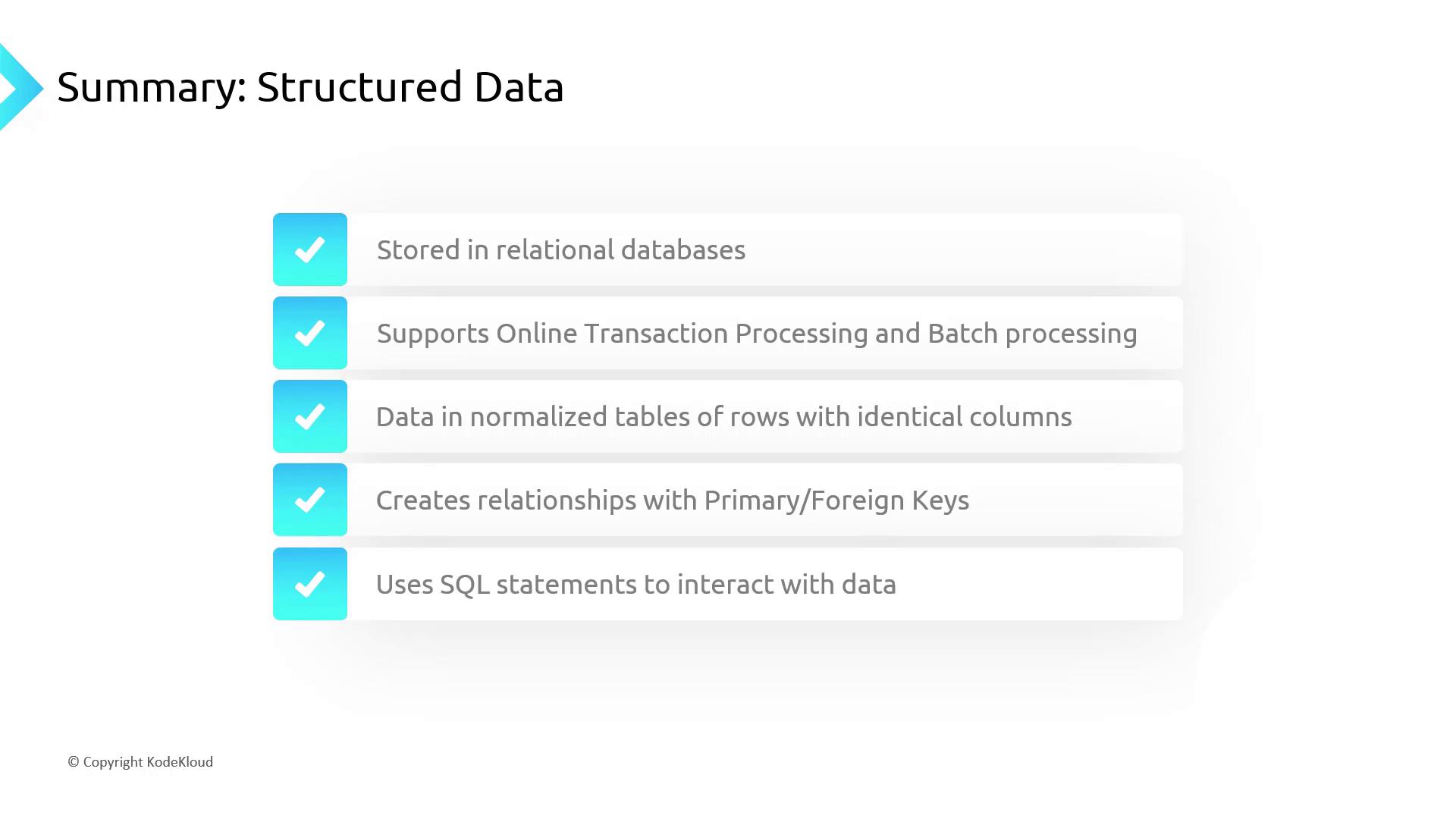
Structured data lives in relational tables with well-defined schemas and relationships:
* Stored in relational database management systems (RDBMS)
* Supports Online Transaction Processing (OLTP) and batch workflows
* Organized into normalized tables with consistent column definitions
* Relationships enforced via primary keys (PK) and foreign keys (FK)
* Accessed and manipulated using SQL (SELECT, INSERT, UPDATE, DELETE)
## Deployment Options and Considerations
Choosing the right infrastructure impacts cost, scalability, and reliability:
| Deployment Type | Pros | Cons |
| ----------------------- | ------------------------------ | -------------------------- |
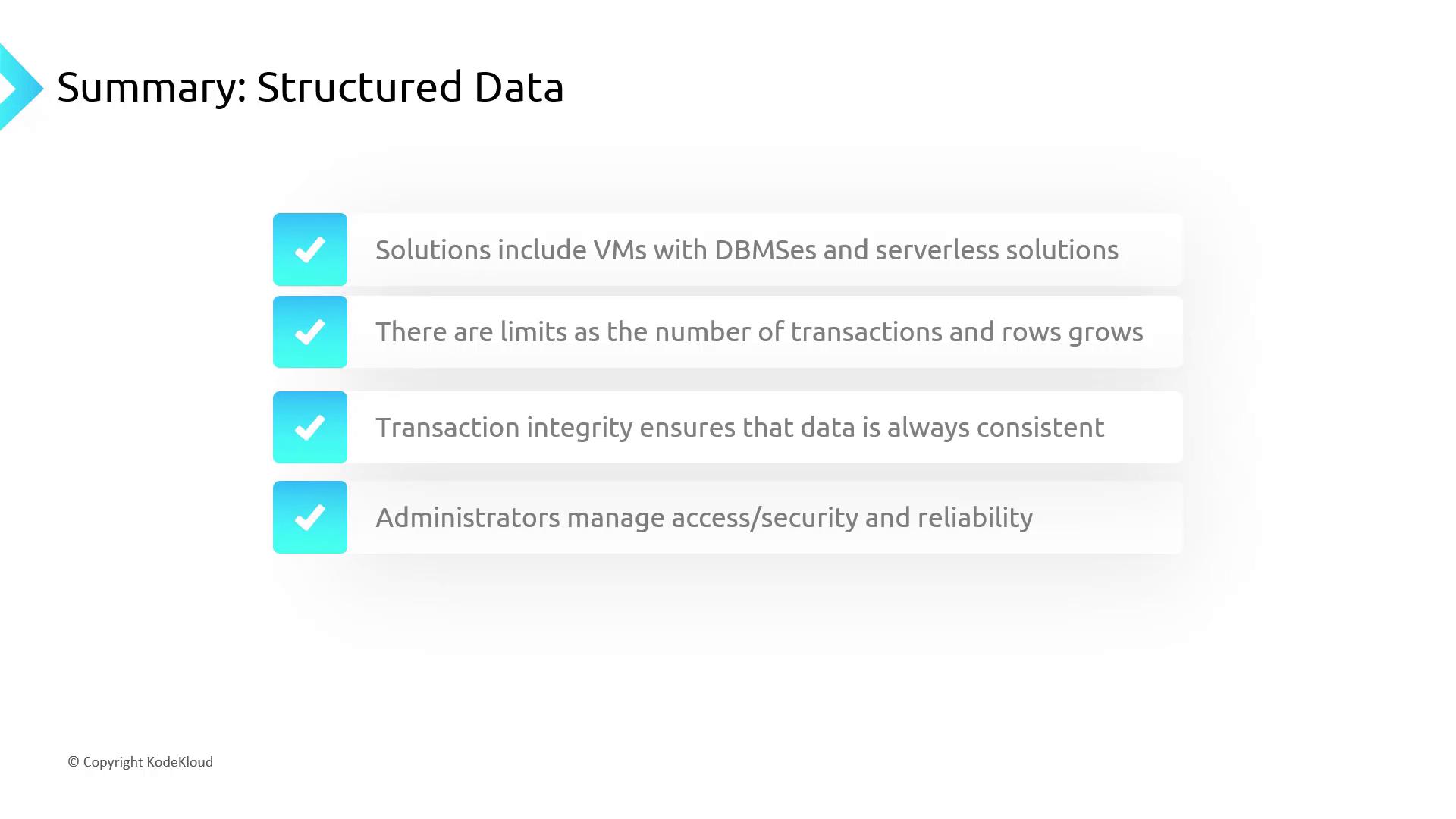
| Virtual Machines + DBMS | Full control, custom tuning | Requires server management |
| Serverless Databases | Automatic scaling, pay-per-use | Potential cold starts |
* Scale horizontally or vertically as transaction volume increases
* Enforce ACID properties to maintain consistency across updates
* Administrators manage network access, encryption, and patching
Improper configuration of network security groups or firewall rules can expose your database to external threats. Always restrict access to known IP ranges.
* [Relational Database Concepts](https://docs.microsoft.com/azure/architecture/data-guide/relational-data/)
* [Azure SQL Database Documentation](https://learn.microsoft.com/azure/azure-sql/)
* [Principles of Least Privilege](https://en.wikipedia.org/wiki/Principle_of_least_privilege)