> ## Documentation Index
> Fetch the complete documentation index at: https://notes.kodekloud.com/llms.txt
> Use this file to discover all available pages before exploring further.
# AWS Question 1
> This article explores instance fleets in AWS, their configuration, and practical applications, particularly in interview scenarios.
In this article, we explore the concept of an instance fleet in AWS, its configuration, and its practical applications—especially in interview scenarios.
## Overview
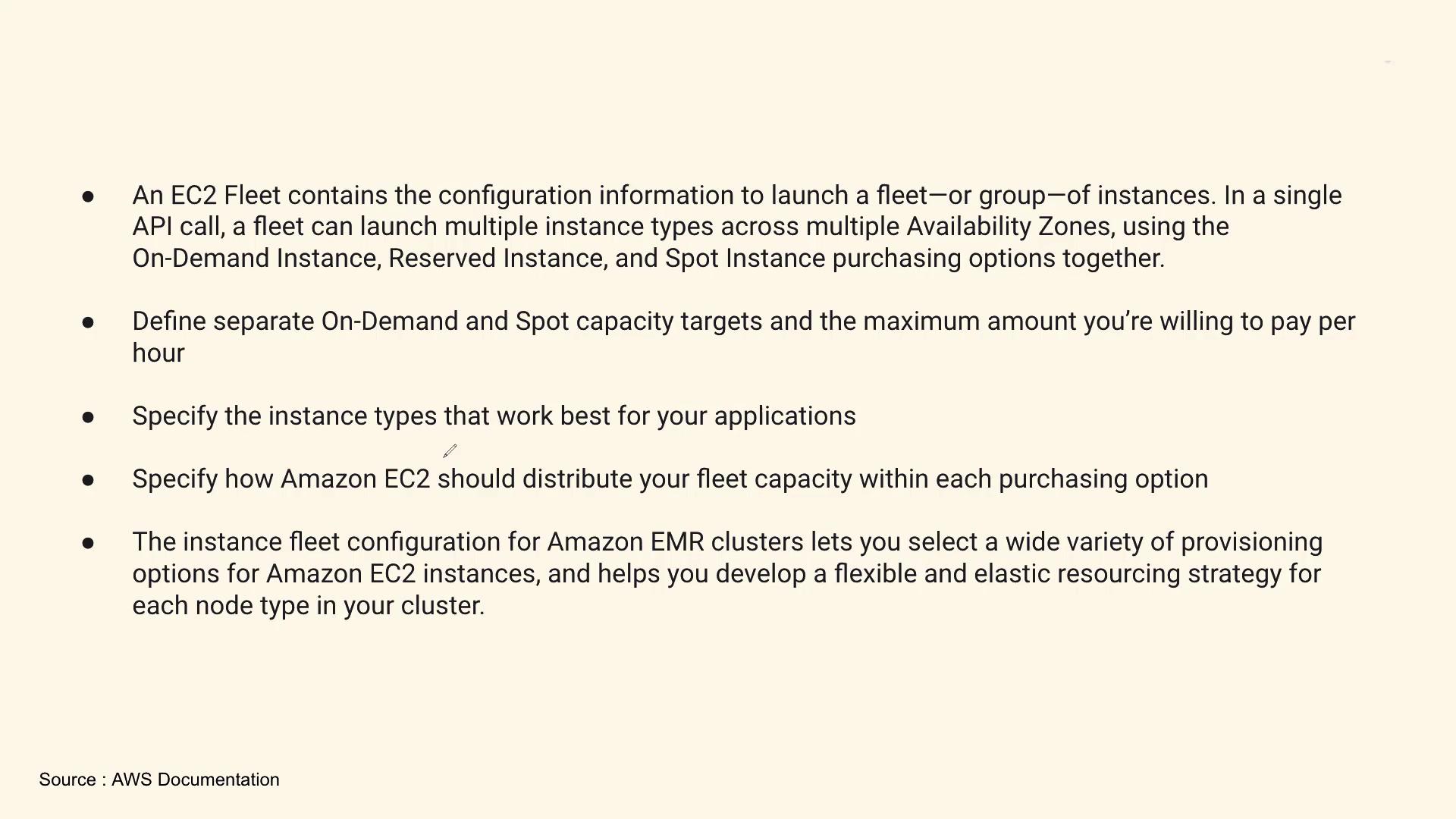
An instance fleet is a configuration that enables you to launch a group of EC2 instances with a variety of instance types. Unlike autoscaling groups that usually deploy similar instance types (for example, multiple T2\_micro instances), an instance fleet offers the flexibility to mix different types—such as T2\_micro, T3\_medium, or M-series—to match your application’s needs.
An instance fleet not only allows the use of multiple instance types but also supports integrating different purchasing options (spot, reserved, and on-demand) in one unified configuration.
## How Instance Fleets Work
Think of an instance fleet as a military fleet where a primary ship is supported by smaller vessels. Similarly, AWS instance fleets allow you to mix and match various EC2 instances. This setup lets you define separate capacity targets for on-demand and spot instances, ensuring that you can fine-tune your infrastructure based on both performance requirements and cost-effectiveness.
## Use Case: AWS EMR
A common use case for instance fleets is with AWS EMR (Elastic MapReduce). When processing large-scale data, the flexibility to blend different EC2 instance types and pricing models allows you to optimize for performance and cost simultaneously.
## Benefits of Using Instance Fleets
| Feature | Benefit | Example Use Case |
| ------------------- | ---------------------------------------------------------------- | ------------------------------------------------------- |
| Mixed Instances | Deploy various EC2 instance types in one fleet | Running heterogeneous workloads in an EMR cluster |
| Flexible Purchasing | Combine on-demand, reserved, and spot instances seamlessly | Cost optimization based on real-time market pricing |
| Fine-Tuned Capacity | Define specific targets for instance types and purchasing models | Customizing capacity to meet specific application needs |
## Conclusion
An instance fleet is a powerful AWS feature that allows you to seamlessly mix EC2 instance types and purchasing models for a customizable and cost-effective infrastructure. This mix-and-match capability is particularly useful for applications requiring diverse machine configurations, such as data processing with AWS EMR.
Stay tuned for our next article as we continue our journey in preparing for DevOps interviews.
Thank you.