> ## Documentation Index
> Fetch the complete documentation index at: https://notes.kodekloud.com/llms.txt
> Use this file to discover all available pages before exploring further.
# gRPC vs RESTful API
> Comparison of gRPC versus RESTful APIs using a ride‑sharing backend, covering performance, payload formats, streaming, tooling, browser support, and when to choose each
Let's compare gRPC and RESTful APIs using a concrete example from a ride‑sharing backend.
Imagine a rider taps "Request Ride". TripService then calls several other services:
* DriverService — find nearby cars
* PricingService — compute fare estimate
* LocationService — stream driver GPS coordinates
* NotificationService — notify the driver
Below we show how the same interactions look with a RESTful API versus gRPC, and when each approach is a better fit.
## RESTful example: simple, human‑readable, but verbose
With a RESTful API, TripService might POST to DriverService:
* Endpoint: `POST /drivers/nearby`
* Payload: JSON with the rider's location and search radius
* Response: a JSON array of nearby drivers
JSON is easy to inspect and debug on a laptop using curl, and its human readability is REST’s biggest strength.
Example request payload:
```json theme={null}
{ "lat": 37.77, "lon": -122.41, "radius_km": 2 }
```
Example curl:
```bash theme={null}
$ curl -X POST https://api.example.com/drivers/nearby \
-H "Content-Type: application/json" \
-d '{"lat":37.77,"lon":-122.41,"radius_km":2}'
```
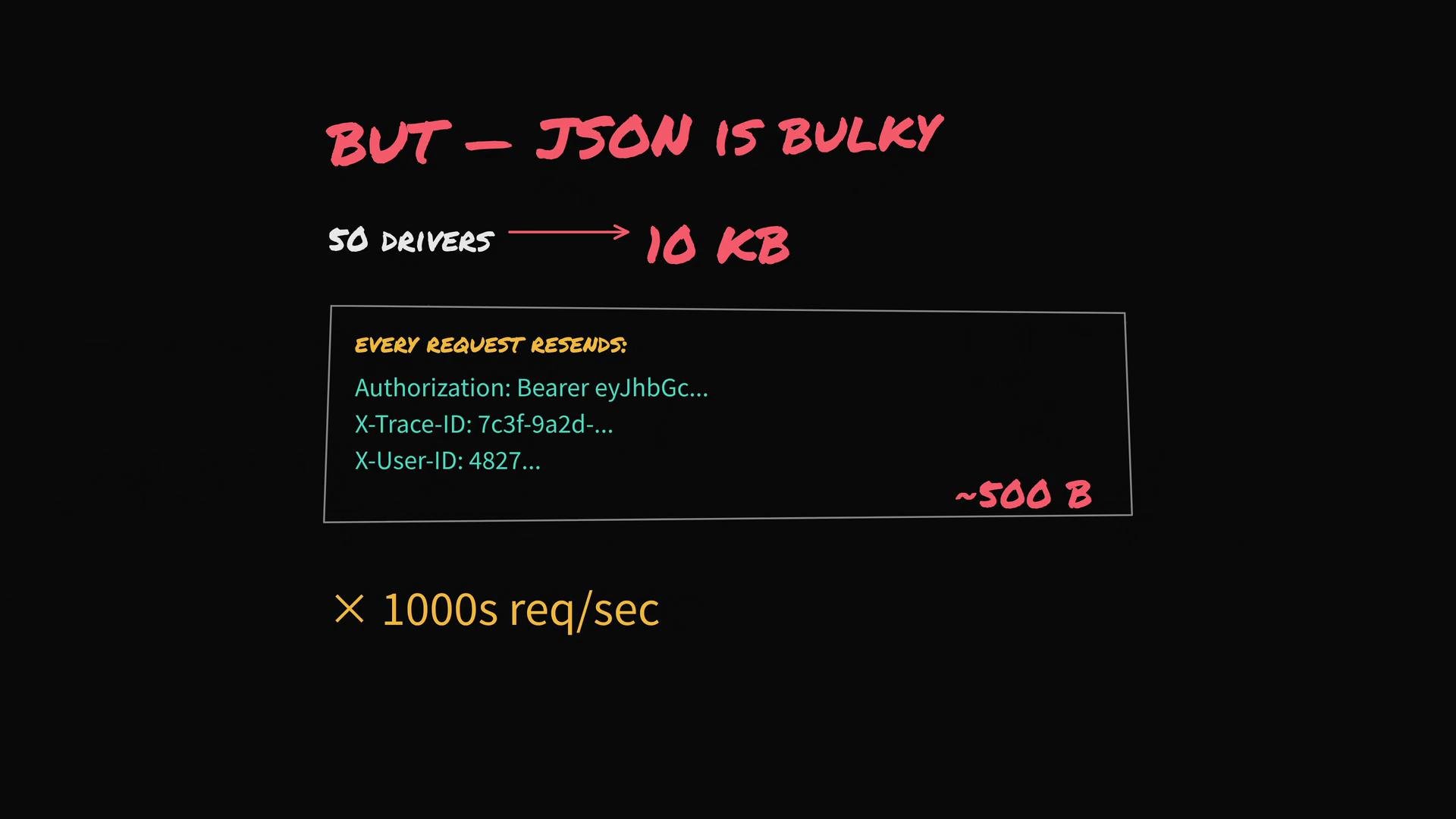
But JSON is verbose. A list of fifty nearby drivers can be several kilobytes of text. Each HTTP call also resends common metadata (auth headers, trace IDs, user IDs), typically a few hundred bytes per request. Multiply this by thousands of requests per second and you incur significant network and CPU overhead.
 ## gRPC + Protobuf: compact, typed, and efficient
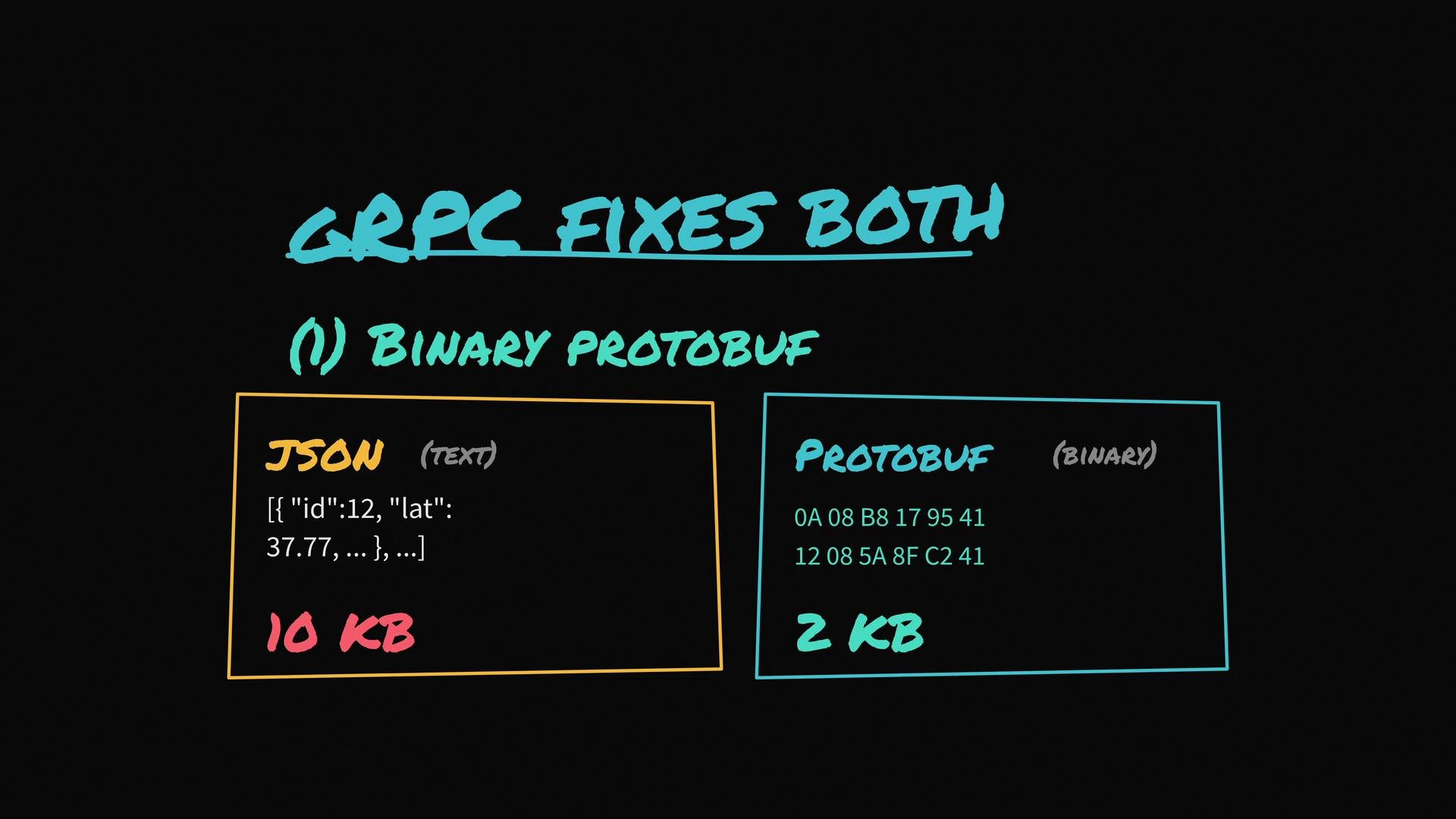
[gRPC](https://grpc.io) typically uses [Protocol Buffers (Protobuf)](https://developers.google.com/protocol-buffers) instead of JSON. The same response with 50 drivers is usually much smaller in binary Protobuf form — often only a couple of kilobytes instead of ten.
Because gRPC runs over [HTTP/2](https://http2.github.io/), it benefits from features like header compression ([HPACK](https://httpwg.org/specs/rfc7541.html)) which reduces repeated metadata overhead across a connection after the initial handshake. At large scale (think Uber or Lyft), these bandwidth and CPU savings matter.
## gRPC + Protobuf: compact, typed, and efficient
[gRPC](https://grpc.io) typically uses [Protocol Buffers (Protobuf)](https://developers.google.com/protocol-buffers) instead of JSON. The same response with 50 drivers is usually much smaller in binary Protobuf form — often only a couple of kilobytes instead of ten.
Because gRPC runs over [HTTP/2](https://http2.github.io/), it benefits from features like header compression ([HPACK](https://httpwg.org/specs/rfc7541.html)) which reduces repeated metadata overhead across a connection after the initial handshake. At large scale (think Uber or Lyft), these bandwidth and CPU savings matter.
 ## API contracts and tooling
* RESTful APIs often rely on documentation (OpenAPI specs, Confluence pages). Docs can drift from code if not kept in sync.
* gRPC centralizes the contract in a `.proto` file. Services and messages (for example, `DriverService` with `FindNearby(Location) returns (stream Driver)`) are defined in one place and compiled into generated client/server stubs.
This means:
* For strongly typed languages, contract changes surface at compile time.
* Teams generate consistent client libraries from the same source-of-truth `.proto` files, reducing mismatch risk.
## Streaming and real‑time updates
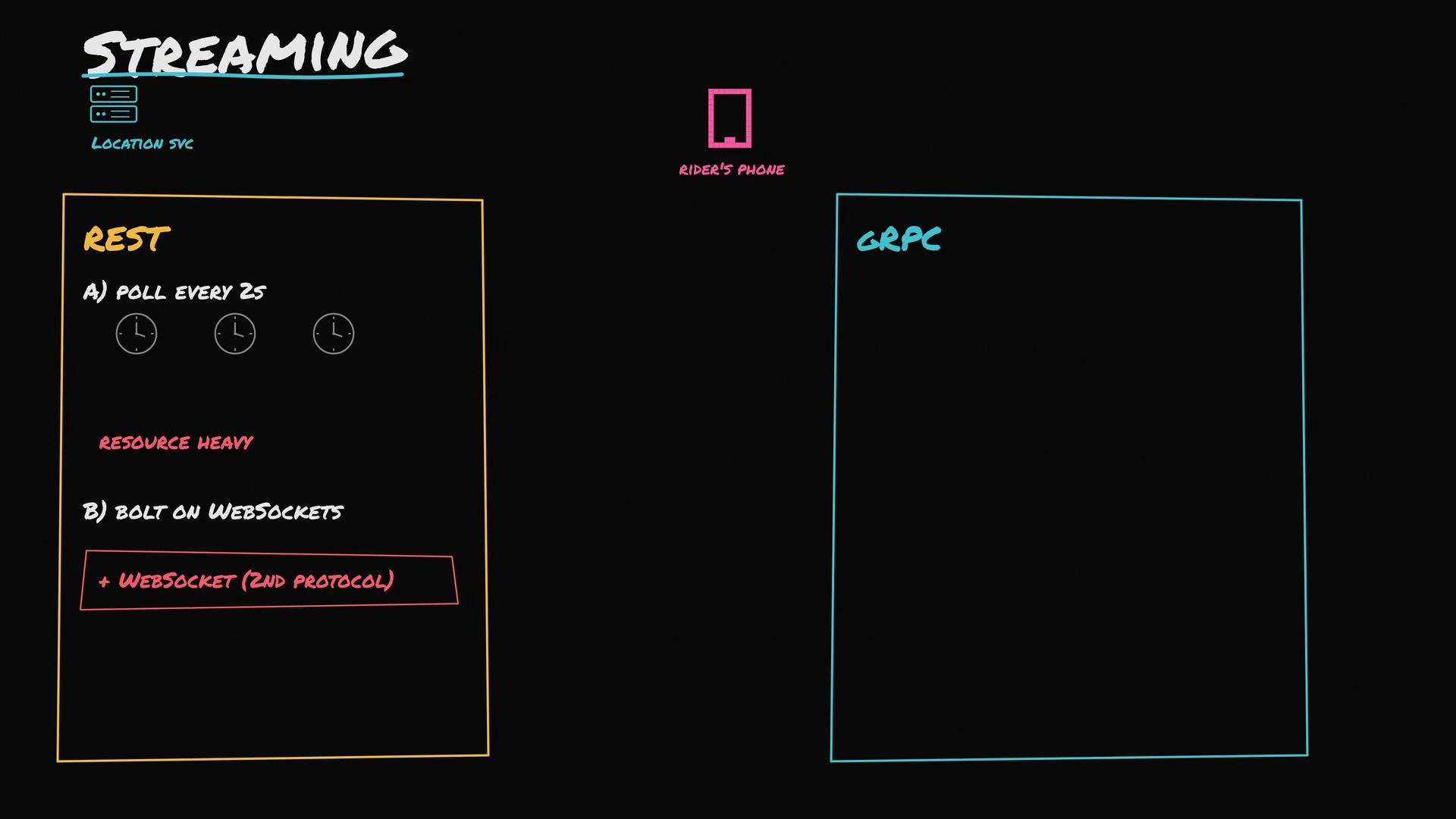
A common use case in the ride app is streaming GPS coordinates from LocationService to the rider every few seconds. Approaches:
* REST: poll the endpoint frequently (inefficient) or use WebSockets (a separate protocol and stack from your REST endpoints).
* gRPC: native support for streaming (server-, client-, and bidirectional). LocationService can open a long‑lived stream and push updates efficiently over the same HTTP/2 connection.
## API contracts and tooling
* RESTful APIs often rely on documentation (OpenAPI specs, Confluence pages). Docs can drift from code if not kept in sync.
* gRPC centralizes the contract in a `.proto` file. Services and messages (for example, `DriverService` with `FindNearby(Location) returns (stream Driver)`) are defined in one place and compiled into generated client/server stubs.
This means:
* For strongly typed languages, contract changes surface at compile time.
* Teams generate consistent client libraries from the same source-of-truth `.proto` files, reducing mismatch risk.
## Streaming and real‑time updates
A common use case in the ride app is streaming GPS coordinates from LocationService to the rider every few seconds. Approaches:
* REST: poll the endpoint frequently (inefficient) or use WebSockets (a separate protocol and stack from your REST endpoints).
* gRPC: native support for streaming (server-, client-, and bidirectional). LocationService can open a long‑lived stream and push updates efficiently over the same HTTP/2 connection.
 Browsers don't expose the raw bidirectional HTTP/2 streams that "raw" gRPC relies on, so browser JavaScript cannot speak plain gRPC directly. Use bridging options such as `gRPC-Web` or deploy a proxy/gateway if you need browser clients to access gRPC backends. Many teams still expose REST for public/client‑facing APIs while using gRPC internally.
Best practice: Use the right tool for the job. Choose gRPC for high‑performance, internal service-to-service calls and streaming. Use REST/HTTP+JSON for public APIs or when human readability and broad compatibility matter.
## Quick comparison table
| Aspect | REST (HTTP/JSON) | gRPC (HTTP/2 + Protobuf) |
| --------------- | -----------------------------------------------: | --------------------------------------------------------- |
| Payload format | Human‑readable JSON | Binary Protobuf (compact) |
| Overhead | Higher per-request (headers + verbose JSON) | Lower (HTTP/2 header compression + compact payloads) |
| API contract | OpenAPI or docs (can drift) | `.proto` files (single source of truth, generated code) |
| Streaming | Polling or WebSockets (separate stack) | First‑class streaming (server/client/bidirectional) |
| Browser support | Native (fetch, XHR) | Requires `gRPC‑Web` or proxy |
| Best for | Public APIs, simple integrations, easy debugging | Internal high‑throughput services, low latency, streaming |
## When to choose which
* Use REST when:
* You need wide compatibility with browsers and third‑party clients.
* Human‑readable payloads and simplicity/debuggability matter.
* You expose a public API or want to support many clients without generated stubs.
* Use gRPC when:
* You need efficient, low‑latency service‑to‑service communication.
* You want strong typing and auto‑generated client/server code.
* You require native streaming (e.g., real‑time location updates).
In practice, most organizations use both: gRPC for internal, high‑performance comms (TripService ↔ DriverService ↔ PricingService), and REST for client-facing endpoints and public APIs.
## Links and references
* [gRPC](https://grpc.io)
* [Protocol Buffers (Protobuf)](https://developers.google.com/protocol-buffers)
* [OpenAPI Specification](https://www.openapis.org/)
* [HTTP/2 specification](https://http2.github.io/)
* [gRPC‑Web](https://grpc.io/docs/platforms/web/)
* [WebSockets API (MDN)](https://developer.mozilla.org/en-US/docs/Web/API/WebSockets_API)
Browsers don't expose the raw bidirectional HTTP/2 streams that "raw" gRPC relies on, so browser JavaScript cannot speak plain gRPC directly. Use bridging options such as `gRPC-Web` or deploy a proxy/gateway if you need browser clients to access gRPC backends. Many teams still expose REST for public/client‑facing APIs while using gRPC internally.
Best practice: Use the right tool for the job. Choose gRPC for high‑performance, internal service-to-service calls and streaming. Use REST/HTTP+JSON for public APIs or when human readability and broad compatibility matter.
## Quick comparison table
| Aspect | REST (HTTP/JSON) | gRPC (HTTP/2 + Protobuf) |
| --------------- | -----------------------------------------------: | --------------------------------------------------------- |
| Payload format | Human‑readable JSON | Binary Protobuf (compact) |
| Overhead | Higher per-request (headers + verbose JSON) | Lower (HTTP/2 header compression + compact payloads) |
| API contract | OpenAPI or docs (can drift) | `.proto` files (single source of truth, generated code) |
| Streaming | Polling or WebSockets (separate stack) | First‑class streaming (server/client/bidirectional) |
| Browser support | Native (fetch, XHR) | Requires `gRPC‑Web` or proxy |
| Best for | Public APIs, simple integrations, easy debugging | Internal high‑throughput services, low latency, streaming |
## When to choose which
* Use REST when:
* You need wide compatibility with browsers and third‑party clients.
* Human‑readable payloads and simplicity/debuggability matter.
* You expose a public API or want to support many clients without generated stubs.
* Use gRPC when:
* You need efficient, low‑latency service‑to‑service communication.
* You want strong typing and auto‑generated client/server code.
* You require native streaming (e.g., real‑time location updates).
In practice, most organizations use both: gRPC for internal, high‑performance comms (TripService ↔ DriverService ↔ PricingService), and REST for client-facing endpoints and public APIs.
## Links and references
* [gRPC](https://grpc.io)
* [Protocol Buffers (Protobuf)](https://developers.google.com/protocol-buffers)
* [OpenAPI Specification](https://www.openapis.org/)
* [HTTP/2 specification](https://http2.github.io/)
* [gRPC‑Web](https://grpc.io/docs/platforms/web/)
* [WebSockets API (MDN)](https://developer.mozilla.org/en-US/docs/Web/API/WebSockets_API)