> ## Documentation Index
> Fetch the complete documentation index at: https://notes.kodekloud.com/llms.txt
> Use this file to discover all available pages before exploring further.
# Container Died with Exit Code 137
> Explains why Docker containers exit with code 137, identifying SIGKILL causes like OOM killer or orchestrator timeouts and steps to diagnose and investigate
Here's a common interview-style scenario from the Docker world:
Scenario: one of your containers died, its logs are empty, and `docker ps -a` shows exit code 137.
```bash theme={null}
$ docker ps -a
CONTAINER ID IMAGE STATUS NAMES
a3f9c1de7b8a myapp:1.2 Exited (137) 4 minutes ago api
```
What happened?
Exit code 137 is not arbitrary — it usually means the container's main process was terminated by a signal. To decode this, remember the Linux convention for signal-based exit codes: an exit caused by a signal yields `128 + signal_number`. In this case:
* 137 = 128 + 9
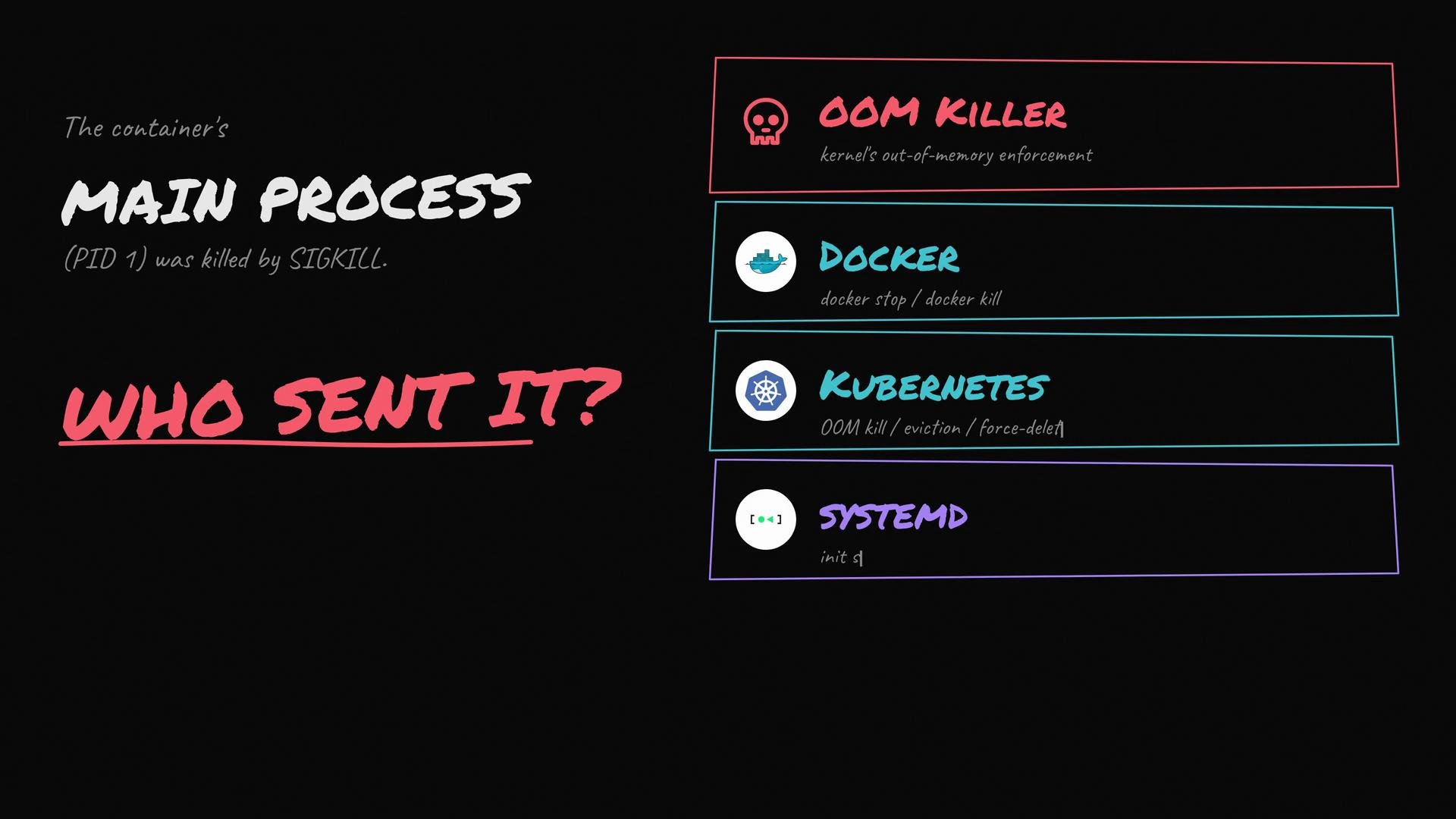
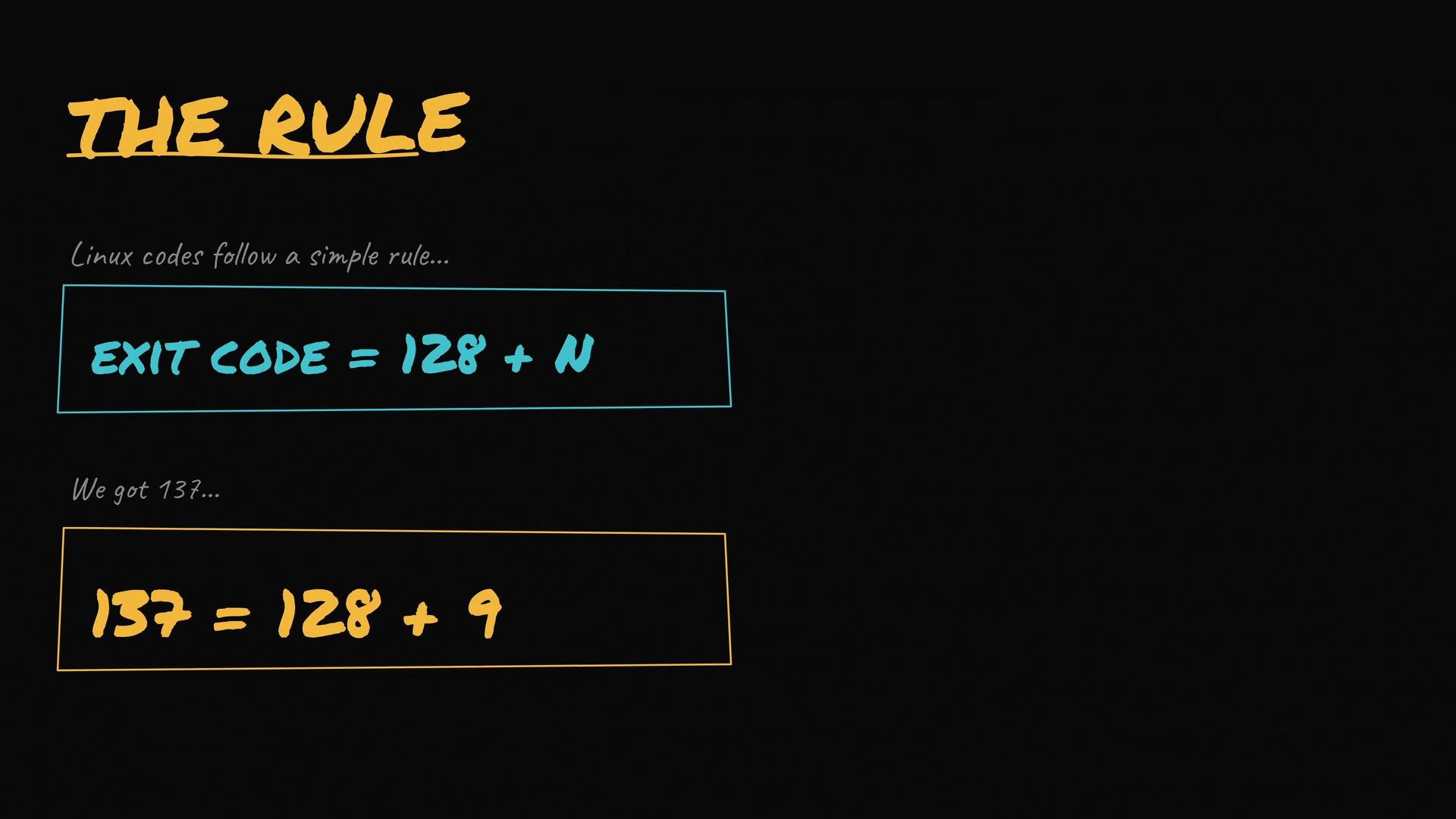 Signal 9 is SIGKILL, so exit code 137 indicates the container's PID 1 (its main process) was forcibly killed with SIGKILL — not a normal exit.
Who can send SIGKILL?
Common senders include:
* The kernel's OOM (Out‑Of‑Memory) killer.
* Docker itself (for example, after a `docker stop` grace period times out).
* Orchestrators like Kubernetes (kubelet follows a SIGTERM → grace period → SIGKILL pattern).
* Systemd on some hosts.
* A person running `docker kill `.
Signal 9 is SIGKILL, so exit code 137 indicates the container's PID 1 (its main process) was forcibly killed with SIGKILL — not a normal exit.
Who can send SIGKILL?
Common senders include:
* The kernel's OOM (Out‑Of‑Memory) killer.
* Docker itself (for example, after a `docker stop` grace period times out).
* Orchestrators like Kubernetes (kubelet follows a SIGTERM → grace period → SIGKILL pattern).
* Systemd on some hosts.
* A person running `docker kill `.
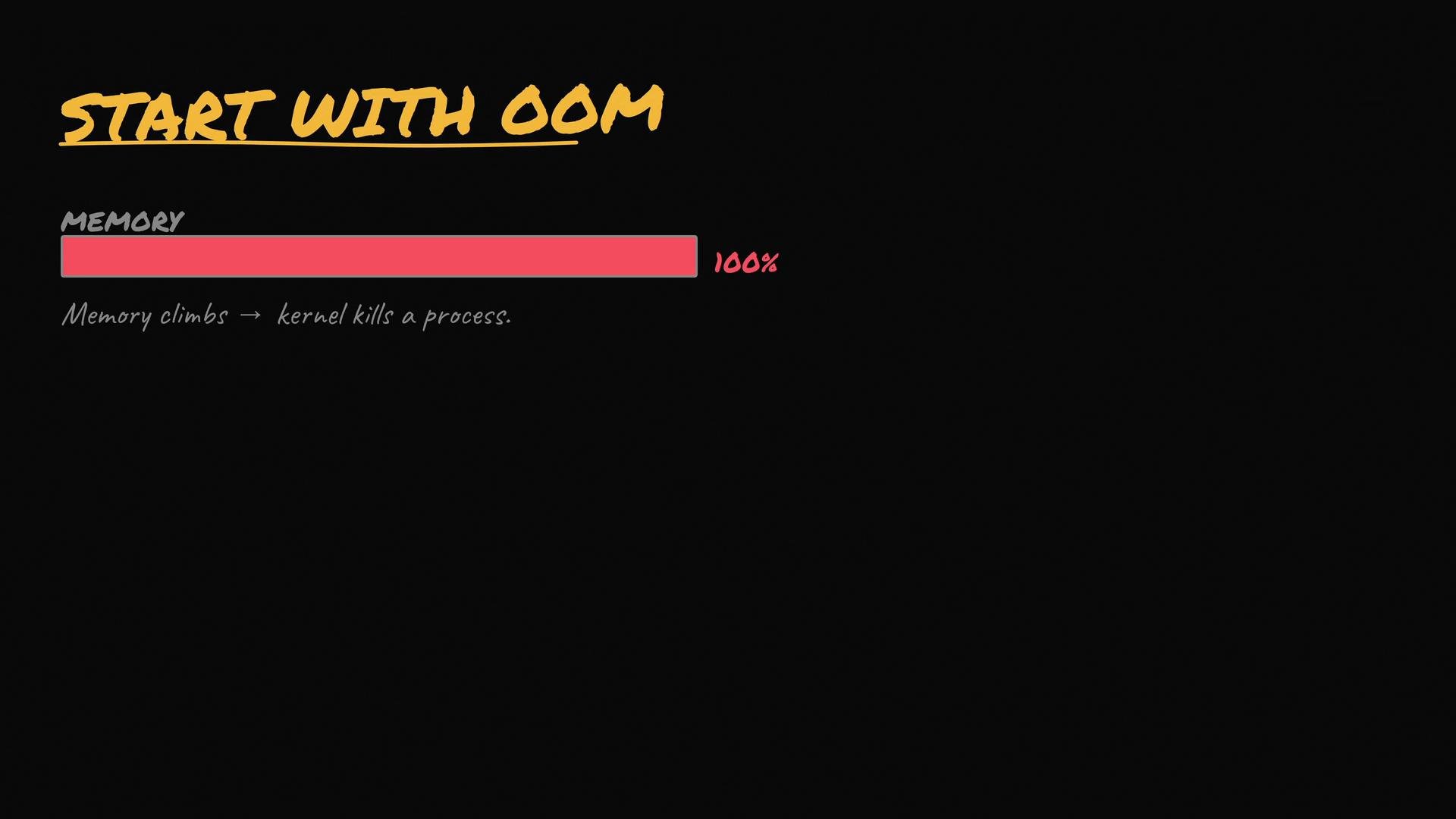
 In production, the OOM killer is often the first suspect, especially when a container has memory limits or memory usage was climbing before the exit. Under memory pressure the kernel frees memory by killing processes, and it uses SIGKILL to do so.
 How to confirm whether SIGKILL was from the OOM killer
* Inspect the container state for the `OOMKilled` flag.
* Check kernel logs (`dmesg` or `journalctl -k`) for OOM messages.
Example commands:
```bash theme={null}
# Inspect the container's OOMKilled flag
$ docker inspect | grep -i oom
"OOMKilled": true,
# Search kernel messages for OOM kills
$ dmesg | grep -i kill
Out of memory: Killed process 4127 (node)
anon-rss:1851232kB
$ journalctl -k | grep -i kill
kernel: Out of memory: Killed process 4127 (node)
```
If you see `OOMKilled: true` or an "Out of memory: Killed process" line in kernel logs, the OOM killer was responsible for the SIGKILL.
If there’s no OOM evidence, consider other common causes:
* Docker after `docker stop`: Docker sends SIGTERM, waits the stop timeout (default 10s), then escalates to SIGKILL.
* Orchestrator termination: Kubernetes/other orchestrators use SIGTERM then SIGKILL after the pod’s termination grace period.
* Manual intervention: someone executed `docker kill`.
To investigate non-OOM kills, check container events and orchestrator logs. Example:
```bash theme={null}
# Observe Docker events for the container over the last 10 minutes
$ docker events --filter 'container=' --since '10m'
```
Related exit codes to be aware of
How to confirm whether SIGKILL was from the OOM killer
* Inspect the container state for the `OOMKilled` flag.
* Check kernel logs (`dmesg` or `journalctl -k`) for OOM messages.
Example commands:
```bash theme={null}
# Inspect the container's OOMKilled flag
$ docker inspect | grep -i oom
"OOMKilled": true,
# Search kernel messages for OOM kills
$ dmesg | grep -i kill
Out of memory: Killed process 4127 (node)
anon-rss:1851232kB
$ journalctl -k | grep -i kill
kernel: Out of memory: Killed process 4127 (node)
```
If you see `OOMKilled: true` or an "Out of memory: Killed process" line in kernel logs, the OOM killer was responsible for the SIGKILL.
If there’s no OOM evidence, consider other common causes:
* Docker after `docker stop`: Docker sends SIGTERM, waits the stop timeout (default 10s), then escalates to SIGKILL.
* Orchestrator termination: Kubernetes/other orchestrators use SIGTERM then SIGKILL after the pod’s termination grace period.
* Manual intervention: someone executed `docker kill`.
To investigate non-OOM kills, check container events and orchestrator logs. Example:
```bash theme={null}
# Observe Docker events for the container over the last 10 minutes
$ docker events --filter 'container=' --since '10m'
```
Related exit codes to be aware of
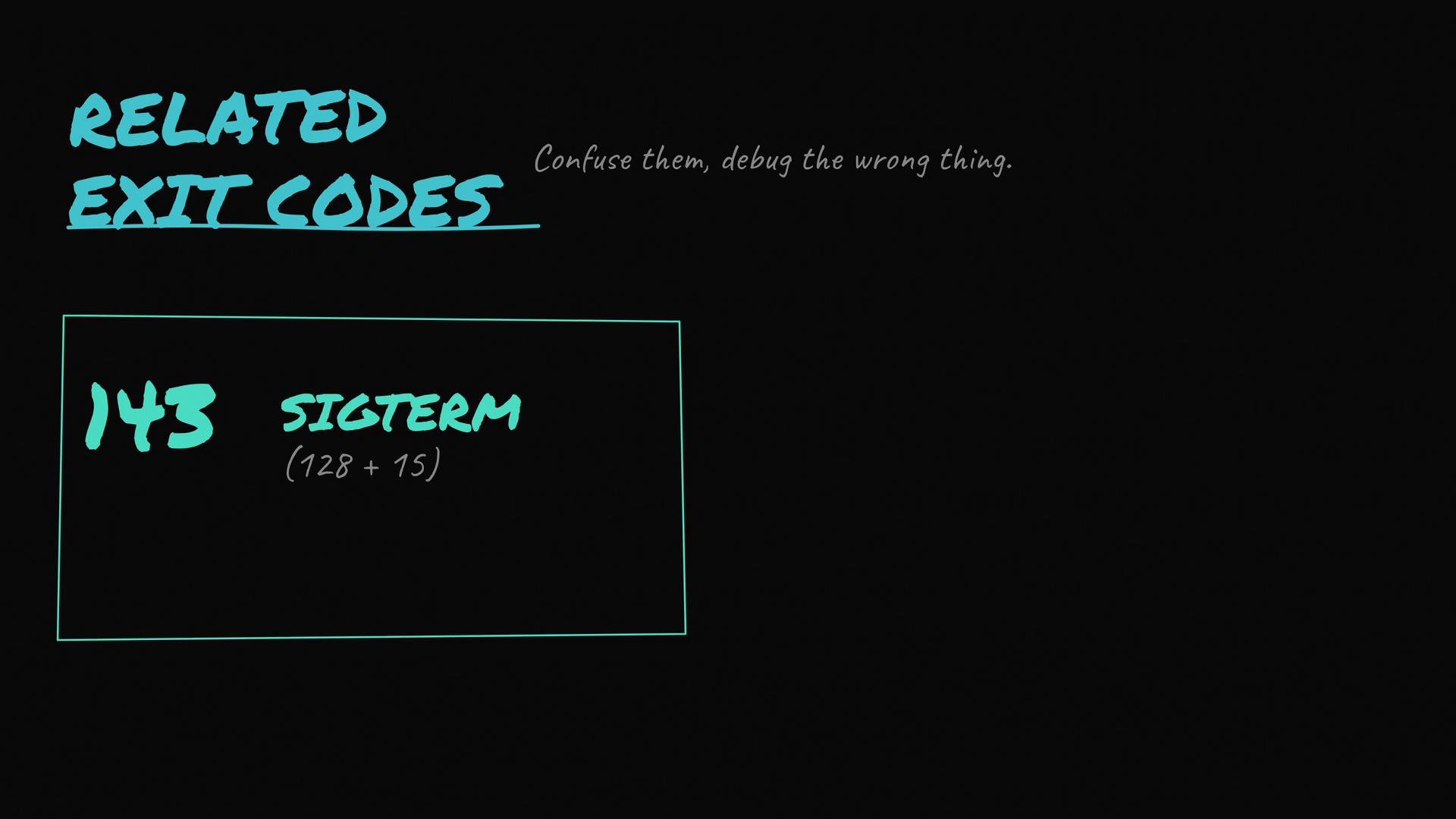 Use the following quick reference table to avoid debugging the wrong symptom:
| Exit Code | Calculation | Signal | Typical Meaning |
| --------- | ----------- | ------- | -------------------------------------------------------------------------- |
| `137` | `128 + 9` | SIGKILL | Process was forcibly killed (often OOM killer or escalation after timeout) |
| `143` | `128 + 15` | SIGTERM | Graceful termination requested (shutdown path may still run) |
| `139` | `128 + 11` | SIGSEGV | Process crashed with segmentation fault (invalid memory access) |
Best-practice checklist when you see Exited (137)
1. docker inspect ``: look for `"OOMKilled": true`.
2. Check kernel logs: `dmesg` or `journalctl -k` for OOM messages.
3. Examine Docker events: `docker events --filter 'container=' --since '10m'`.
4. Review orchestrator logs (kubelet, controller manager, etc.) for stop/kill actions.
5. Confirm memory limits on the container and review memory metrics leading up to the failure.
6. If needed, reproduce the issue while collecting memory and process metrics to pinpoint the root cause.
If you see `Exited (137)` but no `OOMKilled` flag and no kernel OOM messages, focus your investigation on orchestrator logs or manual actions (e.g., `docker kill`). Don’t assume OOM without confirming the kernel logs.
Avoid treating 137 as an application bug by default; it indicates an external kill. Only investigate application-level causes (crashes, segfaults) after ruling out external signals and resource limits.
Links and references
* [Docker Documentation](https://docs.docker.com/)
* [Kubernetes Documentation](https://kubernetes.io/docs/)
* [Monitoring and troubleshooting kernel OOM killer](https://www.kernel.org/doc/html/latest/admin-guide/)
This guide should help you quickly identify why a container exited with code 137 and which next steps to take based on the evidence you find.
Use the following quick reference table to avoid debugging the wrong symptom:
| Exit Code | Calculation | Signal | Typical Meaning |
| --------- | ----------- | ------- | -------------------------------------------------------------------------- |
| `137` | `128 + 9` | SIGKILL | Process was forcibly killed (often OOM killer or escalation after timeout) |
| `143` | `128 + 15` | SIGTERM | Graceful termination requested (shutdown path may still run) |
| `139` | `128 + 11` | SIGSEGV | Process crashed with segmentation fault (invalid memory access) |
Best-practice checklist when you see Exited (137)
1. docker inspect ``: look for `"OOMKilled": true`.
2. Check kernel logs: `dmesg` or `journalctl -k` for OOM messages.
3. Examine Docker events: `docker events --filter 'container=' --since '10m'`.
4. Review orchestrator logs (kubelet, controller manager, etc.) for stop/kill actions.
5. Confirm memory limits on the container and review memory metrics leading up to the failure.
6. If needed, reproduce the issue while collecting memory and process metrics to pinpoint the root cause.
If you see `Exited (137)` but no `OOMKilled` flag and no kernel OOM messages, focus your investigation on orchestrator logs or manual actions (e.g., `docker kill`). Don’t assume OOM without confirming the kernel logs.
Avoid treating 137 as an application bug by default; it indicates an external kill. Only investigate application-level causes (crashes, segfaults) after ruling out external signals and resource limits.
Links and references
* [Docker Documentation](https://docs.docker.com/)
* [Kubernetes Documentation](https://kubernetes.io/docs/)
* [Monitoring and troubleshooting kernel OOM killer](https://www.kernel.org/doc/html/latest/admin-guide/)
This guide should help you quickly identify why a container exited with code 137 and which next steps to take based on the evidence you find.