> ## Documentation Index
> Fetch the complete documentation index at: https://notes.kodekloud.com/llms.txt
> Use this file to discover all available pages before exploring further.
# TCP vs UDP When to Pick Which
> Comparing TCP and UDP for different app needs, using WhatsApp examples to explain when reliability or low latency is preferred and how security and application protocols fit
This guide explains the practical differences between TCP and UDP using a WhatsApp-style backend as an example: text messages, voice/video calls, and how apps pick the appropriate transport for each use case.
## Text messaging: why TCP fits
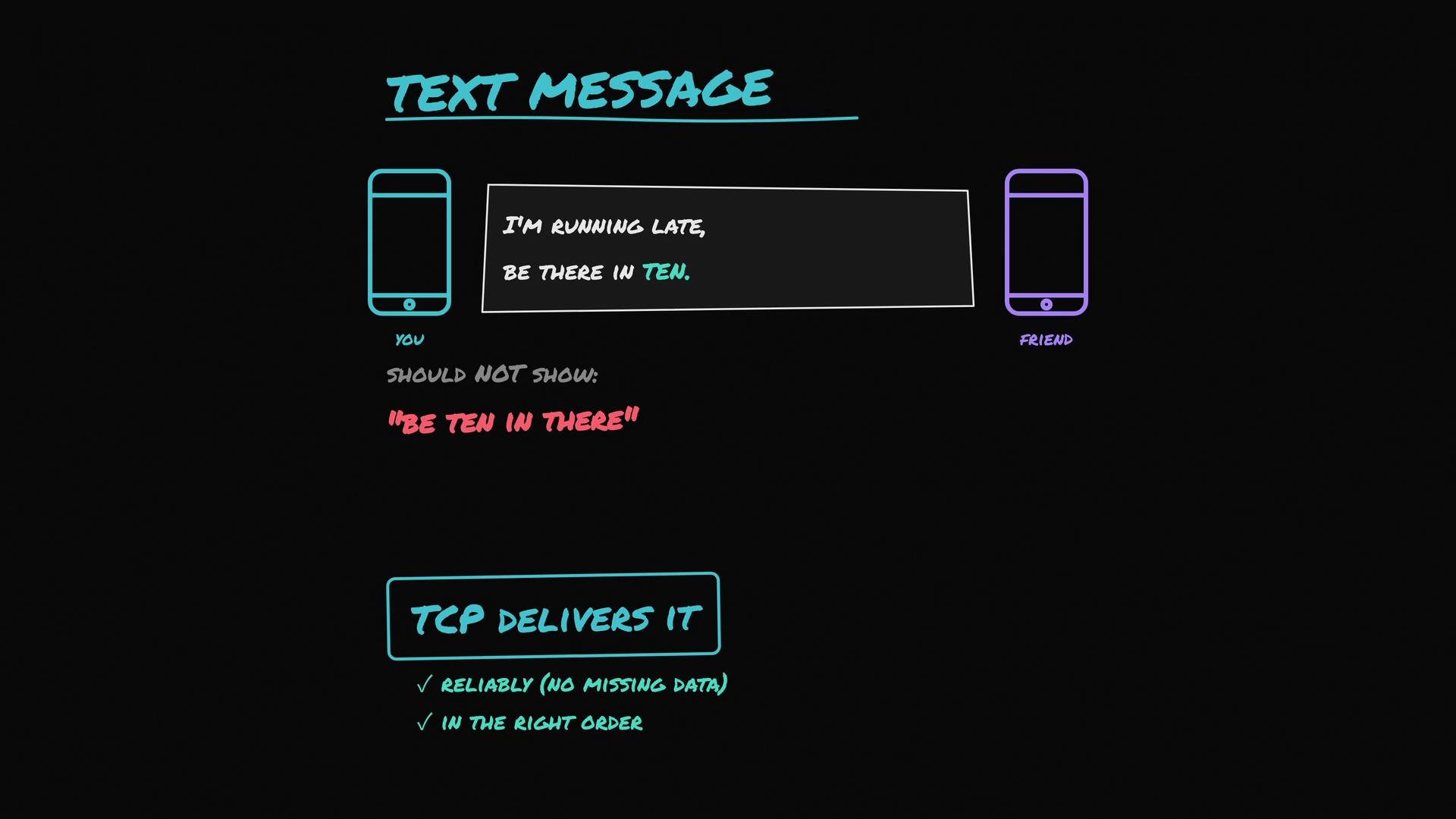
When you send a text like "I'm running late, be there in ten", the receiver must get exactly what you typed — no missing words, no reordering. TCP provides:
* Reliable delivery (retransmits lost data),
* In-order delivery (reassembles packets using sequence numbers),
* Flow and congestion control (keeps the network stable).
These features make TCP ideal for messaging and other data that must arrive intact and in order.
 ## Connection setup: TCP three-way handshake
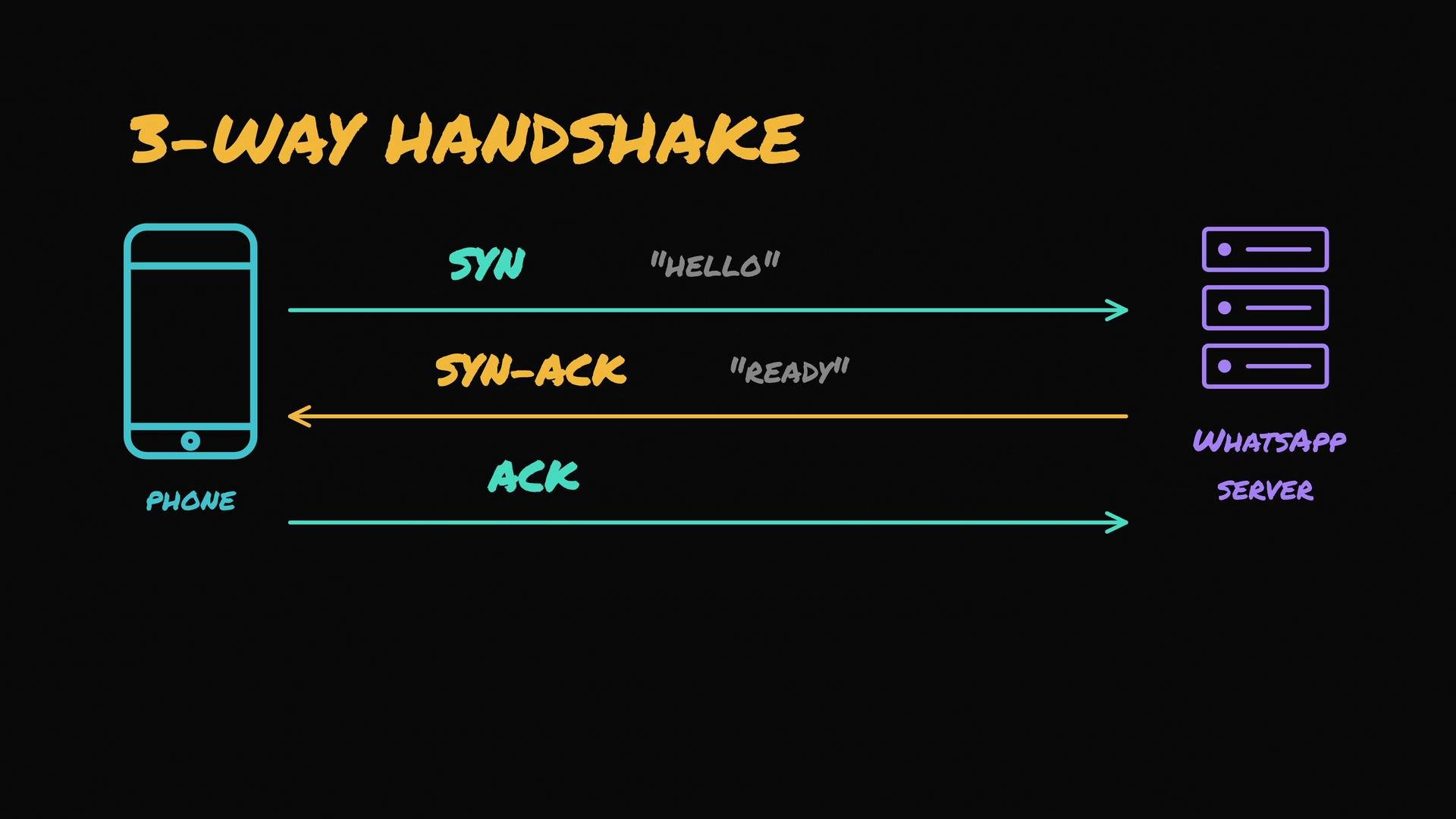
Before application data flows, TCP performs a three-way handshake:
1. Client sends SYN (request to open connection).
2. Server replies with SYN-ACK (acknowledges request).
3. Client sends ACK (completes handshake).
Only after this exchange can the devices start reliable data transfer.
## Connection setup: TCP three-way handshake
Before application data flows, TCP performs a three-way handshake:
1. Client sends SYN (request to open connection).
2. Server replies with SYN-ACK (acknowledges request).
3. Client sends ACK (completes handshake).
Only after this exchange can the devices start reliable data transfer.
 ## Packetization, ordering, and retransmission
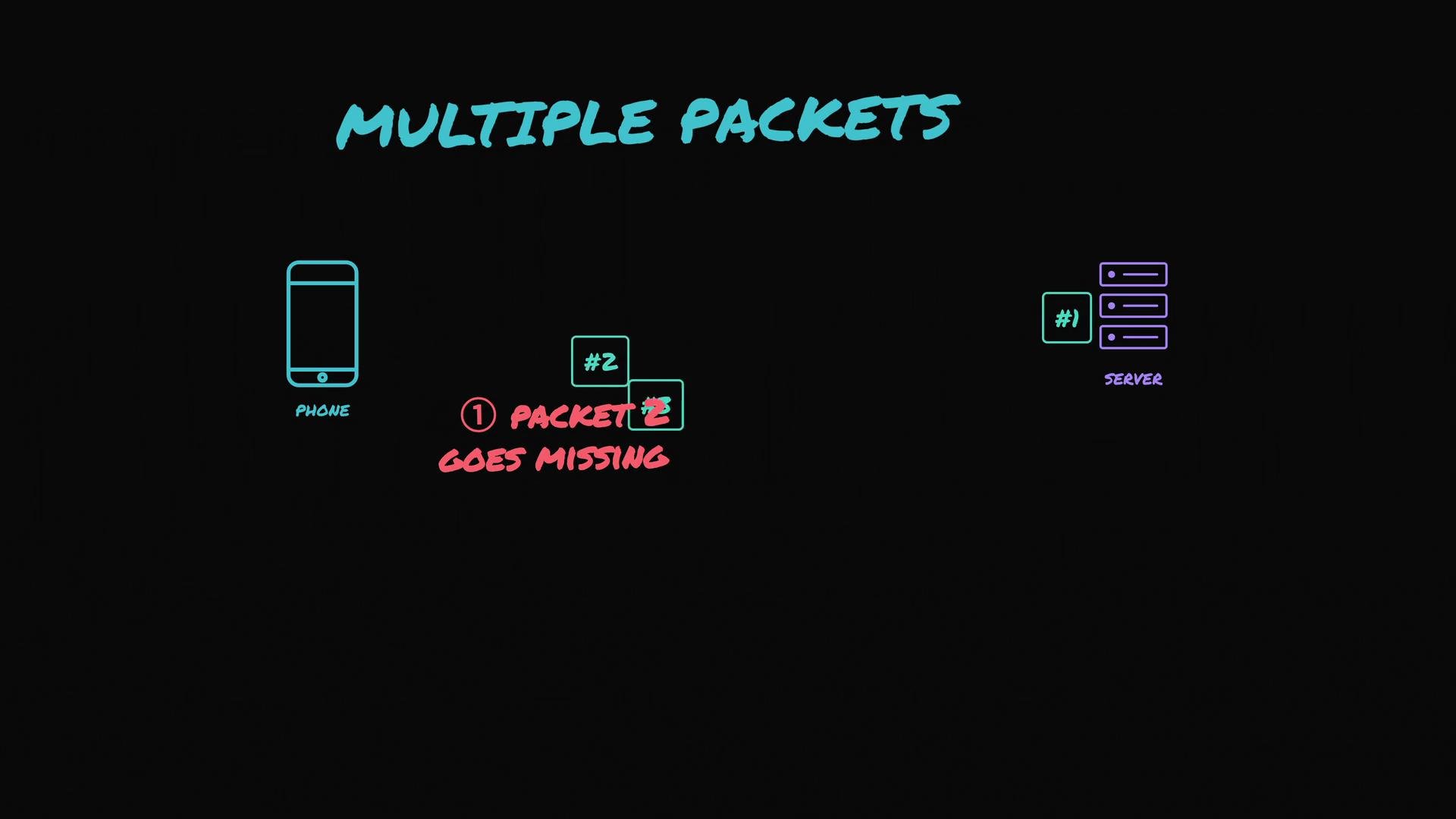
Once the connection is established, TCP breaks data into segments, assigns sequence numbers, and handles:
* Missing packets: the receiver detects gaps and triggers retransmission.
* Out-of-order arrivals: TCP reorders packets before handing data to the application.
This guarantees the application sees a continuous, ordered byte stream.
## Packetization, ordering, and retransmission
Once the connection is established, TCP breaks data into segments, assigns sequence numbers, and handles:
* Missing packets: the receiver detects gaps and triggers retransmission.
* Out-of-order arrivals: TCP reorders packets before handing data to the application.
This guarantees the application sees a continuous, ordered byte stream.
 ## Real-time audio/video: why UDP is usually preferred
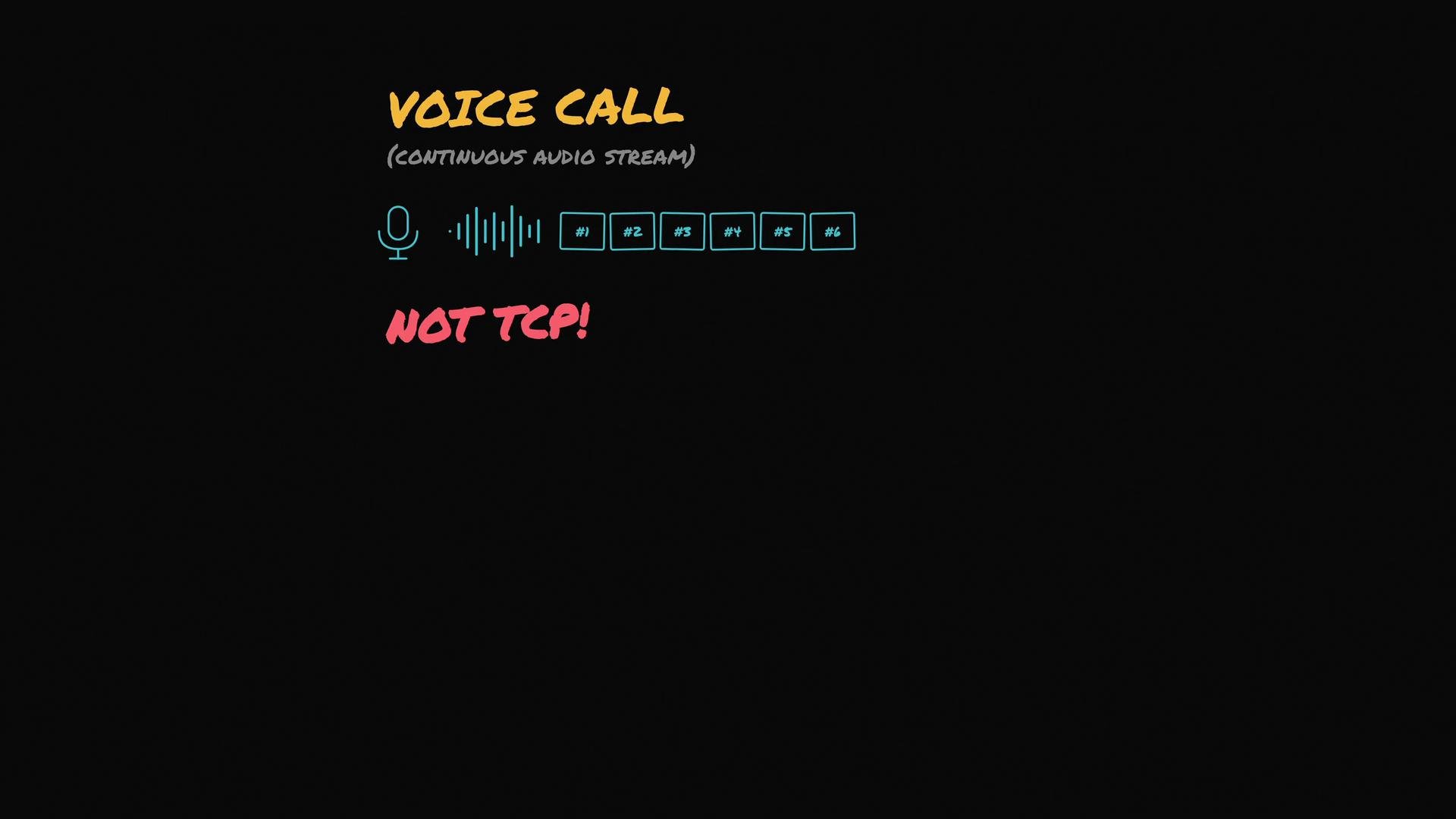
Voice and video calls stream many small packets continuously. For real-time media, timeliness matters more than recovering every lost packet. Using TCP introduces two key problems for live streams:
* Head-of-line blocking: later packets wait for retransmissions of earlier lost packets, causing pauses.
* TCP congestion response: loss causes reduced send rates, increasing latency and making audio/video choppy.
Because a brief packet loss may be less harmful than a stalled stream, real-time applications commonly use UDP for media transport.
## Real-time audio/video: why UDP is usually preferred
Voice and video calls stream many small packets continuously. For real-time media, timeliness matters more than recovering every lost packet. Using TCP introduces two key problems for live streams:
* Head-of-line blocking: later packets wait for retransmissions of earlier lost packets, causing pauses.
* TCP congestion response: loss causes reduced send rates, increasing latency and making audio/video choppy.
Because a brief packet loss may be less harmful than a stalled stream, real-time applications commonly use UDP for media transport.
 ## What UDP provides — and what the application layer adds
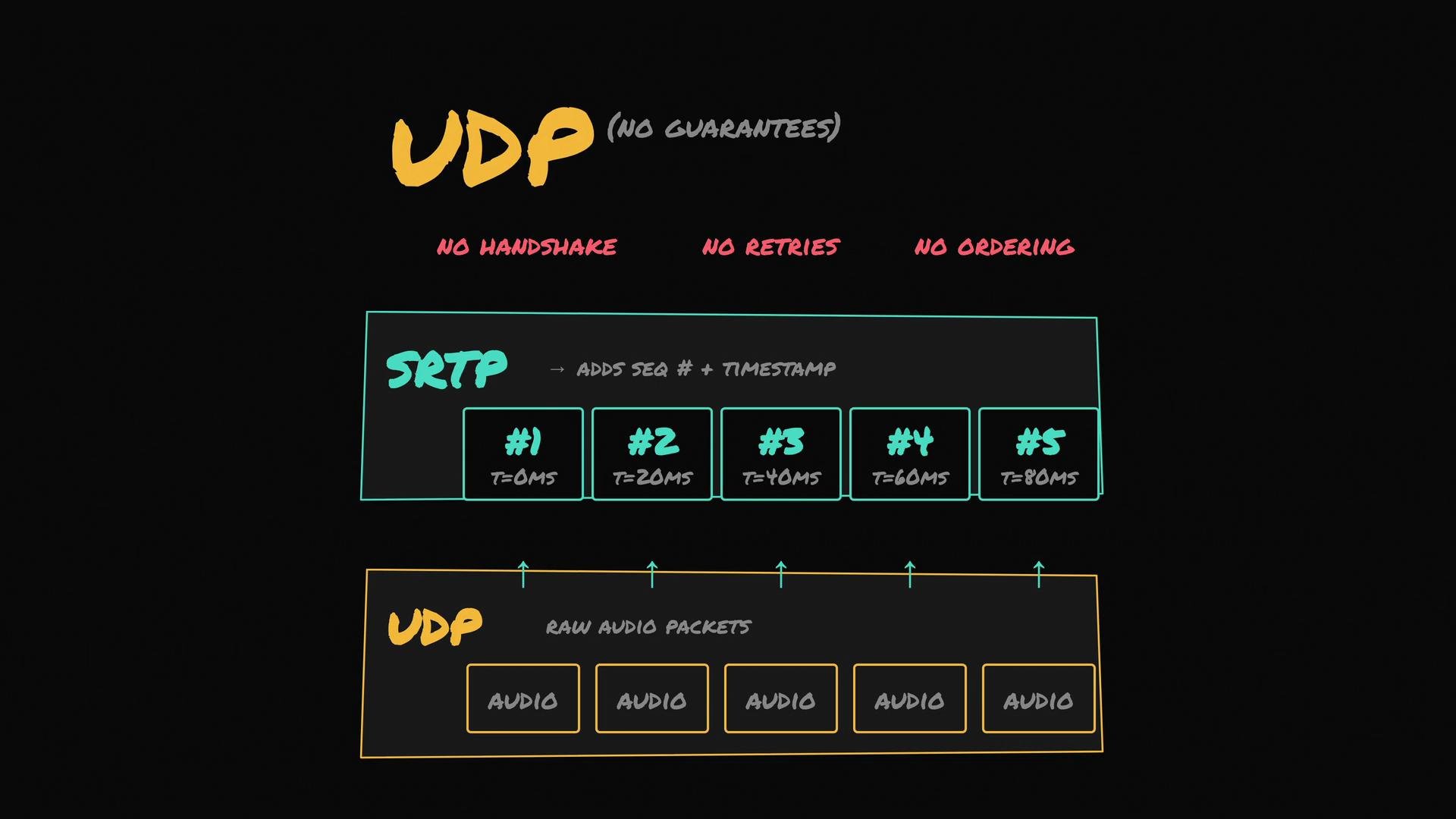
UDP itself is minimal: no handshake, no guaranteed delivery, no automatic retransmission, and no enforced ordering. Real-time apps build reliability and timing handling in the application layer, typically using protocols such as RTP/SRTP.
Application-layer techniques include:
* Sequence numbers and timestamps (detect lost/late packets and reorder),
* Jitter buffers (smooth variable arrival times),
* Selective retransmission or forward error correction (for non-real-time-critical parts),
* Dropping packets that arrive too late to be useful.
SRTP (Secure RTP) can add confidentiality and integrity for RTP streams carried over UDP.
## What UDP provides — and what the application layer adds
UDP itself is minimal: no handshake, no guaranteed delivery, no automatic retransmission, and no enforced ordering. Real-time apps build reliability and timing handling in the application layer, typically using protocols such as RTP/SRTP.
Application-layer techniques include:
* Sequence numbers and timestamps (detect lost/late packets and reorder),
* Jitter buffers (smooth variable arrival times),
* Selective retransmission or forward error correction (for non-real-time-critical parts),
* Dropping packets that arrive too late to be useful.
SRTP (Secure RTP) can add confidentiality and integrity for RTP streams carried over UDP.
 ## Use both protocols where appropriate
Many apps keep both connection types simultaneously:
* Media (real-time voice/video): UDP + RTP/SRTP, optimized for low latency.
* Text, file transfer, or control messages: TCP or TLS over TCP (HTTP/2) for reliability and ordering.
Choose the transport based on whether timeliness or guaranteed delivery is the priority.
## Security is orthogonal to TCP vs UDP
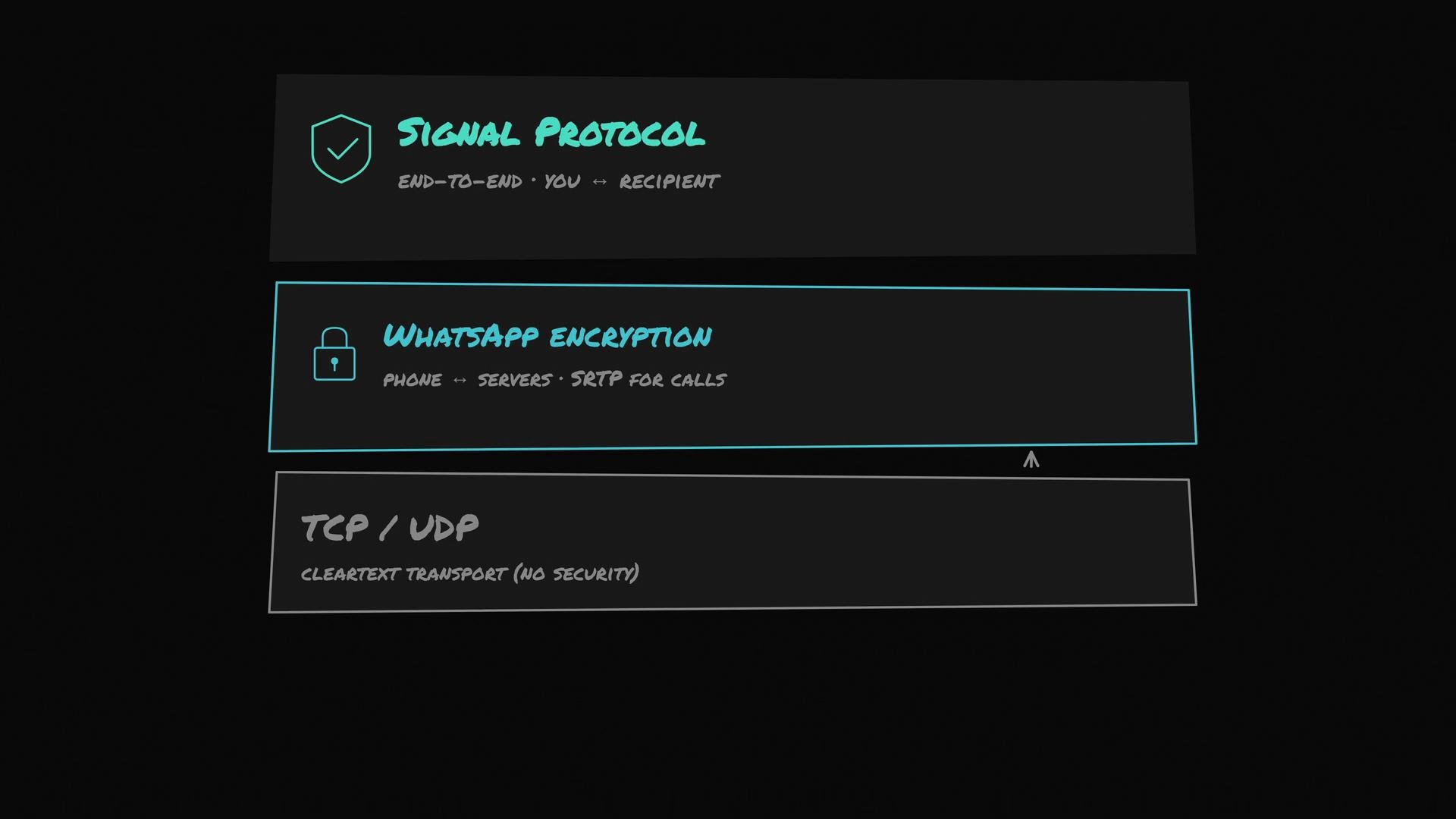
Neither transport encrypts payloads by default. Security (encryption, authentication, integrity) must be added at a higher layer:
* Use TLS to secure TCP streams.
* Use SRTP to secure RTP over UDP.
* Use end-to-end application protocols (e.g., Signal Protocol) for message-level encryption.
Neither TCP nor UDP provides encryption by default. Use [TLS](https://en.wikipedia.org/wiki/Transport_Layer_Security), [SRTP](https://en.wikipedia.org/wiki/Secure_Real-time_Transport_Protocol), or an application-level protocol (e.g., [Signal Protocol](https://en.wikipedia.org/wiki/Signal_Protocol)) to secure transported data.
## Use both protocols where appropriate
Many apps keep both connection types simultaneously:
* Media (real-time voice/video): UDP + RTP/SRTP, optimized for low latency.
* Text, file transfer, or control messages: TCP or TLS over TCP (HTTP/2) for reliability and ordering.
Choose the transport based on whether timeliness or guaranteed delivery is the priority.
## Security is orthogonal to TCP vs UDP
Neither transport encrypts payloads by default. Security (encryption, authentication, integrity) must be added at a higher layer:
* Use TLS to secure TCP streams.
* Use SRTP to secure RTP over UDP.
* Use end-to-end application protocols (e.g., Signal Protocol) for message-level encryption.
Neither TCP nor UDP provides encryption by default. Use [TLS](https://en.wikipedia.org/wiki/Transport_Layer_Security), [SRTP](https://en.wikipedia.org/wiki/Secure_Real-time_Transport_Protocol), or an application-level protocol (e.g., [Signal Protocol](https://en.wikipedia.org/wiki/Signal_Protocol)) to secure transported data.
 ## Quick comparison
| Characteristic | TCP | UDP |
| ------------------- | -----------------------------------: | --------------------------------------------: |
| Connection setup | Three-way handshake (stateful) | Connectionless (stateless) |
| Delivery guarantees | Reliable, retransmits lost data | Best-effort, no retransmission |
| Ordering | In-order delivery (sequence numbers) | No enforced ordering |
| Latency behavior | Can suffer head-of-line blocking | Low latency, suitable for real-time |
| Typical use cases | Messaging, file transfer, web APIs | VoIP, live video, gaming, real-time telemetry |
| Security | Use `TLS` for encryption | Use `SRTP` or app-layer encryption |
## Summary
* Use TCP when you need reliable, ordered delivery (e.g., text, files, transactional data).
* Use UDP when low latency and timeliness trump perfect delivery (e.g., real-time voice/video), and rely on RTP/SRTP or application logic for sequencing, jitter management, and security.
* Encryption and authentication are implemented at higher layers — choose TLS, SRTP, or application-level end-to-end protocols as required.
## Links and references
* [VoIP — Wikipedia](https://en.wikipedia.org/wiki/VoIP)
* [RTP — Real-time Transport Protocol](https://en.wikipedia.org/wiki/Real-time_Transport_Protocol)
* [SRTP — Secure Real-time Transport Protocol](https://en.wikipedia.org/wiki/Secure_Real-time_Transport_Protocol)
* [TLS — Transport Layer Security](https://en.wikipedia.org/wiki/Transport_Layer_Security)
* [Signal Protocol](https://en.wikipedia.org/wiki/Signal_Protocol)
## Quick comparison
| Characteristic | TCP | UDP |
| ------------------- | -----------------------------------: | --------------------------------------------: |
| Connection setup | Three-way handshake (stateful) | Connectionless (stateless) |
| Delivery guarantees | Reliable, retransmits lost data | Best-effort, no retransmission |
| Ordering | In-order delivery (sequence numbers) | No enforced ordering |
| Latency behavior | Can suffer head-of-line blocking | Low latency, suitable for real-time |
| Typical use cases | Messaging, file transfer, web APIs | VoIP, live video, gaming, real-time telemetry |
| Security | Use `TLS` for encryption | Use `SRTP` or app-layer encryption |
## Summary
* Use TCP when you need reliable, ordered delivery (e.g., text, files, transactional data).
* Use UDP when low latency and timeliness trump perfect delivery (e.g., real-time voice/video), and rely on RTP/SRTP or application logic for sequencing, jitter management, and security.
* Encryption and authentication are implemented at higher layers — choose TLS, SRTP, or application-level end-to-end protocols as required.
## Links and references
* [VoIP — Wikipedia](https://en.wikipedia.org/wiki/VoIP)
* [RTP — Real-time Transport Protocol](https://en.wikipedia.org/wiki/Real-time_Transport_Protocol)
* [SRTP — Secure Real-time Transport Protocol](https://en.wikipedia.org/wiki/Secure_Real-time_Transport_Protocol)
* [TLS — Transport Layer Security](https://en.wikipedia.org/wiki/Transport_Layer_Security)
* [Signal Protocol](https://en.wikipedia.org/wiki/Signal_Protocol)