> ## Documentation Index
> Fetch the complete documentation index at: https://notes.kodekloud.com/llms.txt
> Use this file to discover all available pages before exploring further.
# Webhook Delivery System
> Designing a scalable, durable webhook delivery system using transactional outbox, per-customer concurrency lanes, retries with backoff, DLQ and replay UI, and HMAC signing
Designing a webhook delivery system that reliably sends millions of events per day requires durability, isolation, retries, and observability. This guide walks through an incremental design—showing why naive approaches fail and how to evolve to a production-ready architecture that supports durability, per-customer isolation, controlled retries, and replayability.
Why this matters
* Webhooks are asynchronous notifications your customers rely on to react to events.
* A resilient webhook system must avoid data loss, prevent one customer from degrading global throughput, and provide operational tools for failed deliveries.
Version one — the naive approach
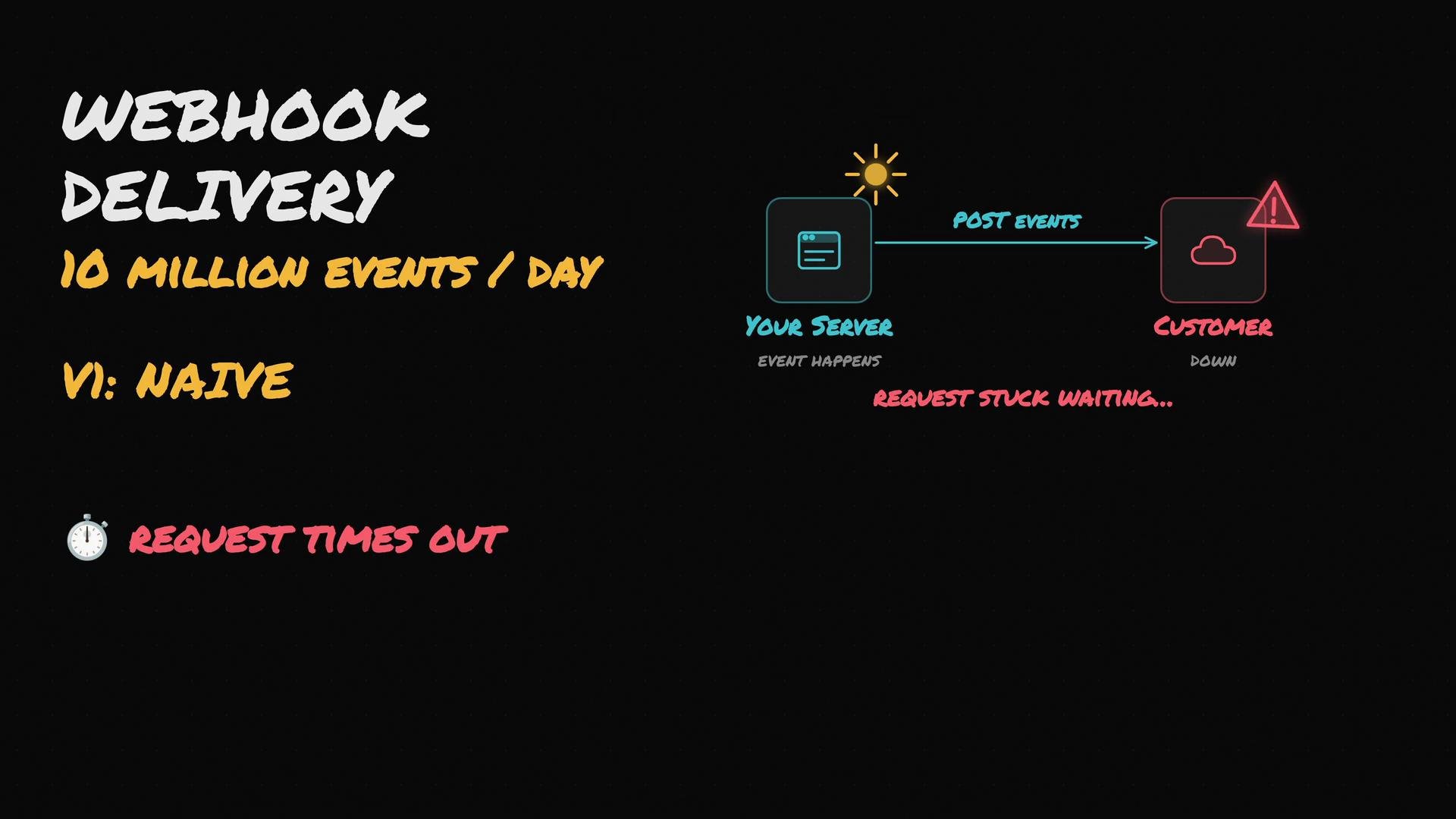
The simplest design: when an event happens, immediately POST to the customer's URL and wait for `200 OK`. This couples the request lifecycle to external availability and can lose events when timeouts occur or downstream systems are down.
 Problems with the naive approach
* Blocked request handlers and degraded request throughput.
* No durability: timeouts can cause permanent event loss.
* No retries, observability, or isolation.
Version two — write first, send later (Transactional outbox)
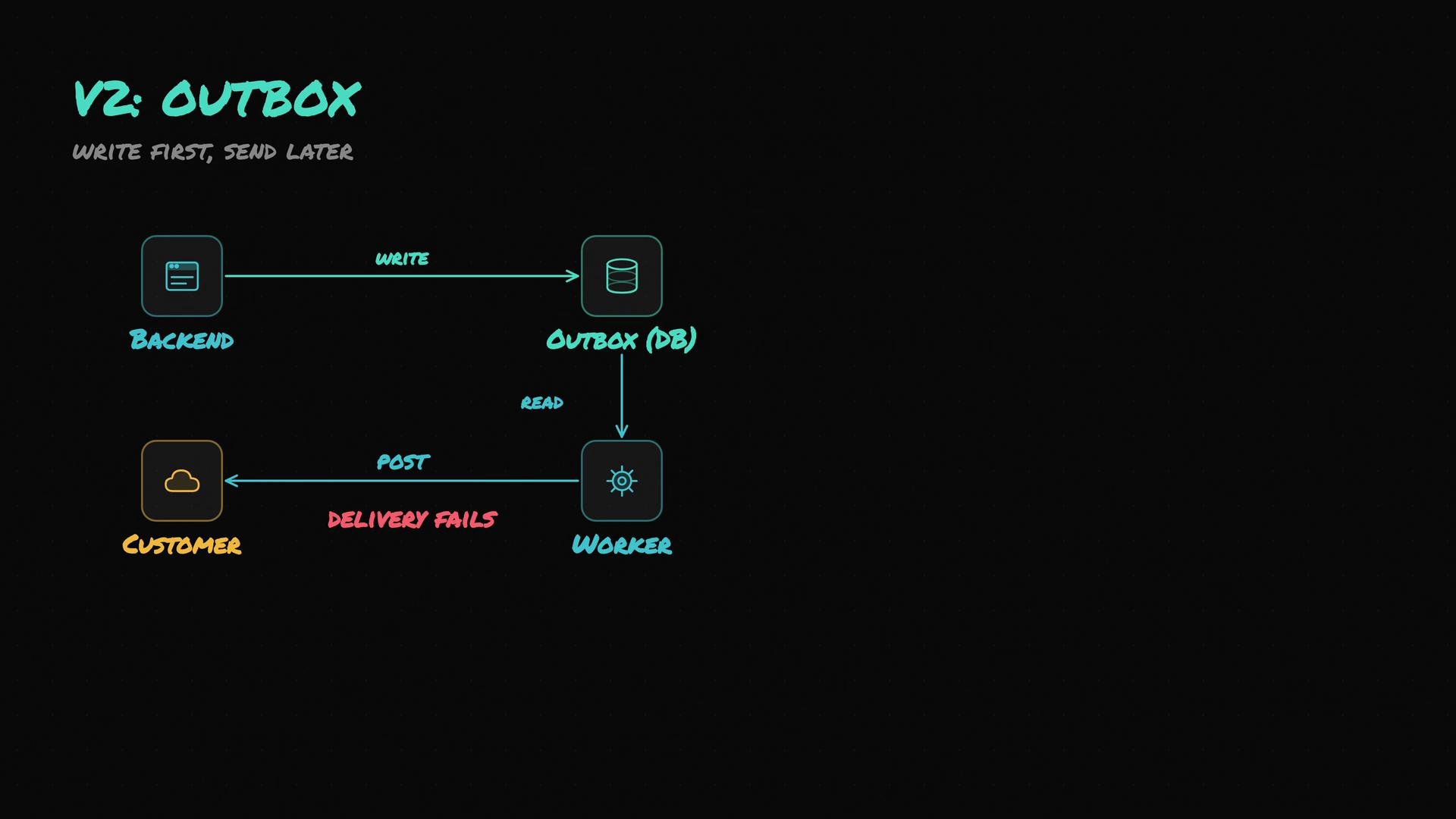
Persist the event before attempting delivery. Use a transactional outbox: write the event to an outbox table or queue within the same transaction that produced the event. A separate worker/process reads the outbox and delivers webhooks asynchronously.
Benefits:
* Immediate durability: the originating request returns quickly.
* Decouples delivery from event production for better latency and reliability.
Basic outbox schema (example)
```sql theme={null}
CREATE TABLE outbox (
id UUID PRIMARY KEY,
created_at TIMESTAMP,
customer_id UUID,
payload JSONB,
status TEXT DEFAULT 'pending', -- pending|in_flight|delivered|failed
attempts INT DEFAULT 0,
next_try_at TIMESTAMP
);
```
Worker pseudo-loop
```python theme={null}
while true:
job = claim_next_outbox_job() # atomically set status -> in_flight
send_webhook(job)
if success:
delete_or_mark_delivered(job)
else:
schedule_retry_or_dlq(job)
```
Problems with the naive approach
* Blocked request handlers and degraded request throughput.
* No durability: timeouts can cause permanent event loss.
* No retries, observability, or isolation.
Version two — write first, send later (Transactional outbox)
Persist the event before attempting delivery. Use a transactional outbox: write the event to an outbox table or queue within the same transaction that produced the event. A separate worker/process reads the outbox and delivers webhooks asynchronously.
Benefits:
* Immediate durability: the originating request returns quickly.
* Decouples delivery from event production for better latency and reliability.
Basic outbox schema (example)
```sql theme={null}
CREATE TABLE outbox (
id UUID PRIMARY KEY,
created_at TIMESTAMP,
customer_id UUID,
payload JSONB,
status TEXT DEFAULT 'pending', -- pending|in_flight|delivered|failed
attempts INT DEFAULT 0,
next_try_at TIMESTAMP
);
```
Worker pseudo-loop
```python theme={null}
while true:
job = claim_next_outbox_job() # atomically set status -> in_flight
send_webhook(job)
if success:
delete_or_mark_delivered(job)
else:
schedule_retry_or_dlq(job)
```
 Version three — per-customer lanes (concurrency isolation)
A shared worker pool can be blocked when a single customer's endpoint is slow. Introduce a dispatcher that enforces per-customer concurrency limits (a “lane” per customer). The dispatcher monitors in-flight counts per customer and only schedules further deliveries for customers that haven’t reached their limit.
Design goals:
* Prevent one slow or failing customer from consuming global worker capacity.
* Apply per-customer rate limits and concurrency caps.
* Fair scheduling across customers.
Implementation patterns:
* Dispatcher reads pending outbox entries and uses a token-bucket or semaphore per `customer_id`.
* Use lightweight in-memory counters (with persistence for recovery) or a distributed store (Redis) for cross-instance coordination.
Version three — per-customer lanes (concurrency isolation)
A shared worker pool can be blocked when a single customer's endpoint is slow. Introduce a dispatcher that enforces per-customer concurrency limits (a “lane” per customer). The dispatcher monitors in-flight counts per customer and only schedules further deliveries for customers that haven’t reached their limit.
Design goals:
* Prevent one slow or failing customer from consuming global worker capacity.
* Apply per-customer rate limits and concurrency caps.
* Fair scheduling across customers.
Implementation patterns:
* Dispatcher reads pending outbox entries and uses a token-bucket or semaphore per `customer_id`.
* Use lightweight in-memory counters (with persistence for recovery) or a distributed store (Redis) for cross-instance coordination.
 Version four — send with short timeouts and exponential retries
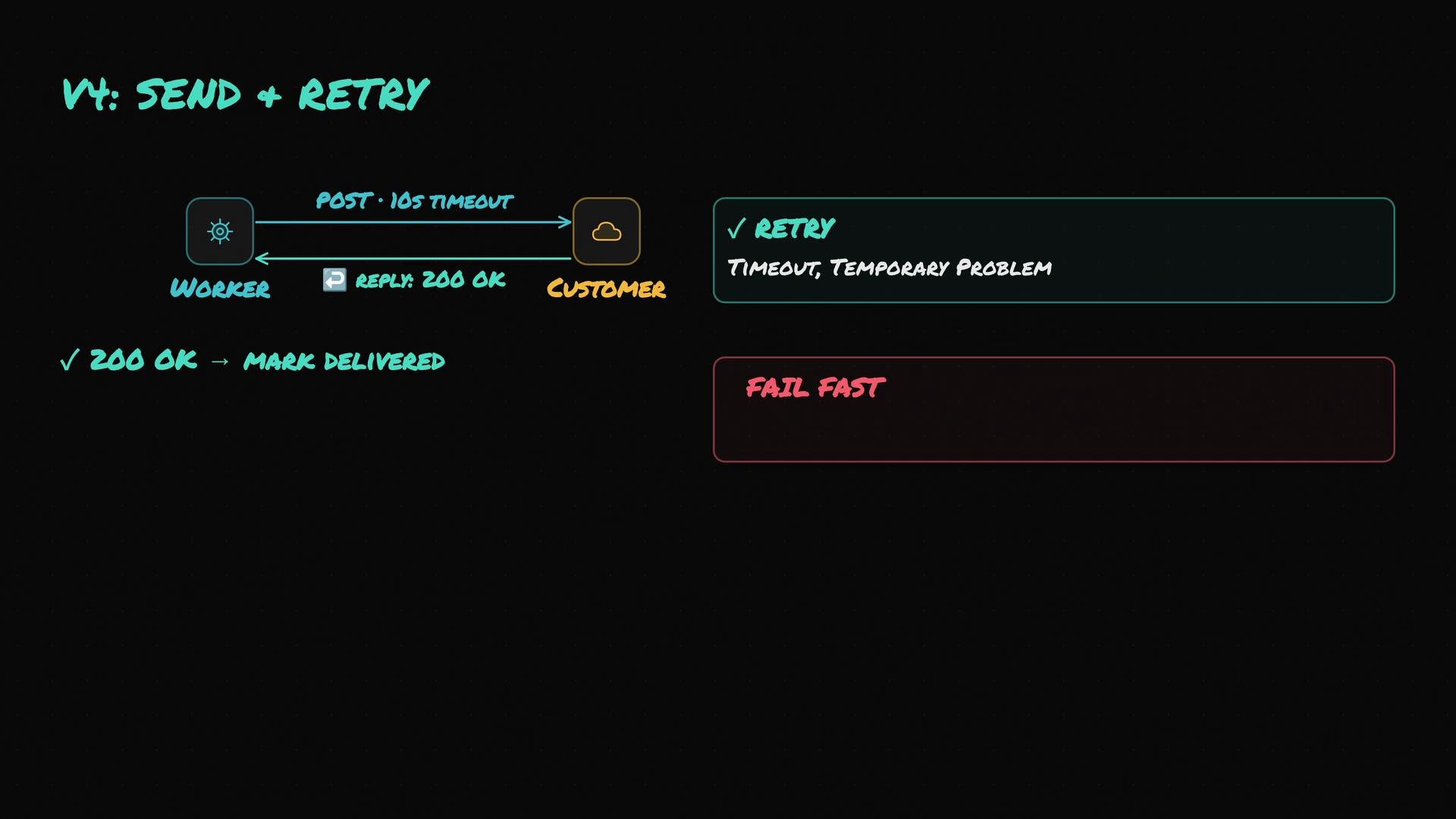
Workers should POST with a conservative client timeout (for example, 5–15 seconds). Use retry logic with exponential backoff for transient errors and timeouts. Treat clear client errors (4xx) as permanent in most cases and fail fast.
Recommended retry policy (example)
* Timeout per request: `10s`
* Retry on: network timeouts, DNS errors, HTTP 5xx
* Backoff strategy: exponential backoff with jitter (e.g., 1s, 2s, 4s, 8s)
* Max attempts: `3–6` depending on SLA and system load
* On 4xx (e.g., `404`, `410`): do not retry; move to DLQ
After retry exhaustion, move the event to a dead letter queue (DLQ) to avoid consuming retry capacity indefinitely.
Version four — send with short timeouts and exponential retries
Workers should POST with a conservative client timeout (for example, 5–15 seconds). Use retry logic with exponential backoff for transient errors and timeouts. Treat clear client errors (4xx) as permanent in most cases and fail fast.
Recommended retry policy (example)
* Timeout per request: `10s`
* Retry on: network timeouts, DNS errors, HTTP 5xx
* Backoff strategy: exponential backoff with jitter (e.g., 1s, 2s, 4s, 8s)
* Max attempts: `3–6` depending on SLA and system load
* On 4xx (e.g., `404`, `410`): do not retry; move to DLQ
After retry exhaustion, move the event to a dead letter queue (DLQ) to avoid consuming retry capacity indefinitely.
 Version five — dead letter queue and replay UI
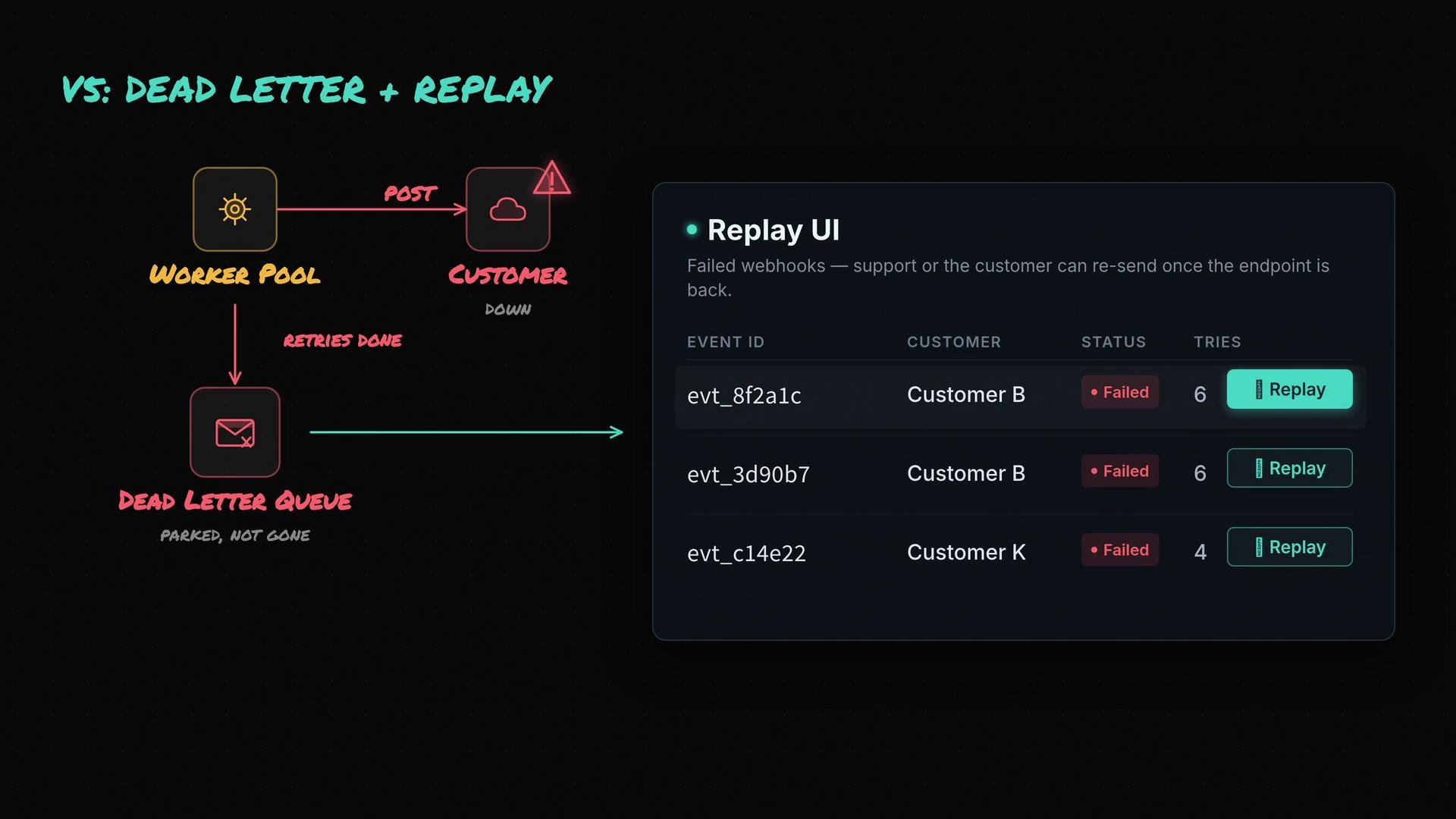
When automated retries are exhausted, store failures in a DLQ and expose them in a Replay UI. This gives operators and customers the ability to inspect payloads, error responses, timestamps, and to trigger manual replays—often with richer logging enabled.
Replay UI features
* Search and filter by `customer_id`, event type, date, and error code.
* Show failure reason, response body, and headers received from customer.
* Allow single or bulk replay with optional metadata (e.g., “force send with debug”).
* Audit trail for replay attempts.
Operational workflow
* Move failed events to DLQ with metadata (error code, attempts, last\_response).
* Support engineers or customers investigate and manually re-queue or replay events.
Version five — dead letter queue and replay UI
When automated retries are exhausted, store failures in a DLQ and expose them in a Replay UI. This gives operators and customers the ability to inspect payloads, error responses, timestamps, and to trigger manual replays—often with richer logging enabled.
Replay UI features
* Search and filter by `customer_id`, event type, date, and error code.
* Show failure reason, response body, and headers received from customer.
* Allow single or bulk replay with optional metadata (e.g., “force send with debug”).
* Audit trail for replay attempts.
Operational workflow
* Move failed events to DLQ with metadata (error code, attempts, last\_response).
* Support engineers or customers investigate and manually re-queue or replay events.
 Security — sign every event
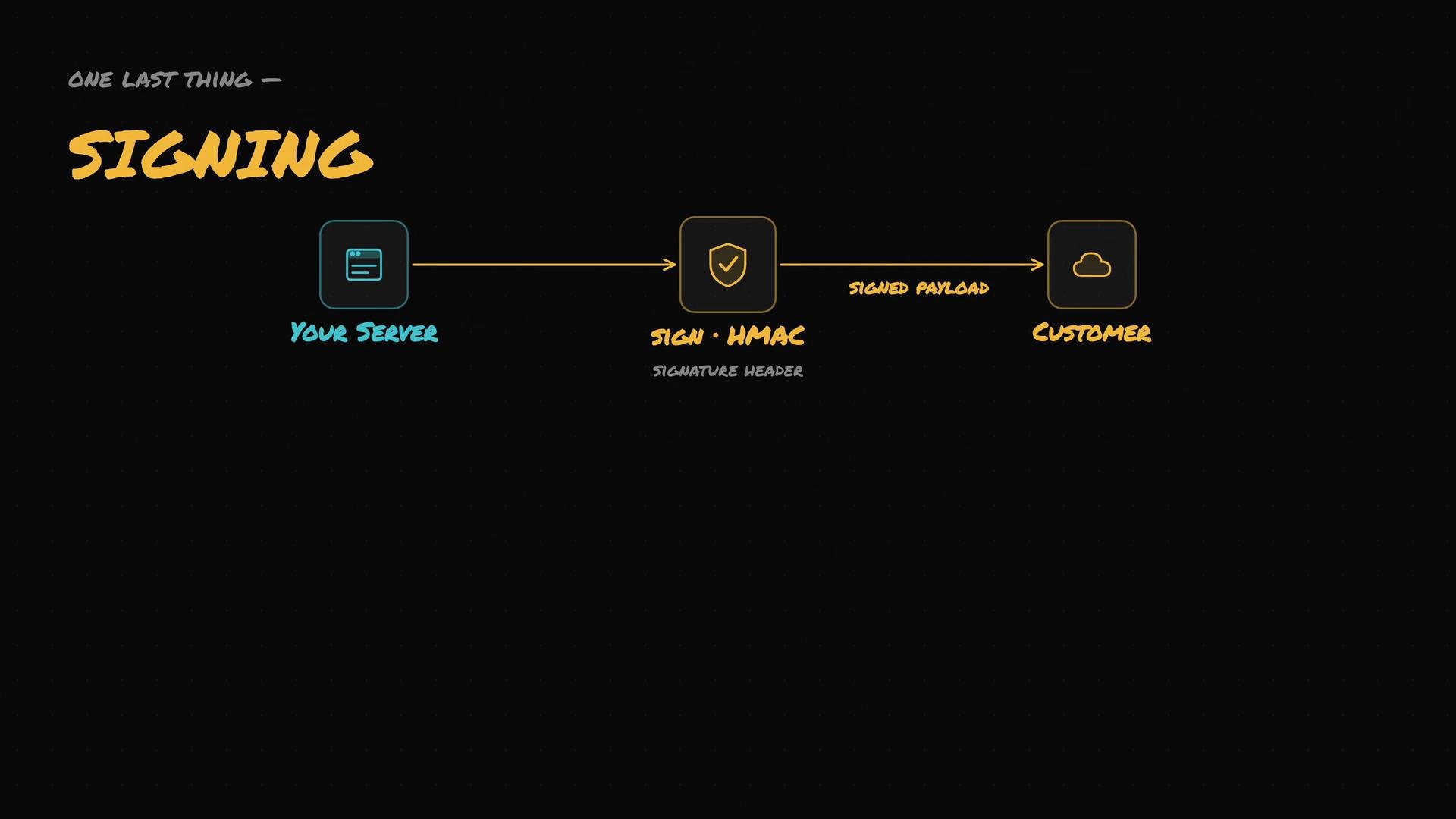
Always sign webhook payloads so recipients can verify authenticity and integrity. Common pattern: compute an HMAC over the payload using a shared secret and include the signature in a header (for example, `X-Signature`).
Signing webhooks (for example, using an HMAC with a shared secret and including the signature in a header) helps customers verify authenticity and detect tampering.
Signing example (concept)
```text theme={null}
signature = HMAC_SHA256(secret, payload)
Header: X-Signature: sha256=
```
Security — sign every event
Always sign webhook payloads so recipients can verify authenticity and integrity. Common pattern: compute an HMAC over the payload using a shared secret and include the signature in a header (for example, `X-Signature`).
Signing webhooks (for example, using an HMAC with a shared secret and including the signature in a header) helps customers verify authenticity and detect tampering.
Signing example (concept)
```text theme={null}
signature = HMAC_SHA256(secret, payload)
Header: X-Signature: sha256=
```
 Full architecture summary
* Backend: write each event to a transactional outbox as part of the originating transaction so events are durable immediately.
* Dispatcher: poll or stream pending outbox entries and enforce per-customer concurrency and rate limits, ensuring fair scheduling across customers.
* Worker pool: workers pick up dispatched jobs, sign payloads, POST to customer endpoints with a short timeout, and implement retry logic with exponential backoff for transient failures.
* Dead letter queue + Replay UI: after retry exhaustion, move failed events into a DLQ and surface them in a replay dashboard for manual investigation and retransmission.
* Security: sign every webhook payload (e.g., HMAC) so customers can verify authenticity.
Component reference table
| Component | Purpose | Example |
| ---------- | ---------------------------------------------------------------------: | ----------------------------------------- |
| Outbox | Durable storage for pending webhooks written in the origin transaction | `INSERT INTO outbox (...) VALUES (...)` |
| Dispatcher | Enforces per-customer concurrency and schedules jobs to workers | Use Redis semaphores or token buckets |
| Worker | Sends HTTP POSTs, implements timeout, retry, and signing | `timeout=10s`, backoff=exponential |
| DLQ | Stores permanently-failed events for inspection and replay | `dead_letter_queue` table or queue |
| Replay UI | Operational tool to inspect failures and manually re-queue | Web dashboard with filters and audit logs |
Common operational considerations
* Idempotency: include a unique `id` in the webhook to allow safe retries and avoid duplicate processing by the customer.
* Observability: emit metrics for delivery latency, success rate, retries, DLQ rate, and per-customer throughput.
* Rate limits: optionally respect customer-specified rate limits (requests/sec) in addition to concurrency caps.
* Back-pressure: when DLQ/backlog grows, reduce generator rate or apply customer throttling to preserve system stability.
* Secrets management: rotate signing keys, and provide customers metadata (key id) so they can validate signatures after rotation.
Example delivery outcome matrix
| Outcome | Action |
| ------------------- | -------------------------------------- |
| HTTP 200 | Mark delivered, remove from outbox |
| HTTP 5xx or timeout | Retry with backoff, increment attempts |
| HTTP 4xx (404/410) | Do not retry; move to DLQ |
| Network error | Retry until attempts exhausted |
| Exceed attempts | Move to DLQ and surface in replay UI |
Links and references
* [Kubernetes Documentation](https://kubernetes.io/docs/) — run scalable worker pools.
* HMAC signing guidance — search for “HMAC SHA256 webhook signing” for implementation details.
* Exponential backoff best practices — aim for randomized jitter to avoid thundering herds.
This incremental design—transactional outbox, dispatcher with per-customer lanes, short timeouts with exponential retries, DLQ plus replay UI, and strong signing—ensures durability, availability, observability, and operational control for a high-volume webhook delivery system.
Full architecture summary
* Backend: write each event to a transactional outbox as part of the originating transaction so events are durable immediately.
* Dispatcher: poll or stream pending outbox entries and enforce per-customer concurrency and rate limits, ensuring fair scheduling across customers.
* Worker pool: workers pick up dispatched jobs, sign payloads, POST to customer endpoints with a short timeout, and implement retry logic with exponential backoff for transient failures.
* Dead letter queue + Replay UI: after retry exhaustion, move failed events into a DLQ and surface them in a replay dashboard for manual investigation and retransmission.
* Security: sign every webhook payload (e.g., HMAC) so customers can verify authenticity.
Component reference table
| Component | Purpose | Example |
| ---------- | ---------------------------------------------------------------------: | ----------------------------------------- |
| Outbox | Durable storage for pending webhooks written in the origin transaction | `INSERT INTO outbox (...) VALUES (...)` |
| Dispatcher | Enforces per-customer concurrency and schedules jobs to workers | Use Redis semaphores or token buckets |
| Worker | Sends HTTP POSTs, implements timeout, retry, and signing | `timeout=10s`, backoff=exponential |
| DLQ | Stores permanently-failed events for inspection and replay | `dead_letter_queue` table or queue |
| Replay UI | Operational tool to inspect failures and manually re-queue | Web dashboard with filters and audit logs |
Common operational considerations
* Idempotency: include a unique `id` in the webhook to allow safe retries and avoid duplicate processing by the customer.
* Observability: emit metrics for delivery latency, success rate, retries, DLQ rate, and per-customer throughput.
* Rate limits: optionally respect customer-specified rate limits (requests/sec) in addition to concurrency caps.
* Back-pressure: when DLQ/backlog grows, reduce generator rate or apply customer throttling to preserve system stability.
* Secrets management: rotate signing keys, and provide customers metadata (key id) so they can validate signatures after rotation.
Example delivery outcome matrix
| Outcome | Action |
| ------------------- | -------------------------------------- |
| HTTP 200 | Mark delivered, remove from outbox |
| HTTP 5xx or timeout | Retry with backoff, increment attempts |
| HTTP 4xx (404/410) | Do not retry; move to DLQ |
| Network error | Retry until attempts exhausted |
| Exceed attempts | Move to DLQ and surface in replay UI |
Links and references
* [Kubernetes Documentation](https://kubernetes.io/docs/) — run scalable worker pools.
* HMAC signing guidance — search for “HMAC SHA256 webhook signing” for implementation details.
* Exponential backoff best practices — aim for randomized jitter to avoid thundering herds.
This incremental design—transactional outbox, dispatcher with per-customer lanes, short timeouts with exponential retries, DLQ plus replay UI, and strong signing—ensures durability, availability, observability, and operational control for a high-volume webhook delivery system.