> ## Documentation Index
> Fetch the complete documentation index at: https://notes.kodekloud.com/llms.txt
> Use this file to discover all available pages before exploring further.
# Recap of key takeaways and techniques
> Concise recap of communication best practices for translating technical ideas, storytelling, handling objections, and iterating to align with stakeholders and drive decisions.
Welcome, students — this lesson is a concise recap of the core communication techniques we covered to help you prepare for the assessment. These best practices focus on stakeholder communication, translating technical concepts, storytelling for impact, handling objections, and continuous improvement. My name is Michael Forrester.
1. Understanding your audience
* Identify primary stakeholders, their goals, and the decisions they must make.
* Tailor your message: match the level of technical detail to the audience (executive, product, engineering, operations).
* Apply empathy and active listening to surface real concerns, align expectations, and build trust. For a refresher on active listening techniques, see MindTools: [https://www.mindtools.com/CommSkll/ActiveListening.htm](https://www.mindtools.com/CommSkll/ActiveListening.htm).
2. Translating technical concepts for non-technical audiences
* Simplify without losing accuracy: prioritize the business outcome, risks, and trade-offs over low-level implementation details.
* Use analogies and metaphors to make abstract concepts relatable (e.g., “microservices are like modular appliances in a kitchen”).
* Emphasize value: show how the technical approach impacts revenue, cost, speed, reliability, or user experience.
3. Storytelling for impact
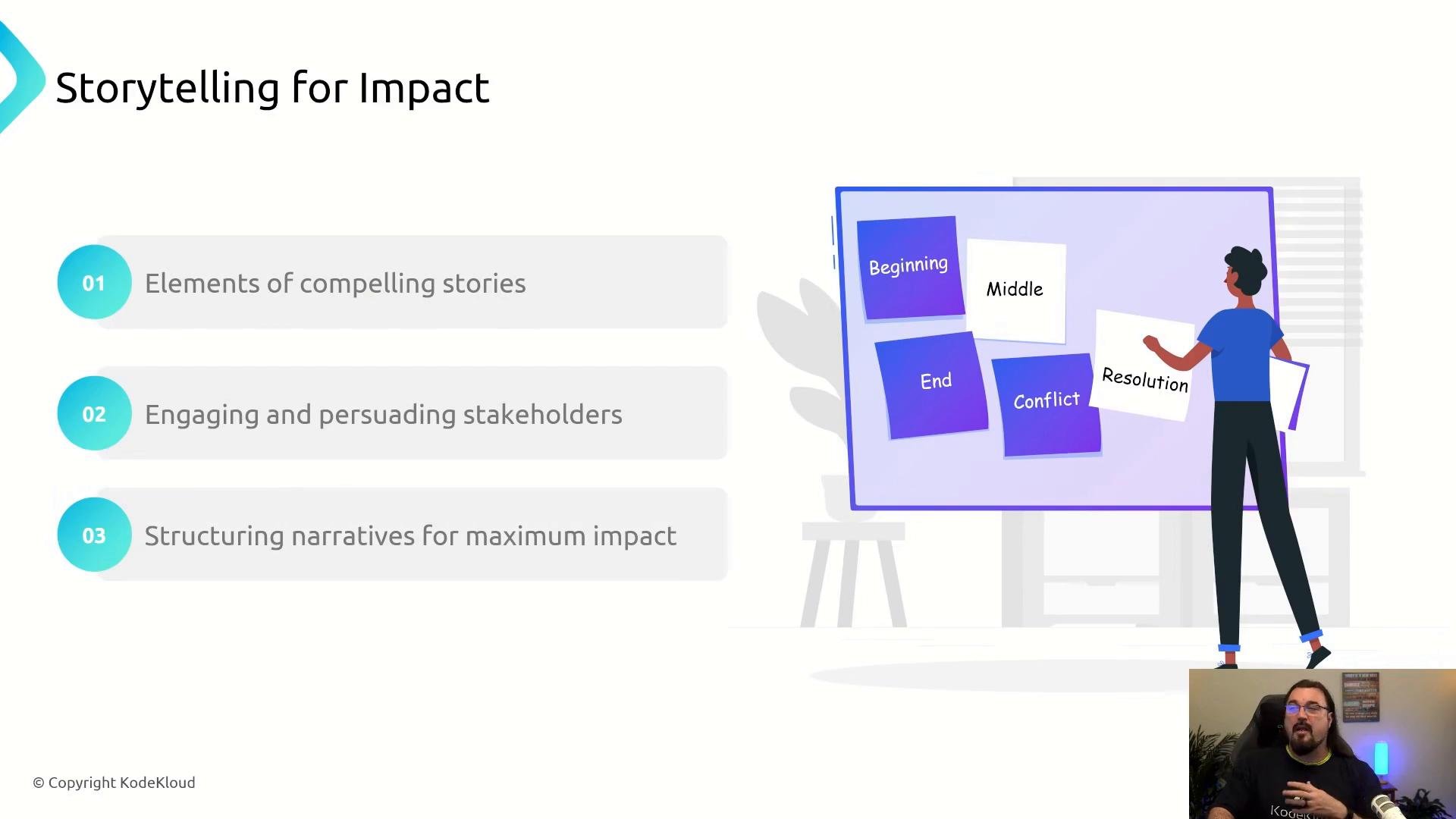
* Structure narratives with clear elements: character (stakeholder), problem (pain point), evolution (approach and trade-offs), resolution (solution), and benefits (outcomes and metrics).
* Use story-driven examples or mini-case studies to engage and persuade technical and non-technical stakeholders alike.
* Organize your story for clarity and momentum so the audience can follow the technical rationale and outcomes.
 4. Handling objections and concerns
* Anticipate common objections and prepare concise, evidence-based responses (data, benchmarks, small experiments).
* Use clarifying questions, reframe the concern, and present alternatives or mitigations.
* Maintain professionalism: acknowledge the concern, explain the rationale, and propose next steps or a plan to test assumptions.
5. Continuous improvement
* Treat communication as iterative: collect feedback after meetings or presentations and measure small, actionable signals.
* Track simple metrics such as stakeholder alignment, decision velocity, and number of follow-up questions to gauge progress.
* Iterate on your messaging, slide format, and supporting data based on outcomes and feedback.
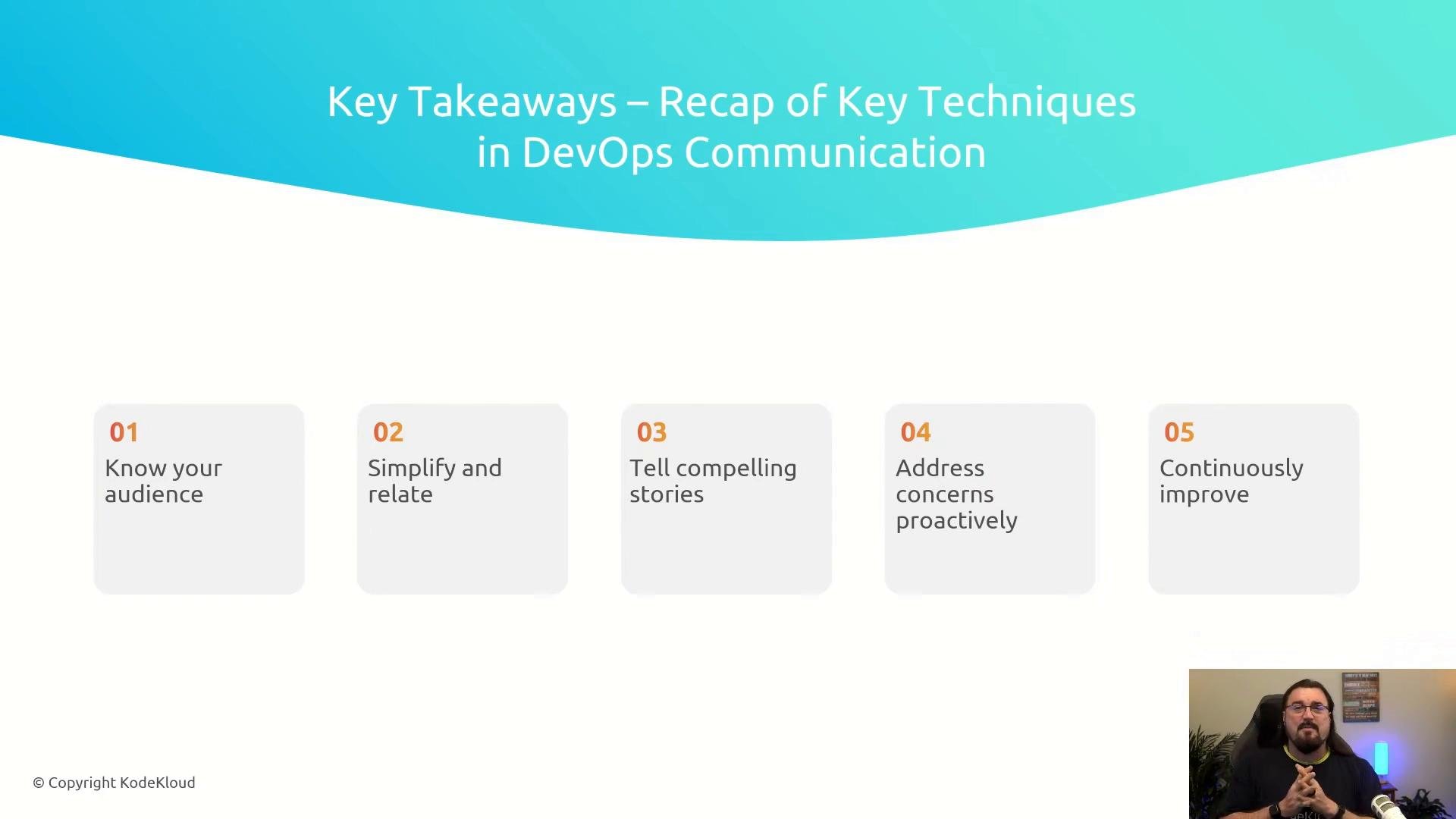
Key recaps — condensed checklist:
* Know your audience.
* Simplify and relate technical content to stakeholder needs.
* Tell compelling stories that show the problem and the resolution.
* Address concerns proactively and professionally.
* Continuously improve through feedback and measurable metrics.
Summary table — techniques, why they matter, and quick actions
| Technique | Why it matters | Quick actions |
| - | -: | - |
| Audience analysis | Ensures your message lands and drives decisions | Map stakeholders, their priorities, and preferred formats |
| Technical-to-business translation | Converts complexity into value for non-technical stakeholders | Lead with outcomes, use analogies, avoid unnecessary detail |
| Story-driven presentations | Improves engagement and persuasion | Use a clear narrative arc: problem → approach → outcome |
| Objection handling | Reduces friction and builds credibility | Prepare data-backed responses and clear next steps |
| Continuous iteration | Improves clarity and alignment over time | Collect feedback, measure simple metrics, run micro-experiments |
 Next steps: practice these techniques through exercises or role-plays. After that, review feedback, refine your approach, and iterate on messaging based on real stakeholder interactions.
It's been a pleasure to engage with you. My name is Michael Forrester, and I look forward to seeing how you apply these techniques.
This documentation is built and hosted on [Mintlify](https://mintlify.com), a developer documentation platform.